UAMS Microbiology Exam 2
 Call Kai
 Learn
 Practice Test
 Spaced Repetition
 Match
 Flashcards
 Knowt Play
1/97

There's no tags or description
Looks like no tags are added yet.
98 Terms
Neisseria gonorrhoeae
GNDC
Requires CO2
NG on BAP
On Choc grows flat, smooth, light brown/grey
Salty or mousy smell
All Neisseria are ox +
Superoxol Test (30% H2O2) + Immediate and vigorous bubbling. Other Neisseria are - or weak, delayed reactions.
Glucose +
Oxidase Reagent
Tetramethyl-para-phenylenediamine dihydrochloride
Positive - blue
Negative - No color
Carbohydrate Utilization Test
pH indicator: Phenol Red
Positive - Yellow (acid produced)
Negative - Red

Neisseria meningitidis
GNDC
Requires CO2
Will grow on BAP
Flat, smooth colonies
Opaque/white
Resembles GC
Latex Agglutination and Coag for urine, CSF and Serum
Oxidase +
Glucose and Maltose positive
Neisseria lactamica
Glucose, Maltose, Lactose +
Neisseria sicca
Glucose, Maltose, Lactose, Sucrose +
Chromogenic Substrate Table

Moraxella catarrhalis
GNC
On BAP - Smooth, white colonies
Oxidase +
Nitrate +
DNAse Test +
Butyrate Esterase + (Blue)
All sugars negative
All species of the genus Neisseria have the enzyme to oxidase:
A. Naphthylamine
B. Dimethylaminobenzaldehyde
C. Glucopyranoside
D. Tetramethyl-phenylenediamine
Tetramethyl-phenylenediamine (Oxidase)
Haemophilus species
GNR (pleomorphic and coccobacilli)
blood loving
All require X Factor (hemin)for growth
Most require V Factor (NAD)
Most won't grow on sheep BAP. Will grow on horse and rabbit BAP (X Factor) and Choc (X and V Factor)
Prefers CO2
On CHOC flat, smooth, Grey/Light Brown color
Mousy or salty smell
Haemophilus aegyptius
Pinkeye
Brazillian Purpuric Fever
Haemophilus ducreyi
Chancroid
sexually transmitted
School of Fish
Requires X Factor
H. ducreyi
Requires V Factor
H. parainfluenzae
H. parahaemolyticus
Requires XV Factor
H. influenzae
H. haemolyticus
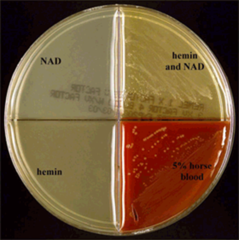
Haemophilus Quadrant Plate
Porphyrin Test
ALA->Porphobilinogen->Porphyrins->Hemin
Porphyrins will fluoresce orange/red in UV light
Positive: H. parainfluenza, H. parahaemolyticus
Negative: H. influenza, H. haemolyticus
Paras are porphyrin positive
Haemophilus Satellite Test
Substitute for the V Factor test
S. aureus lysis the RBCs releasing the NAD (V Factor0
H. influenzae will satellite around NAD producing colonies.
Haemophilus Identification Chart

Requires X Factor
H. ducreyi
Requires V Factor
H. parainfluenzae
H. parahaemolyticus
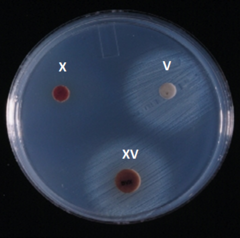
Requires XV Factor
H. influenzae
H. haemolyticus

H. influenzae: Which factors does it require to grow? Gamma.

H. haemolyticus: Which factors does it require to grow? Beta

The organism is gamma hemolytic.
Porphyrin Test- Kovac's Reagent is positive
H. parainfluenzae
H. parahaemolyticus requires which factors. Beta.

An isolate on CHOC agar from a patient with epiglottitis was suggestive of Haemophilus species. Testing showed isolate required only NAD for growth and was nonhemolytic. The organism is most likely Haemophilus:
H. parainfluenzae
What is bipolar staining?
A bacteria that stains only the ends and not the middle.
"O" antigen
cell wall antigens
"H" antigen
flagellar antigen
"K" antigen
capsular antigens
"Vi" antigen
surface antigen
"F" antigen
pili antigens
T/F
All enterics ferment glucose
True
T/F
All enterics are Oxidase negative
True. Except for Plesiomonas
T/F
All enterics reduce nitrate to nitrite
True. Except Photorhabdus & Xenorhabdus
E. Coli O157:H7
Enterohemorrhagic
Produces Shiga-like toxins
Referred to as STEC
Not NF
Colorless on SMAC (Sorbitol-MacConkey) Agar - other E. coli strains are red.
Cause gastroenteritis, diarrhea, HUS
Shigella
Produces Shiga toxins
Can test for "O" antigens. If no agglutination, repeat test after boiling for 15-30 minutes.
Not NF
Cause Shigellosis
Food, feces, fingers, flies
Edwardsiella
Not NF
Found in in environment. Cold-blooded animals (fish, snakes, turtles)
Diarrhea, wound infections.
Samonella
Not NF
Transmission from animals
Asymptomatic carriers
Gastroenteritis, Typhoid fever, Paratyphoid fever, Osteomyelitis, bacteremia, meningitis
Use antisera to test for "O" antigen groups.
Klebsiella
Mucoid colonies
Community acquired pneumonia, UTI, Skin/wound infections.
Enterobacter cloacae
UTI, Bacteremia, Lower respiratory infections, tissue infections.
Serratia marcescens
Commonly isolated from bathrooms.
Catheter, UTI, Wound infections.
Characteristic red/orange colonies.
Proteus
UTI, Kidney stones
Swarming
Burnt chocolate smell
H2S +
Plesiomonas shigelloides
Only enteric that is Oxidase POSITIVE
Contact with fresh water and cold-blooded animals.
Diarrhea and wound infections.
Yersinia pestis
Plague
Fleas or infected animals. Bubonic plague, pneumonic plague, septicemic plague.
West and Southwest.
Enterocolitis, Bacteremia, food poisoning
BSL 3
Oxidase -
Cat +
Urea -
Indole -
NLF
Fast grower at room temperature.
On CIN agar - bullseye
What separates Plesiomonas shigelloides from other members of Enterobacteriaceae?
A. Oxidase +
B. Ferments glucose
C. Produces pyocyanin
D. Requires 10% CO2 for growth.
Oxidase positive
XLD (Xylose Lysine Deoxycholate) Agar
Used to grow Salmonella and Shigella
Contains: Lactose, Sucrose, xylose
pH indicators: Phenol Red
Fermenters: yellow
Non-fermenters: red colonies
H2S Indicator: produces black colonies
Lactose Fermenters Organisms
E. coli
Klebsiella
Enterobacter
Eosin Methylene Blue Agar
Contains lactose
pH indicator: Methylene Blue
Fermenters: blue/black
Non-fermenters: colorless
MAC
Contains Lactose
pH indicator: Neutral Red
SS (Salmonella-Shigella) Agar
Contains Lactose
pH indicator: Neutral Red
Fermenters: red/pink
Non-fermenters: colorless
H2S indicator-produces black colonies
Hektoen Enteric Agar
Contains: Lactose, Sucrose, Salicin
pH indicators: Acid fuschin & Bromthymol blue
Fermenters: yellow/orange
Non-fermenters: green
H2S Indicator: produces black colonies
Utilization of lactose depends on these two enzymes:
Permease
Beta-galactosidase
ONPG (Orthonitrophenyl-B-D-Galactopyranoside
Detects B-galactosidase production.
Positive: yellow (SLOW LACTOSE FERMENTER)
Negative: No color change (NON-LACTOSE FERMENTER)
H2S Producers
Samonella
Proteus
Some Citrobacter
Oxidase (Tetramethyl-para-phenylenediamine dihydrochloride)
Positive = blue
Negative = No color change
Only use colonies collected from non-selective media such as BAP, CHOC.
KIA (Kligler's Iron Agar)
Carbs: Glu 1X and Lactose 10X
Peptones: protein fragment
pH indicator: Phenol Red
Acid - yellow- Report as A
Alkaline - Red- Report as K
H2S Indicator and gas production
KIA results for Lactose Fermenters
A/A
KIA results for Non-Lactose Fermenters
K/A
KIA results for Nonfermenters
K/NC
KIA Reactions

Triple Sugar Iron Agar (TSI)
Carbs: Glu 1X, Lactose 10X, Sucrose 10X
Only MOs that are lactose negative but sucrose positive will have different KIA and TSI reactions.

TSI Reactions

Indole
Kovac's or Ehrlich's reagent
Negative: Yellow color or no color change
Positive: Red color within 30 seconds
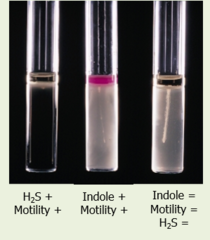
SIM Agar (H2S, Indole, Motility)
Voges-Proskauer (VP)
Determines if MO produces acetoin after glucose
fermentation.
Reagents: Alpha-naphthol and 40% KOH
Positive =Red
Negative = No color change
Methyl-Red (MR)
Determines if MO converts pyruvate into lactic or acetic acid.
pH indicator - Methyl Red
Positive = Red
Negative = No color change
Citrate Utilization Test (Simmons)
Determines if MO uses citrate as source of carbon
pH indicator - Bromthymol Blue
Positive = Blue
Negative = Green
Phenylalanine Deaminase (PDA)
Determines if MO can deaminate phenylalanine into phenylpyruvic acid.
Reagent: Ferric Chloride
Positive: Green
Negative: Yellow
Decarboxylase Test
Determines if MO can decarboxylate a specific amino acid.
Carbs: glucose
Amino acid: One per tube (lysine, ornithine or arginine)
pH indicator: Bromcresol purple and Cresol red
Purple = alkaline (Positive)
Yellow = acid (Control tube and patient-negative)
Anaerobic process. Use oil.
Lysine Iron Agar
Carb: glucose
Amino Acid: Lysine
pH indicator: Bromcresol Purple
H2S indicator
Yellow = Acid / A
Purple = alkaline / K
Red = deamination / R
LIA Results

Urea Test
Detects the production of ammonia
pH Indicator: Phenol Red
Positive = Hot Pink (alkaline)
Negative - Yellow/orange
MUG Test (Beta-glucuronidase)
The end product fluoresces under UV light
Negative = Blue
Positive = white
DNAse-Methyl Green Methold
Positive - Clearing around colonies
Negative - Green
Cit +
H2S -
Indole -
Lysine +
Mot -
ONPG - Yellow
Phenylalanine -
VP - Red
Klebsiella pneumoniae
Cit +
H2S +
Indole +
Lysine -
ONPG -
Phenylalanine +
VP -
Proteus vulgaris
Cit - Blue
H2S -
Indole - Red
Lysine - Negative
Mot +
ONPG - Clear
Phenylalanine - Green
VP- no color change
Providencia
Citrate - Blue
H2S +
Indole - No color change
Lysine +
Motility +
ONPG -
Phenylalanine - No color change
VP - No color change
Salmonella
Cit - Green
H2S - No color change
Indole - No color change
Lysine - Negative
Mot - Negative
ONPG - Clear
Phenylalanine - No color change
VP - No color change
Shigella
Which MOs are lactose negative but sucrose positive and have different KIA and TSI reactions?
Serratia marcescens
Yersinia enterocolitica
Proteus vulgaris
All three have KIA - K/A and TSI A/A
Proteus vulgaris also has H2S in both.
Klebsiella oxytoca is Indole
Positive
Which MO has red pigment and is VP positive?
Serratia marcescens
T/F
Some Citrobacter are lactose fermenters and has H2S
True
Which MO has rose spots?
Salmonella typhi
Yersinia is cat and urea ?
Positive for both
Plesiomonas shigelloides is Oxidase positive or negative?
Positive
Which MOs are non-motile?
Klebsiella, Shigella
Organisms that are Phenylalanine Deaminase (PDA) positive.
Proteus, Providencia, Morganella (PPM)
Which MO's are H2S Positive?
Edwardsiella, Salmonella, Proteus (ESP)
Which MO's are Citrate positive?
Providencia, Citrobacter, Salmonella (PCS)
Which MO's are slow producing colonies?
Serratia, Providencia, Citrobacter
Which MO's are ONPG postive?
Klebsiella, E. coli, Enterobacter
Lactose fermenters
Which MOs are VP positive?
Klebsiella, Enterobacter, Serratia (KES)
Which MOs are Indole positive?
E. coli, P. vulgaris, K. oxytoca
Which MOs are urease positive?
Klebsiella and Proteus
Which MOs are lysine positive?
Salmonella, E. coli, Edwardsiella tarda, K. pneumo, Enterobacter aerogenes, , Serratia marcescens,