1/21
Looks like no tags are added yet.
H₂O, H₂SO₄ (cat) on an alkene
Alkene → alcohol. Markovnikov: OH on the MORE substituted C. Goes through a carbocation, so H or CH₃ shifts can happen. [img 01]
![<p>Alkene → alcohol. Markovnikov: OH on the MORE substituted C. Goes through a carbocation, so H or CH₃ shifts can happen. [img 01]</p>](https://assets.knowt.com/user-attachments/9a26edf7-ea62-4fdf-837d-ed302133c1e1.png)
Hg(OAc)₂, H₂O/THF 2. NaBH₄
Alkene → alcohol, Markovnikov, NO shift (bridged mercurinium ion, no free carbocation). Use when acid hydration could rearrange or wreck a nearby stereocenter. Water is the nucleophile; THF is only solvent. [img 02]
![<p>Alkene → alcohol, Markovnikov, NO shift (bridged mercurinium ion, no free carbocation). Use when acid hydration could rearrange or wreck a nearby stereocenter. Water is the nucleophile; THF is only solvent. [img 02]</p>](https://assets.knowt.com/user-attachments/b5787a4f-8233-4173-b043-28b57a906e15.png)
3,3-Dimethylbut-1-ene: H₂O/H₂SO₄ vs Hg(OAc)₂ then NaBH₄
Acid: 2° cation, CH₃ shifts → 2,3-dimethylbutan-2-ol. Hg: no shift → 3,3-dimethylbutan-2-ol. [img 03]
![<p>Acid: 2° cation, CH₃ shifts → 2,3-dimethylbutan-2-ol. Hg: no shift → 3,3-dimethylbutan-2-ol. [img 03]</p>](https://assets.knowt.com/user-attachments/2aefcaab-3126-4b3b-af22-a7427f7c3d26.png)
BH₃·THF 2. H₂O₂, NaOH (alkene)
Alkene → alcohol, ANTI-Markovnikov: OH on the LESS substituted C. H and OH add SYN, from the less hindered face. No shifts. [img 04]
![<p>Alkene → alcohol, ANTI-Markovnikov: OH on the LESS substituted C. H and OH add SYN, from the less hindered face. No shifts. [img 04]</p>](https://assets.knowt.com/user-attachments/83f39369-fb74-44bd-b6d5-f15400ac25b4.png)
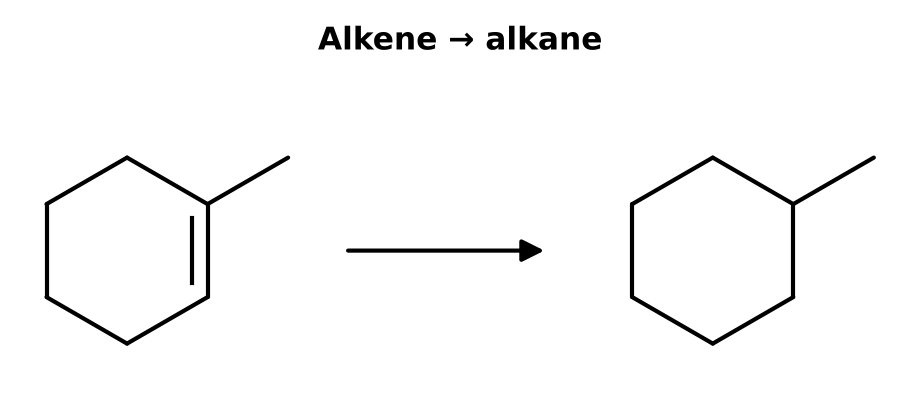
H₂, Pd/C (or Pt, Ni)
Adds H₂ across C=C, SYN, from the less hindered face. Alkene → alkane. Excess H₂ also takes an alkyne all the way to the alkane. [img 05]
![<p>Adds H₂ across C=C, SYN, from the less hindered face. Alkene → alkane. Excess H₂ also takes an alkyne all the way to the alkane. [img 05]</p>](https://assets.knowt.com/user-attachments/845d1c7d-be1f-46ff-bb6e-d2c1be2b3711.png)
Br₂ in CCl₄ or CH₂Cl₂ (DCM)
Two Br, ANTI (bromonium ion). trans alkene + anti = meso; cis alkene + anti = racemic. Needs a C=C; no C=C, no reaction. [img 06]
![<p>Two Br, ANTI (bromonium ion). trans alkene + anti = meso; cis alkene + anti = racemic. Needs a C=C; no C=C, no reaction. [img 06]</p>](https://assets.knowt.com/user-attachments/289deb5c-bdb5-4574-908a-683e361b1e09.png)
Br₂, H₂O
Bromohydrin, not a dibromide. OH on the MORE substituted C, Br on the less, anti. (Br₂/CH₃OH: same, but OCH₃ instead of OH.) [img 07]
![<p>Bromohydrin, not a dibromide. OH on the MORE substituted C, Br on the less, anti. (Br₂/CH₃OH: same, but OCH₃ instead of OH.) [img 07]</p>](https://assets.knowt.com/user-attachments/a69f3402-c328-48d2-9b88-28f8b602ed1b.png)
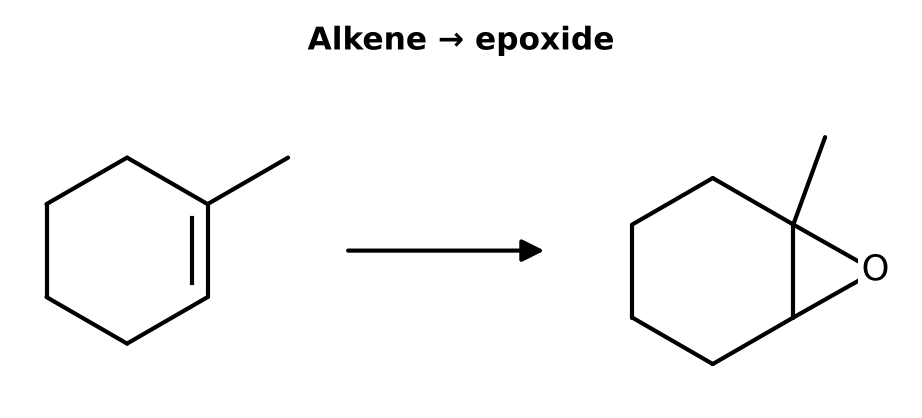
MCPBA
Alkene → epoxide. SYN, one step; alkene geometry is kept. With 1 equiv, the more substituted (electron-rich) C=C reacts first. [img 08]
![<p>Alkene → epoxide. SYN, one step; alkene geometry is kept. With 1 equiv, the more substituted (electron-rich) C=C reacts first. [img 08]</p>](https://assets.knowt.com/user-attachments/ea50b51b-a85d-46a4-891e-5e187359bfc2.png)
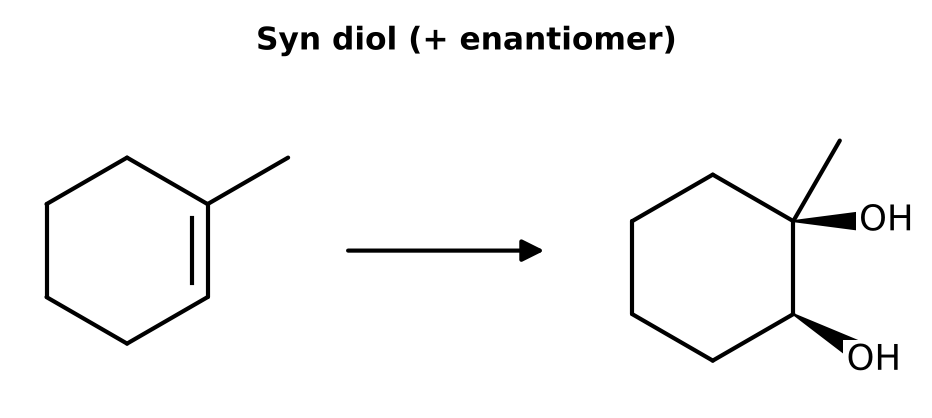
OsO₄ 2. NaHSO₃, H₂O (or cold dilute KMnO₄, NaOH)
Alkene → 1,2-diol, SYN (both OH from the same face). Compare: MCPBA then H₃O⁺ gives the ANTI diol. [img 09]
![<p>Alkene → 1,2-diol, SYN (both OH from the same face). Compare: MCPBA then H₃O⁺ gives the ANTI diol. [img 09]</p>](https://assets.knowt.com/user-attachments/cca0d620-b913-4176-b3fa-d7dd778545fa.png)
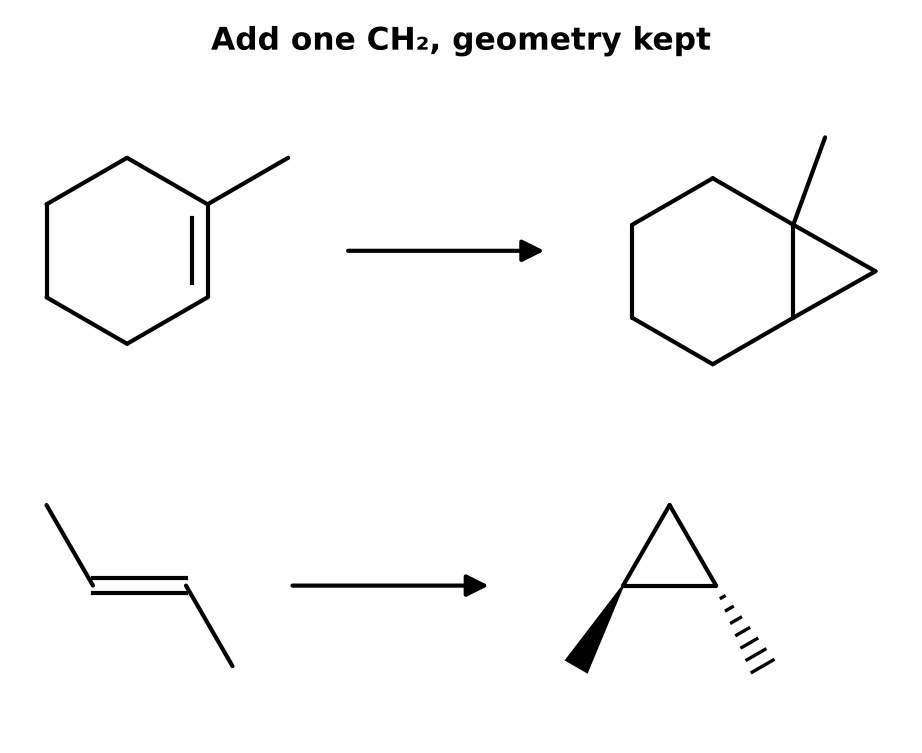
CH₂N₂, hν or heat (or CH₂I₂, Zn(Cu))
Makes carbene :CH₂ (loses N₂), which adds to C=C in one step → cyclopropane. SYN: trans stays trans, cis stays cis. [img 10]
![<p>Makes carbene :CH₂ (loses N₂), which adds to C=C in one step → cyclopropane. SYN: trans stays trans, cis stays cis. [img 10]</p>](https://assets.knowt.com/user-attachments/4b5cff97-642f-4d8c-9c5d-94fe516f29fa.png)
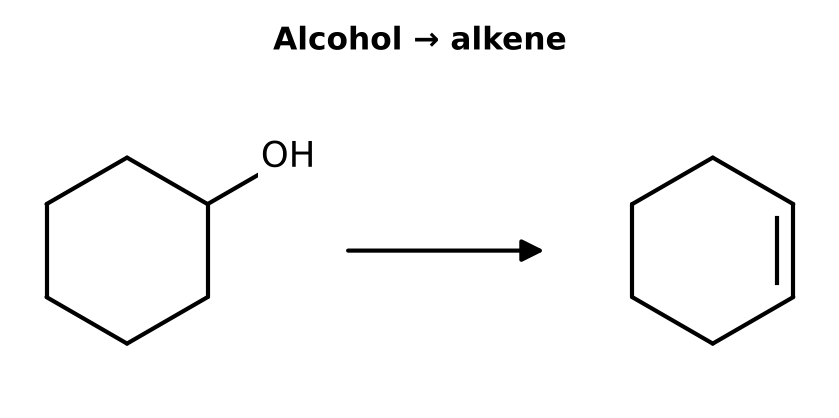
H₂SO₄ (or H₃PO₄), high heat, remove water — on an alcohol
Dehydration: alcohol → alkene. 2°/3° alcohol: E1 (watch shifts). 1° alcohol: E2. Zaitsev. Needs: higher temperature, non-nucleophilic acid, removal of water. Lower heat on a 1° alcohol → symmetrical ether (SN2). [img 11]
![<p>Dehydration: alcohol → alkene. 2°/3° alcohol: E1 (watch shifts). 1° alcohol: E2. Zaitsev. Needs: higher temperature, non-nucleophilic acid, removal of water. Lower heat on a 1° alcohol → symmetrical ether (SN2). [img 11]</p>](https://assets.knowt.com/user-attachments/baf89b0a-d850-46fb-928c-92a8e9c3cf2f.png)
NaOCH₃ / CH₃OH (also NaOEt, NaOH)
Small strong base. On a 2°/3° halide: E2 → ZAITSEV (more substituted) alkene, E beats Z, H must be anti-periplanar to the leaving group. On a 1° halide with no β-H: SN2 → ether. [img 12]
![<p>Small strong base. On a 2°/3° halide: E2 → ZAITSEV (more substituted) alkene, E beats Z, H must be anti-periplanar to the leaving group. On a 1° halide with no β-H: SN2 → ether. [img 12]</p>](https://assets.knowt.com/user-attachments/a23446e5-3b78-45fa-897b-74070ec5d493.png)
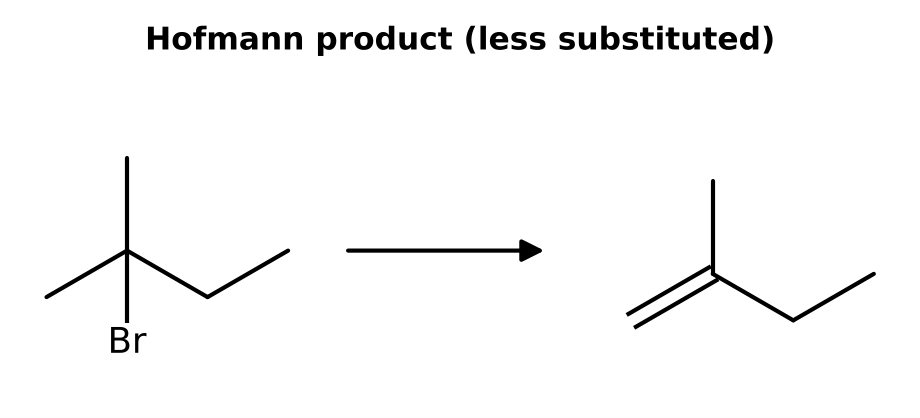
KOt-Bu (or LDA)
Bulky strong base. E2 → HOFMANN (less substituted) alkene, because it grabs the most accessible H. [img 13]
![<p>Bulky strong base. E2 → HOFMANN (less substituted) alkene, because it grabs the most accessible H. [img 13]</p>](https://assets.knowt.com/user-attachments/8fe1b57d-35c3-47e5-9838-e10a057cac9f.png)
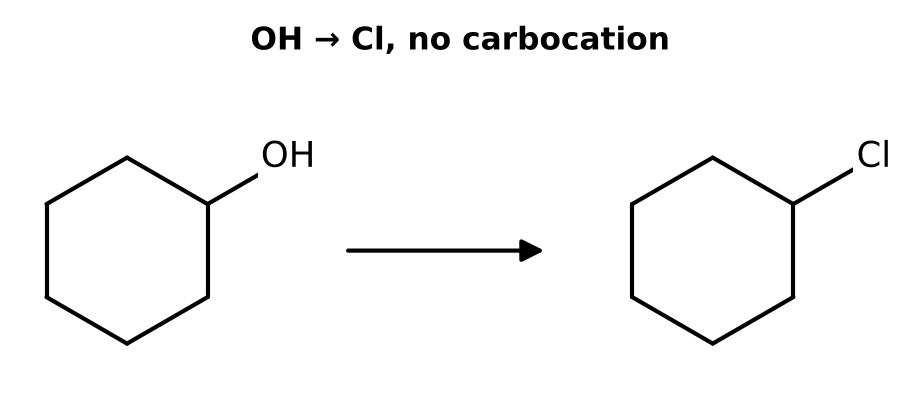
SOCl₂, pyridine
Alcohol → alkyl chloride with NO carbocation (no shifts, no ring expansion). Use instead of HCl when a shift is possible. (PBr₃ does the same for Br.) [img 14]
![<p>Alcohol → alkyl chloride with NO carbocation (no shifts, no ring expansion). Use instead of HCl when a shift is possible. (PBr₃ does the same for Br.) [img 14]</p>](https://assets.knowt.com/user-attachments/046bf78c-80a3-491e-b7fd-1cae46f2d7d5.png)
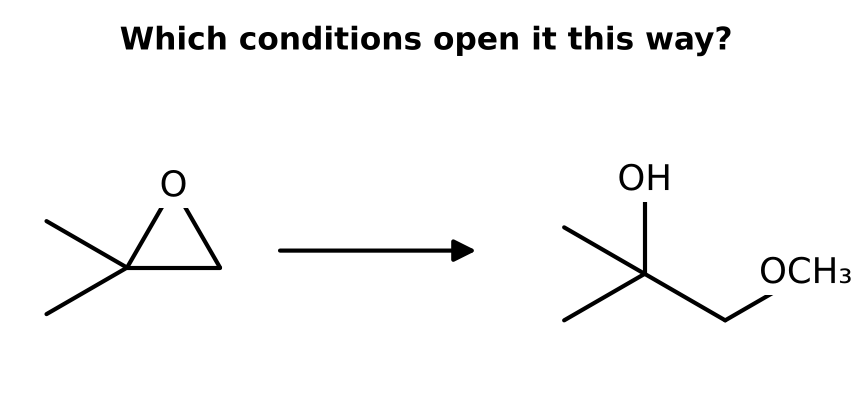
Epoxide + base / strong nucleophile (NaOCH₃, NaOH, RMgX, LiAlH₄)
SN2: attacks the LESS substituted C, from the back (inversion). Gives anti/trans products. Workup with H₂O or H₃O⁺. [img 15]
![<p>SN2: attacks the LESS substituted C, from the back (inversion). Gives anti/trans products. Workup with H₂O or H₃O⁺. [img 15]</p>](https://assets.knowt.com/user-attachments/0c889bd9-1314-42fb-9253-e9d8b817490c.png)
Epoxide + acid (H₃O⁺, or CH₃OH + H₂SO₄)
Protonate O first, then the nucleophile attacks the MORE substituted C (most + charge), from the back (inversion). [img 16]
![<p>Protonate O first, then the nucleophile attacks the MORE substituted C (most + charge), from the back (inversion). [img 16]</p>](https://assets.knowt.com/user-attachments/82aff7fd-04ac-4b06-8ac0-34b42b6724cd.png)
H₂, Lindlar's catalyst
Alkyne → CIS alkene (syn addition, stops at the alkene). [img 17]
![<p>Alkyne → CIS alkene (syn addition, stops at the alkene). [img 17]</p>](https://assets.knowt.com/user-attachments/68366b61-2f2a-4678-b157-0add70954afa.png)
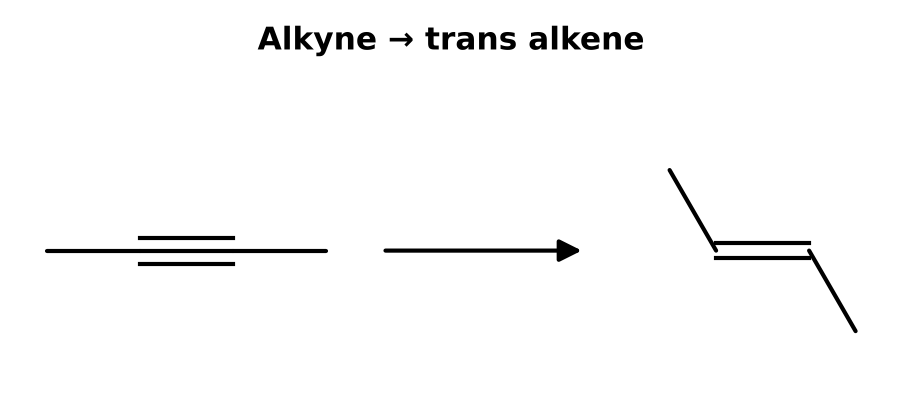
Na (or Li), NH₃(l)
Alkyne → TRANS alkene (anti addition through a radical anion). [img 18]
![<p>Alkyne → TRANS alkene (anti addition through a radical anion). [img 18]</p>](https://assets.knowt.com/user-attachments/d60f5578-0ced-4c0a-8819-29ebd0a4ea3e.png)
Terminal alkyne + 1. BH₃/THF 2. H₂O₂, NaOH
Anti-Markovnikov enol → tautomerizes → ALDEHYDE. (Textbook may use a bulky borane like 9-BBN; your key uses BH₃.) [img 19]
![<p>Anti-Markovnikov enol → tautomerizes → ALDEHYDE. (Textbook may use a bulky borane like 9-BBN; your key uses BH₃.) [img 19]</p>](https://assets.knowt.com/user-attachments/52dc141e-7c02-492e-b7c5-234d51cc9738.png)
Terminal alkyne + H₂SO₄, H₂O (+ HgSO₄)
Markovnikov enol → tautomerizes → METHYL KETONE. (Your key omits HgSO₄.) [img 20]
![<p>Markovnikov enol → tautomerizes → METHYL KETONE. (Your key omits HgSO₄.) [img 20]</p>](https://assets.knowt.com/user-attachments/9fe51aad-adb7-47c3-b899-06f381cfbd6f.png)
Mg, ether or THF (on R–X)
R–X → R–MgX (Grignard). Carbon flips from δ+ to δ−, becoming a nucleophile. Water or alcohol destroys it (R–MgX + CH₃OH → R–H), so keep them out until workup. [img 21]
![<p>R–X → R–MgX (Grignard). Carbon flips from δ+ to δ−, becoming a nucleophile. Water or alcohol destroys it (R–MgX + CH₃OH → R–H), so keep them out until workup. [img 21]</p>](https://assets.knowt.com/user-attachments/7431f40b-3f4e-4293-8c93-f71486c25e88.png)
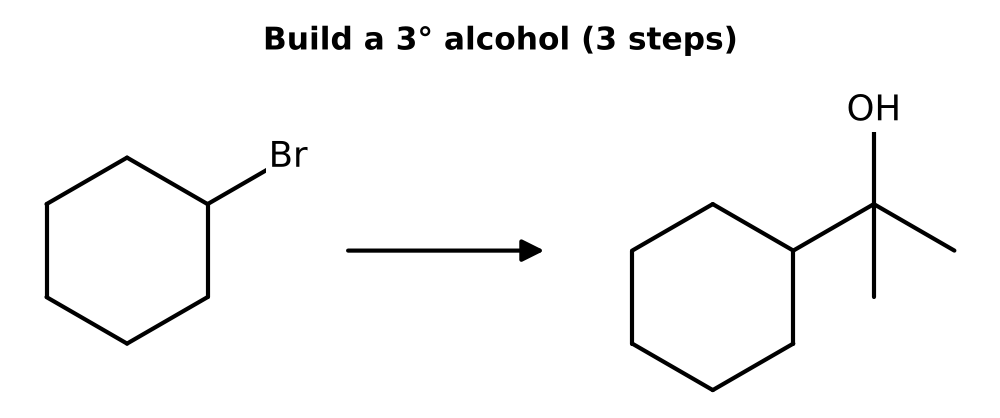
Grignard (RMgX) + C=O or epoxide, then H₃O⁺
H₂C=O → 1° alcohol. Aldehyde → 2° alcohol. Ketone → 3° alcohol. Epoxide → alcohol 2 C away (attacks the less substituted C). [img 22]
![<p>H₂C=O → 1° alcohol. Aldehyde → 2° alcohol. Ketone → 3° alcohol. Epoxide → alcohol 2 C away (attacks the less substituted C). [img 22]</p>](https://assets.knowt.com/user-attachments/86f566ea-86a6-4c65-be92-492e6554800a.png)



