Exam 2 ENVI 101
 Call Kai
 Learn
 Practice Test
 Spaced Repetition
 Match
 Flashcards
 Knowt Play
1/104

Earn XP
Description and Tags
exam 2
105 Terms
Green Revolution
Rrom roughly the 1940s through the 1960s, researchers including Norman Borlaug developed high-yield crop varieties, especially rice and wheat, and paired them with irrigation, fertilizer, pesticides, machinery, and improved management.
• Plant breeding examples: the International Rice Research Institute helped develop improved rice; dwarfing genes produced shorter, sturdier wheat that resisted falling over and could devote more energy to grain.
• Benefits: greatly increased yields and food production in many developing countries and helped reduce famine risk.
• Costs and unequal effects: new varieties often required more water, synthetic fertilizer, pesticides, machinery, credit, and infrastructure. Runoff and pollution increased, and wealthier farmers were better able to afford the inputs; some smaller farmers lost land or were pushed out.
How did we discuss the comparison between overall U.S. agriculture and agriculture in Burkina Faso at the beginning of lecture?
• Scale and purpose - United States agriculture: Large-scale industrial and market-oriented; Burkina Faso example: Small-scale and often subsistence-oriented
• Inputs - United States agriculture: Resource-intensive machinery irrigation fertilizer pesticides improved seed; Burkina Faso example: Fewer purchased inputs and less mechanization
• Output and risk - United States agriculture: High output but substantial environmental effects; Burkina Faso example: Lower output and greater vulnerability to drought climate variability and limited market access
Main lesson: a method that increases output in one agricultural system may not transfer fairly or effectively to another. Local climate, resources, infrastructure, land tenure, and affordability matter.
What is the definition of chronic undernutrition or hunger?
people who cannot grow or buy enough food to meet their basic energy needs, which threaten their ability to live healthy and productive lives
What is the definition of malnourishment?
nutritional imbalance caused by a lack of specific dietary components or an inability to absorb or utilize essential nutrients
Macronutrients
are needed in relatively large amounts: carbohydrates, fats, and proteins
Mirconutrients
· are needed in smaller amounts: vitamins and minerals such as iron, iodine, vitamin A, and zinc.
What are some problems that arise when we lack access to certain micro nutrients?
Micronutrient deficiencies can cause specific health problems
for example:
Iron deficiency can cause anemia
Iodine deficiency can impair thyroid function and development
Vitamin A deficiency can impair vision and immune function.
Food security
ability to obtain sufficient and nutritious food on a day-to-day basis
What are healthy food priority areas?
Healthy food priority areas (often called food deserts in older usage) are places where access to affordable, nutritious food is limited.
What are examples of organizations trying to address these issues in the Binghamton area?
VINES, volunteers improving neighborhood environments and the greater good grocery located on the north side of Binghamton are some examples of organizations that are trying to address the issues of food deserts
What are some trends we see with food production and diet?
CAFOs
Major emitter of one particular greenhouse gas
Antibiotic use
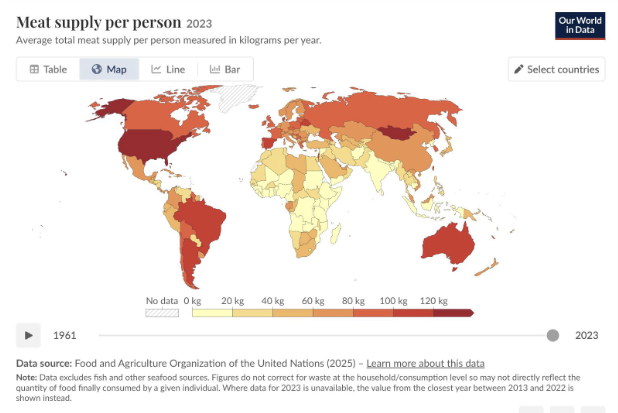
How do different countries rank in production/consumption of products we went over in class?
Trends in meat production and consumption show China produces most pork and U.S. produce most beef. Overall, China produces most meat. Top consumers of meat in the U.S. Seafood production used to be gotten from wild fisheries but now aquaculture has surpassed it as the main source of production.
What are CAFOS
CAFO = Concentrated Animal Feeding Operation: a large number of animals confined at high density.
Problems with CAFOs
Potential concerns include concentrated manure and nutrient runoff, odor, air pollution, animal-welfare concerns, disease transmission, and antibiotic use that can contribute to antimicrobial resistance.
What is the difference between fisheries and aquaculture? What are some problems we noted with both practices? What are some innovations we discussed in class that address some of these problems?
• Fishery - Meaning: A wild aquatic population suitable for commercial harvest in a body of water; Main concern: Overfishing can deplete stocks and reduce future harvest and biodiversity
• Aquaculture - Meaning: Farming fish shellfish seaweed or other aquatic organisms; Main concern: Waste disease parasites escapes habitat damage and feed made from wild fish
• Trawling - Meaning: Dragging a large net through the water or along the seafloor; Main concern: Bottom habitat damage and high bycatch
• Purse seine - Meaning: Encircling surface-schooling fish with a net; Main concern: Can capture non-target animals
• Long lining - Meaning: Long lines carrying many baited hooks; Main concern: Bycatch of sharks seabirds turtles and other species
Bycatch
the unintended capture of non-target organisms. Illegal, unreported, and unregulated fishing can push total harvest beyond reported levels and make management less effective.
What are examples of different fishing techniques we discussed in class?
Trawling, purse-seine fishing, long lining
What are farm subsides?
a government payment or other support intended to help farmers remain in business and stabilize food production or income.
Concerns of farm subsides
Benefits may flow disproportionately to large producers or a few commodity crops; incentives can promote overproduction, monoculture, high chemical use, or cultivation of vulnerable land; and subsidies can distort prices and markets.
Conservation Reverse Program
benefits may flow disproportionately to large producers or a few commodity crops; incentives can promote overproduction, monoculture, high chemical use, or cultivation of vulnerable land; and subsidies can distort prices and markets.