Zoology Chapter 12
 Call Kai
 Learn
Learn Practice Test
 Spaced Repetition
 Match
Match Flashcards
 Knowt Play
1/23

There's no tags or description
Looks like no tags are added yet.
Name | Mastery | Learn | Test | Matching | Spaced | Call with Kai | Chat |
|---|
No analytics yet
Send a link to your students to track their progress
24 Terms
Taxonomy
the naming and classifying of organisms
taxon (pl. taxa)
each level of taxonomy is called a …
domain, kingdom, phylum, class, order, family, genus, species
hierarchical organization of organisms
Genus + species
binomial nomenclature
bacteria, archaea, eukarya
the broadest modern classification divides organisms into three domains…
bacteria and archaea
which of the three domains consist of prokaryotic organisms
phylogeny
the evolutionary history and relationships among organisms
the relationships/history
systematics
the study of the evolutionary relationships among organisms
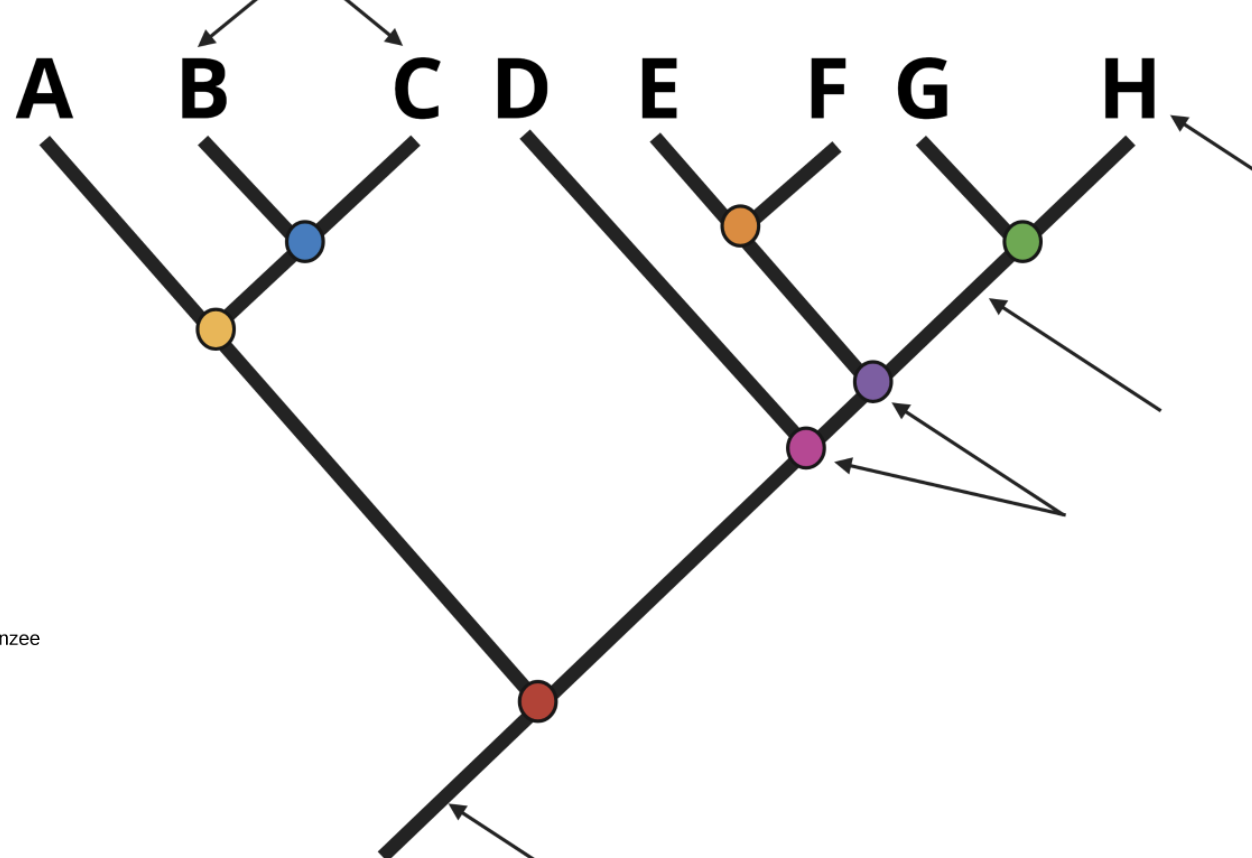
phylogenetic tree
Show relationships and evolutionary change over time
Relatedness depends on the most recent common ancestor, not how close organisms may appear
sister taxa
two groups that share most recent ancestor
B & C
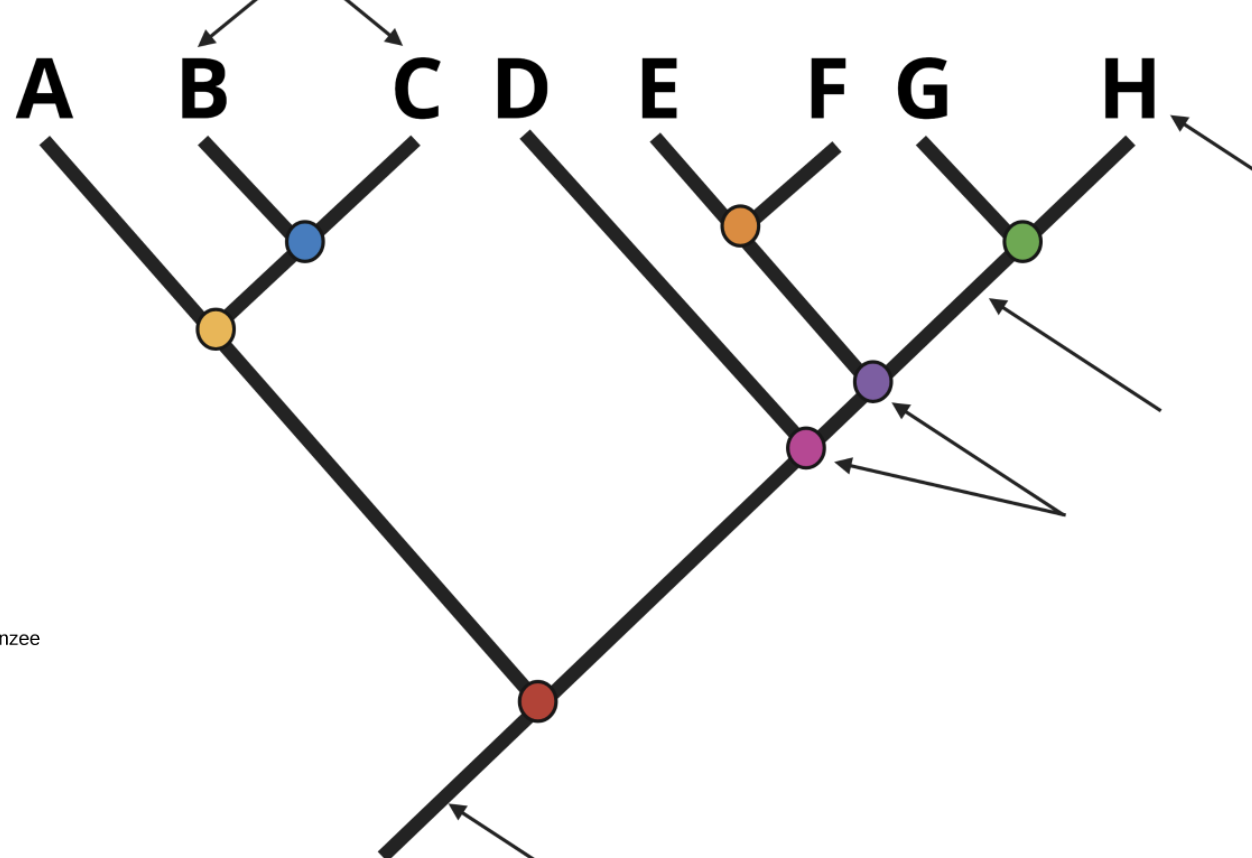
terminal taxa
H

node (the dots)
where there is a split of an ancestral lineage into two or more descendent lineages
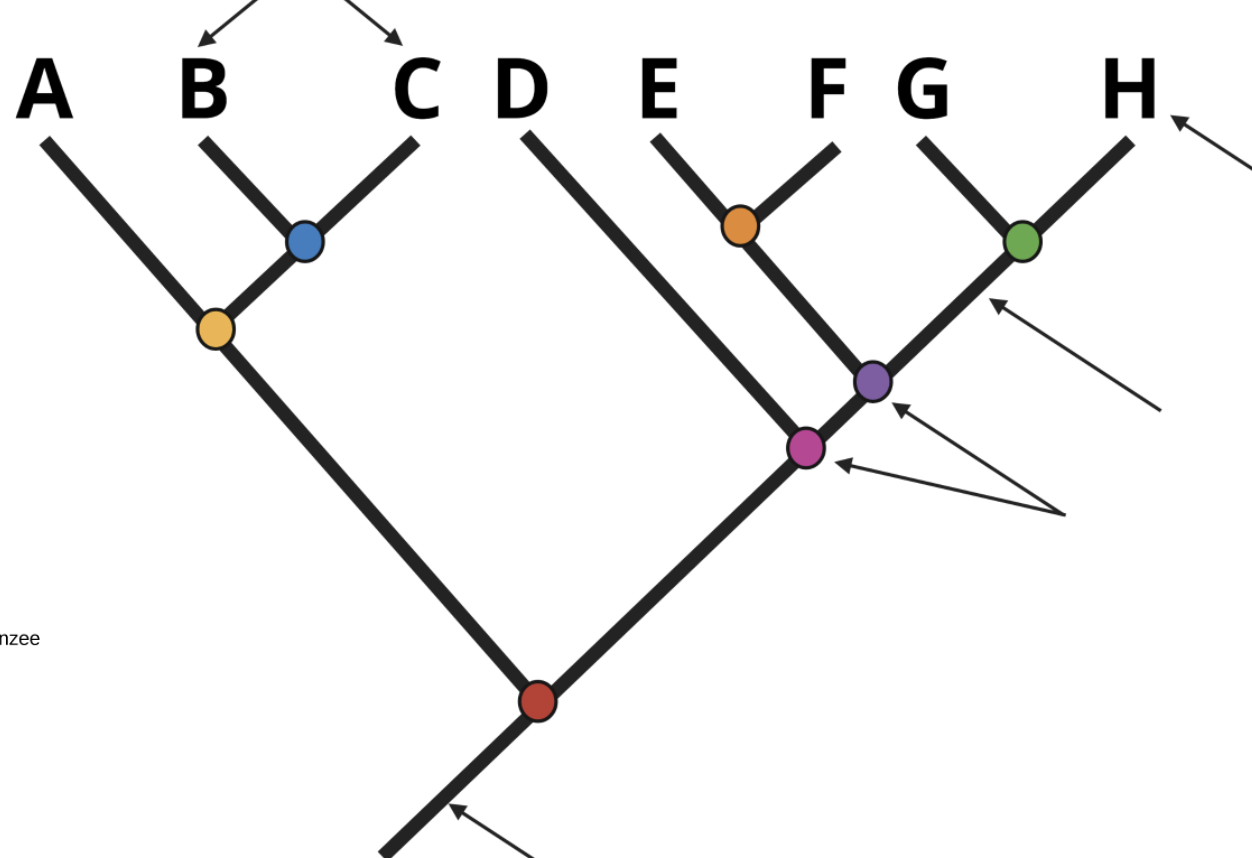

root


branches
homologous characteristics
similarity due to common ancestry → useful for phylogeny
examples: human arm, whale flipper, bat forelimb, and cat foreleg
analogous characteristics
similarity due to convergent evolution → can be misleading for phylogeny
examples: wings in birds and insects, streamlined bodies in sharks and dolphins, camera-like eyes in vertebrates and cephalopods (octopus)
shared ancestral characteristic
present in all
characteristic that originated before the group being examined
shared derived characteristic
differentiates
characteristic that evolved in a particular group and is shared by its descendants
cladistics
method of grouping organisms based on common ancestry and shared derived traits
a way to determine/represent those relationships
clade
a common ancestor and all of its descendants
a group on the tree
monophyletic group
cladogram
shows relationships based on shared traits
molecular systematics
use of molecular data to determine evolutionary relationships
DNA sequences
RNA sequences
amino acid sequences of proteins
more sequence similarity generally supports a more recent common ancestor
molecular clock
method for estimating when lineages diverges
uses rate of mutation to estimate when two or more species diverged from a common ancestor
molecular changes accumulate over time and can be used to estimate divergence time
maximum parsimony
favors the hypothesis requiring the fewest evolutionary changes
simplest explanation requiring the fewest evolutionary changes
smallest possible number of changes
multiple polygenetic trees can often be constructed to fit the available evidence