Rotator Cuff
 Call Kai
 Learn
Learn Practice Test
 Spaced Repetition
 Match
Match Flashcards
 Knowt Play
1/37

There's no tags or description
Looks like no tags are added yet.
Name | Mastery | Learn | Test | Matching | Spaced | Call with Kai | Chat |
|---|
No analytics yet
Send a link to your students to track their progress
38 Terms
w/ Subacromial bursitis, tend to think what is the prime pain center w/ added compressive force?
supraspinatus tendinopathy (Subacromial Impingement Syndrome)
Pathoanatomical Diagnosis of Subacromial Pain Syndrome (SAPS)
Subacromial Impingement Syndrome: Subacromial bursitis
Rotator Cuff Tendinopathy/Dysfunction/Tears
Bicipital Tendinopathy
Superior Labral Anterior to Posterior (SLAP) Tear
rotator cuff disease progression (impacted by aging, compression of humeral head on acromion)
tendinopathy → Tendinosis/Degenerative Tendon → Tendon Tearing
The Degenerative Mircotrauma Model for Rotator Cuff Tears is age related; 50% chance of cuff tear after
60 y/o, repetitive mircoload leads to break down of tendon
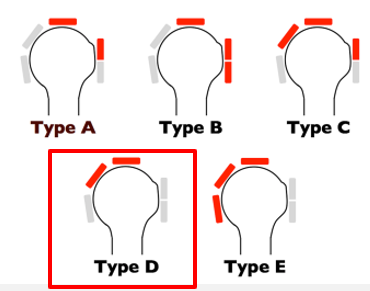
which tendon is most commonly torn in rotator cuff?
Supraspinatus → Infraspinatus → Subscapularis
(Biceps may become involved in larger tears)
w/ a supraspinatus injury, stress moves onto
the biceps tendon
A small RC tear; partial thickness (<1cm) includes
Tear of 1 tendon, usually supraspinatus is involved
May remain asymptomatic or mild sxs of pain
No loss of AROM (moderately strong)
A Moderate thickness RC Tear (1-3 cm) can involve
2 tendons: Supra & infraspinatus
More likely to become symptomatic
May lose AROM (lose ability to elevate shoulder)
A large tear-full/complete thickness (3-5 cm) RC tears includes
Tear or tears of 3-4 tendons: Supra/infra, & Subscapularis, long head of biceps tendon
Symptomatic
Loss of AROM (barely lift arm above chest height)
what does RC tear thickness mean?
how much of the tissue belly is torn
Cuff Disease as a whole w/ partial thickness tears
10% Can heal
10% Become Smaller
54% propagate
28% become full thickness tears
Cuff Disease as a whole w/ larger tears there is
a greater rate of progression (rest of RC must compensate)
Increase fatty infiltrate & atrophy
3-5 years
Traumatic Rotator Cuff Tearing can be from
Fall On Out-Stretched Hand (FOOSH)
Lifting injuries
Traction injuries (grab/pull on arm)
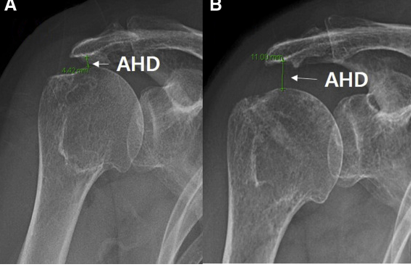
Rotator Cuff Pathologies/Dysfunction on radiograph, what is seen visually?
once is torn, the humeral head migrates superioly
Patient reported sxs of RC Pathologies/Dysfunction
Shoulder pain
pain w/ laying on the shoulder
Rotator Cuff Pathologies/Dysfunction: clinical signs
Pain w/ shoulder AROM
Weak & painful resisted testing
Full PROM (if not pain limited)
RC Tear Clinical Tests: Dx of full thickness RTC is likely if 3/4 Positive Tests [4/4 (+) variables = (+) LR 28]
Age > 65
(+) Painful Arc
(+) Infraspinatus Muscle Test (resisted ER MMT)
(+) Drop Arm Test
ROM findings & special tests for diagnosing Rotator Cuff Tear
AROM < PROM Discrepancy
(+) Drop arm test
(+) ER Lag sign
during drop arm test, a well compensated pt will use deltoid to compress humeral head into glenoid, so in order to account for this
tap the arm
Decision Making in RC Tears: Traumatic versus degenerative tears
if Traumatic → then surgery
Degenerative can be managed conservatively successfully
But may progress & require surgical intervention
Decision Making in repairing RC Tears: Demographic factors
Increased age, >70 y/o increases rate of re-tear
Comorbidities
Decision Making in RC Tears: Reparability of the cuff
Massive Tears may not be repairable
Superior capsular reconstruction?
Reverse Total Shoulder?
What is the stronger predictor of success with PT for RC tear?
Patients belief in physical therapy
PT vs Surgical Repair
No difference in pain or function at 1 yr
5-10 yr outcomes may favor RC repair
(degenerative) tears generally get worse over time, conservative management 1st, then escalate to
surgical repair if necessary
Conservative Management for higher irritability RC pts
Manage Pain: MT (neck, shoulder, spine), Modalities, Gentle Exercise
ROM: Manual therapy (GH, CT), AAROM (cane), PROM (ROM in prone too)
Strengthening: Lower Load for Cuff, Scapular strengthening, Emphasis on restoring AROM
Conservative Management for lower irritability RC pts
Manage Pain PRN
ROM: Emphasis on AAROM & AROM
Strengthening: RC & Scapular strengthening
Functional training
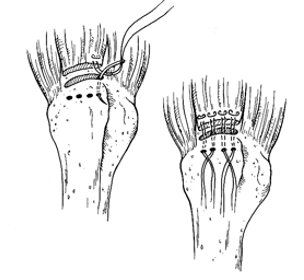
Rotator Cuff Repair Mini -Open (Decreasing in use)
Visualization: split deltoid in order to get to RC
Fixation: in bone trough in humerus, sutures through bone &/or suture anchors, greater fixation than arthroscopic
Surgery: Supraspinatus, Maybe infraspinatus, Typically will let you know if subscap is involved, RC Interval may be closed
Increase stability of shoulder
May increase shoulder stiffness
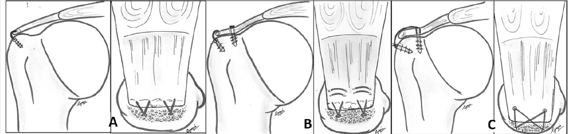
With Arthroscopic Rotator Cuff repair, C is best because
Visualization: Through porthole camera
Fixation: Through bony anchors (dissolve, boney healing takes over)
Advantages: Less pain, Less disruption of tissue
RC repair rehab restrictions/precautions (restrictions depend on surgeon)
No Active motion for 6 weeks (allows healing of tendon to bone, based on size of tear & whether muscle retracted)
Quality of muscle tissue will also affect restrictions
What are the RC repair rehab passive restrictions? (ROM Restrictions from surgeon, when in the ROM, tension is put on sutures)
Avoid passive IR for 4-6 weeks
Behind the back (shoulder adduction) w/ IR not allowed ~ 8 weeks
Precautions for post op RC rehab are to allow for RC healing at boney footprint. Prioritize protection of repair due to retear rates which 50% of re-tears happen in
1st 3 months
Most of rest of re-tears happen 3-6 months
Post surgical stiffness: Lower re-tear rates (2% vs 57%)
Early Vs Late Mobilization post op RC repair: Delayed mobilization for >4 weeks results in
less anatomic tearing w/ no effect on long term function
No significant impact on post surgical stiffness
Post op RC repair it is important to delay strengthening for
>8 weeks
Avoid overcoming isometrics, use iso therabands/cables
Early Rehab (0-6 weeks) Post-op Rotator Cuff Repair begin PROM at 2 weeks:
Flexion to 90°, IR to 0°, ER to 30°
AAROM >2 wks (may be delayed until 6 wks)
No strengthening, but Scapular isometrics allowed
Post Surgical Rehab of RC Repair: Middle phase (6-10 wks)
ROM: AAROM, MT, Initiate AROM
Light Strengthening: Isotonics, Scapular Strengthening
Post-Surgical Rotator Cuff Rehab Middle to Late Phase (10-16 wks) includes
ROM as needed
Progressive resistance exercise: RC, Scapular stabilizers, Prime Movers
Late-Stage Post-Surgical Rotator Cuff Rehab (>16 Weeks) includes
ROM: PRN
Progressive Resistive Exercises: RC, Scapular stabilizers, Prime Movers
Functional/Work/Sport related training