Ecology Exam 2 Jeop
 Call Kai
 Learn
 Practice Test
 Spaced Repetition
 Match
 Flashcards
 Knowt Play
1/23

There's no tags or description
Looks like no tags are added yet.
24 Terms
What are the three survivorship curves and examples of each?
Type 1 (Convex):
More likely to die as you age. Humans
Type 2 (Diagonal)
Consistent mortality. Birds
Type 3:
High mortality at the start. Trees
What does logistic growth look like? What is an example of an organism exhibiting logistic growth, and what is K?
K = carrying capacity = the maximum number of individuals an area can support
Increases as N → K; dN/dt approaches 0
Eurasian collared doves in Britain, acorn barnacles, northern elephant seals
What is symbiosis? Name three kinds of symbiosis
When multiple organisms live together intimately, most or all of the life cycle of one organism occurs in another
Mutualism, commensalism, and parasitism
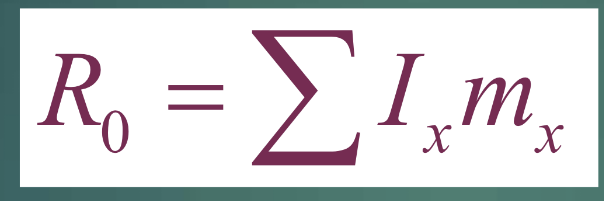
What does the equation represent? What does each variable mean?
Net reproductive rate for annual plants
R0 = Net reproductive rate (like the average number of seeds produced by an individual in a population during its lifetime)
I0 = Percent of the population surviving to each age
mx = Average number of seeds produced by each individual in each age category
x = Age interval
What is Gause’s competitive exclusion principle? What does it predict, and what does it have to do with character displacement?
Two species with identical niches cannot coexist indefinitely (leads to competitive exclusion) – Paramecia experiments
Predicts that species living together have different niches (niche partitioning)
Character displacement: Sympatric species have more dissimilar traits vs. allopatric
Six requirements:
Differences are genetic
Differences evolved when living together
Species are more different when together than when apart
Specific traits affect resource gathering/use
Similar traits lead to more competition
Traits are not caused by different locations
What are the three main methods of estimating patterns of survival?
Cohort life table: Identify individuals born at the same time and keep records from birth
Static life table: Record the age at death of individuals
Age distribution: Calculate differences in the proportion of individuals in each age class
What is a rank-abundance curve? How can you tell richness and evenness from it?
A rank abundance curve is used to display and compare biodiversity, specifically species richness and species evenness, within a community.
X-axis (Rank): Species are ranked from left to right in order of abundance, where Rank 1 is the most abundant species, Rank 2 is the second most abundant, and so on
Y-axis (Relative Abundance): The vertical axis shows the relative abundance (proportion or percentage) of each species
Richness: How many species there are
Evenness: The relative abundance and proportional representation of each species within a biological community
Lower slope = species have similar/even abundances
Steep drop = One or few species dominate the environment
How does the Lotka-Volterra predator-prey model predict predators and prey will change through time? What does a plot of predators vs. prey look like?
Predator and prey populations oscillate. Prey peak always slightly behind the predators.
Prey increase → predators increase → Prey decrease → Predators decrease
If you eliminate the time axis, there is an elliptical oscillation in predator and prey numbers
It is called a phase plot
What is the equation for geometric growth, and in what cases would you use it?
Geometric growth is a constant ratio that describes how a population multiplies during a discrete period of time
Generations do not overlap
Generations differ in size by a constant ratio
Lambda = 1 is no population growth
Example: Annual plant with abundant resources
What disturbance conditions generate the most diversity? Give an example
Intermediate levels
Intermediate disturbance hypothesis
Algae and invertebrates
Diversity of algae and invertebrates growing on boulders in the intertidal zone
Boulders supporting the greatest diversity of species were those subject to intermediate levels of disturbance
What is the exponential growth rate equation, and when would you use it?
Continuous population growth in an area where resources are not limiting
Characteristic of rebounding populations (elephants) or establishing in a new environment/during newly favorable conditions (e.g., Scots pines, whooping cranes)
dN/dt = rN
dN/dt = rate of population growth)
R = per capita rate of population increase (this is constant)
N = population size
What is the logistic growth rate equation, and when would you use it?
Accounts for carrying capcity/limiting resources
dN/dt = rmax N (1 - N/K)
Change in numbers / Change in time
Intrinsic rate of increase
As the ratio of population size to carrying capacity (N/K) approaches 1, the population growth rate approaches 0."
What are the different types of species interactions?
Mutualism +/+
Commensalism +/0
Predation/Herbivory/Parasitism +/-
Amensalism -/0
Competition -/-
What assumptions does the Lotka-Volterra predator-prey model make? What confounding variables might occur in reality?
Assumes:
Prey population grows exponentially in absence of predators
Predator population declines exponentially without prey
Predators consume prey at rate proportional to prey density
No predator interference or competition
Environment is constant
No age structure or spatial structure
Predator and prey interact continuously
Showed that predator-prey interactions could produce population cycles
What increases species diversity in a community? Give specific examples
Environmental heterogeneity/complexity
Examples:
MacArthur, birds, tree height diversity
Hutchinson’s Paradox of the plankton
Variation in soil type and depth to groundwater
What are the three types of competition? Give an example of each. What type of niche does competition affect?
Interference competition: Direct interactions between individuals where organisms actively block, fight, or intimidate others to stop them from accessing a shared, limited resource (opposite of exploitative competition)
Aggressive territory defense, production of chemical toxins
Intraspecific competition: Individuals of the same species
Self thinning
Interspecific competition: Individuals of different species
Can affect species' realized niche
What are the three types of competition? Give an example of each. What type of niche does competition affect?
A metapopulation is a "population of populations"—a group of spatially separated populations of the same species that live in fragmented habitat patches.
Connection to dispersal: Dispersal allows individuals to move between habitat patches and recolonize empty ones after local extinctions, preventing the entire metapopulation from dying out.
What is an example of a density-independent and a density-dependent factor that limits population growth?
Density-independent: Tend to be abiotic factors
Volcanic eruption
Density-dependent: Tend to be biotic factors
Reproductive success of sparrows
What is the Lotka-Volterra competition model, and what does it predict about coexistence?
Competition model that predicts coexistence when interspecific competition is weaker than intraspecific competition (related to Gause’s principle)
What are the two types of mutualism? What are examples of each?
Facultative: Species can live independently
Obligate: Depend on the relationship for survival
Can be specialized or generalist–each plays a different role in mutualism networks (specialist pollinators often interact with generalists; loss of generalist can have big consequences)
What are types of refuges?
Flight, Size, Space, Large groups, Fear
When does theory predict mutualism will occur? What factors contribute to this in the ant-plant system?
Theory predicts that mutualism will evolve when benefits are larger than costs (for combined successful and unsuccessful mutualists)
For ant plants
High probability of attracting ants
High potential for herbivory
Low effectiveness of alternative defences
High effective ant defenses
What is the difference between species richness and species diversity?
Species richness is simply the total count of different species in a community, while species diversity accounts for both the number of species (richness) and how evenly individuals are distributed among them (evenness).
How does nutrient enrichment influence species diversity?
Nutrient enrichment reduces environmental complexity, which reduces diversity (plants and algae)
Light becomes limiting, and the best light competitor dominates