STUPID ART HISTORY MIDTERM
 Call Kai
 Learn
 Practice Test
 Spaced Repetition
 Match
 Flashcards
 Knowt Play
1/54

There's no tags or description
Looks like no tags are added yet.
55 Terms
What is prehistoric?
Before written records that document objects, structures, and images.
What are possible explanations for prehistoric cave paintings?
They may have related to hunting or magic, but these are theories and some have been discredited.
How do you recognize the Venus of Willendorf?
Small limestone female figurine, exaggerated features, no facial features; ca. 28,000–25,000 BCE.

What might the Venus of Willendorf represent?
Womanhood rather than one specific woman.
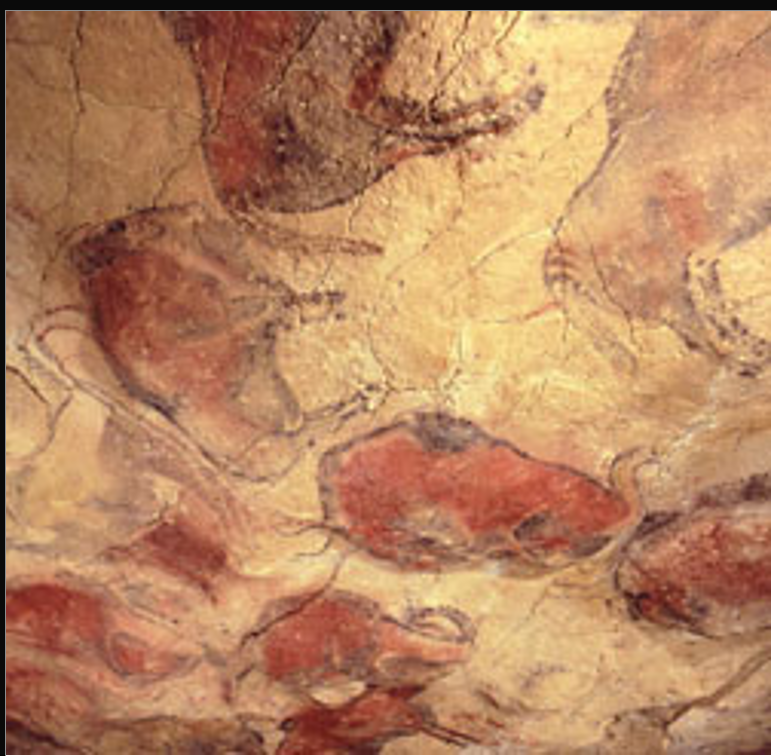
Bison at Altamira?
Large bison paintings in a dark cave; each bison is approximately eight feet long; ca. 12,000–11,000 BCE.
What distinguishes the animals in
Chauvet Cave?
Relatively realistic animal depictions, with horns positioned one behind the other; ca. 30,000–28,000 BCE.

What does Mesopotamia mean?
The land between the Tigris and Euphrates Rivers.
What are the main achievements and concerns of Sumerian civilization?
Irrigation, flood control, writing, urban life, literature, trade, and city-states associated with protective gods.
Why did Mesopotamians develop writing?
To keep administrative and planning records for cities involved in trade.
What is the Epic of Gilgamesh?
The most famous work of Sumerian literature mentioned in the slides.
What does the banquet scene on the Sumerian cylinder seal demonstrate?
Hierarchy; it comes from Pu-abi's tomb at Ur and dates to ca. 2600 BCE.

ziggurat
A massive raised mud-brick structure associated with a temple; the Ziggurat of Ur dates to ca. 2100 BCE.

What was the purpose of the Assyrian lamassu?
A guardian figure intended to protect the king and intimidate enemies.
assyrians made image of themselves to scare ppl off
It has five legs, appearing at rest from the front and in motion from the side; ca. 720–705 BCE.
-mesopotamia
What are the central ideas of ancient Egyptian civilization?
The Nile as a symbol of life, godlike rulers, and the importance of the afterlife.
Why was the Nile important to Egypt?
It made life possible and became a symbol of life.
Why does much surviving ancient Egyptian art concern death?
Rulers invested in tombs and funerary works to prepare for the afterlife.
What was the Egyptian ka?
A person's life force or spiritual double that could continue after physical death.
Why did Egyptians build tombs and pyramids?
To provide for the deceased and support the pharaoh's existence in the afterlife.

Palette of King Narmer
The king is depicted in a godlike manner, a tradition that continued in Egyptian royal representation.

Khafre's statue
The ruler's divinity through his idealized body and symbols on the throne.
What are the Great Pyramids of Giza associated with?
Pharaohs, monumental royal architecture, death, and preparation for the afterlife.

What distinguishes _______ statue from earlier pharaoh representations?
Akhenaton's
It retains frontality and rigidity but has softer features and a protruding stomach; one interpretation links this to a sun god incorporating both genders.
What is important about Egyptian royal art generally?
Much surviving art is official art made for rulers, and rulers were represented in a godlike manner.
How does the Indus Valley differ from Egypt and Mesopotamia in the slides?
No identified temple or palace; public buildings existed, but no monuments on the scale of pyramids or ziggurats.

What ? used for?
Indus Valley seals used for?
Securing trade goods; designs often show animals or short narratives, and some may have served as identification.
Why is the title Priest-King uncertain?
Archaeologists gave it that name, but there is no evidence that priests or monarchs ruled Mohenjo-daro.
What does the patterned shawl of the Indus Valley Priest-King suggest?
Interaction between the Indus Valley and Mesopotamian civilizations because similar patterns occur in Mesopotamia.
What features did houses at Mohenjo-daro have?
Wells, kitchens, toilets, and bathing platforms.
What are the main concerns of Shang civilization?
Developed writing, bronze casting, pottery, warfare, ancestor worship, and preparation for the afterlife.

oracle shel
A tortoise shell inscribed with characters from the Shang writing system.

What does the Shang gong of animal forms help illustrate?
Bronze art and ancestor worship, including offerings of food and liquids.

Why is the Sanxingdui standing figure important?
Its discovery in 1986 changed ideas about ancient Chinese art; it is a large bronze figure, ca. 1200 BCE.

What is important about ___
Cycladic male lyre player
A marble musician found in a grave; its purpose is uncertain and it may have been connected to the afterlife.

What is the main idea of Landscape with _____?
peaceful minoans
A celebration of nature and one of the earliest known examples of a pure landscape; Minoan, ca. 1650 BCE.

What does the____suggest about Mycenaean civilization?
Lion Gate
Concern about attack and defense; it dates to ca. 1300–1250 BCE.
What is the difference between Minoan and Mycenaean art in the slides?
Minoan art suggests a peaceful, nature-loving culture; Mycenaean architecture reflects concern about attack.

What is the Geometric krater?
A Greek cemetery vessel from Athens with stylized human figures; ca. 740 BCE, Geometric period.
What is the Greek Geometric period?
Ca. 900–700 BCE; human figures appear in stylized rather than naturalistic form.
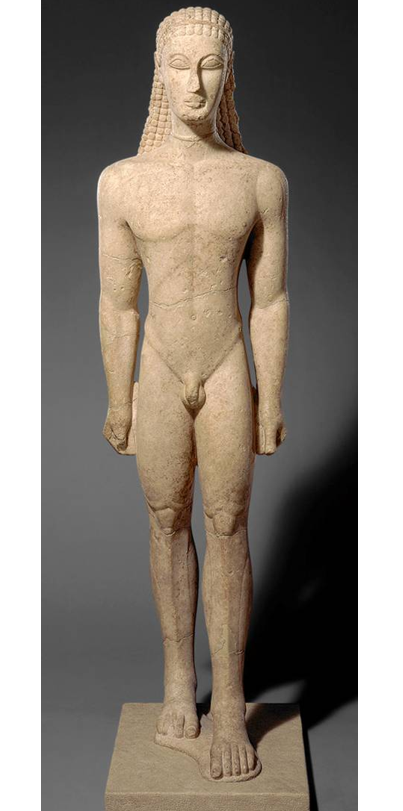
How was the Greek ______influenced by Egyptian sculpture?
kouros
It served as a grave marker, but it was free from the stone block and nude.
A nude, free-standing male sculpture associated with the Archaic period; ca. 600 BCE.

What is the main idea of _____?
Doryphoros
The ideal body constructed through mathematical proportions and ratios.
What is Polykleitos's Canon?
A treatise describing how body parts relate to one another through proportions and ratios.
How did the Parthenon use mathematics?
It used mathematical relationships to achieve rational balance and visual perfection.
What are optical corrections in the Parthenon?
Deliberate adjustments, including curved steps and inward-leaning columns, to make the building appear visually perfect.

What distinguishes Hellenistic art, represented by Nike of Samothrace?
Dramatic movement, sweeping lines, strong contrasts of light and shadow, and emotion.
What is hierarchy in art?
Showing differences in status or importance through the representation of figures.
What is relief sculpture?
Sculpture that projects from a background surface.
What does sculpture in the round mean?
Sculpture that can be viewed from multiple sides rather than only against a background.
What does contemporary civilizations mean?
Civilizations whose periods overlap; it does not necessarily mean they interacted.
How do Mesopotamian and Egyptian monumental structures differ?
Ziggurats were associated with temples and gods; Egyptian pyramids were associated with pharaohs and the afterlife.
How can you compare Egyptian art with Indus Valley art?
Egypt emphasizes royal monuments and funerary beliefs; Indus Valley evidence emphasizes seals, trade, and planned homes.
How did Greek sculpture develop across the periods in the slides?
Geometric: stylized figures; Archaic: kouros; Classical: ideal proportions; Hellenistic: drama, movement, and emotion.
If asked to design a building inspired by three works, what should your explanation include?
Name the works, identify specific architectural features borrowed from each, and explain how the features reflect their historical purposes or ideas.
If asked to find differences between two religious objects, what should you compare?
Their appearance, materials, scale, symbols, intended purpose, religious beliefs, and the civilizations that created them.
If asked to explain similarities between two artworks, what should you do?
Name a specific shared feature, describe evidence visible in both works, and explain the shared historical or cultural idea.
What should you prioritize when identifying an artwork from an image?
Recognize its visual features, name the civilization or period, recall its approximate date, and explain its main historical meaning