Greek Art & Architecture I
 Call Kai
 Learn
Learn Practice Test
 Spaced Repetition
 Match
Match Flashcards
 Knowt Play
1/21

There's no tags or description
Looks like no tags are added yet.
Name | Mastery | Learn | Test | Matching | Spaced | Call with Kai | Chat |
|---|
No analytics yet
Send a link to your students to track their progress
22 Terms

Amphora from Dipylon Cemetery
detail showing prothesis (lying in state;
Athenian funerary ritual) of female
deceased and mourners
height 5’1”, c. 750 BCE
National Archaeological Museum, Athens
terms: frieze, narrative
NW of Athens; placed as a grave marker
shape relates to sex of deceased; amphora = woman
handles at widest point → accentuate width
narrative frieze → deer grazing, funerary procession
simple, geometric human forms

Man and Centaur
perhaps from Panhellenic sanctuary at Olympia
bronze, height 11 cm, c. 750 BCE
Metropolitan Museum of Art, New York
cast in one piece of bronze
helmet - narrative combat?
found in sanctuary; perhaps an offering
geometric sculpture

Amphora showing Achilles and
Ajax playing dice, c. 540-530 BCE
Vatican Museums, Rome
terms: black-figure vase
Exchians → rise of signing names onto work
black-figured vases would be replaced with red-figure vases

Griffin-headed protome from bronze-tripod cauldron,
from Rhodes, c. 650 BCE, British Museum, London.
placed in temple
orientalized visual element
straight lines animate the curves
entasis
a slight swelling of the shaft of a
column intended to compensate for the illusion
of concavity resulting from straight sides; slight
curvature
peristyle
a colonnade around a building or court
column
base + shaft (drums) + capital
entablature
architrave + triglyphs/metopes (or frieze) + cornice
pediment
triangular area with acroterion (sculpture) on top

The temples of Hera I and Hera II at Paestum (Magna Graecia), Italy,
c. 550 and c. 460 BCE
terms:
Stylobate - the top step or continuous flat platform of a classical temple or building that directly supports a row of columns
Cella / naos - main inner chamber of a Greek or Roman temple that houses the cult statue
Pronaos - inner porch or vestibule in front of the cel
Peristyle / colonnade - a long sequence of evenly spaced vertical columns that support a horizontal roof, ceiling, or entablature using a post-and-lintel system
Side passage / pteroma - the enclosed space or walkway between the outer columns (peristyle) and the solid main walls (cella or naos) of an ancient Greek or Roman temple
Anta - a slightly projecting pier or pillar that terminates and reinforces the end of a load-bearing wall

Kore (maiden)
c. 630 BCE
Louvre, Paris
Egyptian-style frontality, clothed compared to men

New York Kouros (youth)
Height 1.9 m, c. 600 BCE
Metropolitan Museum of
Art, NYC
freestanding, more frontality
in the nude
archaic smile
more stylistic → earlier

The Temple of Artemis, Corfu, c. 600 – c. 580 BCE
Medusa and her children are here
Ionic columns

Medusa with her children Pegasus and
Chrysaor between two feline creatures,
from west pediment of temple
Apotropaeic guardian animals or
an image that emphasizes the power of divinity

The Siphnian Treasury at Delphi
Ionic frieze - allegories of good and evil (earliest)
Two caryatides - guardian statues
Entirely of marble
Closed cella
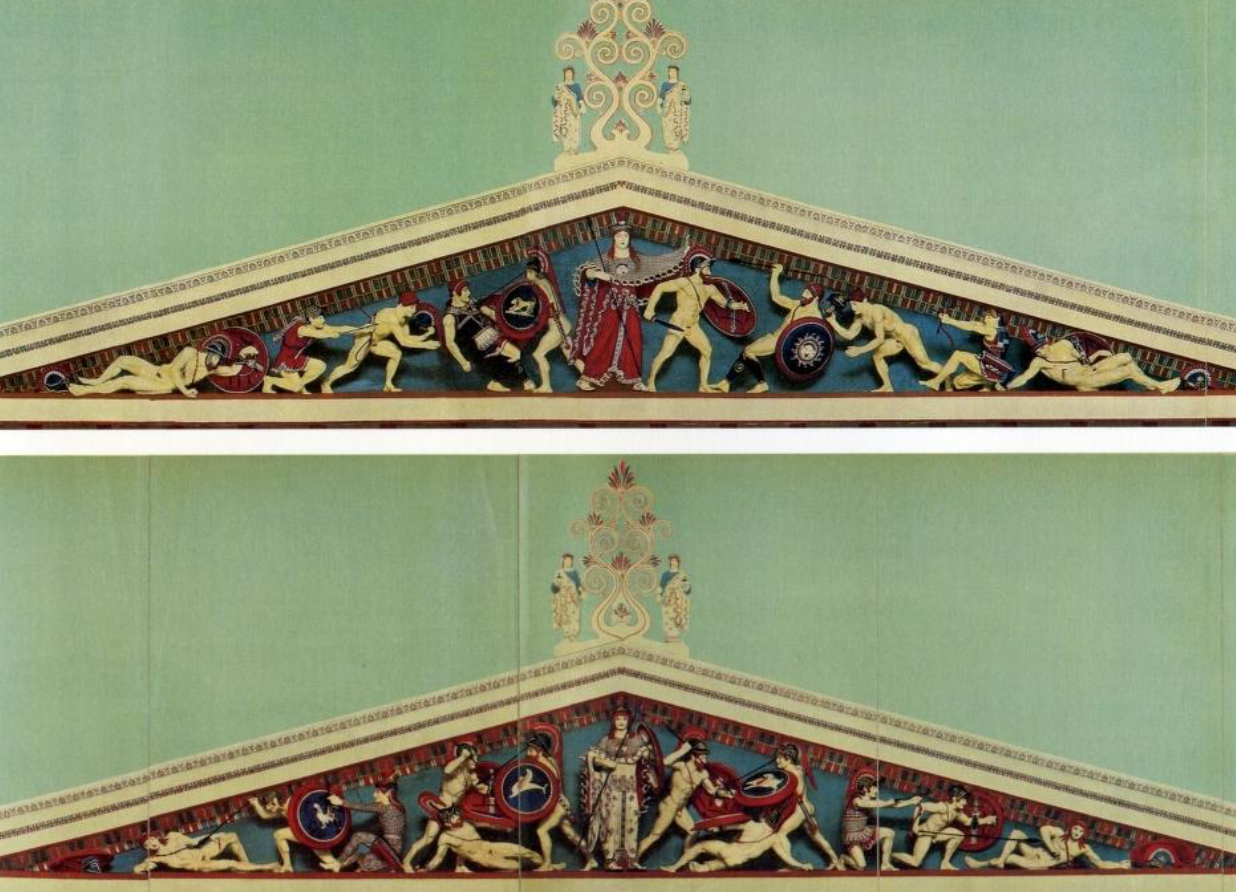
The east and west pediments of the Temple of Aphaia, Aegina
c. 500 – c. 480 BCE
shows new techniques to fit sculptures into triangles
more naturalism in warriors
late Archaic - more depictions of suffering

Kritios Boy, attributed to the sculptor Kritios, c. 480 BCE
height 1.17 m, Akropolis Museum, Athens
asymmetrical; weight shifted to one side
less rigid than Kouros figures
chiastic pose - pronounced in charioteers and clothed figures; engaged and free leg

The so-called Riace Warriors, found in the sea
at Riace, Italy, probably initially part of a
victory monument, Museo Archaeològico
Nazionale, Reggio Calabria, Italy
found at sea (why bronze survived)
cast in bronze from mold
naturalistic poses; different eye and teeth material
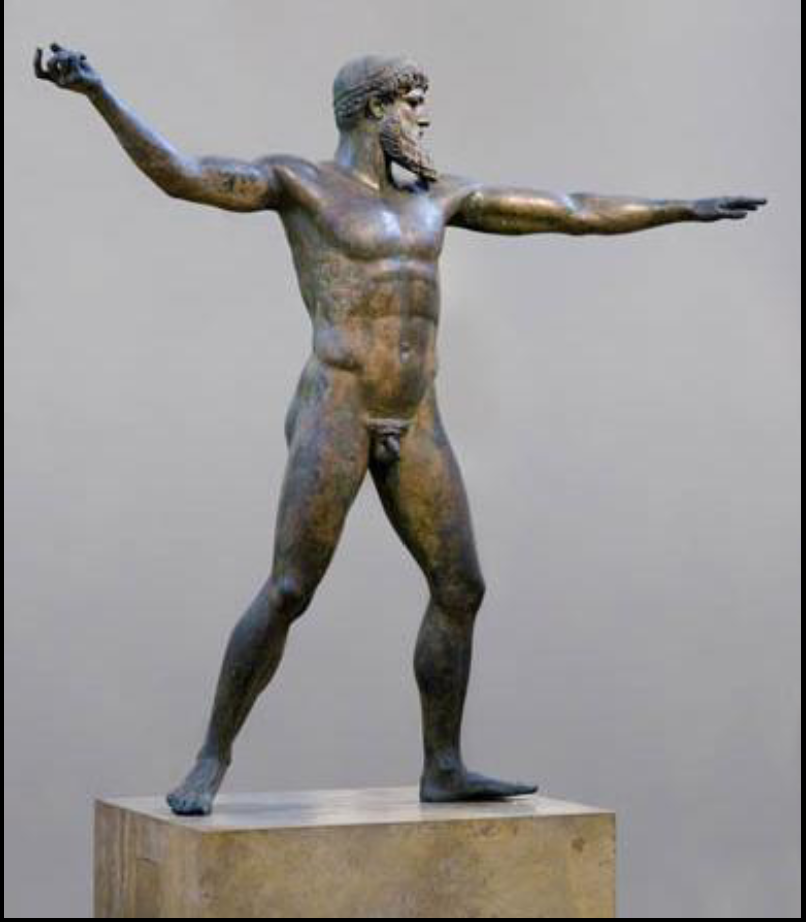
Zeus, bronze, c. 460-450 BCE, National
Archaeological Museum, Athens
power pose
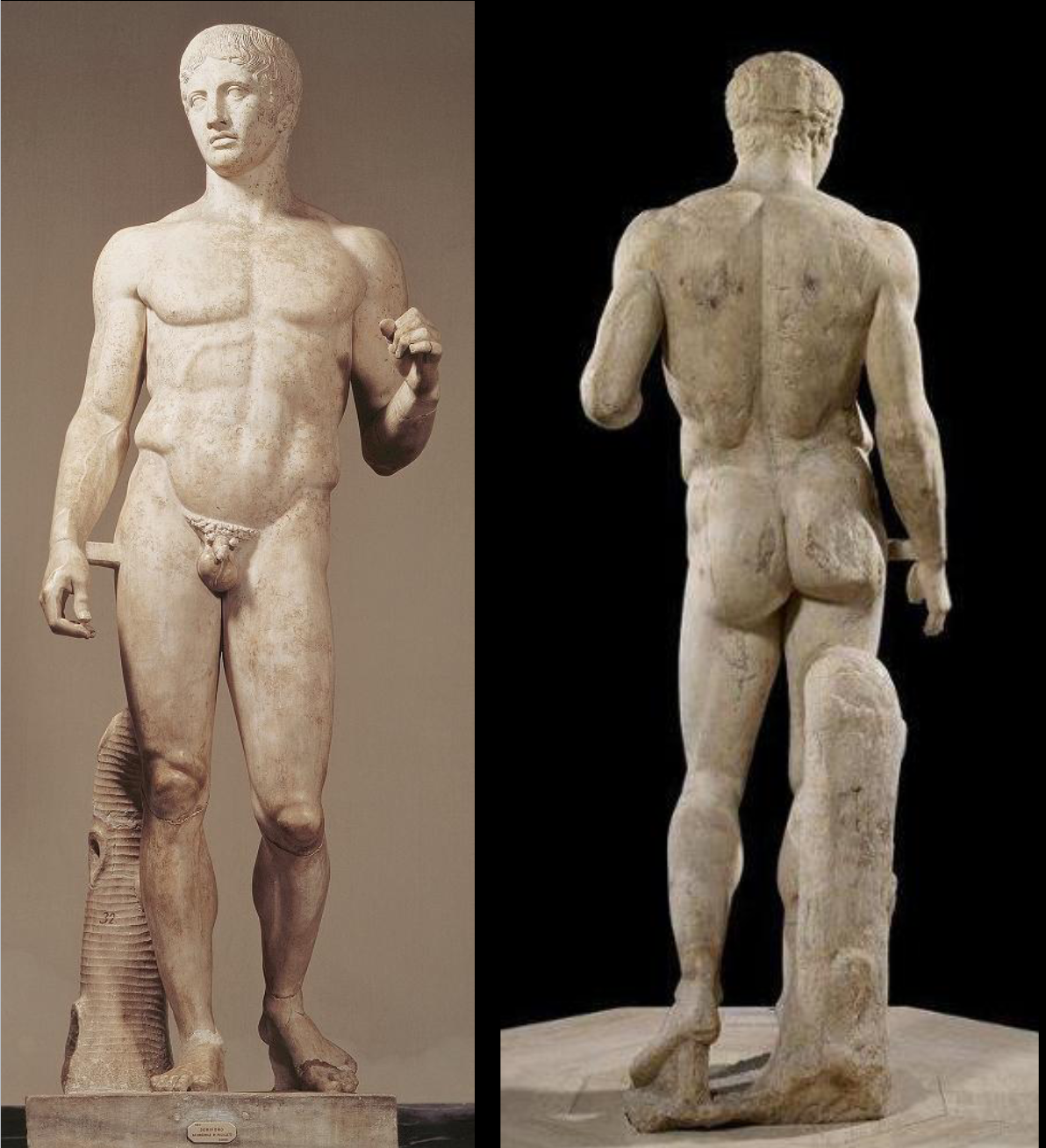
Doryphoros (spear-bearer), by Polykleitos
Roman marble copy after the original bronze of
c. 450 – 440 BCE
Museo Archaeològico Nazionale, Naples, Italy
tree trunk and bracing strut are Roman additions
that would have been unnecessary in the bronze
original
chiastic pose = contrapposto
head turned, taking a step

Aphrodite of Knidos, Roman marble copy after bronze
original of c. 340-330 BCE by Praxiteles
Musei Vaticani, Rome
first nude statue of a goddess
preparing to bathe
emotional/physical engagment
most women were clothed prior in statue
kylix
wine-drinking cups for symposiums