allied health - tissues
 Call Kai
 Learn
 Practice Test
 Spaced Repetition
 Match
 Flashcards
 Knowt Play
1/44

There's no tags or description
Looks like no tags are added yet.
45 Terms
simple cuboidal
Function: Secretion and absorption
Found in kidneys tubules, ducts and covering the ovaries

skin is a type of
epithelial tissue
four types of tissue
epithelial, connective, muscle, nervous
tissue
a group or mass of similar cells working together to perform common functions
epithelial tissue
- Covers all body surfaces both inside and out.
- Main glandular (glands) tissue.
- Attached to underlying connective tissue at the basement membrane
- Usually has no vascular tissue (no blood supply)
- Cells reproduce rapidly, results in rapid healing (and scarring)
- Cells tightly packed together
what is the largest organ in the human body?
skin
function of epithelial tissue
protection, secretion, absorption, excretion, senses
How are epithelial tissues classified?
shape and number of layers
simple
single layer

stratified
multiple layers

squamos
flat

cuboidal
square

columnar
taller than wide

basement membrane
Cells at the base of an epithelial layer are attached to this

simple squamous
Form: Single layer, Flat and thin
Function: diffusion and filtration. Air sacs in lungs, capillaries
- in the lining of lungs

simple columnar
Function: Secretion and absorption
Found in digestive tract and uterus
*Contains scattered goblet cells to secrete mucus
*Can have microvilli to increase surface area

stratified squamous
- Multi layer squamous
- functions in protection
- Found lining body cavities; skin and mouth

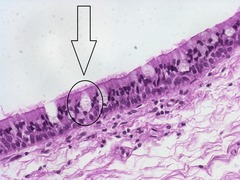
pseudostratified columnar
- Appear stratified, but just a single layer of cells, nuclei at different levels
- Can have cilia (hair-like projections) and goblet cells
- Function: Secretion and cilia-aided movement
- Location: lining air passages and tubes of the reproductive system

transitional epithelium
- Stretchable
- Blocks diffusion (no leaking)
- Found in the urinary bladder

goblet cells
secrete mucus
connective tissue (function)
-Binds structures together
-Provides support, protection, framework, fills space, stores fat, produces blood cells, fights infection
connective tissue is composed of
-Composed of more scattered cells within matrix
-Made up of a ground substance and fibers (most have a good blood supply)
most abundant tissue in the body
connective tissue
collagen fibers
found in bones, ligaments and tendons
elastic fibers
found in ears, vocal cords
Loose Connective Tissue or Areolar Tissue
- Binds underlying organs to skin and to each other
- Forms delicate thin membranes throughout the body

Adipose Tissue (fat)
- Protective cushion
- insulation to preserve body heat
- Stores energy

Fibrous Connective Tissue
- Tendons = muscles to bones
- Ligaments = bones to bones
- in dermis of skin
- has collagens that are closely packed
- functions in support

cartilage
- type of dense connective tissue
- Cartilage cells are called chondrocytes

hyaline cartilage
- Location: covers ends of joints, nose and respiratory passages, serves as padding

elastic cartilage
Location: external ear, larynx
Function: flexible support
Fibrocartilage
Tough, shock absorbing
Location: Between vertebrae
muscle tissue
smooth, skeletal, cardiac
cardiac muscle tissue
only in heart, involuntary

skeletal muscle tissue
striated, voluntary, attached to bones

skeletal muscle tissue function
- voluntary movement, posture
smooth muscle tissue function
- involuntary movement (ie. peristalsis)
cardiac muscle tissue function
as it contracts, it propels blood into the circulation; involuntary control
smooth muscle tissue
involuntary, in intestines

nerve tissue
Neurons - transmit signals (via Axons & Dendrites)
Neuroglia - support cells
- in spinal cord

nervous tissue is found in
brain, spinal cord, nerves
dendrite
a short branched extension of a nerve cell, along which impulses received from other cells at synapses are transmitted to the cell body.

axon
A threadlike extension of a neuron that carries nerve impulses away from the cell body.

melanocytes
cells that produce melanin

Keratinocytes
The most abundant epidermal cells, they function mainly to produce keratin.