OCD
 Call Kai
 Learn
Learn Practice Test
 Spaced Repetition
 Match
Match Flashcards
 Knowt Play
1/14

There's no tags or description
Looks like no tags are added yet.
Name | Mastery | Learn | Test | Matching | Spaced | Call with Kai | Chat |
|---|
No analytics yet
Send a link to your students to track their progress
15 Terms


What are the criteria for OCD (3)
What are obsessions?
What are compulsions
What are the different specifiers
Criteria for Obsessive- Compulsive Disorder
Obsession or compulsions or both
PT realizes excessiveness/unreasonable
obsessions or compulsions are time-consuming or causes distress/impairments
Obsessions
Recurrent/persistent thoughts, urges or images that are intrusive/ inappropriate -> anxiety or distress
Pt attempts to ignore/suppress/neutralize
Compulsions
Actions pt feels driven to perform in response to obsession or rigid rules
Actions aimed at preventing/reducing anxiety/distress or preventing dreaded event
No logical connection or logical excess
Specifiers:
Good/fair insight
Poor insight
absent/delusional beli
Biological findings?
Biological Findings
Dysfunction @ Corticostriatal circuit
Orbitofrontal cortex
Caudate nuclei
Globus pallidus
Also maybe @ basal ganglia
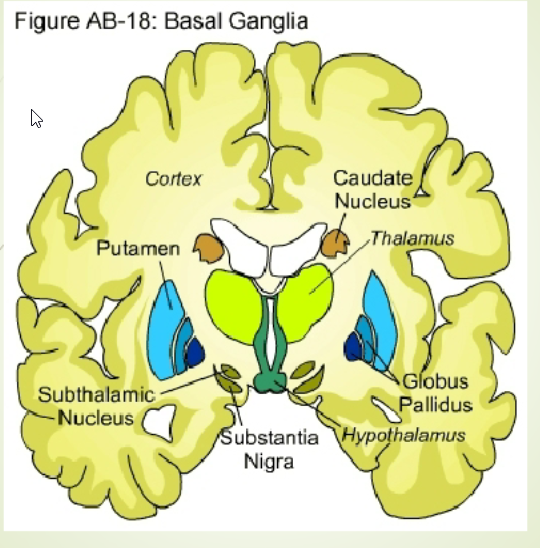


What are the biological findings
Patterns of Anxiety?
Panic attacks
Anticipatory anxiety
Typical cognitions
Typical physical symptoms
Typical behaviors
Biological Findings
Dysfunction @ Corticostriatal circuit
Orbitofrontal cortex
Caudate nuclei
Globus pallidus
Also maybe @ basal ganglia
Pattern of Anxiety
Panic attacks
If present, related to obsessive fears
Anticipatory anxiety
For situations that trigger obsessions or compulsions
Typical cognitions
Obsessive fears of contamination, causing harm to others, not doing something “just right”
Typical physical symptoms
Nonspecific
Typical behaviors
Washing/cleaning, checking, ordering, avoiding contaminants
What are the treatments of OCD?
First line: 4
Second line: 1
OCD: Treatment
First-line
SSRI’s
Clomipramine
Cognitive-behavioral therapy
Exposure therapy
Fear and avoidance hierarchy
Family therapy
Second-line
Atypical antipsychotic augmentation
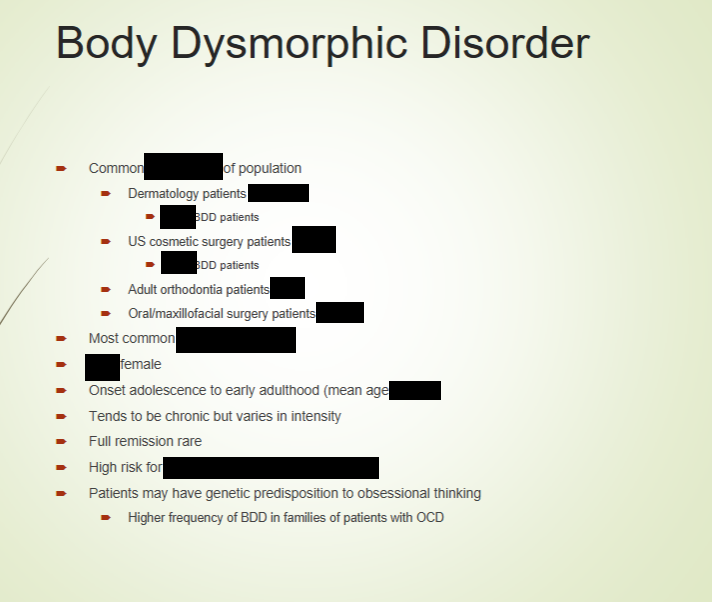
What are the Dx criteria for Body Dysmorphic Disorder (3)
Specifiers?
How to treat
Body Dysmorphic Disorder Diagnosis Criteria
Preoccupation with perceived defects or flaws in physical appearance
Benign or not observable to others
Pt performed repetitive behaviors or mental acts in response to perception
Causes clinically significant distress/impairment
Specifiers
With muscle dysmorphia
Preoccupation with small or insufficiently muscular body build
With good or fair insight
With poor insight
With absent insight/delusional beliefs
How to treat:
Express empathy and instill hope
Education
Focus on suffering and impact on life
First-line treatments:
CBT:
SSRI’s
No evidence for efficacy with antipsychotics
Don’t refer to a plastic surgeon

Describe Hoarding Disorder
Dx criteria
Tx
Focuses on?
Plans?
Hoarding Disorder
Dx Criteria:
Persistent difficulty discarding possessions
Regardless of value
Difficult b/c perceived need to save items + distress discarding
Causes sig. distress or impairment
Tx:
Focuses on:
Excessive acquisition
Difficulty discarding
Disorganization/Cluttering -> impairs function
Plans:
CBT
Thoughts and feelings about not acquiring things
Avoidance of anxiety due to lack of object
Test what will happen if does not acquire
Thoughts and feelings about getting rid of possessions
Avoids anxiety about being less than perfectly prepared
Testing of predictions about how this will feel
Data very limited on psychopharmacological interventions
Maybe SSRIs


Describe Trichotillomania
Dx criteria
Tx (4)
Trichotillomania
Dx Criteria:
Recurrent pulling of hair -> hair loss
Has repeated attempts to stop behavior
Sig. distress/impairment
Tx:
Behavior therapy
Self-monitoring
(habit record)
Habit reversal
(apply barriers to hairpulling)
FIRST LINE TREATMENT
Meds:
Clomipramine
most promising
N-acetylcysteine
(glutamate modulator)
Memantine
olanzapine
Cog. Therapy
Correct faulty beliefs about self; improve self-esteem
Hypnosis


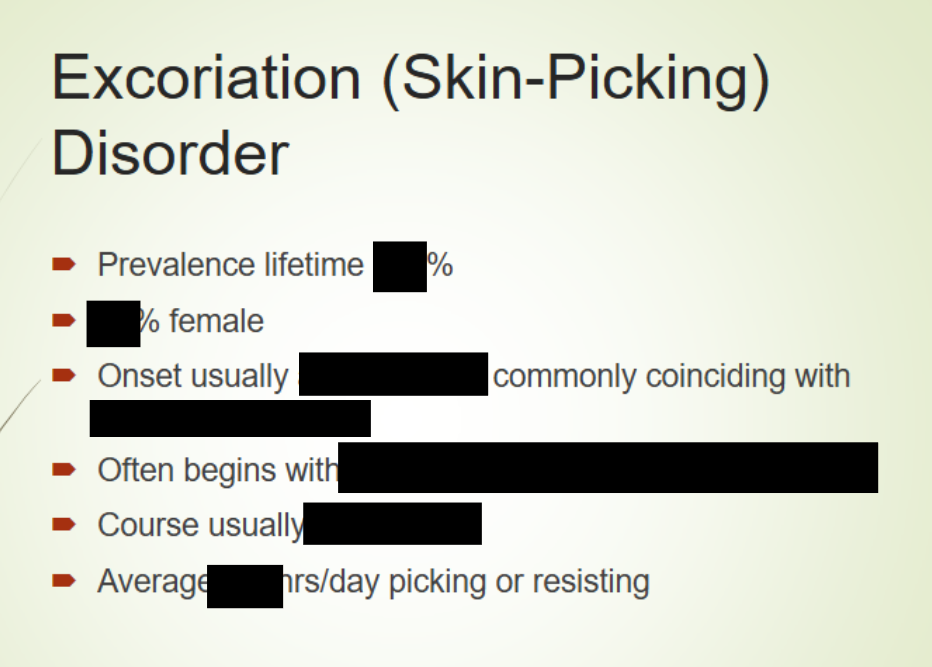
Describe Excoriation Disorder
What is it?
Tx (4)
Excoriation Disorder
What is it?
Recurrent skin picking -> lesions
Attempts to stop
Sig. Distress
Tx:
Meds
SSRI’s
lithium, gabapentin, olanzapine
Low dose doxepin (cyclic AD) may help
Behavior therapy
Self-monitoring
Habit reversal
Cog Therapy
Hypnosis

Describe PANDAS
AKA
What is it?
Labs
MOA
Tx
PANDAS
AKA:
Pediatric Autoimmune Neuropsychiatric Disorder Associated with Streptococcal Infection
What is it:
Strep infection -> OCD/Tics/Basal Gang. Dysfunction
Glabellar tap reflex
Tongue movements
Milkmaid’s grip
Choreiform movements
Labs:
Positive anti-streptococcal antibody titer
MOA:
Unknown; possible ABs interfere w/ basal ganglia function
Tx:
SSRI
CBT