GEO 102: Earthquakes and Earth's Interior
 Call Kai
 Learn
 Practice Test
 Spaced Repetition
 Match
 Flashcards
 Knowt Play
1/29

There's no tags or description
Looks like no tags are added yet.
30 Terms
Understanding Earth’s Interior: Astronomy
Used the average acceleration of the Earth to figure out average density
Kimberlite Pipes
Narrow, vertical, pipe-shaped bodies of rock that form deep in the mantle, at depths between roughly 150 and 450 kilometers, and rise toward the surface very rapidly and violently
Xenoliths
Fragments of the rock from deep below the Earth carried upward by kimberlites
Ophiolite
A slice of oceanic crust and the upper mantle beneath it that has been lifted up onto a continent
Understanding Earth’s Interior: Earthquakes
By far the most powerful tool for probing the Earth’s interior
Vibrations of Earth produced by rapid release of energy
Energy release due to plate tectonics and fault zones
Energy radiates in waves from the source (focus)
Epicenter: surface expression of the focus
Elastic Rebound Theory
Two blocks of rock along a fault are forced past each other; they bend and store energy
When the stress finally exceeds the strength of the rock, the fault slips suddenly and the rock snaps back toward its original shape
Elastic Region: Once stress is removed object returns to original size/shape
Plastic Region: permanently deformed by the stress
Where Earthquakes Occur
Divergent boundaries: where plates pull apart, earthquakes are frequent but shallow and modest in size (mid ocean ridges)
Transform boundaries: where plates grind horizontally past each other, earthquakes are shallow but can be large
Convergent boundaries: where one plate is forced beneath another, most powerful earthquakes of all
Benioff Zone
Slopping band the earthquake foci trace
Begins shallow at the ocean trench and follows the descending slab down as deep as 700 kilometers
Intraplate Earthquakes
Earthquakes that occur within the stable interior of a plate
Usually along ancient faults buried beneath younger rock
EX: New Madrid Seismic Zone- where Missouri, Tennessee, Arkansas, and Kentucky meet in the Mississippi River valley
Understanding Earth’s Interior: Drilling
Crust is around 40 kilometers thick
Deepest hole ever dug was 12km deep
Kola Superdeep Borehole (in Russia)
Had to abandon the project because drill was melting
Body waves
Travel through the interior, or body, of the Earth, and because they sample the deep planet they are the waves that reveal its structure
P and S Waves
Surface waves
Travel along the surface, like ripples spreading across a pond, and although they cause much of an earthquake's destruction, they tell us less about the deep interior
Primary Waves (P-Waves)
Compressional (particle motion parallel to wave propagation)
Travel through all materials
Fastest wave
Smallest amplitude
Moves by alternately compressing and expanding the material it travels through, so the rock vibrates back and forth in the same direction the wave is moving, much as a sound wave travels through air
Secondary Wave (S-Wave)
Shear waves (particle motion perpendicular to wave propagation) (moves the rock from side to side, at right angles to the direction the wave is traveling)
Only travel through solids
Second to arrive at seismic station
S waves shake the ground more strongly than P waves and cause much of the damage in an earthquake
They have one property that turns out to be extraordinarily useful for studying the interior: an S wave can travel only through solids
Surface Waves
Travel along the ground itself
Love waves and Rayleigh waves
Cause the most damage
Can move in all directions
Most damaging waves
Last to arrive at seismic station
Greatest amplitude
travel more slowly than body waves and arrive last, but because their energy is concentrated near the surface they often produce the most violent shaking and the greatest damage to buildings
Love Waves
move the ground from side to side in a horizontal, snaking motion,
Rayleigh Waves
roll the ground in a circular, up-and-down motion, like an ocean swell passing beneath a boat
Wave Speed & Rock
Loose, water-logged sediment and soil carry seismic waves slowly
Sedimentary rocks such as sandstone and shale are faster, solid crystalline rocks such as granite and basalt faster still, and the dense rock of the mantle faster than any rock found at the surface
Wave speed also increases with depth, because the growing pressure squeezes rock into a stiffer, denser state
A sudden jump in wave speed marks a boundary between two kinds of rock, and this is exactly how the base of the crust was first detected
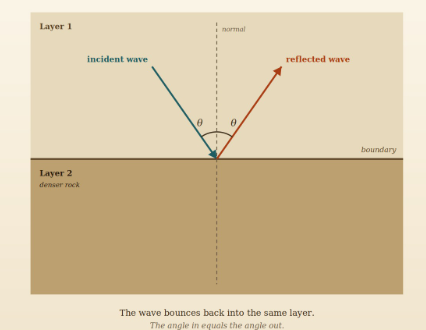
Reflection
When a seismic wave meets such a boundary, part of its energy bounces back
The return of a wave off a boundary, much as light reflects from a mirror
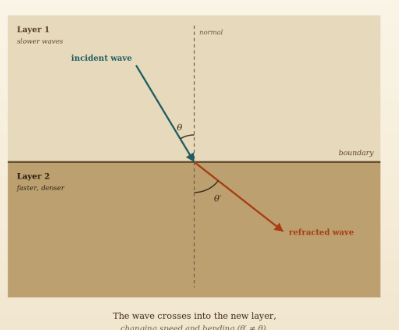
Refraction
When a seismic wave meets such a boundary part of its energy continues onward in a new direction
The bending of the wave that continues across the boundary, a change in the direction and speed of a wave as it passes from one material into another
Locating Earthquakes
Three recording stations used to pinpoint epicenter
A station close to the earthquake records the P and S waves arriving close together; a distant station records a long gap between them
The size of that gap tells a recording station how far away the earthquake was, though not in which direction
Seismic Shadow Zones
The vast S-wave shadow is therefore direct proof that a large part of the Earth's interior, the outer core, is molten. A single missing wave reveals a liquid layer thousands of kilometers down
The existence and exact width of the P-wave shadow zone reveal both the size of the core and the depth of its boundary with the mantle
Measuring Earthquake Size
Three Scales:
Richter: records amplitude of seismic waves ( a measure of energy); logarithmic, no fixed limit
*Moment Magnitude: records energy from fault area and slip, based on energy and physical observations (best for large quakes) (logarithmic, no fixed limit)
Mercalli: records intensity of shaking and destruction at a place (I to XII)
Richter Scale
Magnitude (energy)
Measures amplitude of largest wave
1 digit increase is a 30-fold increase in energy
Mercalli index
Assesses damage
Based on human observation

Moment Magnitude
Based on energy released and physical observations
Each step up the scale means about 10 times stronger shaking and about 32 times more energy released
A magnitude of 7 unleashes roughly 1,000 times the energy of a magnitude 5
Anything <3 is not felt by humans
More low magnitude earthquakes than high magnitude
Tsunamis
Waves created by earthquakes
Move at speeds between 500 and 950 km/hr (300-600 mil/hr)
Waves reach height of over 30 meters (100ft)
Occur near subduction zones/ fault lines
Liquefaction
Pores of sand contain liquid, when pressure increases liquid pushes grains apart
Sand is no longer solid, acts like a fluid
Quicksand
Time Interval Analysis
Statistics is used to generate a “best-fit line” which can be used to predict the time of the next earthquake
Not reliable; earthquakes are not linear
Seismic Gaps
Areas that have had earthquakes recently are less likely to have them again because the energy has already been released
Why this is unreliable:
Smaller earthquakes can release stress so larger more devastating earthquakes don’t occur