Brain regulation, Coordination & protection
 Call Kai
 Learn
 Practice Test
 Spaced Repetition
 Match
 Flashcards
 Knowt Play
1/59

There's no tags or description
Looks like no tags are added yet.
60 Terms
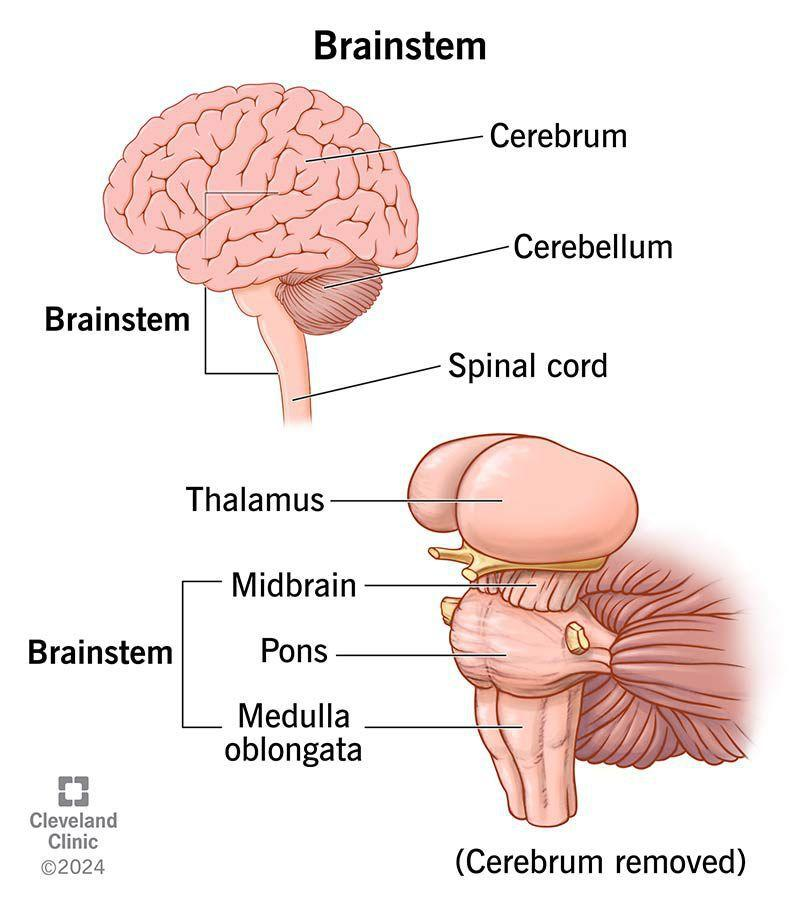
thalamus
Relays most sensory information to the cerebral cortex and helps regulate attention and awareness. doesn’t include smell.
Hypothalamus
Maintains homeostasis by regulating temperature, hunger, thirst,sleep and autonomic nervous system and pituitary hormone release.
epithalamus
contains the pineal gland, which secretes melatonin to help regulate circadian rhythms
Amygdala
process emotional significance, especially fear and threats
hippocampus
forms new declarative memories
hypothalamus
coordinates bodily and hormonal responses associated with emotions

midbrain
visual and auditory reflexes, eye movements and movement regulation

Pons
Helps adjust breathing rate and depth

Medulla oblongata
Regulates heart rate, blood vessel activity, basic breathing rhythm and protective reflexes

reticular formation
helps maintain wakefulness, alertness, consciousness, and sensory attention
basic nuclei
help select desired movements and suppress unwanted movements (movement selection)
cerebellum
refines movements, timing, balance , posture, and motor learning
( movement correction)
parkinsons disease
associated with basal nuclei circuits
cerebellar ataxia
involves impaired coordination and balance
meninges
three protective membranes surrounding the brain
Dura mater, arachnoid mater, and pia mater
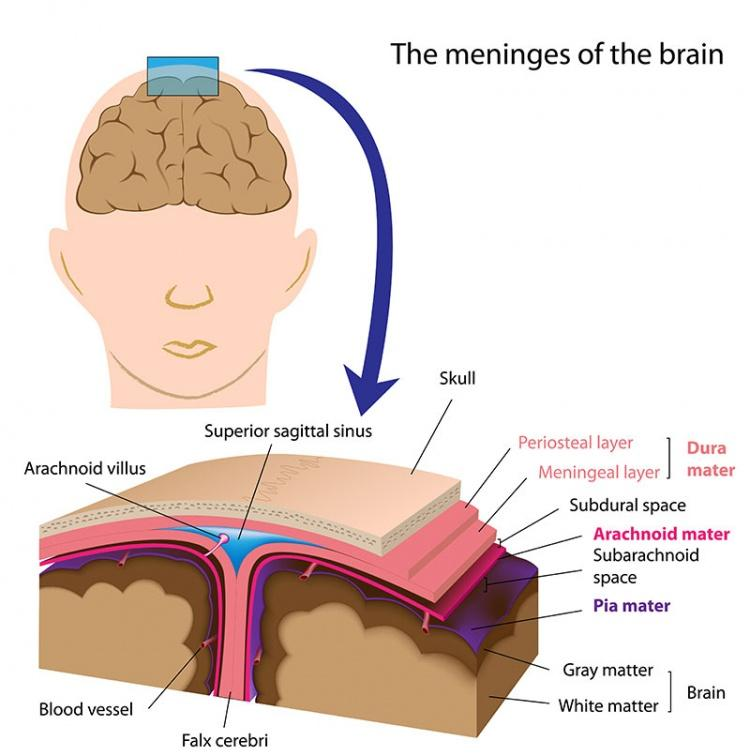
Dura matter
tough outer layer of brain protection

Arachnoid mater
middle layer of brain protection: middle layer, CSF circulates beneath it in the subarachnoid space

Pia matter
Delicate inner layer that follows the brains surface in brain protection
cerebrospinal fluid (CSF)
provides Buoyancy, reducing the brains effective weight
helps cushion the brain and spinal cord
helps maintain chemical stability
Hydrocephalus
CSF accumulates because circulation is blocked or reabsorption is impaired. This can enlarge the ventricles and increase intracranial pressure (ICP).
inter-cranial pressure
The skull is rigid, so swelling, bleeding, or excess CSF can raise pressure, reduce blood flow, and decrease oxygen delivery to brain tissue.
Blood - Brain barriers
Tight junctions: Restrict movement between capillary endothelial cells.
Glucose: Enters using transport proteins.
Oxygen and carbon dioxide: Diffuse readily.
Astrocytes: Help maintain the barrier.
Some medications, toxins, and pathogens are restricted from entering.
BBB ( blood brain barrier )
selectively controls which substances enter brain tissue
Stroke (CVA)
Blood supply is interrupted or bleeding occurs within the brain, potentially damaging brain tissue.
TIA
A A transient ischemic attack is a brief episode of disrupted blood flow.
Symptoms depend on the affected brain region. Examples include difficulty swallowing, weakness, dizziness, abnormal breathing, and poor coordination.
The hypothalamus coordinates responses that keep the body's internal environment stable this includes
Body temperature: Activates heat-loss or heat-
conserving responses
• Water balance: Regulates thirst and ADH release
• Autonomic control: Influences heart rate, blood
pressure, and digestion
• Endocrine control: Regulates pituitary hormone
secretion
• Biological rhythms: Helps regulate sleep–wake
cycles and hunger
Limbic system
includes the amygdala, hippocampus and hypothalamus and is focused on linking emotion, memory and physiology
Midbrain
connects sensory information and movement
Visual reflexes ( superioir conculi) , adutitory reflexes (inferior conculi), motor regulation , eye movements using midbrain nuclei.
Arousal & wakefulness:
Ascending pathways help
maintain alertness and consciousness.
Sensory filtering:
Helps regulate which incoming
stimuli receive attention.
Motor & autonomic regulation
Descending pathways
contribute to posture, muscle tone, and autonomic
functions.
Basal Nuclei
Selecting and regulating
movement
• Help initiate desired
movements
• Suppress unwanted movements
• Contribute to automatic,
learned motor patterns
• Clinical example:
• Parkinson's disease
cerebellum
Refining and correcting
movement
• Coordinates timing and
precision
• Maintains balance and
posture
• Corrects movement errors
• Clinical example:
• Cerebellar ataxia
Hydrocephalus:
When CSF Accumulates
Blocked circulation or impaired
reabsorption causes CSF to accumulate; ventricles enlarge, potentially
increasing intracranial pressure (ICP),Headache, nausea/vomiting, and
changes in mental status
Intracranial Pressure (ICP):
Limited Space, Serious Consequences
Swelling, bleeding, or CSF accumulation, increased intracranial pressure (ICP) , reduced blood flow, Decreased oxygen delivary and nueronal dysfunction
Movement and coordination
Basal nuclei regulate movement selection; cerebellum refines coordination, precision and balance
Regulation & Homeostasis
Hypothalamus regulates internal conditions; brainstem controlls vital functions like breathing and blood pressure
Protection and stability
Meninges provide physical protection,CSF cushions the CNS , and the blood-brain barrier selectively regulates entry of substances
Two cerebral hemispheres
separated by the longitudinal fissures with surface folds that increase the area for the cerebral cortex. the two hemispheres are connected by the corpus callosum.
frontal lobe
Voluntary movement, planning, decision-
making, personality, speech production
parietal lobe
Processing touch, pressure, temperature,
pain, and spatial awareness
temporal lobe
Hearing, memory, language comprehension
occipital lobe
visual processing
Insula
Taste, visceral sensation, and integration of
internal body signals
Motor areas
produce movement and control voluntary skeletal movements.
sensory areas
Receive information
Allow conscious awareness of sensations such as touch,
vision, and hearing.
Association areas
Interpret and integrate
Combine information with memories and experiences to
guide behavior.
Motor homunculus
Larger cortical areas are devoted to body regions requiring precise, fine
movements.
Sensory homunculus
Larger cortical areas are devoted to body regions with greater sensory
sensitivity.
Sensory association areas
Interpret sensory input, allowing us to
recognize what we see, hear, or feel.
Motor association areas (premotor cortex)
Plan and coordinate learned, skilled
movements.
Prefrontal cortex
Supports judgment, planning, decision-
making, and working memory
Brocas’s area
speech production
Usually in the left frontal
lobe
•Helps plan the movements
needed for speech
•Damage: slow, effortful
speech with relatively
preserved comprehension
Wernicke’s area
Language comprehension
•Usually in the left posterior
temporal region
•Important for understanding
language
•Damage: fluent but often
nonsensical speech with
impaired comprehension
Association fibers
Connect cortical regions within the same hemisphere
Commissural fibers
connect the left nd right hemispheres
Projection Fibers
Connect the cerebral cortex with
deeper brain regions and the
spinal cord
Gray matter
process information
White matter
provides pathways for communication