Lecture 4: Essentials Neural Coding
 Call Kai
 Learn
Learn Practice Test
 Spaced Repetition
 Match
Match Flashcards
 Knowt Play
1/21

There's no tags or description
Looks like no tags are added yet.
Name | Mastery | Learn | Test | Matching | Spaced | Call with Kai | Chat |
|---|
No analytics yet
Send a link to your students to track their progress
22 Terms
What are spike trains?
Sequences of Action Potentials
What are the main topics of neural coding?
1. Statistic models of spike trains
2. Measuring Firing Rates
3. Reverse correlation analysis
What do measurements of neural responses look like? How do they vayr based on where they are collected from?

EPSPs and IPSPs are ____ signals.
analog
How is neural data processed?
Raw Data → Filtered Data → Spike Train
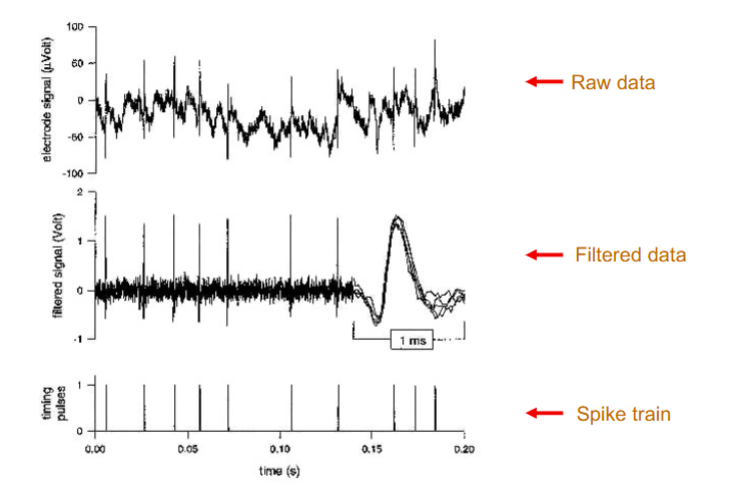
What is the neural response function?

Spike trains can be modeled as a _____ process.
Poisson

In Poisson process, what does Spike Count corrspond to? How about Inter-Spike Interval?
Spike count: Poisson Distribution
Inter-Spike Interval: Exponential Distribution

_____ periods modify the Poisson process model
Refractory

The randomness of a spike train can be measured by ____ ___ _____
“coefficient of variation (CV)”

How to simulate a Poisson Process?
General Method:
If u is a random variable of uniform distribution [0, 1], and F(t) is the
probability distribution function of random variable τ, then
w=F-1(u) is a random variable with probability distribution function F(t).
![<p></p><p>General Method:</p><p>If u is a random variable of uniform distribution [0, 1], and F(t) is the</p><p>probability distribution function of random variable τ, then</p><p>w=F-1(u) is a random variable with probability distribution function F(t).</p><p></p>](https://assets.knowt.com/user-attachments/f9470478-5904-42d9-9b9f-a05687b0e286.png)
What is the best measure of spike train?
Inter-Spike Interval (ISI) Histogram
____ _____ ____ (or ____ _____ ____) is a function of the time window used in the calculation.
Average discharge rate (or mean firing rate)

Spikes trains encode the information about a sensory stimulus
in the form of ____ or __ ____ pattern
Spikes trains encode the information about a sensory stimulus
in the form of discharge rate or temporal discharge pattern

What is discharge rate?
How many spikes per unit of tim
How to make a period histogram?

Diff between Period and Peristimulus Histogram?
Period histogram starting reference is beginning of period, while PSTH is the beginning of the recording.
What is phase-locking?
Phase locking is a process where neurons synchronize their electrical firing (spikes) to a specific phase or point of a repeating external wave, such as a sound wave. [1]
Instead of firing randomly, a neuron will fire action potentials at the exact same part of the cycle over and over again. It usually does not fire on every single cycle, but when it does fire, it locks into that specific timing
What is used to ensure the measured phase locking is statistically significant?
Circular Statistics

Why does Phase Locking Matter for Neural Coding?
Phase locking matters for neural coding because it allows neurons to represent the precise timing of sensory stimuli rather than just their overall firing rate
Phase-locking in a spike train can be quantified by
_____ _____ (___ ___)
Phase-locking in a spike train can be quantified by
synchronization index (vector strength)

What is Reverse Correlation
Reverse correlation is another name for calculating the spike-triggered average (STA). It is a powerful data-analysis method used in neuroscience to figure out what kind of sensory input makes a neuron fire an electrical impulse, or spike.
Normally, an experimenter controls a stimulus and watches how the neuron reacts. Reverse correlation does the opposite (hence "reverse"): it looks at the output (the spikes) and works backward to see what the input looked like right before the spike happened. [1, 2]
![<p><span><strong>Reverse correlation</strong> is <mark>another name for calculating the </mark><strong><mark>spike-triggered average (STA)</mark></strong>. It is a powerful data-analysis method used in neuroscience to figure out what kind of sensory input makes a neuron fire an electrical impulse, or <strong>spike</strong>.</span></p><p></p><p><span>Normally, an experimenter controls a stimulus and watches how the neuron reacts. Reverse correlation does the opposite (hence "reverse"): it looks at the output (the spikes) and works backward to see what the input looked like right before the spike happened.</span> [1, 2]</p>](https://assets.knowt.com/user-attachments/a5762bbc-4f8d-4dab-9393-c48222cb792a.png)