Biomaterials Exam 1 (ch 1-3)
 Call Kai
 Learn
Learn Practice Test
 Spaced Repetition
 Match
Match Flashcards
 Knowt Play
1/125

There's no tags or description
Looks like no tags are added yet.
Name | Mastery | Learn | Test | Matching | Spaced | Call with Kai | Chat |
|---|
No analytics yet
Send a link to your students to track their progress
126 Terms
Biomaterial
a material intended to interface with biological systems to evaluate, treat, augment, or replace any tissue, organ, or function of the human body.
Biomaterials science
the study of biomaterials and their interactions with the biological environment
1st generation of biomaterials were designed to be
inert
2nd generation of biomaterials were designed to be
bioactive\integration\interaction
3rd generation of biomaterials were designed to be
fully interactive/healing
what makes a implantable device successful (6)
Clinical issues:
biocompatibility
patient factors (health, anatomy, weight, physical activity)
Structural requirements
stress strain- material properties
Implant design
fits good w body
Material selection
Processing
machining/sterilization
Regulatory issues
FDA approval
FDA approval process (3)
biocompatibility analysis
simulated loading conditions
clinical trials
Def of biocompatibility
ability of a material to perform its designed function with respect to a medical therapy without eliciting any undesirable local or systemic effects in the recipient
biological responses of implants (6)
inflammation
immune system activation
localized blood clotting
infection
tumor formation
implant calcification
list important factors of biocompatibility and suitability (5)
type of material
shape of implant
material degradation characteristics
surface chemical properties
chemical and mechanical properties
biological response (most basic level to decide implant success)
the protein and cellular responses to the material determine the overall success of the implant
what are the four things that help classify a biomaterial
property
clinical application
structure
synthetic vs. natural
List the 3 types of biomaterials based on structure
metals
polymers
ceramics
metals/alloys advantages vs. disadvantages
Advantages
strength
conductive
machining
Disadvantages
not flexible
corrosive
toxins
expensive
ceramics advantages vs. disadvantages
Advantages
bone compatibility
porous
Disadvantages
fragile
brittle
hard to machine
polymers advantages vs. disadvantages
Advantages
flexible
ductile
versatile
custom design
easy to machine
Disadvantages
lack of strength
degradation
composites advantages vs. disadvantages
Advantages
many properties
Disadvantages
manufacturing process
has weaknesses
can separate

crystaline
atoms are arranged in a periodic pattern resulting in long-range order

amorphous
lacks systematic atomic arrangement and can be considered to possess a molecular structure much more like that of a liquid
metals are what chemical structure
crystalline
crystal structures are described based on their
unit cell- the configuration of atoms in a small section of the crystal that is repeated in a 3D to form the material
crystal structure are compared based on their _____ and ______
coordination number- each atom in a crystal has a coordinate number equal to the number of nearest neighbor atoms
atomic packing factor- based on the atomic hard sphere model, depicting each atom as a sphere requiring a fixed volume

FCC structure
atoms are located at each of the corners as well as the center of each face
coordination number- 12
APF- 0.74
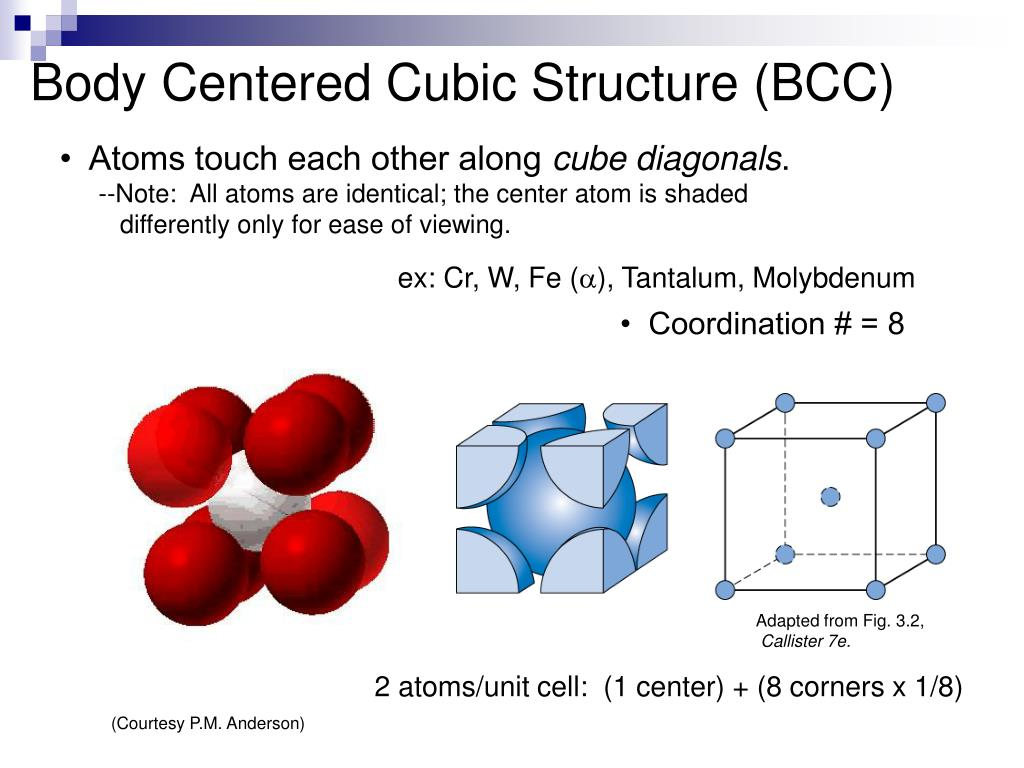
BCC structure
atoms at all 8 corners and a single atom at the center of the cube
coordination number- 8
APF- 0.68
which is denser FCC or BCC
FCC
point defects
involves only one or two atoms in a crystal

common types of point defects
vacancy- found at a lattice site where an atom would normally be present but is missing
self-interstitial- occurs when an atom from the crystal is crowded into the interstitial space between 2 adjacent atoms
Impurities
can be an artifact of material processing or can be added deliberately to alter the final properties of a material
solid solution
formed if the normal crystal structure is maintained upon addition of the impurity atoms
example: metal alloy
liquid solution
host material is the solvent while the impurity is the solute

types of liquid solutions
interstitial solutions- fill spaces between solvent atoms
substitutional solution- tales the place of the solvent atoms
concentration of an alloy can be described as the
weight percent composition
ceramic structures of thought to be composed of ____ rather than atoms
ions
ceramic crystal structure is affected by two parameters
magnitude of electrical charge on constituent ion'
physical size of ions
an ions coordination number refers to the number of
nearest neighbors with opposite charges
certain ratios will _____ between cations and anions producing______
not allow close contact, unstable structures
the ____ cations and anions are, the more stable
closer
point defects- ceramic structure
individual point defects do not occur instead groups of defects are formed:
miss an anion → also miss a cation (equal charge)

types of ceramic structure point defects
Schottky- vacancies in both cations and anions in the correct ratio to maintain neutrality
Frenkel- a vacancy pair is created to maintain electroneutrality
both Schottky and Fenkel defects can act as
stress concentrators
If rc~ra, which defect is more likely to occur
Schottky
what bond is the main constituent in polymers?
hydrogen-carbon bonds
mer
smallest building block (polymer)
equivalent to unit cell in metals
unsaturated
2 of carbons in repeat unit are bonded with double bonds
bifunctional
may bond with other mers on both ends
trifunctional
three active bonds that can bond with other mers
degree of polymerization
number of repeat units in a polymer usually indicated by the letter n in the chemical equation
the smallest possible value for polydispersity index (PI)
1
increases as the molecular weight distribution broadens
what plays a major role in the mechanical properties of polymers?
mer configuration
conformation
used to describe the part of the structure of a molecule that can be changed by rotation around a single bond
cant bend
bulky side groups and carbon double bonds prevent from rotation
configuration
the part of the structure of a molecule that cannot be changed except by the breaking down and reforming of primary bonds
cant change order

List 3 common types of configuration
isotactic- same side of chain
syndiotactic- alternate positions on either side of the chain
atactic- random

What structures can polymers resemble
linear- repeat units joined in an end to end fashion
branched- chains that branch off the main polymer chain
crosslinked polymers- adjacent chains are joined at certain points via covalent bonds, forming a 3D polymer network
network- have tri or multifunctional mer units that can bond monomers or other polymers into more complicated formations
polymerization
occurs through repeated chemical reactions that join individual mer units into a longer chain
types of polymerization
addition
condensation
genetic
addition polymerization
product contains same chemical structure as the original mer unit
steps:
initiation- activation of monomer through a rxn with either a radical species or anionic or cationic species
propagation- monomers continue to sucessfully join the polymer chain and increase its molecular weight
termination- free radical (PI>1) or anionic or cationic termination (PI~1)
condensation polymerization
involves more than one monomer species and no radical inhibitor is required
occurs through elimination of one molecule (usually h2o)
products do not have some chemical formular as either mer
PI>1
Longer process
chains of various lengths
Genetic engineering polymerization
the expression within a host organism of a genetic vector that encodes the protein polymer of interest
copolymers
2 or more repeat unit types

types of copolymers
random- no pattern
alternating
block-each type of repeated unit is clustered in regions of blocks alongside the chain
graft- homopolymer chains are attached to a main homopolymer chain containing a different repeat unit
which type of copolymer is more likely to form a crystal
block or alternating
methods of polymerization
bulk- only monomer and monomer-soluble initiator are present in the reaction
high yield and purity
difficulty with heat dissipation
Solution- reaction in water or an appropriate solvent with high thermal conductivity
no heat dissipation
monomer and inhibitor must be soluble in solvent
smaller yield
Suspension- monomer and initiators that are not soluble in water are added under stirring to a reactor full of water
formation of monomer droplets
high heat transfer
emulsion- the addition under stirring of a hydrophobic monomer, a water soluble initiator, and a surfactant to a reactor containing water
cant see droplets
gaseous- gas phase
solid-state- monomer in their crystalline state are polymerized through exposure to heat or irradiation
Plasma- in a plasma environment
highly uniform
Bulk Polymerization

solution polymerization

suspension polymerization

what affects polymers ability to form a crystal
polymers tacticity
degree of branching
what are the most important characteristics of crystals
the amount of dislocations
the type of dislocations

What is a type of edge dislocation that occurs when an extra portion of a plane of atoms terminates in a crystal
edge dislocations
for edge dislocations (linear) what are two important characteristics
magnitude and direction of atomic displacement
The burgers vector is ____ to the dislocation line in an edge dislocation
perpendicular

a linear defect that are caused by shear forces on part of the material that caused the displacement of a portion of the crystal
screw dislocation
The burgers vector is ____ to the dislocation line in a screw dislocation
parallel
dislocation cannot end in a _____ on a crystal, but instead on which a dislocation may move contains both the burger vector and the dislocation line
defect-free region
plastic deformation, caused by dislocations, occurs by
movement of dislocations
in crystals what is plastic deformation referred to as
slip
increased slip system causes more brittle or ductile properties in a crystal
ductile
does a metal object or ceramic object have more slip systems
metal object
atoms not bonded to the max number of neighbors that posses higher energy (surface free energy) than most in the crystal
external surface
the interface between randomly oriented grains is called a ___ and has high chemical reactivity
grain boundary
small angle grain boundaries (grains on either side of the boundary) include two types
tilt boundary- aligned edge dislocations
twist boundary- aligned screw dislocations
high angle grain boundaries are a more severe misalignment and the ____ the misorientation, the ____ the energy of the boundary
greater, higher
what special type of grain boundary only occurs when there is a mirror image of atomic placement across the boundary
twin boundary
what 3D defect occurs when long-range order of crystal is lost
volume defects/voids
voids are important to biomaterials because they create ___ that can alter to biological response of the material
pores
porogens can be either ___ or ___
solids or gases
percent crystallinity is highly dependent on the chemical structure of the mer. Anything that prevents chain alignment or discourages secondary bonding between chains will ___ the polymer crystallinity
reduce
What factors influence percent crystallinity (4)
mer side groups
chain branching
tacicity
regulatory of mer placement in copolymers
Do you expect branch polymer to have more or less crystallinity than one linear polymer?
less due to the branching
the basic unit of crystalline structure is the ____ which is larger than the polymeric crystal’s unit cell and contains a large number of polymer chains folded back on themselves.
lamella
spherulites are the 3D version of
lamella

characteristic thermal transition for crystalline materials is the
melting point

Amorphous ceramics have no distinct ___. As the temp decreases the material becomes more viscous until it is a ____. Above the temp, the material can be handled as a ____
Tm, solid, liquid
for a polymer if the Tm and Tg increases, so does the
molecular weight
in a polymer what is one of the major determinates of Tg
chain flexibility
the ability to crystalize above the Tg temp is known as
crystalline temp Tc
a polymer can be ____ by raising the temp of the sample to a Tc
annealed
a group of characterization techniques that involve the measurement of the physical properties of a material as a function of temp
thermal analysis
power compensated DC
used to keep thermal or mechanical conditions stable
heat flux dsc
measures thermal transitions by detecting the difference in heat flow between a sample and a reference as heat passes through a conductive plate.
endothermic
require energy to proceed and is positive