LECTURE 20 WORKSHEET: CYTOSKELETON, INTERMEDIATE FILAMENTS and MICROTUBULES.
 Call Kai
 Learn
 Practice Test
 Spaced Repetition
 Match
 Flashcards
 Knowt Play
1/100

There's no tags or description
Looks like no tags are added yet.
101 Terms
Which of the following statements about cytoskeleton is FALSE?
a) The cytoskeleton is made up of two types of protein filaments and one type of tubes.
b) Subunits are diffusible in cytosol when not organized into filaments or tubes
c) Protein monomers that are held together with covalent bonds form cytoskeletal filaments
d) The cytoskeleton of a cell can change in response to the environment
C (is false)
Which is the toughest and most durable of the three types of cytoskeletal structures?
a) Intermediate filaments
b) microtubules
c) actin filaments
d) they all have the same toughness and durability
A
Which of the statements below about intermediate filaments is TRUE?
a) They form non-structurally polar filaments
b) They can be found in the cytoplasm and the nucleus
c) They can be anchored to the plasma membrane at cell-cell junction
d) They are not directly responsible for generating intra-cellular movements.
e) All of the above
E
Which of the following statements about the cytoskeleton is TRUE?
a) The cytoskeleton provides a rigid and unchangeable structure important form the shape of the cell.
b) Actin filaments and microtubules, but not intermediate filaments, have an inherent structural polarity, which a plus(+) end that grows more quickly than the minus(-) end.
c) The three types of cytoskeletal filaments perform tasks in the cell and act completely independently of one another.
d) All cytoskeletal elements support motor protein function.
B
Which of the following describes the main function of intermediate filaments?
a) To provide tracks for guiding intracellular transport
b) To enable cell motility
c) The enable cells to withstand the mechanical stress that occurs when cells are stretched
d) none of the above
C
Microtubules emanating from the centrosome have some of their plus(+) ends attatched to the centrosome.
a) True
b) False
B) FALSE
Intermediate filaments are:
a) tube-like structures
b) spring-like structures
c) rope-like structures
d) mesh-like structures
C
The nuclear lamina disassembles and reassembles during cell division
a) True
b) False
A
Which of the following cytoskeletal structures extend out from a centrosome towards the cell periphery?
a) intermediate filaments
b) microtubules
c) actin filaments
d) none of the above
B
Increased levels of phosphorylation of the Tau protein leads to the decreased ability fro it to bind to and stabilize microtutubles in neurons
a) Ture
b) False
A
In a centrosome, which structures serve as nucleation sties for the formation of microtubules?
a) Tubulin protofilaments
b) Alpha/beta tubulin dimers
c) Gamma tubulin ring complexes
d) Alpha and beta tubulin momoners
C
The minus (-) end of a microtubule is attached to the centrosome
a) True
b) False
A
Dynamic instability is ___
a) the behavior of microtubules to polymerize rapidly during mitosis
b) the behavior of microtubules to switch back and forth between a positive and negative charge.
B
Depolymerization of microtubules stems from the ability of beta tubulin proteins to hydrolyze ___.
a) kinesin
b) GDP
c) GTP
d) ATP
C
Kinesin and dynein motor proteins each use ATP hydrolysis to power their movements along microtubules.
a) True
b) False
A
A basal body is the microtubular organizing center for ___
a) the interphase cytoplasmic microtubules
b) the cytoskeletal elements found in microvilli
c) microtubules found it cilia and flagella
d) none of the above
Kinesin motor proteins ‘walk’ along microtubules in a processive manner towards their plus(+) end.
a) True
b) False
A
Cytoskeleton
A network of filaments or tubes composed of protein subunits and associated proteins
Accessory Proteins
A diverse group of proteins that bind to filaments/tubes or subunits to control sites of filament assembly, regulate filament polymerization an depolymerization, and control motility of cell and cytoplasmic components
Keratins
The family of intermediate filaments that form a 3-D mesh work throughout the cytoplasm of epithelial cells, Forms the structural network that links cytoplasmic components(plasma membrane, nucleus) and provides intercellular connections.
Plectin
IF accessory protein, further stabilizes and reinfores network by cross-linking IFs into bundles and linking them to microtubules, actin filaments and to adhesive structures in desmosomes.
Nuclear lamina
Interconnected web of filaments that underlies the inner nuclear membrane; Provides mechanical support to the nuclear envelope and aids in organizing peripheral chromatin
Microtubules are formed the ___ heterodimer, which is composed of the nucleotide-binding ___ protein and the ___ protein. Tubulin dimers are stacked together into protofilaments; ____ parallel protofilaments from the ___ strucutre of a microtubule ____ rings are important for microtubule ___ and are found in the _____, which is usually found near the cell’s ____ in cells that are not undergoing mitosis. A microtubules that is quickly growing iwll have a ___ cap that help prevent the loss of subunits from its ____ end. Microtubules typically have the ____ and attached to the MTOC, which the other ____ end extedning into the cytoplasm.
Microtubules are formed the tubulin heterodimer, which is composed of the nucleotide-binding B-tubulin protein and the a-tubulin protein. Tubulin dimers are stacked together into protofilaments; thirteen parallel protofilaments from the tubelike strucutre of a microtubule y-Tubulin rings are important for microtubule nucleation and are found in the centrosome, which is usually found near the cell’s nucleus in cells that are not undergoing mitosis. A microtubules that is quickly growing iwll have a GTP cap that help prevent the loss of subunits from its growing end. Microtubules typically have the minus and attached to the MTOC, which the other plus end extedning into the cytoplasm.
Name the contributions provided by the cytoskeelton?
1) intracelular motility
2) cytoplasmic Order
3) cell and tissue shape and support
The pharmacological agent taxol is an antineoplastic compound used for the treatmentl of certain through stabilization of microtubules. Explain how this affects the cells.
Taxol binds tightly to microtubules thus stabilizing them and preventing them from depollymerization. Cells treated with taxol develop large aggregates of microtubules in their cytoplasm and effect that inhibits many cellular provesses; cell undergoes apoptosis
The microtubule cytoskeleton uses molecular motors for transporting cargo (vesicles, organelles) through the cytosol. Speculate on why two families of motors (kinesin and dynein) are associated with the microtubules-based transport.
The microtubular cytoskeleton requires two groups of motors (one for movement away from the cell center and one ofr movment towards the cell center) because, in general, microtubules are arranged with their minus (-) ends associated at or near the centrosome (cell’s center) and their plus (+) ends directed towards the cell’s peiphery.
What is dynamic instability and how is it controlled?
Dynamic instability is the rapid swtiching between growth and shrinkage shown by microtubules. As free tubulin dimers are added to a growing microtubule, they hydrolyze their GTP to GDP. If tubulin is added faster than the GTP is hydrolyzed, the microtubules will continue to grow. The presence of the bound GTP allows the tubulin dimers to bind more strongly, promoting microtubule stability and growth. If, however, the GTP is hydrolyzed before the next tubulin dimers are added, the microtubules will destabilize and start to shrink becasue GDP-bearing dimers associate less tightly, tipping the balance in favor of dissassembly.
Which of the following statements about actin is FALSE?
a) ATP hydrolysis decasese actin filament stability
b) Actin at the cell cortex helps govern the shape of the plasma membrane
c) Actin filaments are nucleated at the side of existing actin filaments in lamellipodia
d) The dynamic instability of actin filaments is important for cell movement
D is false
The hydrolysis of bound ATP to ADP in an actin filament ___ the strength of binding between monomers in the filament.
a) increases
b) decreases
c) has no effect
B
The think sheet-like structures that a fibroblast, neutrophils, and keratocytes regularly extends during cell crawling are called:
a) pseudopods
b) filopodia
c) lamellipodia
d) stress fibers
C
Mysoins are motor proteins that use the energy of ATP hydrolysis to move along actin filaments
a) true
b) false
A
Which of the following examples are characterized by having actin microfilaments arranged in bundles of opposite polarities?
a) microvilli
b) lamellipodia and filopodia
c) contractile rings and adhesion belts
d) all of the above
C
All of the following examples are characterized by having actin microfilaments arranged in tight bundles and thin sheets and are structurally polar except for ___
a) stress fibers
b) microvilli
c) lamellipodia
d) filopodia
A
Gel-like networks are characterized by having F-actin arranged in a loose yet highly viscous 3D open arrary with many interconnections; mixed polarity
a) True
b) False
A
____ is a peptide derived from the very poisonous Amanita phalloides and promotes actin polymerization by binding directly to and stabilizing actin filaments
a) Cytochalasin
b) Rhodamine
c) Phalloidin
d) Villian
C
__ is an actin molecular motor that is crucial for the movements of opposite oriented F-actin; it generates tension in stress fibers, contractile ring adhesion belts, and muscle contraction
a) Myosin I
b) Myosin II
c) Filamin
d) Kinesin
e) Dynein
B
Why would a crawling cell stop crawling almost immediately after being exposed to cytochalasin?
a) cytochalasin results in the depolymerizatin of microtubules
b) cytochalasin would have NO effect on cell crawling
c) cytochalasin causes the depolymerization of F-actin
d) cytochalasin binds to and inhibits the actin of myosin II
C
The actin-related protein complex, knows as the APR2/3 complex, is analogous to the y-tubulin ring complex in that it promotes F-actin nucleation
T/F
True
__ binds to G-actin preventing it from being transferred to profilin
a) cofilin
b) APR2/3 complex
c) filamin
d) thymosin
D
Unlike microtubules, F-actin is structurally polar
T/F
F
__ are hair-like, non-contractile extensions on the surface of a motile cell composed of a tight parallel bundle (structurally polar) of F-actin
a) microvilli
b) lamellipodia
c) cilia
d) filopodia
d
Stress fibers antiparallel bundle of actin attached to focal adhesions, that exert contractile forces abundant in crawling and are activated by Rho.
T/F
True
__ support and stabilize the microvilli
a) villin
b) ARP2/3 complex
c) cofilin
d) profilin
A
Contractile and adhesion belts are composed F-actin arranged in tight bundles of opposite polarities and mysoin II.
T/F
True
Which of the following statements about microtubules is TRUE?
a) motor proteins move in a directional fasion along microtubules by using the inherent structural polarity of a protofilament.
b) The ARP2/3 complex nucleates the microtubules of the mitotic spindle
c) because microtubules are subject to dynamic instability, they are used only for transient structures in a cell.
d) ATP hydrolysis by a tubulin heterodimer is important for controlling the growth of a microtubule.
A
What is the role of myosin I in cell motility?
a) involved in contraction of stress fibers
b) pulls plasma membrane forward as lamellipodia extends
c) functions in collaboration with formins to polymerize F-actin during cell crawling
d) myosin I is involved in all of the processes listed in this question
B
Proteins that bind to the plus(+) ends of microtubules have diverse functions, some of which include:
i) linking (binding) microtubules to other cellcular structures
ii) stabilizing the plus (+) end of microtubules,
iii) promote rapid microtubule growth,
iv) induce microtubule disassembly
T/F
T
__ is a motor protein that binds to keratin, an intermediate filament.
a) myosin
b) kinesin 13
c) plectin
d) none of the above
D - none of the above
abnormally high levels of phosphorylation of the TAU protein is a characteristic of this disease
a) Progeria
b) alzheimer
c) epidermolysis bullosa simplex
d) spring fever
B
Contractile rings, adhesion belts, and stress fibers are characterized by having actin microfilaments arranged in bundles of opposite structural polarities and myosin I.
T/F
T
Actin is a primary component found in cilia and flagella
T/F
F
Lamellipodia and microvilli are characterized by having filamentous actin arranged in opposite polarities (antiparallel)
T/?F
F
Gel-like networks are characterized by having filamentous actin (F-actin) arranged in loose 3D arrays that are stabilized by filamin
T/F
T
__is an actin motor responsible for the movement of filamentous actin (F-actin) within anti-parallel (opposite polarities) and thus generating contractions in stress fibers, contractile ring, and adhesion belts
a) myosin I
b) myosin II
c) kinesin
d) dynein
f) all of the above are true
b
Exposing filamentous actin (F-actin) to a compound that inhibits the function of profilin would increase the rate of F-actin polymerization
T/F
False
50-70% of a cell’s actin is maintained in a monomeric globular actin (G-actin) state. Cells maintain this condition through the action of thymosin that bind to and sequester G-actin until it is needed fro rapid construction of filamentous actin (F-actin)
T/F
T
Cell crawling/mesenchymal cell migration involves the coordination of many events in the cell. Which of the folllowing event is NOT required for this form of cell motility?
a) myosin-mediated contraction at the rear of the moving cell
b) integrin association with the extracellular enviroment
c) nucleation of new actin filaments
d) released of Mg2+ from the sarcoplasmic reticulum
D
Actin is primarily involved in the actions required for function of cilia and flagella
T/F
F
Which mechanism best describes the process by which focal adhesions promote cellular attachments to their substrates during cell crawling?
a) proteins bind to the cell cortex
b) protiens bind to extracellular matrix
c) proteins bind to the proteins on the surface of another cell
d) protein movement is limited by the presence of a diffusion barrier
B
which of the situations listed below will enhance filamentous actin depolymerization?
a) activation of myosin II
b) expose cells to the plant toxin called taxol
c) expose cells to the fungal toxin called cytochalasin
d) correct response is not provided
C
What is the role of myosin I in cell carwling/mesenchymal cell migration?
a) regulaltes the attachment of focal adhesions to integrins
b) pulls plasma membrane forward as lamellipodia extend
c) involved in contraction of stress fibers
d) function in collaboration with formins to polymerize F-actin during cell crawling
B
The thin sheet-like structures that fibroblasts, neutrophils, and keratocytes extends during cell migration/crawling are called:
a) microvilli
b) filopodia
c) flagella
d) stress fiber
e) lamelipodia
E
Three modes of cell migration include Cell Crawling/ Mesenchymal Cell Migration, Amoeboid Cell Migration, and Blebbing Cell Migration
T/F
T
During the first stage of cell crawling/mesenchymal cell migration (Protrusion), the extension of the plasma membrane (lamellipodia filopodia) are driven by the rapid polymerization of __.
a) keratin
b) microtubules
c) microfilaments
d) the correct response is not provided
C
The attachment phase of cell crawling/mesenchymal cell migration requires the binding of transmembrane proteins (integrins) to molecules in the extracellular matrix (ECM) (fibronectins, collagen) that surround the cell
T/F
T
Extracellular matrix protein found in basal laminae, where it forms a 2D sheet-like network
a) keratin
b) lamin
c) laminin
d) fibronectin
e) nidogen
C
A sheet of basal lamina underlies all epithelia
T/F
T
A major distinction between the connective tissues in an animal and other main tissue types, such as epithelium is
a) the ability of connective tissue cells such as fibroblasts to change shape
b) the amount of extracellular matrix in connective tissues.
c) the ability of connective tissues to withstand mechanical stresses
d) the presence of proteoglycans
e) the numerous connections connective tissue cells make with each other
B
What protein is mutated in patients who suffer from Ehlers-Danlos syndromes?
a) type V collagen
b) fibronectin
c) elastin
d) vitronectin
e) thrombospondin
A
Which of the following statements about animal connective tissues is true?
a) enzymes embedded in the plasma membrane synthesisze the collagen in the extracellular matrix extracellularly
b) Cells can attach to a collagen matrix by using fibronectin, and integral membrane protein
c) Proteoglycans can resist compression in the extracellular matrix
in connective tissues, cells make connections to each other.
C
Which of the following statements about collagen is FALSe?
a) collagen synthase organizes the mature collagen molecules into ordered collagen fibrils
b) Collagen is synthesized as procollagen and secreted to the outside of the cell in a secretory vesicle
c) the terminal procollagen domains are cleaved by a protease in the extracellular space
d) collagen 1 is the most abundant protein iin the ECM of connective tissue
A is false
Match the four lettered lines in the figure to the right with the appropriate numbered label.
integrin
actin
collagen
fibronectin
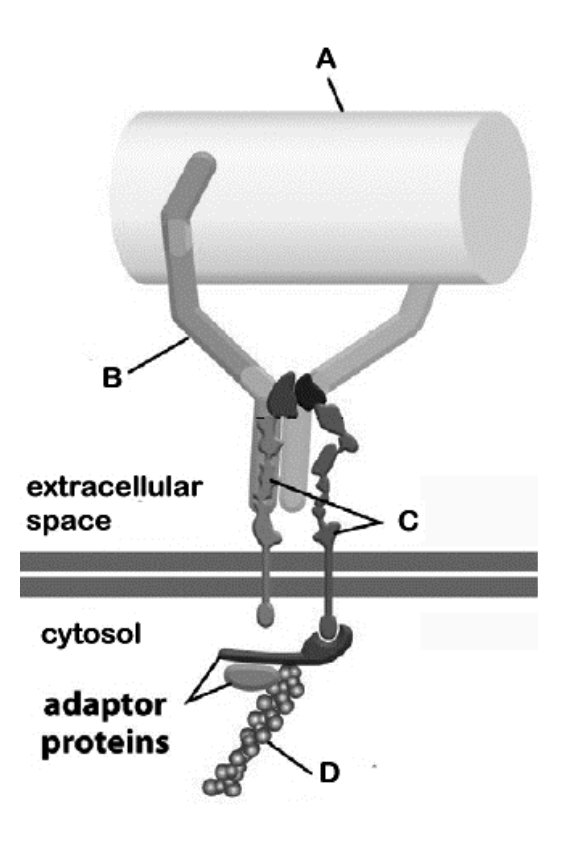
C, D, A, B
Match the labeled parts of the figures with the phrase that best matches the part
basal lamina
apical surface
cell junction
connective tissue

B, A, C, D
What roles do integrin receptors play in connective tissue?
a) to add mechanical strength by binding microtubules to collagen fibers
b) to provide the signalling pathway that connects the extracellular matrix directly to the nucleus
c) to link the extracellular matrix to the cytoskeletal protein via the molecular fibronectin
d) to play a role in nervous tissue and promote intercellular communication
C
Anchoring junction that connects actin filaments in one cell to those in the next cell
a) gap junction
b) septate junction
c) desmosome
d) adherens junction
e) tight junction
D
Label the 5 types of cell-cell and cell-matrix junctions shown in the Figure below and identify the apical and basal surfaces of the epithelium

apical surface
tight junction
adherens junction
desmosome junction
gap junction
hemidesmosome
basal surface
Match the molecules & the cell structures in which they are involved

a) E-Cadherin — adherens junctions
b) Collagen IV — Basal lamina
c) Connexons — gap junctions
d) Occludins — Tight junctions
e) Claudins — Tight junctions
f) integrins — Hemidesmosome
g) desmocolin — desmosome
At a typical anchoring junction, many cadherin molecules are arrayed in a specific pattern, functioning like
a) a channel
b) velcro fabric
c) a motor
d) a synapse
e) none of the above
B
Which type of junction contributes the most to the polarization of epithelial cells?
a) adherens junction
b) desmosome
c) tight junction
d) gap junction
C
Cadherins
a) are used to transfer proteins from one cell to another.
b) mediate cell-cell attachements through homophilic interacitons
c) are abundant in the plant cell wall.
d) bind ot collagen fibrils.
B
Cell cycle checkpoints determine whether or not a celll proceeds to the next cycle phase.
T/F
T
The phase of the cell cycle associat3ed with the doubling of the amount of DNA and duplication of the centrosome is the
a) S phase
b) G0 phase
c) M phase
d) G2 phase
e) G1 phase
A
The G1 DNA damage checkpoint ___.
a) causes cells to proceed through S phase more quickly
b) involves the degradation of p53
c) is activated by errors caused during DNA replication
d) involves the inhibition of cyclin-Cdk complexes by p21
e) results in the activation of Cdc25
D
Mitogens are
a) extracellular signals that stimulate cell division
b) transcription factors important for cyclin production
c) kinases that cause cells to grow in size
d) produced by mitotic cells to keep nearby neighboring cells from dividing
e) ligases that add ubiquitin to cyclins
A
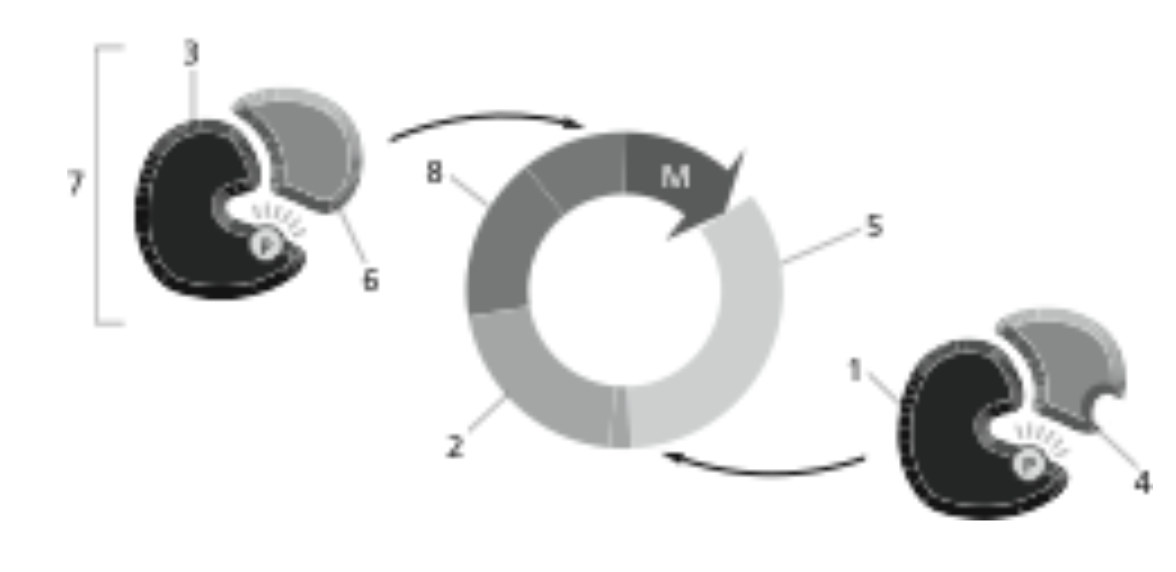
a) G1 phase
b) mitotic cyclin
c) mitotic Cdk
d) S phase
e) S-phase cyclin
f) S-phase Cdk
g) M-Cdk
h) G2 phase
a) G1 phase — 5
b) mitotic cyclin — 6
c) mitotic Cdk — 3
d) S phase —- 2
e) S-phase cyclin — 4
f) S-phase Cdk — 1
g) M-Cdk — 7
h) G2 phase — 8
Which of the following events does NOT usually occur during interphase?
a) Cells grow in size
b) The nuclear envelope breaks down
c) DNA is replicated
d) the centrosomes are duplicated
B
Which of the following descriptions is consistenet with the behavior of a cell that lacks a protein required for a checkpoint mechanism that operates in G2?
a) The cell would be unable to enter M phase
b) the cell would be unable to enter G2
c) The cell would enter M phase under conditions when normal cells would not.
d) the cell would pass through M phase more slowly than normal cells
C
Levels of Cdk activity change during the cell cycle becasue
a) the Cdks phosphorlyate each other
b) the Cdks activate the cyclins
c) Cdk degradation precedes entry into the next phase of the cell cycle.
d) cyclin activity changes during the cycle
D
Which of the following statment is FALSE?
a) Cdc25 dephosphorylation of Wee1 activates the kinase, promoting the G2/M transition
b) Phosphorylation of mitotic Cdk by the inhibitory kinase (Wee1) makes the Cdk inactive
c) inhibiting the Cdc25 phophatase will delay the G2/M transition
d) the activating phosphatase (Cdc25) removes the phosphates from mitotic Cdk that were added by Wee1, so that M-Cdk will be active
A
Centrosome separation initiates the assembly of the bipolar mitotic spindle and is assoiated with a sudden increase in the dynamic instability of microtubules
T/F
T
The principal microtubule-organizing center in animal cells is the
a) centrosome
b) centromere
c) kinetochore
d) cell cortex
e) centriole
A
Nuclear envelope breakdown
a) results in the formation of ER
b) causes the separation of the inner nuclear membrane from the outer nuclear membrane
c) is dependent on the actin of the M-Cdk, which phosphorylates lamins and nuclear pore complex proteins
d) occurs at the end of S phase
e) must occur for astral microtubules to form during meaphase
C
Which stage of mitosis in an animal cell does each part of the Figure below represent?
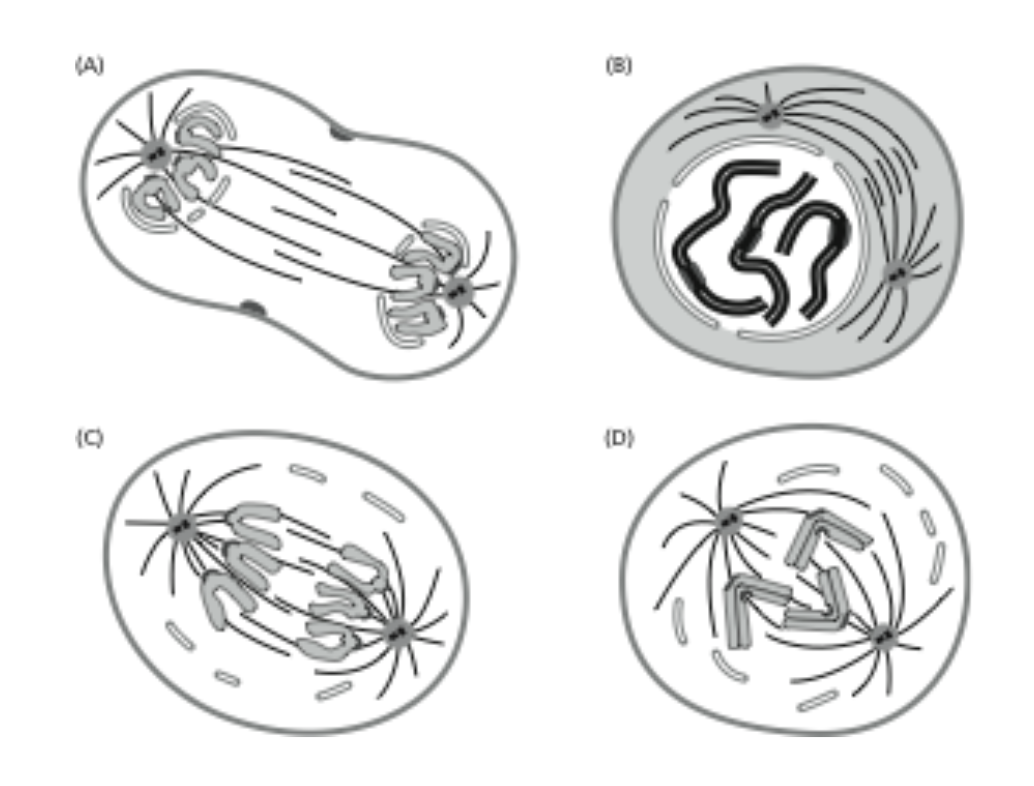
A - telophase
B - prophase
C - anaphase
D - Prometaphase
Name the stage of M phase in which the following events occur. Place the numbers 1-8 next to the letter headings to indicate the normal order of events

G - 1. Prophase
E - 2. Prophase
C - 3. Prometaphase
B - 4. Prometaphase
A - 5. Metaphase
H - 6. Anaphase
F - 7. Telophase
D - 8. Cytokinesis
Circular band containing actin and myosin that forms under the surface of animal cells undergoing cell division and contracts to pinch the two daughter cells apart.
a) Midbody
b) Metaphase plate
c) Contractile ring
d) Cortex
e) None of the above
C
Condensins
a) are degraded when cells enter M phase
b) assemble into complexes on the DNA when phosphorylated by M-Cdk
c) are involved in holding sister chromatids together
d) bind to DNA before DNA replication begins
B
Which of the following statements is true?
a) The mitotic spindle is largely made of intermediate filaments
b) The contractile ring is made largely of microtubules and actin filaments
c) The contractile ring divides the nucleus in two.
d) The mitotic spindle helps segregate the chromosomes into the two daughter cells
D
Which word or phrase below best describes the phase in mitosis depicted in the Figure below?
a) anaphse
b) prometaphse
c) S-phase checkpoint
d) Metaphase

D
Which letter is associated with the line that is pointing to the kinetochore microtubules in the Figure below?

A, B, C, D
D
Disassembly of the nuclear envelope
a) causes the inner nuclear membrane to separate from the outer nuclear membrane
b) results in to the conversion of the nuclear envelope into protein-free membrane vesicles
c) is triggered by the phosphorylation of integrins
d) must occur for kinetochore microtubules to form in animal cells.
D