Unit 5 PT/OT: Medical Terms & Body Anatomy
 Call Kai
 Learn
 Practice Test
 Spaced Repetition
 Match
 Flashcards
 Knowt Play
1/72

There's no tags or description
Looks like no tags are added yet.
73 Terms
What is the simplest organization level?
Cell.
What is the most complex organization level?
Organ system.
What is the correct organization levels, least to most complex?
Cell, tissue, organ, organ system.
What are tissues made of?
Group of similar cells working together.
What are organs made of?
Different tissues.
What’s inside the cranial cavity?
The brain.
What’s inside the thoracic cavity?
The lungs and heart.
What’s inside the abdominal cavity?
The stomach, small and large intestines, spleen, pancreas, liver, and gallbladder.
What’s inside the pelvic cavity?
Portions of the small and large intestines, bladder, rectum, and reproductive organs.
What’s inside the spinal cavity?
The spinal cord.
What’s a another name for internal organs?
Viscera.
What separates the thoracic and abdominal cavity.
Diaphragm.
What is inferior to the abdominal cavity?
Pelvic cavity.
What cavity contains the lungs?
The thoracic cavity.

What is cavity 1?
Cranial.

What is cavity 2?
Thoracic.

What is cavity 3?
Abdominal.

What is cavity 4?
Pelvic.

What is cavity 5?
Spinal.

What is region 1?
Right Hypochondriac.

What is region 2?
Epigastric.

What is region 3?
Left Hypochondriac.

What is region 4?
Right Lumbar.

What is region 5?
Umbilical.

What is region 6?
Left lumbar.

What is region 7?
Right Inguinal.

What is region 8?
Hypogastric.

What is region 9?
Left Inguinal.
What is the abbreviation for right upper quadrant?
RUQ.
What is the abbreviation for left lower quadrant?
LUQ.
What organs are in the right upper quadrant?
Liver (right lobe), gallbladder, part of the pancreas, parts of small and large intestines.
What organs are in the left upper quadrant?
Liver (left lobe), stomach, spleen, part of the pancreas, parts of small and large intestines.
What organs are in the right lower quadrant?
Parts of small and large intestines, right ovary, right fallopian tube, appendix, right ureter.
What organs are in the left lower quadrant?
Parts of small and large intestines, left ovary, left fallopian tube, left ureter.

What quadrant is a?
Right upper.
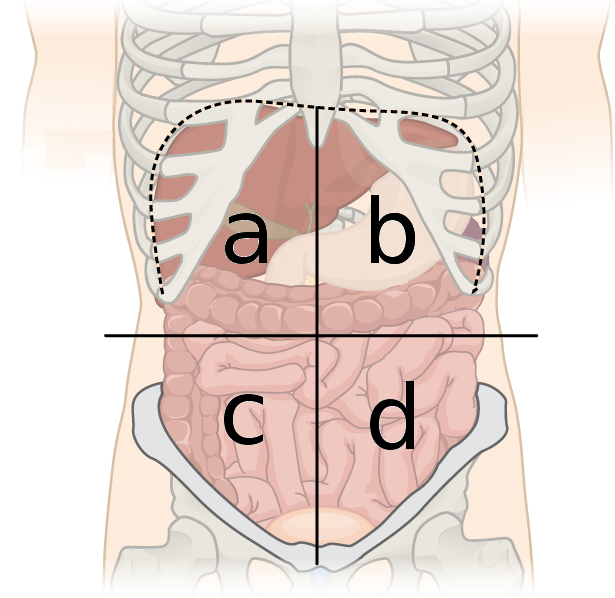
What quadrant is b?
Left upper.

What quadrant is c?
Right lower.
What quadrant is d?
Left lower.

What is number 1?
Cervical.

What is number 2?
Thoracic.

What is number 3?
Lumbar.

What is number 4?
Sacral.

What is number 5?
Coccygeal.
What does anterior mean?
Front.
What does posterior mean?
Back.
What does deep mean?
Farther away from the surface of the body, within the skin.
What does superficial mean?
Closer to the surface of the body/skin.
What does proximal mean?
Closer to the trunk/point of attachment.
What does distal mean?
Further from trunk/point of attachment.
What does inferior mean?
Below/feet.
What does superior mean?
Above/head.
What does medial mean?
Closer to midline of the body.
What does lateral mean?
Further from the midline of the body.
What does supine mean.
Laying one back, face up.
What does prone mean?
Laying on face, back up.
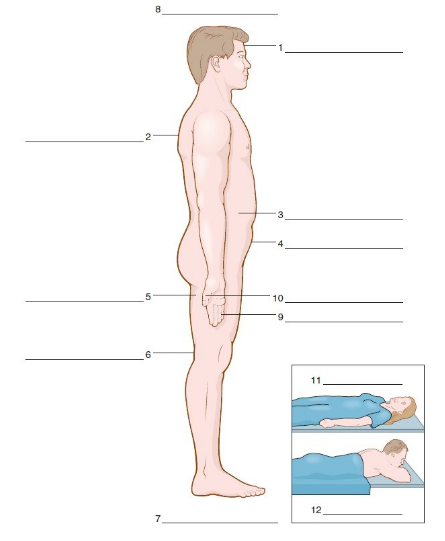
What position is 1?
Anterior.

What position is 2?
Posterior.

What position is 3?
Deep.

What position is 4?
Superficial.

What position is 5?
Proximal.

What position is 6?
Distal.

What position is 7?
Inferior.

What position is 8?
Superior.
What position is 9?
Medial.
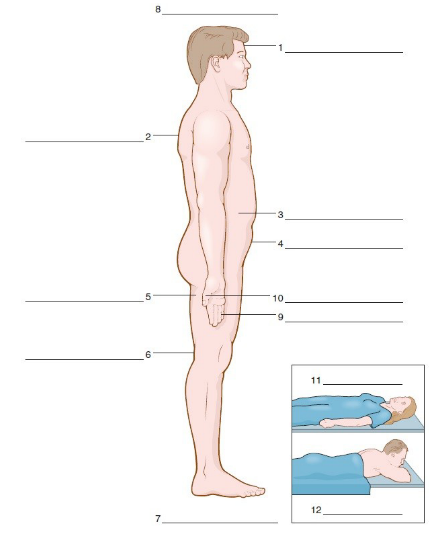
What position is 10?
Lateral.

What position is 11?
Supine.
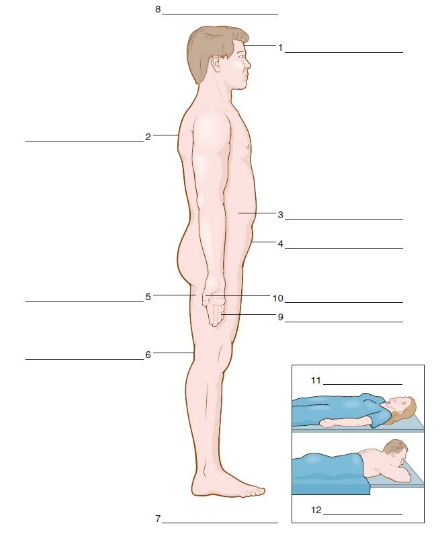
What position is 12?
Prone.
What is the frontal/coronal plane?
Body cut to front (anterior) and back (posterior) sides.
What is the sagittal/lateral plane?
Body cut to left and right sides.
What is the transverse/cross-sectional/axial plane?
Body cut to top (superior) and bottom (inferior) sides.

What plane is 1?
Transversal/cross-sectional/axial.

What plane is 2?
Sagittal/lateral.

What plane is 3?
Frontal/coronal.