Joining vs assembly
 Call Kai
 Learn
 Practice Test
 Spaced Repetition
 Match
 Flashcards
 Knowt Play
1/29

There's no tags or description
Looks like no tags are added yet.
30 Terms
Joining techniques
Welding
Soldering
Brazing
Adhesive bonding
welding
Coalescing parts that are in contact by using heat and or pressure
→ Works by locally changing microstructure of grains -> i.e. melting
soldering
Melting and flowing a filler metal into the joint
Filler = low melting point
Base metal not melted during the project
E.g. roof flashing
brazing
Soldering but using filler metal that has a higher melting point
Better strength than soldered joints
Higher temp can cause problems
adhesive bonding
Filling gap with an adhesive (polymer) which forms a surface bond with the metal
Assembling techniques
Bolts and nuts
Rivets
Stitching
Stapling
Molding inserts
Integral fasteners
bolts and nuts
Two connecting parts that are easy to assemble on site
• Components can be dismantled for repair/modifications
rivet
Permanent connection
E.g. skin panels of aircraft, harbour bridge
Needs lots of maintenance
stitching
Fastening operation using a stitching machine to form U-shaped stiches from a steel wire
Immediately drive them through the two parts to be joined
Stapling
Preformed U-shaped staples are pinched through two parts
molding inserts
The placement of a component into a mold before plastic molding or metal casting
So it becomes a permanent part of molding or casting
E.g. internally threaded nuts, externally threaded bearings
integral fasteners
Use deformation of component parts so that they interlock
How to decide which technique to use
Consider
Strength
Ease of manufacture
Cost
Permanency
Corrosion-resistance
Appearance
E.g. Bridge
Joints in girders carry varying loads of vehicles
Constraints
Joints have to be made on site
Time is not important parameter
Repair is hard
Welding requires lots of experience
types of welding
Fusion welding
Solid-state welding
fusion welding + steps
Fusion welding
Heat to melt base metals
Use filler material most of time
Most welding process is this
Steps
Parent metal melted on each side of joint line
Molten metal combines to form liquid pool between two components
Molten metal solidifies to create a bridge
types
arc welding
gas welding
resistance welding
high energy welding
what is Solid-state welding
Pressure alone OR combination of pressure and heat
If heat involved -> below melting temp of base metals
No filler metal used
types
diffusion welding
roll welding
friciton wleding
forge welding
pros of welding
Permanent joint
Can be a lot stronger than parent material if filler material has better strength properties
Usually most economical way to join components regarding material use and fabrication cots
Not restricted to factors -> i.e. can be onsite
cons of welding
Limitations in operations | Limitations on metals |
|
|
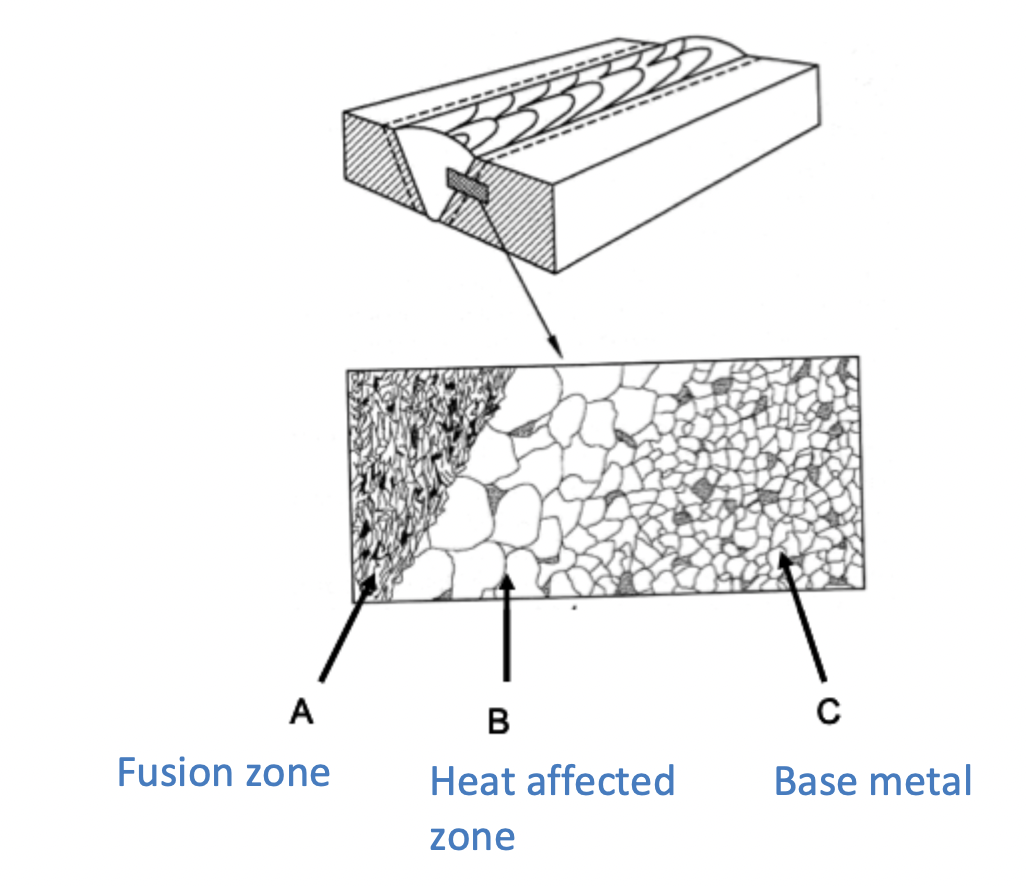
Parts of Weld
Fusion zone
Heat-affected zone (HAZ)
Unaffected base metals
what is fusion zone
Mixture of filler and base materials that have completely melted
Inhomogeneous grains
Preferred grain growth orientation
Columnar grains
Perpendicular to boundaries of weld interface
Coarse grains
what is Heat-affected zone (HAZ)
Metal experiences below melting temperature -> still changes microstructures
How much metal is changed depends on
Heat input
Peak temp
Distance from fusion zone
Medium grains
what is Unaffected base metals
Remaining parent metal in original structure
Not enough temperature to change properties
Can be high residual stresses due to expansion and shrinking of fusion zone
Fine grains

Factors affecting distortion and residual stress in welding
Coefficient of thermal expansion
Melting point
Phase changes
Difference of thermal expansion between two metals
Energy input
Heat treatment history
External restraints during welding
How to reduce residual stress in welding
Peening
Can induced distortion
Difficult to control
Heat treatment
Most controllable
More effective than peening
Metal needs proper heat treatment
when does weld induced distortion occur
Due to non-uniform heating of weld and base metal
what is weldability
= capacity to be welded under fabrication materials
Depends on carbon content
More carbon = harder to weld
Microstructure evolution
Peak temperature = can change microstructure
Low carbon steel weld easily
Strength can be higher than base material
Fine pearlite forms during cooling step
Welding of medium and high carbon steels is more difficult
Martensite can form in HAZ easily
Decreases toughness of material
what is carbon equivalence
Over 0.76% carbon is hard and difficult to weld
Add other elements to improve weldability and strength
If CE < 0.4%
Very easy to weld
If CE between 0.4 - 0.6
Prone to hydrogen cracking so need to add some low-hydrogen electrodes
Called hydrogen embrittlement
If CE > 0.6
Need to add things to prevent hydrogen cracking and formation of martensite
Martensite is hard but very brittle -> we want tempered martensite to have ductility
We don't like brittle because we want plastic deformation
Done through pre-heat and post-heat treatment
Slower cooling rates
Higher heat welding input
ce%

are residual stresses always bad
Residual stresses are not always bad
Compressive stress = crack don't grow