Affective Disorders: Clinical Aspects
 Call Kai
 Learn
 Practice Test
 Spaced Repetition
 Match
 Flashcards
 Knowt Play
1/29

There's no tags or description
Looks like no tags are added yet.
30 Terms
What is MOOD?
Moods characterise the state of mind or inner disposition of a person; a mood is a result of prolonged feelings and colour the whole mental life while it lasts (Karl Jaspers, 1913)
How do you ASSESS Mood?
Descriptive psychopathology: phenomenological (empathic) assessment of subjective experience. It describes and categorises abnormal experiences as reported by the patient and observed in behaviour
How is Mood Dirsorders assessed with Psychiatric Examination?
1) Presenting symptoms and their chronology
2) History / timeline of mood symptoms
3) Mental state examination
4) Diagnosis
Timeline of Mood Symptoms

What are the different aspects of MENTAL STATUS EXAMINATION?

Why are there no diagnostic tests for psychiatruc disorders?
1) There are no diagnostic tests for any psychiatric disorder: tests are used to exclude physical causes
2) Diagnosis is based on identifying symptoms that cluster into “syndromes”
3) DSM-5 and ICD-11 define the standard set of criteria used to classify all psychiatric disorders
Mood Disorders: The Episodes
1) Major Depressive Episode
2) Manic Episode
3) Hypomanic Episode
4) Mixed affective episode
What are the SYMPTOMS of DEPRESSIVE episodes?

Major Depressive Episode - DIAGNOSIS

Persistent Depressive Disorder - DIAGNOSIS
1) Depressed mood for most of the day, for more days than not, for 2 years or longer
2) Never without symptoms for more than 2 months at a time
The Maniac Episode - DIAGNOSIS

The Hypomanic Episode - DIAGNOSIS

What are MIXED FEATURES and MIXED EPISODES?
1) DSM-5 'with mixed features' specifier: full criteria for a (hypo)manic or depressive episode, plus at least 3 symptoms of the opposite polarity
2) ICD-11 keeps a separate 'mixed episode' category
3) Associated with greater severity, treatment resistance and suicide risk
What are the OTHER SYMPTOMS that frequently occur in both Depressiona and (Hypo)Mania?
1) Anxiety
Restlessness, tension, worry, anticipatory anxiety, fear of losing control
2) Psychotic symptoms
Delusions and hallucinations, mood mostly congruent (eg delusion of guilt in depression; delusion of grandiosity in mania)
Mood Disorders - DEPRESSIVE DISORDER
1) Major depressive disorder: at least 1 major depressive episode, never (hypo)manic
2) Persistent depressive disorder: depressed mood on most days for 2 years or more
Mood Disorders - BIPOLAR
1) Bipolar I disorder: at least 1 manic episode (depressive episodes common but not required)
2) Bipolar II disorder: at least 1 hypomanic and 1 major depressive episode, never manic
Mood Disorders - CYCLOTHYMIC DISORDER
Cyclothymic disorder: 2 years or more of fluctuating hypomanic and depressive symptoms that do not meet episode criteria
Clinical Subtypes of Depression - MELANCHOLIC FEATURES
With melancholic features
Profound anhedonia, lack of mood reactivity, early-morning waking, mood worse in the morning, psychomotor change, weight loss, excessive guilt
Clinical Subtypes of Depression - ATYPICAL FEATURES
With atypical features
Mood reactivity, increased appetite or weight, hypersomnia, leaden paralysis, rejection sensitivity – often linked to inflammation and metabolic dysfunction
Clinical Subtypes of Depression - PSYCHOTIC FEATURES
With psychotic features
Mood-congruent delusions (guilt, poverty, nihilism) or hallucinations
Clinical Subtypes of Depression - OTHER SPECIFIERS
Other specifiers
With anxious distress, with mixed features, with peripartum onset, with seasonal pattern
Differential Diagnosis - PHYSICAL CAUSES
Physical Causes
1) Eg Hypothyroidism, Cushing's, neurological disease (stroke, Parkinson's, MS, dementia), cancer
2) Medicines and substances: corticosteroids, interferon-α, alcohol, cannabis, stimulant withdrawal
3) Mania starting after age 50 or with atypical features: look for an organic cause (steroids, stimulants, hyperthyroidism, frontal lesions)
Differential Diagnosis - PSYCHIATRIC DIFFERENTIALS
Psychiatric Differentials
1) Normal sadness and grief (ICD-11 prolonged grief disorder), adjustment disorder
2) Anxiety disorders, PTSD, substance use disorders, ADHD
3) Emotionally unstable personality disorder vs bipolar disorder: mood shifts over hours, often triggered by interpersonal events
Differential Diagnosis - BASELINE TESTS
Baseline Tests
1) FBC, U&E, LFT, TFT, glucose/HbA1c (± CRP, drug screen, brain imaging if indicated)
Question 1

Question 2

Major Depressive Disorder - EPIDEMIOLOGY
1) One of the most prevalent psychiatric disorders worldwide
2) Most common mental disorder in primary care
3) Age of onset most often 25–35 years (but can be at any age)
4) More prevalent in women than men (2:1)
5) Lifetime prevalence : 20% (females); 10% (males)
6) 12-month prevalence: highly variable, average about 7%
7) The median duration of a depressive episode is 3 months
8) Recurrent course in up to 80% of clinical cases (lower in community samples)
9) Lifetime suicide risk about 2% (outpatients) to 6% (after a suicidal inpatient admission)
What is the IMPACT of Major Depressive Disorders?
1) A leading cause of disability worldwide, more than most chronic medical diseases
2) High comorbidity (~70%) with other psychiatric disorders; MDD usually starts after the comorbid disorder
3) Bidirectional relationship with physical illnesses (metabolic syndromes, cardiovascular disease, chronic pain, inflammatory conditions…)
4) Increased morbidity/mortality from co-existing medical conditions
5) Decreased work productivity
6) Suicide is the 3rd leading cause of death among 15–29-year-olds worldwide (WHO)
7) Immense costs to society
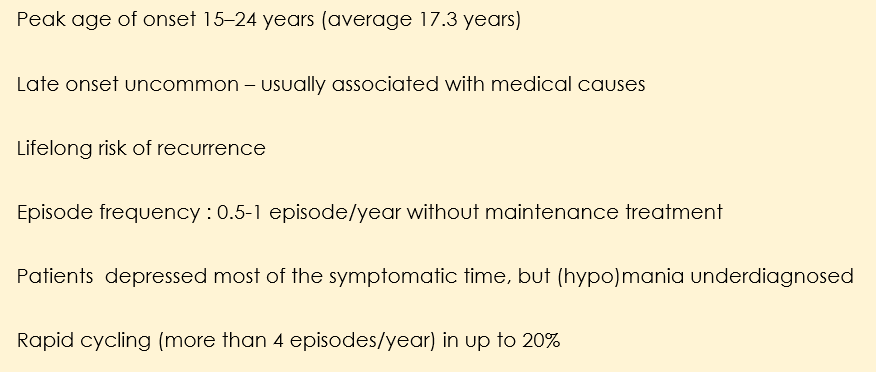
Bipolar Disorder - EPIDEMIOLOGY

What is the PROBLEM with EARLY DETECTION of Bipolar Disorder?
