WLM Lec 10: Intro to Wildlife Pop. Dynamics
 Call Kai
 Learn
 Practice Test
 Spaced Repetition
 Match
 Flashcards
 Knowt Play
1/74

There's no tags or description
Looks like no tags are added yet.
75 Terms
what is usually the focus of wildlife management?
populations
biologist regular monitor...
the habitat conditions in which populations exist
population ecology
an attempt to explain phenomena, such as population cycles, and the underlying causes for the regulation of animal numbers
population
group of organisms, usually the same species, occupying a defined area during a specific time
desnity
number of individuals per unit area
birth rate
number of births per thousand, hundred, or individual per year
age structure
distribution of numbers of individuals of various ages
sex ratios
proportion of male to female sexes in a population
fecundity
number of eggs per female, or number of sperm per male
fertility
percentage of eggs that are fertile
production
number of offspring produced during a period of time
recruitment
the number of new individuals of breeding age in a population
population patterns
all living organisms need resources to survive, and those resources are not unlimited, so most populations are limited at some point
4 factors of population growth
birth rate, death rate, immigration, emigration
death rate
how many individuals are being removed from a population
immigration
how many individuals join a population
Emmigration
how many individuals leave a population
general growth equation
dN/dT = rN
exponential population growth
a population's growth rate increases over time, in proportion to the size of the population
key to exponential growth
number of organisms added to the population increases as the population gets larger
exponential growth formula
dN/dt = rmaxN
logistic population growth
as populations rise in exponential growth, resources are depleted, resulting in slowed growth
key to logistic growth
infinite resources do not exist in the real world
logistic growth formula
dN/dT = rmax ((K-N)/K) N
positive density-dependent factors influencing population growth
Allee effects; predatory vigilance, looking for food, breeding opportunities, group care of young
negative density-dependent factors influencing population growth
negatively impact populations when more individuals are present; group is more detectable to predators, more competition for food and mating opportunities, easier spread of diseases
density-independent factors
happen to populations regardless of how many individuals are there; stochastic events
stochastic factors
random factors that affect population
demographic stochasticity
Random variations in birth and death rates that occur in a population from year to year
genetic stochasticity
accumulations of mal-adaptive alleles or loss of adaptive alleles
environmental stochasticity
unpredictability of major weather events; droughts, floods, fires, etc.
extrinsic factors
factors that influence individual survival externally to them; like predation
intrinsic
factors that influence individual survival internally; genetic factors like genetic diseases or mal-adapted alleles
deterministic factors
habitat quality, predation, disease, interspecific interactions (competition among populations), anthropogenic effects
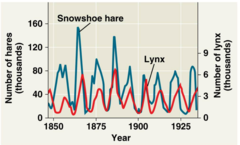
Lynx-Hare field study
predator-prey interactions; rise in the lynx populations causes a fall in the hare population. The fall in the hare population causes a fall in the lynx population, and subsequently a rise in the hare population. (cycle continues)
how does existing habitat influence birth and death rate?
rate = births - deaths
how does movement impact populations?
rate = (births - deaths) + (immigration - emmigration)
influences on birth and death rates
1. age of sexual maturity for both sexes
2. length of gestation
3. sex ratio
4. mating system
5. number of females that breed at each age
6. number of young per female at each age
7. influence of nutritional condition on reproduction
primary sex ratio
sex ratio at fertilization (50:50)
secondary sex ratio
the sex ratio at birth or hatching, usually approximates 50:50 but may show the first indication of sex-specific mortality
tertiary sex ratio
sex ratio pre-sexual maturity; more sex specific mortality
quaternary sex ratio
sex ratio of adults; sex ratio of most concern due to being linked with productivity
Mating Systems
- monogamy
- polygamy
- promiscuity
monogamy
one mate at a time
Seasonal monogamy
pair bond is formed for a breeding season
true monogamy
having only one mate for one's entire life
Polygamy
having more than one mate at a time
polyandry
One female, several males.
polygyny
One male, several females.
promiscuity
indiscriminate mating; mainly seen in widespread, solitary species (e.g. rabbits, most large cats)
Age specific birth rates
- age often heavily influences reproductive success
- age-specific birth rate separates birth rate by age class
reproduction in short life history species
as females get older, they give birth to more younger
reproduction in long life history species
females have a prime age for reproduction, which decreases as time goes on
mortality
death rate of a population
additive mortality
mortality that actively reduces population size; often density independent, exerts more influence on smaller populations
compensatory mortality
- focuses on multi-causal reasons for mortality
- Ex: if an organism has a disease but is eaten by a predator, it is likely that the organism still would have died to the disease
- often density dependent
Type I survivorship curve
extremely high survival until the individual reaches old age
Type I species
long life history individuals (ex: elephants, humans, many dinosaurs)
Type II survivorship curve
constant mortality across life
Type II species
short life history species that are small in size (ex: rodents and small birds)
Type III survivorship
low survival in young individuals and then become relatively constant in older individuals
Type III species
species born relatively vulnerable, but have high survival at larger sizes (ex: larger reptiles like sea turtles, crocodilians)
Life tables
systematic means of describing mortality as it affects various age groups in a population
Metapopulations
a group of spatially distinct populations that are connected by occasional movements of individuals between them allowing them to function as one big population
theory of biogeography
a theory that demonstrates the dual importance of habitat size and distance in determining species richness
source populations
Populations that occupy and disperse away from high quality habitat patches
Sink populations
Populations that occupy low quality habitat patches; colonized from source populations
ecological traps
areas of low-quality habitat that reduce survival and reproduction
Connectivity
- keeping metapopulations connected to one another
- overpasses and underpasses
problem with population data
obtaining accurate information about animal numbers and densities is one of the biggest wildlife management hurdles
sampling theory
collected data must represent the population at large
population census
the official count of a population
population estimate
an approximation of the true population size based upon sampling a portion of the population
population index
a quantitative measure of a population that doesn't generate exact numbers, but compares abundance over a given time
sources of data
- collection of fish scales by wildlife officials
- submission of wings or tails from game birds
- banding programs
- Christmas Bird count
- Breeding Bird survey
- check stations for big game hunters
- Migratory Bird Harvest Information Program