Muscle Tissue Types, Structure, and Function in Human Anatomy
 Call Kai
 Learn
 Practice Test
 Spaced Repetition
 Match
 Flashcards
 Knowt Play
1/76

There's no tags or description
Looks like no tags are added yet.
77 Terms
Types of Muscle Tissue
Skeletal, Smooth, Cardiac

Myology
Study of structure, function, & diseases of muscle tissues
Skeletal Tissue
Moves skeletal bones; striated; primarily voluntary control
Cardiac Tissue
Only in the heart; striated; involuntary control; intrinsic rhythm acts as natural pacemaker

Smooth Tissue
In walls of hollow structures; not striated; usually involuntary

Functions of Muscular Tissues
Produce body movements, stabilize body positions, store & move substances, produce heat
Electric Excitability
Ability to respond to stimuli from electrical signals
Contractility
Ability to contract when stimulated by action potential
Extensibility
Ability to stretch without being damaged & take on new length
Elasticity
Ability to stretch & return to original length
Muscle Fibers
Structure that make up the skeletal muscle system
Muscle Belly
Body of the muscle; vascularized
Tendons
Connects muscles to bone; white dense connective tissue

Endomysium
Binds together muscle fibers

Fascicle
Muscle fiber bundle
Perimysium
Surrounds muscle fiber bundles
Epimysium
Surrounds each muscle
Fascia
Surrounds every muscle, nerve & blood vessel
Neurovascular Bundle
Nerves & blood vessels that typically enter the muscle together
Motor Fibers
Initiate contractile function of muscle cells
Sarcolemma
The plasma membrane of a muscle fiber

Transverse Tubules
Tunnel in from the surface toward the center of each muscle fiber
Sarcoplasm
The cytoplasm of a muscle fiber
Myofibril
Small structures that are the contractile elements of skeletal muscle

Sarcoplasmic Reticulum
Fluid-filled system of membranous sacs that encircle each myofibril
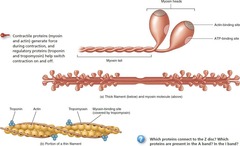
Actin Filaments
Thin filaments that extend from anchoring points within the Z discs

Myosin Filaments
Thick filaments; main component of thick filaments
Sarcomere
Basic functional unit of myofibril; separated by Z discs
Z Discs
Narrow, plate-shaped regions of dense protein material that separate one sarcomere from the next
A Band
Dark, middle part of the sarcomere that extends the entire length of the thick filaments
I Band
Lighter, less dense area of sarcomere; contains the rest of the thin filaments but no thick filaments
H Zone
A narrow region in the center of each A band; contains thick filaments but no thin filaments
M Line
A region in the center of the H zone; contains proteins that hold the thick filaments together at the center of the sarcomere
Contractile Proteins
Proteins that generate force during contraction
Regulatory Proteins
Proteins that help switch the contraction process on and off
Structural Proteins
Proteins that keep the thick & thin filaments in the proper alignment
Neuromuscular Junction
Location where muscle action potential arises

Synapse
Region where communication occurs between two neurons
Neurotransmitter
Chemical messenger
Muscular System
Voluntarily controlled muscles of your body comprise the muscular system.

Muscle Function
Produce movements by exerting force on tendons.
Muscle Attachment
Muscles are attached to bones by tendons at their origin & insertion.
Origin
The attachment of a muscle's tendon to the stationary bone.

Insertion
The attachment of the muscle's other tendon to the movable bone.
Rule of Thumb for Origin and Insertion
The origin is usually proximal & the insertion distal, especially true in the limbs.
Belly of Muscle
Fleshy portion of the muscle.
Muscle Action
Main movements that occur when the muscle contracts.
Reverse Muscle Action (RMA)
Certain muscles are also capable of reverse muscle action, also called closed kinetic chain (CKC) exercises.
Levers
Rigid structure that can move around a fixed point (fulcrum).
Effort (E)
Force exerted by muscular contraction.
Load
Weight of the body part or some resistance that the moving body part is trying to overcome.
Mechanical Advantage
If load is closer to the fulcrum, the effort farther from the fulcrum; only a relatively small effort is required to move a large load over a small distance.
Mechanical Disadvantage
If load is farther from the fulcrum, the effort is applied closer to the fulcrum; a relatively large effort is required to move a small load (but at greater speed).
First Class Lever
Fulcrum is between the effort & the load; can produce either a mechanical advantage or mechanical disadvantage.
Example of First Class Lever in Body
Skull resting on the vertebral column; effort is contraction of the posterior neck muscles.

Second Class Lever
Load is between the fulcrum & the effort; operates like a wheelbarrow.
Third Class Lever
Effort is between the fulcrum & the load.
Example of Lever in Body
Biceps brachii flexing the forearm at the elbow as an object is lifted.
Fulcrum
The fixed point around which a lever moves.
Second Class Lever in Body
Example in body: standing up on your toes (plantarflexing)
Fulcrum in Second Class Lever
Fulcrum (F)= ball of the foot
Load in Second Class Lever
Load (L)= weight of the body
Effort in Second Class Lever
Effort (E)= contraction of the muscles of the calf, which raise the heel off the ground
Example of Third Class Lever
Example: Pair of forceps (tweezers)
Third Class Lever in Body
Example: elbow flexion (biceps)
Effort in Third Class Lever
Effort (E)= biceps brachii muscle contracting
Load in Third Class Lever
Load (L)= weight of the arm or something held in hand
Fulcrum in Third Class Lever
Fulcrum (F)= elbow joint
Fascicles
Bundles of skeletal muscle fibers (cells)
Muscle Fiber Arrangement
All muscle fibers are parallel to one another
Muscle Fascicle Patterns
May form one of 5 patterns with respect to the tendons: Parallel, Fusiform, Circular, Triangular, Pennate
Concentric Contraction
Shortening
Eccentric Contraction
Lengthening
Prime Movers
Contracts to cause an action while the other muscle (follower) stretches & yields to prime mover
Antagonist
Stretches and yields to the prime mover
Example of Prime Mover and Antagonist
Flexing forearm at elbow: Biceps brachii (prime mover) and Triceps brachii (antagonist)
Naming Skeletal Muscles
Contain combinations of the word roots of their distinctive features: Pattern, Size, Shape, Action, Number of origins, Location, Sites of origin and insertion