Cellular transport, Cell cycle, and Differentiation.
 Call Kai
 Learn
Learn Practice Test
 Spaced Repetition
 Match
Match Flashcards
 Knowt Play
1/20

There's no tags or description
Looks like no tags are added yet.
Name | Mastery | Learn | Test | Matching | Spaced | Call with Kai | Chat |
|---|
No analytics yet
Send a link to your students to track their progress
21 Terms
What is passive transport
movement along the concentration gradient without energy.
simple diffusion is without a channel
facilitated diffusion is with either a channel protein or carrier protein.
What is active transport?
Movement against the concentration gradient using energy (ATP)
When do you need active transport?
Its needed when transporting a substance from lower concentration into a higher one.
the most common one is the sodium-potassium pump
works to keep a low concentration of NA and a high concentration of K in the cytosol cell.
Explain what the Na-K pump maintains, explain what happens in the Na-K pump during active transport, and explain what the result is.
The Na-K pump maintains a low concentration of Na+ and a high concentration of K+ in the cytosol.
Three sodium ions from inside the cell enter the pump, theres spaces shaped specifically for sodium ions in the pump.
An ATP molecule attaches to the pump and is broken down, transferring a small phosphate group to power the pump.
That energy payment forces the pump to change its shape, opening up toward the outside of the cell.
The pump lets go and pushes those three sodium ions outside of the cell.
Two potassium ions from outside of the cell get into the pump in the spaces shaped for them.
The pump releases the phosphate group; releasing that piece makes the pump snap back to its original shape, carrying the two potassium ions inside the cell.
The pump is now reset and can start the cycle again.
Result: 3 Na+ pumped out of the cell, 2 K+ pumped into the cell, using 1 ATP.
Endocytosis (in)
Intake of particles and substances too large to cross the cell membrane
Exocytosis (out)
Transports particles and substances out of the cell
How do endocytosis and exocytosis work together?
They work together to allow cells to take in nutrients and get rid of waste products.
Endosymbiotic theory and what proves it?
Mitochondria were once free-living prokaryotic organisms that were engulfed by a protoeukaryotic cell and formed a symbiotic relationship, becoming an important part of eukaryotic cells
- Evidence supporting theory
mitrochondria and chrondoplasts are the same size as the cell
DNA is circular
ribosomes exist in it
what are the contents for the nucleus?
the nucleus is surrounded by double walled membrane and contains the chromosomes (wrapped up DNA)
What are the steps for genes building proteins?
DNA → RNA → proteins
DNA - RNA (transcription)
RNA - protein (translation)
Transcription
Infomation is copied from DNA to mRNA
DNA cannot exit the nucleus, but mRNA can
Carried out by an enzyme called RNA polymerase
Translation
mRNA is read by ribosomes to produce proteins
Occurs outside the nucleus, by the ribosomes
Amino acids are formed into a protein
Alternative splicing
Post-transcriptional process in which a cell mixes and matches different combinations of exons from a single gene.
This results in different proteins and different traits.
Chromosomes
Tightly wrapped DNA and protein found inside the nucleus. It carries genetic information in a unique location.
Explain the parental copies of genes
During reproduction, the mother’s egg cell and the father’s sperm cell each contain 23 chromosomes.
When a sperm and an egg cell join, the zygote has 46 chromosomes (23 from each parent.)
the zygote chromosomes are organized into 23 pairs. one of the chromosomes in each pair from the mother and the other from the father.
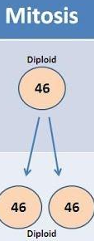
Mitosis
Diploid to diploid
Produces two genetically identical cells from a single parent cell.
4 stages in total (plus interphase)
Happens in somatic cells (not reproductive cells)
genetic variation doesn’t change
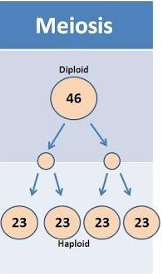
Meiosis
Diploid to haploid
Produces cells that are genetically unique from the parent with half as much DNA
8 stages in total
Purpose is sexual reproduction
produces 4 haploid daughter cells
Chromosome number is halved in each daughter cell
Name the parts of the cell cycle
interphase, G1 phase, S phase, G2 phase, and miotic phase.
What phase is the cell mostly in?
Interphase; unless its dividing in the end phase
90% interphase, 10% mitosis phase
What is cytokinesis?
It’s the cleavage of the animal cell.
seperates the daughter cell
what are the steps to mitosis
prophase - chromosomes arent lined up
anaphase - chromosomes start to line up
metaphase - chromosomes line up
telophase - cell forms then become ready to split up