Unit 3
 Call Kai
 Learn
 Practice Test
 Spaced Repetition
 Match
 Flashcards
 Knowt Play
1/50

There's no tags or description
Looks like no tags are added yet.
51 Terms
The ancient continent Laurentia includes most of modern day continents of:
North America and Greenland
The Phanerozoic Eon, starting with the Cambrian, is characterized by the expansion of _____________ organisms.
hard shelled
The St Peter's sandstone is supermature. Why is it considered to be a mature (or supermature) sandstone?
It is made of all quartz grains that reflecting recycling of material
The exterior skeletons of arthropods, such as Trilobites and insects, are composed of ______________.
chitinous
The craton of North America was periodically flooded by shallow seas. These seas favored which of the following?
diversification of marine life
Which one of the following are some (not all) of the periods of the Paleozoic era:
Cambrian, Ordovician, Silurian
Which one of the following occurred first (is the oldest)?
Stromatolites
The most likely cause of the late Ordovician extinctions is thought to have been:
sea-level fall due to global cooling and wide-spread glaciation
If you had rocks with fossils that represent the Cambrian Fauna, then you would expect to see:
Trilobites, inarticulate brachiopods, and archaeocyathids
What is the Burgess Shale and why is it important?
This is a fossil bearing rock located primarily in Canada. These rocks formed during the Middle Cambrian period about 500 million years ago. Whole marine communities were often swept away in mudslides. Because these mudslides cut off oxygen, they preserved soft body parts (eyes, guts, and gills). These rocks give us a complete picture of the whole ecosystem. They preserved soft bodied animals that we don't normally find fossils of, as well as strange experimental groups that include phyla unknown to us today.
What is a trilobite? Describe it for me.
Trilobites are an arthropod, which means they have a segmented body and
jointed appendages. They were covered in a tough, mineralized outer shell made of chitin that they molted as they grew. Many species had advanced compound eyes built with real mineral lenses made of calcite. They lived on the sea floor—crawling, burrowing in sediment, swimming in open water, or feeding as scavengers, predators, and filter-feeders
Cambrian trilobites are relatively primitive and unspecialized, with simple (or no) tail shield, simple flat head shields, and lots of thoracic segments and spines. They're hard to tell from each other, but VERY different from later trilobites. Most archaic elements of Cambrian trilobites eventually vanish, but trilobites become more specialized for protection against the new nautiloid predators.
Explain to me what a supermature sandstone (such as the St Peter's Sandstone) is and why they are important.
Because quartz is incredibly hard and chemically stable, weaker minerals rot away over millions of years of recycling, leaving behind a composition that can be as high as 99% pure quartz. Winds or water currents have completely washed away the muddy "dirt", leaving less than 5% clay or silt. Intense friction, usually from wind abrasion in ancient deserts, has ground down all sharp edges, meaning the individual grains are highly spherical with smooth, "frosted" edges.
Supermature sandstones cannot form in rapidly changing landscapes. such as growing mountain chains. They require stable, flat continental areas like cratons where sand can be washed, blown, and recycled through multiple cycles of erosion over vast spans of time. The frosting and extreme roundness of the grains in formations like the St. Peter Sandstone indicate wind-blown desert environments and coastal dunes. They map out where Earth's ancient deserts and coastlines used to be.
What organisms dominate Silurian reefs?
Tabulate corals , solitary (horn) corals, and sponges
Laurentia collided with Baltica and the _________________ to produce the Acadian orogeny.
Avalon terrane
A rock contains abundant brachiopods and bryozoans. It mostly likely formed during which era?
Paleozoic
The earliest plants were likely:
similar to spore bearing and non-vascular plants such as liverworts and mosses.
What advantage do vascular systems provide plants?
Allows plants to grow vertically
Which of the following is a transitional species between fish and amphibian?
Tiktaalik
What organism was the most likely to move onto land from the ocean first?
algae
The earliest four legged vertebrate animals would be the ________________.
amphibians
The first of the four legged animals to invade the land were the ______________. By studying their features, scientists have inferred that their ancestors were the ______________.
amphibians, lobe-finned fish
There are similar obstacles that plants and animals had to overcome in order to come on land. Please describe two of these obstacles.
With life beginning in water, organisms never had an issue with dehydration or drying out. When they started to go on land, the lack of water and abundance of dry sand and air put them at risk of drying out. For plants, they adapted waxy outer layers to lock in moisture. Animals, such as early crustaceans, developed waterproof skin, shells, and internal lungs to keep their respiratory systems wet while on land.
Another factor to overcome was weight. While in water, natural buoyancy helps support the weight of an organism (think of swimming/water aerobics being a favored exercise for overweight people to decrease strain on their joints or for the elderly for similar reasons). While on land, gravity pulls on an organism’s structure harder, so you need a way to hold yourself upright and move. Plants adapted by developed vascular tissues that allowed them to grow vertically against gravity. Animals developed skeletal systems, either internal or exoskeletons, as well as limbs to walk or crawl as opposed to swimming.
Sea-level rose a few times during the Paleozoic resulting in sequences such as the Tippecanoe and Kaskaskia. Describe some of the rocks that demonstrate this sea-level rise.
1. Basal Sandstone (Nearshore/Beach): High-energy beach environments deposit coarse sand. As the ocean moves inland, this beach sand covers the old continental land surface.
2. Shale (Offshore/Mudflat): In deeper, calmer waters just past the breaking waves, fine-grained mud and silt settle, compressing over time into shale.
3. Limestone (Deep Marine): Furthest from the shore, where the water is warm, clear, and devoid of muddy land runoff, marine organisms thrive and deposit calcium carbonate shells, forming massive limestone layers.
What were the causes of the Late Devonian mass extinction? How did it impact life?
70% of marine species died out about 370 m.y. ago (3rd largest extinction in earth history), especially reef community of corals and sponges, brachiopods, trilobites. Two big oxygen isotope events suggest pulses of cooling and glaciation, not consistent with a single extraterrestrial impact such as an asteroid. During this two wave extinction, evidence found from fossils, rocks, and glacial deposit in North America and polar South America show evidence of glaciers likely covering the globe. This massive cooling was the cause of the mass extinction, especially the above-mentioned reef communities that survived in warmer, shallow waters. Surviving vertebrates include the living groups of fish: sharks and ray-finned bony fish.
Which is not an orogenic belt along the margins of the North American Craton?
Uralian
Name the orogenic belts along the margins of the North American Craton
Taconic, Acadian, Alleghenian, Ouachita
The late Paleozoic was the time of the _____________________.
Assemblage of Pangea
"Sea lillies" are not a plant, but an animal with a calyx with arm-like structures on a central stalk or stem. The are also know as:
Crinoids

Mississippian Limestones contained vast numbers of which type of fossil?
Crinoids

Seed bearing plants that include your conifers, cycads, and ginkgoes are also called the:
Gymnosperms
During the Pennsylvanian cyclic sequences of marine and non marine strata groups called ________________ were formed.
cyclotherm

What is the primary cause for the mass extinction at the end of the Permian?
Extreme global warming

Which taxon did become extinct at the end of the Paleozoic Era?
Trilobites
The Pennsylvanian time period is characterized by coal deposits formed from ancient:
plants from swamp forests
During the Late Devonian, the "Rockies" started to form when a volcanic island arc collided with western North America and creating the:
Antler orogeny
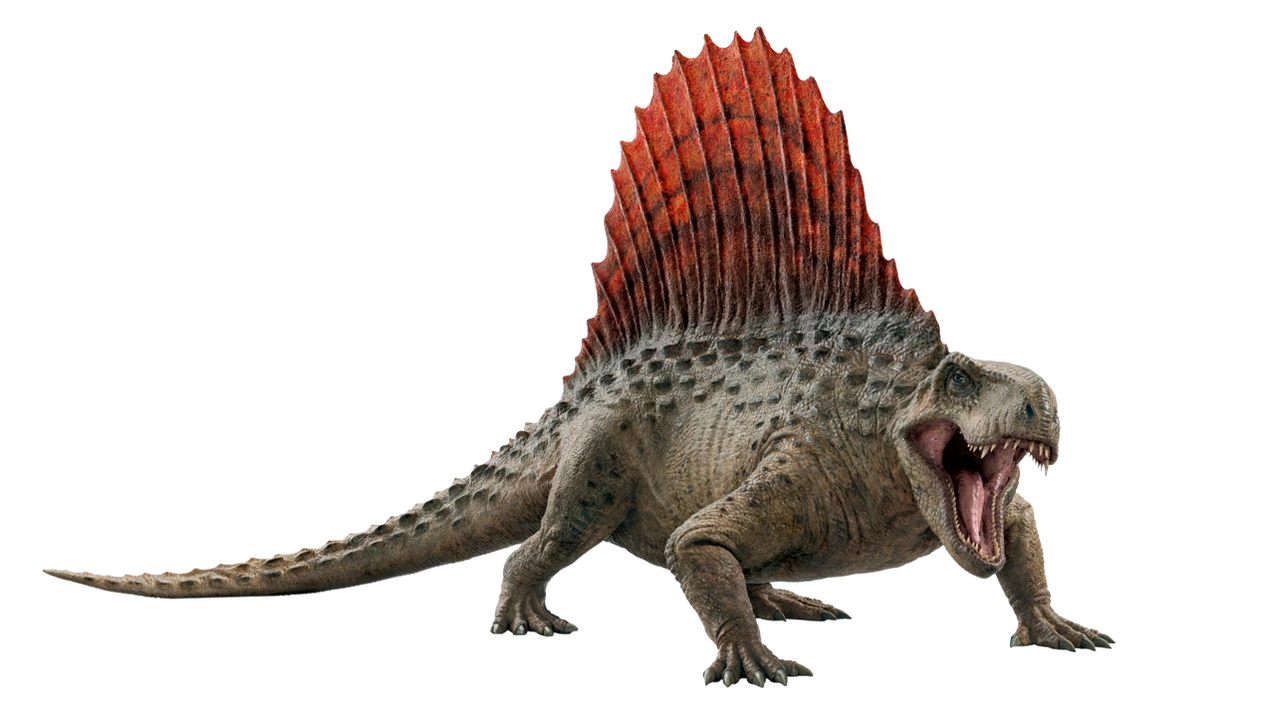
Sailback reptiles like Dimetrodon belong to the:
Synapids
List the orogenies that led to the development of the Appalachians from oldest to youngest.
Taconic, Acadian, Alleghenian, Ouachita (age)

What are the synapsids and why are they important?
Mammal-like reptiles with four-limbs and vertebrates. NEVER had anything to do with reptile lineage. Branched off at the same time as the reptiles during the Carboniferous, evolved in a separate evolutionary lineage that eventually gave rise to mammals. All living mammals are the surviving branch of the synapsid lineage. They provide one of the clearest fossil records of major evolutionary transitions, showing how cold-blooded, sprawling, egg-laying ancestors gradually developed warm-bloodedness, specialized teeth, erect postures, and the unique single-bone jaw and inner-ear bones seen in modern mammals
During Late Permian - Early Triassic time the "Rockies" (or Cordillera) had formed a ________________ during the Sonoma Orogeny.
volcanic island arc

What ocean formed as Pangaea starts rifting apart?
Proto-Atlantic Ocean
The Cretaceous was the time when _____________ appeared in the geologic record.
angiosperms

The flying reptiles of the Mesozoic, which often fed on marine organisms such as fish, crustaceans, and cephalopods, are called:
Pterosaurs

What is the name of the first bird?
Archaeopteryx
Early dinosaurs were:
small, bipedal, and carnivorous
The two major groups of dinosaurs, the Saurischia and Ornithischia, are based on what skeletal part?
Hip

Warm-blooded animals are called __________________.
endothermic

Cretaceous reefs were dominated by which of the following?
Rudistids
During Mesozoic, the __________ became some of the first reptiles to invade the marine realm.
plesiosaurs, ichthyosaurs, and nothosaurs

What are the Deccan Traps?
Large quantities of basaltic lava flows
List 2 pieces of evidence that support the meteorite impact idea for the K-T Extinction.
First, a thin grey clay layer was discovered worldwide with abnormally high iridium levels—rare in Earth's crust but common in meteorites. With the layer being observed across such vast distances, the idea of a giant meteorite was posed by a physicist. Additionally, there was a sharp decrease in the amount of fossils found above this layer of clay, and absolutely no dinosaur fossils found above it, implying that something happened during the formation of this layer that ended the dinosaurs and multiple other species.
Second, quartz was discovered with distinct fractures caused by extreme shock pressures from a high-velocity impact. The only other place we'd observed this quartz, called shocked quartz, was near the sites of nuclear bombs. This showed scientists that there had to have been an absolutely massive impact to have caused this. The physicist who supported the theory of a meteorite strike found that an object the size of Mt. Everest had to have struck the Earth.
Tell the differences in the Modern Fauna and the Paleozoic Fauna.