Behavior Quiz 4
 Call Kai
 Learn
 Practice Test
 Spaced Repetition
 Match
 Flashcards
 Knowt Play
1/37

There's no tags or description
Looks like no tags are added yet.
38 Terms
What are ethical frameworks?
Guidelines that allow us to look at issues in a systematic way & apply ethical reasoning to those issues
Why discuss ethics?
At some point need to decide what is acceptable & unacceptable in terms of animal use & treatment
Are our goals to prevent pain, disease, & suffering?
To create pleasure, positive emotions, & the opportunity to live natural lives?
Ethics helps us make these decisions
What are the 3 approaches to assessing ethics?
1.) Virtue-oriented ethical theories
2.) Action-oriented ethical theories
3.) Value-based ethical theories
**we will focus on 1 & 2
What is virtue-oriented ethics?
“Morality” is what matters
Kindness, generosity, loyalty, compassion, fairness, etc.
Socrates & Aristotle are best known for these ideas
People will act the way that they “should” only if they already have these “virtuous” dispositions of character, not bc you are following pre-set rules or laws
Being virtuous person will automatically make us act better & be better people
Particularly important way to view ethics as a veterinarian & animal caretaker
People expect veterinarians to be moral, virtuous people — it’s why they are one of the most trusted professions, even more than physicians
Often laws & rules in practice can be contradictory to your internal moral standards
Pro & a con for us ;(
What is action-oriented ethics?
All about consequences of our action & how we act, rather than how we should inherently be
Considers concepts like outcomes, duty, & obligation
Ex: utilitarianism, deontology
What is utilitarianism?
Look at the consequences of one’s actions to determine whether they are right or wrong
Consequentialism: only the consequences are what matter when decisions are made — a defining feature of utilitarianism
Maximize the good, minimize the bad
“For the greater good”
Most common approach to animal ethics
Most utilitarians recognize that animals feel pain
Do not restrict their moral calculations to what benefits only human welfare
Jeremy Bentham & Peter Singer
“The question is not, Can they reason?, nor Can they talk? but, Can they suffer?”
It would be speciesist, according to Peter Singer, to only consider the outcomes in relation to humans
What is deontology?
Immanuel Kant — 18th-century German philospher
Some moral obligations override how much good may be produced in the future & are universally important
Future consequences are not the only source of your moral duties
Those duties or obligations take precedent & always take precedent
Includes moral belief that animals should not be used or killed for human purposes, regardless of the overall benefit to humans
Variations of this theory:
We have a moral obligation to our pets & do not consume those species
We have an obligation to preserve the “wildness” of certain species & it is wrong to keep them in captivity
What is the difference between utilitarianism vs deontology?
Burning building with 2 people in it:
A scientist that has the answer for how to cure cancer
Your mother
Ultilarian would save the scientist
The greater good for more people is all that matters
Deonologist would save their mother
You have a moral duty that outweighs the potential good that would be done in the future
What is abolitionism in terms of animal rights?
Opposition to all animal use by humans because all sentient beings have the right to not be treated as property
What are moral rights in terms of animal rights?
Inherent in a being simply bc they exist & is part of what it is to be a “being”
Tom Regan (modern American philosopher & pioneer of animal rights) — all sentient beings have a basic moral right to life & respectful treatment
Direct opposition to utilitarianism — animals cannot be a “means to an end”
What are legal rights in terms of animal rights?
Backed by legislation
Offenses punishable by law
What is guardianship & personhood?
"Guardianship” rather than “ownership”
AVMA opposes this term
Creates confusion about responsibilities
By law requires the “guardian” to pursue any & all treatments for their “ward”
Makes it impossible to buy/sell livestock
Makes it impossible to elect procedures such as euthanasia or spaying/neutering
“Personhood” — legal backing of rights, like the right to life & right to not be “imprisoned”
Stereotypic Behavior
A repetitive, unchanging behavior pattern that has no function or obvious goal
If highly motivated behaviors are prevented, stereotypic behaviors can develop
Generally seen as “bad” behaviors
Act as a way to cope with stressful circumstances
Preventing them from performing stereotypes can result in worse welfare since no longer able to cope
Always happens when held captive or in human-controlled setting
Stereotypic Behaviors: Cribbing / Crib-biting
Can harm horse’s teeth, is annoying, & has been associated with colic
More specifically, large intestine colic
Associated with feeding & husbandry
Not a behavior that is seen in wild horses unless they are kept in captivity
There are devices to prevent cribbing
How Stereotypic Behaviors Develop: Step 1
Constant exposure to a stimulus (or lack of a stimulus) leads to the repetitive nature of the behavior
Ex:
Barren cage — always faced with lack of enrichmentHow Stereotypic Behaviors Develop: Step 1
Stall door — acts as physical barrier, preventing them from getting something
How Stereotypic Behaviors Develop: Step 2
Lack of consummation — can’t reach goal & obtain it
Stuck in appetitive phase, never in reward phase
Having access to a resource does not mean that feeling of completion or satisfaction has been achieved
Idea of not being able to go through full process to get that reward, making the animal not feel satisfied
How Stereotypic Behaviors Develop: Step 3
Increases in frequency & duration until it becomes fully developed
Almost like they try to perfect it & once they do, that is all they do
Essentially become hyper focused on the stereotypic behavior
Spend a significant amount of active time performing the stereotypic behavior (50-80%)
How Stereotypic Behaviors Develop: Step 4
Will eventually become an invariable pattern that does not change between repetitions
Constantly repeating same exact pattern
Can be very complex, especially in carnivores
“Route-tracing”
How Stereotypic Behaviors Develop: Step 5
Become “emancipated”
Where stereotypic behaviors occur in response to many different stimuli, & eventually to the point that they may occur when the stimulus isn’t even present
How Stereotypic Behaviors Develop: Step 6
Longer the stereotypic behavior goes on, the more difficult it becomes to eliminate
Doesn’t necessarily mean in a state of negative/poor welfare — just at some point the behavior developed bc it was stressed
What is the purpose of a stereotypic behavior?
Coping hypothesis
Pathology hypothesis
**most likely combination of both
“Coping” Hypothesis
The “purpose” of a stereotypic behavior is to allow an animal to cope with consistently negative welfare
Two ways this may work:
Stereotypic behavior serves as an internal reward mechanism where endorphins are released when stereotypic behavior is performed
Behavior helps an animal cope with a negative situation or environment by doing something positive (buffering GI pH, or “staying busy”)
Fills up their time with something else & gives them something else to focus on
“Pathology” Hypothesis
A normal brain relies on feedback mechanisms to tell it when a goal has been achieved
A certain level of neurotransmitter or hormone is reached, & the process of obtaining the goal/resource stops
When that mechanism fails due to inability to achieve that goal, or due to dysfunction, the brain continues on a consummatory loop
Nothing is stopping it
Stereotypic behaviors have been experimentally induced pharmacologically, forcing these loops to perpetuate
Types of Stereotypic Behaviors in Different Species
Oral
Cribbing — horses
Tongue-rolling — cattle
Feed-tossing — cattle
Wool-chewing — sheep
Bar-biting — rodents & pigs
Vacuum/sham chewing — pigs (not actually chewing on anything)
Locomotor
Swaying/head bobbing — elephants, bears, large carnivores
Pacing — large cats, bears, carnivores
Route-tracing — polar bears
Wheel-running — mice
Jumping/looping — mice
Circling — mice
Wheel-Running in Rodents
Complicated
Can be both stereotypic & non-stereotypic
Features that make it a normal behavior:
Can stop the behavior when interrupted
Have an otherwise enriched environment
Occurs immediately upon provision of the wheel & explores it
Features can make it stereotypic:
Repetitive
“Functionless” — performing compulsively, not out of desire to exercise
SSRI administration (ex: Prozac) will stop the behavior
Why do oral stereotypic behaviors develop?
Reduced gut fill
Reduced time spent foraging
Reduced time spent feeding/eating
High concentrate / low pH gut environment
Why do locomotor stereotypic behaviors develop?
Motivation to forage?
Motivation to explore?
Ranging behavior / being generally active?
Motivation to escape?
Motivation to approach members of the same species?
Motivation to patrol territory?
Environmental Enrichment
Meaningful change to an animal’s environment that has positive consequences, & therefore an improved life / enhanced animal welfare
Replicate the opportunities that animals would have in their natural environment to have natural behavioral expressions
What is not enrichment?
Providing “stuff,” especially if it’s the wrong stuff
Must understand an animal’s motivation to perform certain behaviors to have effective enrichment
No one-size-fits-all solution — should be individualized
Food-based Enrichment
Hidden food → foraging opportunities
Food that is low calorie that needs to be worked for
Harder it is to get, more calories used up, more likely to be deficient in calorie intake
Not limit-feeding
Physical Enrichment
Beams, platforms
Ponds
Hiding spots
Brush
Sensory Enrichment
Visual — ex: having a window
Audio
Olfactory — ex: dog going on sensory walk to just sniff
Tactile — ex: snakes in box of rice moving around
Social Enrichment
Cage-mates
Herd-mates
Parent/offspring
Cognitive Enrichment
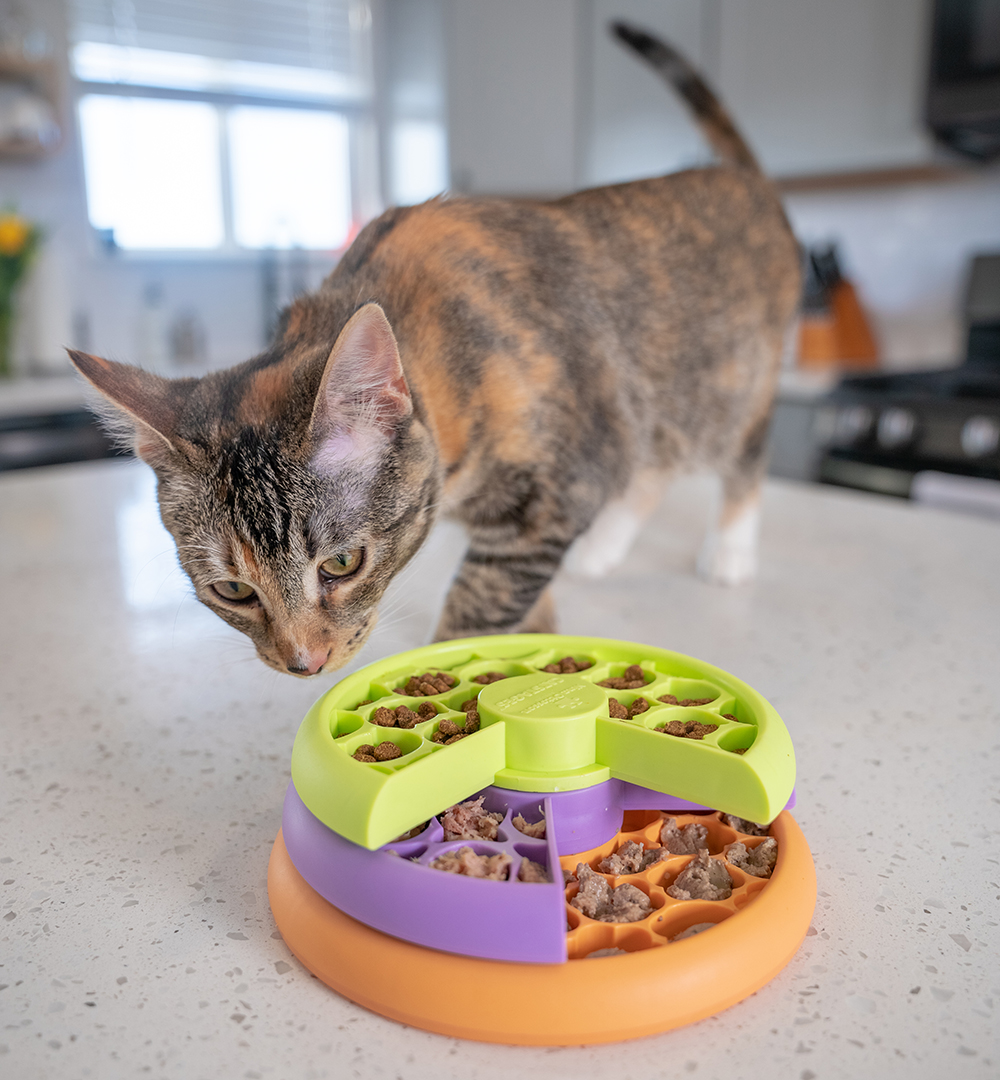
Puzzle feeders
Take care that either you monitor food intake closely, or not allow this to be the only form of food
Displacement Behavior
Type of abnormal behavior
A normal behavior that is performed at an inappropriate time or in a different way
Ex:
Cat grooming itself between should blades when stressed
Dog grabbing toy when excited
Vacuum Behavior
Type of abnormal behavior
Behavior performed in absence of the stimulus that typically initiates it
Ex:
Hens will go through the dust-bathing motions without dust present
Sham chewing sows will make a repetitive chewing motion without food in their mouths
Redirected Behavior
Type of abnormal behavior
A behavior that is directed toward an inappropriate target
Ex:
Chicken feather pecking
Pig tail biting