Final Exam - Dietary Supplement Regulation and Quality
 Call Kai
 Learn
 Practice Test
 Spaced Repetition
 Match
 Flashcards
 Knowt Play
1/34

There's no tags or description
Looks like no tags are added yet.
35 Terms
Learning Objectives
Know key dates of regulations
Know details of legislation
Know the difference between drug and dietary supplement
Know the difference between structure function and health claim
Know how to get a ‘New Dietary Ingredient’ approved.
Know about 3rd party verification (pros and cons)
Know the difference between USP verified ingredient and USP verified Dietary Supplement
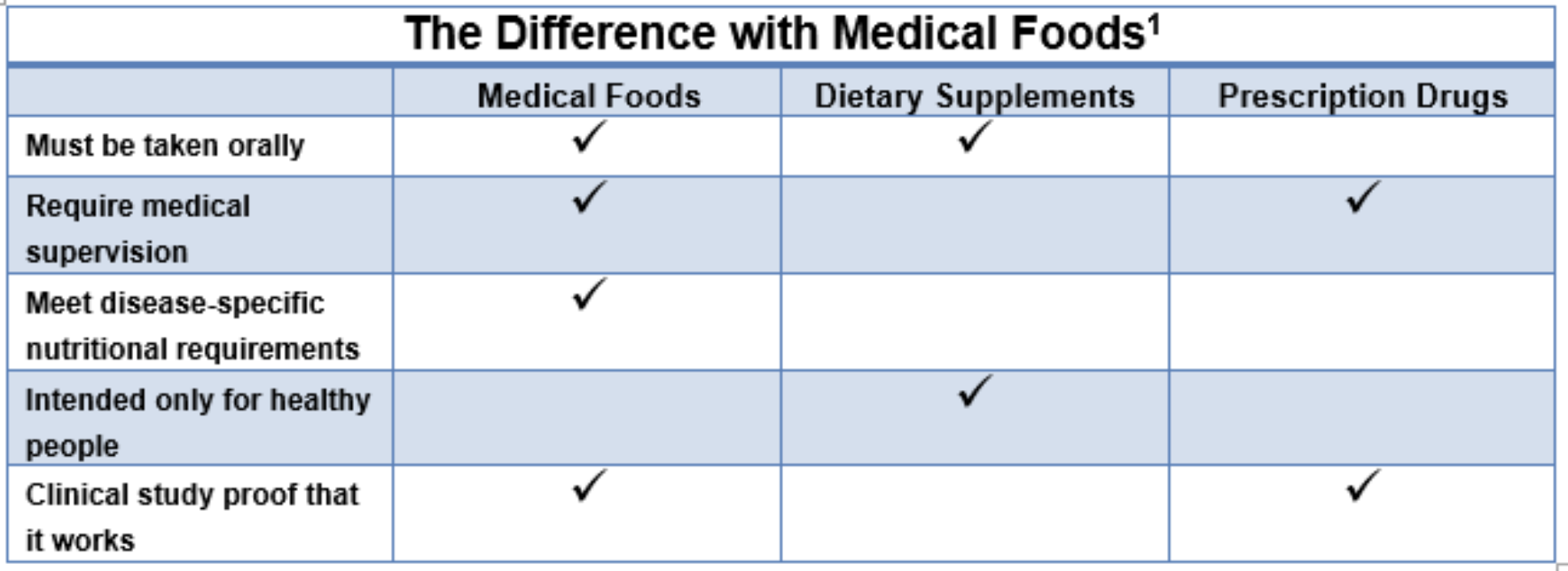
Know the difference between dietary supplements and medical foods/homeopathic medicine
What is DSHEA and what year was it established?
DSHEA - Dietary Supplements Health and Education Act of 1994
Most important regulatory component for dietary supplements
Does DSHEA provide regulations for the quality, safety, or efficacy of dietary supplements?
No
Does the FDA have the same regulations for dietary products and prescription medications?
No
FDA regulates both finished dietary supplement products and dietary ingredients under a different set of regulations than those covering "conventional" foods and drug products (prescription and Over-the-Counter).
What constitutes the definition of a dietary supplement?
① A product intended to supplement the diet that is:
(a) Vitamin
(b) Mineral,
(c) HERB/BOTANICAL
(d) Amino acid
(e) Supplement that increases total dietary intake
(f) A Concentrate, Metabolite, Constituent, Extract or combination of (a, b, c, d and/or e)
② Must be ingested in pill, capsule, tablet, or liquid form.
Dosage form must be ORAL
Topical products are cosmetic products
③ Must NOT be represented for use as a conventional food or as the sole item of a meal or diet.
④ MUST BE labeled as a "dietary supplement."
What is DSHEA’s definition of a dietary ingredient?
The term "new dietary ingredient" (NDI) means a dietary ingredient that was not marketed in the United States in a dietary supplement before October 15, 1994.
There is no authoritative list of dietary ingredients that were marketed in dietary supplements before October 15, 1994.
Therefore, manufacturers and distributors (you) are responsible for determining if an ingredient is a "new dietary ingredient".
Must notify FDA 75 days prior to marketing product.
If you have a new dietary ingredient that you plan on selling, how soon must you notify the FDA about this NDI?
Must notify FDA 75 days prior to marketing product.
What are differences in FDA requirements between medications and dietary supplements?
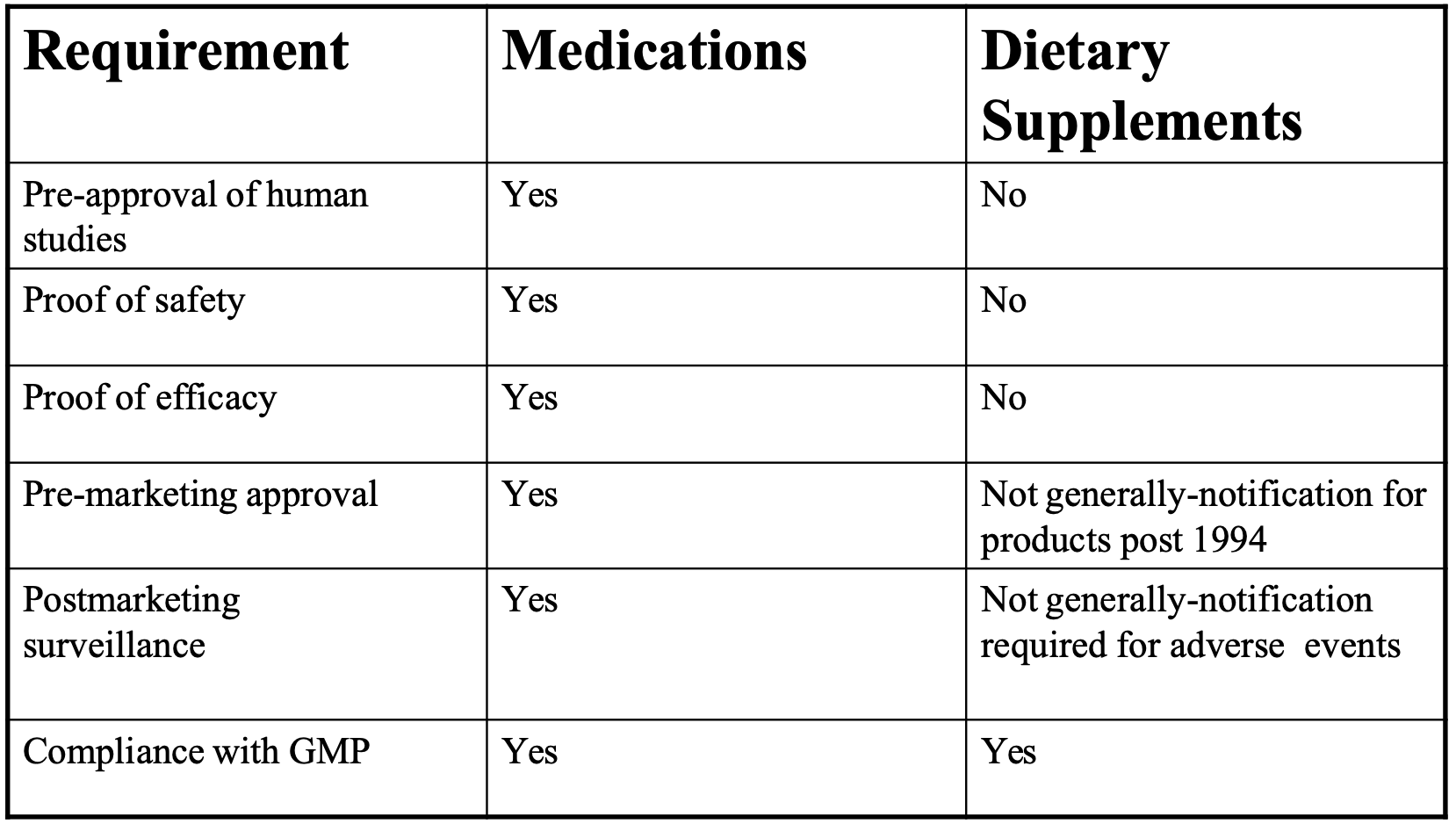
Medications require pre-approval of human studies, proof of safety, proof of efficacy, pre-marketing approval, post-marketing surveillance, and compliance with GMPs
Dietary supplements only require compliance with GMPs
Which FDA requirement is shared between medications and dietary supplements?
Compliance with GMPs
Conditionally***
Pre-marketing approval
Postmarketing surveillance
When did the FDA issue a regulation for cGMPs of dietary supplements?
February 1997: Advance notice of proposed rule making on cGMPs in manufacturing, packing, or holding of dietary supplements.
What are examples of disease states on label claims (aka things that medications can be indicated for)? Are dietary supplements allowed to have these marked on their label?
DISEASES : UNCOMMON OR SERIOUS CONDITIONS
Alzheimer’s disease, Antibiotic, Anti-inflammatory, Arteriosclerotic disease, Benign Prostatic Hyperplasia, Reduces blood pressure, Bronchodilator, Lowers cholesterol, Chronic constipation
Dietary supplements are NOT allowed to claim to treat these disease states
What are dietary supplements allowed to have label claims on? What are examples?
NON-DISEASES: Common conditions associated with natural states/processes that DO NOT cause permanent harm (ALLOWED)
AAMI (age associated memory impairment)
Examples:
Antispasmodic, Appetite Suppressant, Leg edema associated with pregnancy, Cartilage and joint function, Promotion of digestion, Hair loss in aging, Hot flashes, Immune system function, Laxative, Noncystic acne, PMS, Menopausal symptoms, Increasing stamina, Stress relief, Tonic, Wrinkles
What are health claims? Do they require FDA evaluation?
A health claim describes the effect a substance has on reducing the risk of or preventing a disease, e.g., “this product will reduce blood sugar levels in people with high blood sugar."
YES → Health claims require FDA evaluation
Dietary supplement MAY have health claims as long as they are evaluated and verified by the FDA
What are structure/function claims? Do they require FDA evaluation?
A structure/function claim describes the role of a substance intended to maintain the structure or function of the body.
Must commonly found on dietary supplements
NO → Structure/function claims do not require pre-approval by FDA.
Example of difference in structure/function vs health claim
Structure Function claim: “This product will increase the activity of GLUT4 in adipocytes.”
Does not require FDA approval
Health claim: “This product will decrease blood sugar levels.”
*Requires FDA approval
What are label requirements currently required by DSHEA?
Name of product / Latin name of plant
Part of the plant
Amount (i.e. 500mg/capsule)
Statement of nutritional support
Label stating that product is a dietary supplement
Net quantity of product (contents of package)
Statement of identity
Structure/function claim
Supplemental facts
Directions to take
Ingredient list
Name of business of the manufacturer, packer, or distributor
FDA disclaimer (if there is a structure/function claim)→ “This product has not been evaluated by the FDA. This product is not intended to diagnose, mitigate, treat, cure or prevent any disease”
What is the significance of the “DIETARY SUPPLEMENT AND NONPRESCRIPTION DRUG CONSUMER PROTECTION ACT S.3546”
Establishes a mandatory reporting system of serious adverse events for non-prescription (also known as `over-the-counter') drugs and dietary supplements sold and consumed in the United States
What provisions does this consumer protection act (S.3546) have?
It requires manufacturers and distributors of dietary supplements and OTC drugs to report all serious adverse events to FDA.
The committee has limited the reporting requirement to the information FDA really needs: reports of death; a life-threatening experience; hospitalization; a persistent or significant disability or incapacity; a congenital anomaly or birth defect.
The bill recognizes the need for reports to be accurate and valid. It does so in two ways:
By prohibiting false reporting
By authorizing the FDA to issue guidance on the information that is needed for a report to be deemed complete.
15-day timeframe for responsible persons to submit the serious reports they receive to the FDA and requires that manufacturers keep for 6 years.
The new Federal reporting requirement supersedes state reporting.
How soon do you have to report adverse events to DSHEA for a dietary supplement?
15 day timeframe
What does the FDA 21 CFR enforce?
Current good manufacturing practice in manufacturing, packaging, labeling, or
holding operations for dietary supplements
What do GMPs are required for manufacturers of dietary supplements?
New GMP rules require manufacturers to manufacture all dietary supplements under Good Manufacturing Practice Guidelines (GMP)
815 page rule "establishes the minimum CGMPs necessary for activities related to manufacturing, packaging, labeling, or holding dietary supplements to ensure the quality of the dietary supplements
Documentation of the entire manufacturing process
Who enforces the GMPs?
FDA
Can dietary supplements be certified by third party organizations?
Yes… Can be lead to problems down the line
Which organizations can conduct independent analysis of herbal products?
ConsumerLab
National Nutritional Foods Association (NNFA)
National Sanitation Foundation (NSA)
United States Pharmacopoeia (USP)
What are potential issues with verification programs?
Can be expensive
Companies that are certified by programs does not always indicate they are compliant with GMPs
There may not be an agreed-upon monograph for a specific product
Testing assays have variability
What is required for a dietary supplement to have the USP initials on the label?
This is Self-representation
Finished products/ingredients that:
Meet the requirements of an official USP Monograph
Meet general requirements for tests and assays as set forth in the USP–NF
What is required for a dietary supplement to have the USP verification mark on the label?
This is 3rd party verification
Allowed for finished products that:
Pass GMP inspection, including documentation review
Pass testing for strength, integrity, purity
Pass post-verification surveillance testing
What is the relationship between quality control and GMPs?
Quality control is REQUIRED by GMPs
What should be assessed in quality control of a dietary supplement?
Performance characteristics (i.e., dissolution)
Contaminants—not to exceed acceptable levels
Heavy metals
Pesticides (botanicals)
Microbial contaminants: Total plate count; yeast & molds; pathogens (E. coli, Salmonella, S. aureus); aflatoxins (botanicals)
Identity
Potency/label declaration → Must be 100% of what the label says at the time of expiration
What is homeopathy?
A claim that a substance that causes the symptoms of a disease in healthy people would cure similar symptoms in sick people.
“Like cures like”
What is the homeopathic potency scale?
Dilution of 1X = 1:10 → This is considered low potency
Greater dilution = Higher potency in homeopathy
Dilution of 2X = 1:10 is higher potency than 1X
6X = 1:1,000,000
What are homeopathy label requirements?
The rules require packaging to effectively communicate two key disclaimers:
1) “There is no scientific evidence that the product works.”
2) “The product’s claims are based only on theories of homeopathy from the 1700s that are not accepted by most modern medical experts.
What are defined as medical foods?
Foods that are specially formulated and intended for the dietary management of a disease that has distinctive nutritional needs that cannot be met by normal diet alone.
What are the minimum requirements for something to be considered a medical food?
1) Be a food for oral ingestion or tube feeding (nasogastric tube)
ORAL intake only
2) Be labeled for the dietary management of a specific medical disorder, disease or condition for which there are distinctive nutritional requirements, and
3) Be intended to be used under medical supervision.
Prescriptions are not required, but MD must be aware that you are taking
Comparison of dietary supplements / medical foods / prescription drugs