Physics and Human Affairs Exam 2
 Call Kai
 Learn
 Practice Test
 Spaced Repetition
 Match
 Flashcards
 Knowt Play
1/135

There's no tags or description
Looks like no tags are added yet.
136 Terms
The main limitation on the efficiency of heat engines is due to
the second law of thermodynamics
The "efficiency" of a heat engine is defined to be
work output divided by thermal energy input.
A heat engine operates between two reservoirs, one at a temperature of 300C and the other at 200C. In one cycle, the engine takes in 700 J of thermal energy and does 150 J of work. How much thermal energy is exhausted?
550 J
In one cycle of operation, the thermal energy input to a particular heat engine is 200 joules and the exhaust is 80 joules. The efficiency of this engine is
Work= input-exhaust
efficiency= work/input
60%
In the operation of a steam-electric generating plant, the thermal energy input occurs
at the point where the energy from the furnace is transferred into the boiler
If I put two positively charged movable objects near one another, what will they do?
Move away from each other
The basic energy transformation that takes place in all heat engines is
thermal energy to kinetic energy
Does a standard electric vehicle, like a Tesla, come equipped with a heat engine?
no - since it has no gasoline engine, it does not have a heat engine
What is the kinetic energy of a 4kg object that is moving at 3 m/s? The units are joules, so just enter the number in the box below
18
What is the gravitational energy of an object with a weight of 4N that is on a shelf 2 m high? The answer is in joules, so just enter the number in the box below.
8
You put a warm can of coke in a cooler with some ice, and the coke gets cooler. Why? It is because of the flow of thermal energy. Which way is the thermal energy flowing?
from the coke to the ice
You grasp a cold doorknob and find that this warmed your hand and further cooled the doorknob. This violates:
second law of thermodynamics
What is the kinetic energy of a 18 kg bulldog running at 2 m/s?
36 J
When you touch a piece of ice...
thermal energy flows from your hand to the ice
You pour some hot coffee into a cold coffee cup. What is the energy flow like for the next few minutes?
thermal energy flows from the coffee to the cup, causing the cup to warm up
Regarding the above question (the coffee in the cup), what kind of interaction is this?
Heat conduction
The second law of thermodynamics says...
thermal energy flows spontaneously from a high temperature object to a low temperature object
Suppose I positively charge a clear plexiglass rod by rubbing it with felt. I then negatively charge a white pvc rod by rubbing it with felt. What will happen when I bring the white rod near the clear rod?
the clear rod will move towards the white rod
Two identical rods have been rubbed the same way, with the same piece of fur. After the rubbing, one of the rods will be brought near the piece of fur. What will happen?
they will attract
When I walk across a carpet, I scuff electrons off the carpet and onto me. Am I now positively or negatively charged?
negative
If I rub a certain type of clear plastic rod with felt fabric the rod will end up with a positive charge. Why?
electrons rub off the rod and stick to the felt
If I rub a balloon on my hair, it will become negatively charged. If I then put the balloon near a wall, it will stick to the wall. Why?
the wall becomes polarized because the positives stay in place in the wall, but the negatives move away from the balloon. There is an attractive force between the negative balloon and the positive side of the wall, and so they stick together.
Two identical rods have been rubbed the same way, with the same piece of fur. When the rods are brought near each other, what will happen?
they will repel
Which types of particles within the atom are electrically charged?
protons and electrons
If you cut a permanent magnet in half, what do you get?
two magnets, each with a north and a south pole

Where is the electric field strongest in this diagram?
point B
I have two permanent magnets, magnet A and magnet B. If I bring the north pole of magnet A near the south pole of magnet B, what will happen?
magnet B will feel an attractive force, and move toward magnet A
Is a steam electric power plant an example of an internal combustion engine or an external combustion engine?
External combustion engine
In the heat engine part of a steam electric power plant, thermal energy is converted into kinetic energy. Where does that happen?
In the turbine
Can a steam-electric power plant ever be 100% efficient?
No, because it would violate the second law of thermodynamics
A heat engine takes in 200 J of thermal energy per cycle and does 40 J of work. What is its efficiency?
0.2 (20%)
An engine that has an input 400 J of thermal energy while exhausting 300 J has does how many joules of work?
100J
Two identical rods have been rubbed the same way, with the same piece of fur. After the rubbing, one of the rods will be brought near the piece of fur. What will happen?
they will attract
Which of the following would result in an ionized atom (assume you start with a neutral atom)
adding an electron and removing an electron
How do you know that the force between two bar magnets is not due to gravity?
the force between bar magnets can be repulsive, while the gravitational force is always attractive
Each magnet has two different ends. What are they called?
north pole and south pole
What would be found in the nucleus of an atom?
Protons and Neutrons
Objects may be charged in either of two ways, known as
positive and negative
An ion is
an atom with an excess or deficiency of electrons

Where is the electric field weakest in this diagram?
point A
If I put two freely moveable objects near each other (this means that they can move), and both of the objects are negatively charged, what will happen?
they will be repelled by each other
If you saw off one end of a magnet, you will have
two magnets, each having both a north and a south pole
Explain what it means for an object to be electrically neutral
It means it has equal amounts of both positive and negative charges
What type of charge does an electron have?
negative
What kind of field is there around a stationary charged object?
only an electric field
Which one of the following scientists postulated that a changing magnetic field should create an electric field?
Faraday
According to Maxwell's equations, a changing electric field creates...
a magnetic field
Identify all the possible causes of magnetic fields
Electric charges in motion (electric current), The natural magnetism of some elementary particles, such as electrons, Changing electric fields
An interesting difference between wave motion and particle motion is
wave motion transfers only energy while particle motion transfers both energy and matter
Susi rubs a balloon on her hair and then brings it close to her friend Debbie's hair. [Susi and Debbie have similar hair.] How will Debbie's hair react when the rubbed side of the balloon gets close to it?
Debbie's hair will be attracted toward the balloon
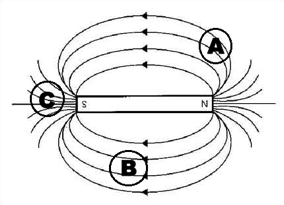
Where is the magnetic field strongest in this diagram?
point C
Which of the following is (or are) correct? (there may be more than one right answer, check all that you think are right)
Moving charges create magnetic fields and changing magnetic fields create electric fields
Which of the following will create a magnetic field? Check all that are correct (so there may be more than one right answer)
A permanent magnet, A moving charged object, electricity flowing through a wire, and A changing electric field
Consider a water wave with an amplitude of 5 cm. How high above the undisturbed water level (the normal water level) is the top of the wave crest?
5 cm
Assuming that these waves are travelling with the same wavespeed through the same medium, which wave has the longest wavelength?
the wave on top has the longest wavelength

Robin Hood pulls back his bow and shoots an arrow towards a deer in Sherwood Forest. The elastic energy in the bow after he pulls it back is 150N. The arrow has a mass of .25Kg. What is the minimum amount of additional information that you need in order to figure out ow much kinetic energy the arrow has just before it hits the deer? (ignore air resistance)
150J
You hold your hand just above burner of an electric stove. your hand feels warm primarily due to…
convection
The process in which thermal energy flows between two objects that are touching is known as
heat conduction
According to the second law of thermodynamics,
thermal energy flows spontaneously from high temperatures to low temperatures
How much kinetic energy does a car have when it moves at 80 km/hr, as compared with when it moves at 40 km/hr?
Four times as much
About when did Joule do his famous experiment with weights and the water wheel
in the 1800s
You receive your electric bill in the mail for the month of February. Your total charge is $45.65 before taxes are added in. You read through the bill but the total amount of energy you consumed is not listed. However the bill state that the power company is charging you $0.091/kW h (kilowatts x hour). How much energy did you consume in kW h?
[note: you don't really need a calculator for this - round the numbers and use what you know about division to help you pick the right answer]
501.6 kW h
Two objects in thermal contact will transfer all their energy to only one of the objects?
False
A good way to insulate your home is by using _____________________?
Insulators
What type of material allows for the slow transfer of energy?
Conductor
Two objects with the same internal temperature can feel like they are at different temperatures.
True
Energy flows faster between two objects if there is a small temperature difference between them.
False
When electrons are transferred to an object, that object becomes positively charged.
False
A charged rod exerts a force on an electrically neutral object.
True
In an insulator, electrons are free to move around so they conduct electricity easily.
False
Like charges repel.
True
Materials that allow electrons to be easily removed or added are called?
Conductors
Charge induction (separation of charges) occurs when:
a neutral object is in the presence of an electric field.
I have a heat engine with an input of 700J and an exhaust of 500J. What is its efficiency?
200/700 = 29%
Kinetic Energy
Energy of Motion. Depends on the mass of the object and the speed of the object.
Gravitational Energy
The Energy due to Position and Gravity. Based on how far an object can fall.
Elastic Energy
Energy due to the ability of deformed objects to “snap back”
Thermal Energy
Energy due to microscope motion
Electromagnetic Energy
Energy due to electric or magnetic forces
Radiant Energy
Energy of light
Chemical Energy
Energy due to molecular structure
Nuclear Energy
Energy due to nuclear forces in an atom
Let’s find the kinetic energy of an American football going about 55 mph (the speed of a punt) Mass is about 0.4 kg. Speed is 25 m/s. What is the kinetic energy?
𝑘𝑖𝑛𝐸= 1/2 ×𝑚𝑎𝑠𝑠 × (𝑠𝑝𝑒𝑒𝑑)^2
125J
What is the kinetic energy of a 2 kg bowling ball travelling 3 m/s? 𝑘𝑖𝑛𝐸= 1/2 ×𝑚𝑎𝑠𝑠 × (𝑠𝑝𝑒𝑒𝑑)^2
9J
WHAT IS THE GRAVITATIONAL ENERGY OF A 2N BOOK ON A SHELF 1M HIGH? 𝑔𝑟𝑎𝑣𝐸 = 𝑤𝑒𝑖𝑔ℎ𝑡 × ℎ𝑒𝑖𝑔ℎ𝑡
2J
What is the gravitational energy of a .5 kg (5 N) book on a shelf that is 2m high? 𝑔𝑟𝑎𝑣𝐸 = 𝑤𝑒𝑖𝑔ℎ𝑡 × ℎ𝑒𝑖𝑔ℎ𝑡
10J
a Book falling, a Roller Coster, and Sky diving are all examples of what kind of energy transfermation?
gravE—> kinE
Stretching a hair tie and letting go, Boe shooting an arrow, and sling shooting a rock are all examples of what kind of energy transfermation?
elastE—> kinE
fireworks launching into air, car engine, and an animal moving are all examples of what kind of energy transformation?
chemE—>kinE
rubbing socks on rug, rubbing hands together, and a moving tire warming up are all examples of what kind of energy transformation?
kinE—>thermE
What is thermal energy?
Microscopic kinetic energy
2nd law of thermodynamics
Heating: thermal energy spontaneously flows when two objects are at different temperatures
Always from high temp to low temp!!
Thermal Equilibrium
Same temperature on both sides!!
How does ice cool soda cans off?
Thermal energy goes from the warm cans to ice
three mechanisms for thermal energy transfer
Heat conduction, Infrared radiation, and Convection
(In most situation, all three are somewhat responsible for energy transfer between warmer and cooler objects.)
IR (Infrared) Radiation
a form of energy that travels as waves and is experienced as heat.
Ex: feeling heat from a campfire, A hear lamp warming, a TV remote uses this
Convection
liquid or gas transforming thermal energy usually by rising.
Ex: Water in a boiling pot circulates as hot water rises and cooler water sinks, transferring heat by convection.
Conduction
the movement of heat from one object to another through touching. Ex: A metal spoon gets hot when left in a pot of hot soup because heat travels through the spoon by conduction.
You touch a hot iron or a hair straightener and burn yourself. Why? How does the thermal energy go from the iron to your hand?
Conduction
How to convert thermal energy to kinetic energy?
Use an engine!!