Organic Chemistry Functional Groups Exam 1

0.0(0)
Studied by 1 person
call kaiCall Kai
learnLearn
examPractice Test
spaced repetitionSpaced Repetition
heart puzzleMatch
flashcardsFlashcards
GameKnowt Play
Card Sorting

1/13

flashcard set

Earn XP

Description and Tags

wow things for exam 1 so exciting

Last updated 10:48 PM on 10/16/26
Name
Mastery
Learn
Test
Matching
Spaced
Call with Kai
Chat

No analytics yet

Send a link to your students to track their progress

14 Terms

1
New cards

Alkene

A compound containing at least one Carbon-Carbon double bond (C=C)

Naming: -ene suffix

Characteristics: Both double-bond carbons are sp² hybridized: trigonal planar, bond angles about 120°.

Nonpolar

Examples: Ethene (ethylene), Propene (propylene), Cyclohexane (cyclic alkene)

Note: Two lines (a double bond) between two carbons that are not part of a benzene ring

Quick ID: C=C, not in a benzene ring, only C and H

<p>A compound containing at least one Carbon-Carbon double bond (C=C)</p><p>Naming: -ene suffix</p><p>Characteristics: Both double-bond carbons are <strong>sp²</strong> hybridized: trigonal planar, bond angles about <strong>120°</strong>.</p><p>Nonpolar</p><p>Examples: Ethene (ethylene), Propene (propylene), Cyclohexane (cyclic alkene)</p><p>Note: Two lines (a double bond) between two carbons that are not part of a benzene ring</p><p>Quick ID: C=C, not in a benzene ring, only C and H</p>
2
New cards

Alkyne

A compound containing at least one carbon–carbon triple bond (C≡C)

Naming: -yne suffix

Characteristics: Both triple-bond carbons are sp hybridized: linear, bond angle 180°. That is why the triple bond and its two neighbors are drawn in a straight line.

Nonpolar

Examples: Ethyne (acetylene), Propyne (terminal alkyne), 2-Butyne (internal alkyne)

Quick ID: C≡C, only C and H

<p>A compound containing at least one carbon–carbon triple bond (C≡C)</p><p>Naming: -yne suffix</p><p>Characteristics: Both triple-bond carbons are <strong>sp</strong> hybridized: <strong>linear</strong>, bond angle <strong>180°</strong>. That is why the triple bond and its two neighbors are drawn in a straight line.</p><p>Nonpolar</p><p>Examples: Ethyne (acetylene), Propyne (terminal alkyne), 2-Butyne (internal alkyne)</p><p>Quick ID: <span>C≡C, only C and H</span></p>
3
New cards

Arene

A compound containing an aromatic ring, most often a benzene ring: six sp² carbons in a flat ring with three alternating double bonds whose π electrons are shared around the whole ring.

Naming: benzene/phenyl- prefix

Characteristics: All six ring carbons are sp²: a flat hexagon with 120° angles.

Nonpolar

Examples: Benzene (C6H6), Toluene (methylbenzene), Naphthalene (two fused rings)

Quick ID: Benzene ring (alternating double bonds), only C and H

<p>A compound containing an aromatic ring, most often a benzene ring: six sp² carbons in a flat ring with three alternating double bonds whose π electrons are shared around the whole ring.</p><p>Naming: benzene/phenyl- prefix</p><p>Characteristics: All six ring carbons are <strong>sp²</strong>: a <strong>flat hexagon</strong> with <strong>120°</strong> angles.</p><p>Nonpolar</p><p>Examples: Benzene (C6H6), Toluene (methylbenzene), Naphthalene (two fused rings)</p><p>Quick ID: Benzene ring (alternating double bonds), only C and H </p>
4
New cards

Alkyl Halide

A compound in which a halogen atom (F, Cl, Br or I) is bonded to an sp³ carbon, a carbon with four single bonds.

Naming: Halo- prefix

Characteristics: The carbon bearing X is sp³: tetrahedral, about 109.5°.

Polar

Examples: Bromoethane (ethyl bromide), 2-Chloropropane (isopropyl chloride), 2-bromo-2-methylpropane (tert-butyl bromide)

Quick ID: Halogen (F, Cl, Br, I) on a carbon with four single bonds

<p>A compound in which a halogen atom (F, Cl, Br or I) is bonded to an sp³ carbon, a carbon with four single bonds.</p><p>Naming: Halo- prefix</p><p>Characteristics: The carbon bearing X is <strong>sp³</strong>: tetrahedral, about <strong>109.5°</strong>.</p><p>Polar</p><p>Examples: Bromoethane (ethyl bromide), 2-Chloropropane (isopropyl chloride), 2-bromo-2-methylpropane (tert-butyl bromide)</p><p>Quick ID: Halogen (F, Cl, Br, I) on a carbon with four single bonds </p>
5
New cards

Alcohol

A compound with a hydroxyl group (–OH) bonded to an sp³ carbon.

Naming: -ol suffix, or prefer hydroxy- when a higher group is present

Characteristics: Oxygen is sp³ with two lone pairs; the C–O–H angle is bent, close to 109°.

Polar

Examples: Ethanol (ethyl alcohol), 2-propanol (isopropyl alcohol), 2-methyl-2-propanol

Quick ID: O-H on an sp3 carbon, oxygen w/ no C=O

<p>A compound with a hydroxyl group (–OH) bonded to an sp³ carbon.</p><p>Naming: -ol suffix, or prefer hydroxy- when a higher group is present</p><p>Characteristics: Oxygen is <strong>sp³</strong> with <strong>two lone pairs</strong>; the C–O–H angle is bent, close to 109°.</p><p>Polar</p><p>Examples: Ethanol (ethyl alcohol), 2-propanol (isopropyl alcohol), 2-methyl-2-propanol</p><p>Quick ID: O-H on an sp3 carbon, oxygen w/ no C=O</p>
6
New cards

Thiol

A compound with a sulfhydryl group (–SH) bonded to an sp³ carbon: the sulfur version of an alcohol. The older name is mercaptan.

Naming: -thiol suffix

Characteristics:

Polar (weakly)

Examples: Ethanthiol (natural-gas odorant), 3-methylbutane-1-thiol (skunk spray), Cysteine (amino acid)

Quick ID: -SH on an sp3 carbon, sulfur

<p>A compound with a sulfhydryl group (–SH) bonded to an sp³ carbon: the sulfur version of an alcohol. The older name is mercaptan.</p><p>Naming: -thiol suffix</p><p>Characteristics:</p><p>Polar (weakly)</p><p>Examples: Ethanthiol (natural-gas odorant), 3-methylbutane-1-thiol (skunk spray), Cysteine (amino acid)</p><p>Quick ID: -SH on an sp3 carbon, sulfur </p>
7
New cards

Ether

A compound with an oxygen atom bonded to two carbon groups (R–O–R′), where neither carbon is part of a C=O.

Naming: alkoxy- prefix

Characteristics: Oxygen is sp³ with two lone pairs; the C–O–C angle is bent, about 110°.

Polar (weakly)

Examples: Diethyl ether (ethoxyethane), MTBE (methyl tert-butyl ether), THF (tetrahydrofuran (cyclic))

Quick ID: C-O-C, oxygen, no C=O

<p>A compound with an oxygen atom bonded to two carbon groups (R–O–R′), where neither carbon is part of a C=O.</p><p>Naming: alkoxy- prefix</p><p>Characteristics: Oxygen is <strong>sp³</strong> with <strong>two lone pairs</strong>; the C–O–C angle is bent, about <strong>110°</strong>.</p><p>Polar (weakly)</p><p>Examples: Diethyl ether (ethoxyethane), MTBE (methyl tert-butyl ether), THF (tetrahydrofuran (cyclic))</p><p>Quick ID: C-O-C, oxygen, no C=O</p>
8
New cards

Amine

A compound in which a nitrogen atom is bonded to one, two or three carbon groups, an organic version of ammonia (NH₃), with no C=O attached to the nitrogen.

Naming: -amine suffix, amino- prefix when higher priority group is present

Characteristics: Nitrogen is sp³ with one lone pair: trigonal pyramidal, bond angles about 107°.

Polar

Examples: Ethylamine (ethanamine), Diethylamine (N-ethylethanamine), Trimethylamine (fishy odor)

Quick ID: N with single bonds to C, nitrogen, no C=O

<p>A compound in which a nitrogen atom is bonded to one, two or three carbon groups, an organic version of ammonia (NH₃), with no C=O attached to the nitrogen.</p><p>Naming: -amine suffix, amino- prefix when higher priority group is present</p><p>Characteristics: Nitrogen is <strong>sp³</strong> with <strong>one lone pair</strong>: <strong>trigonal pyramidal</strong>, bond angles about <strong>107°</strong>.</p><p>Polar</p><p>Examples: Ethylamine (ethanamine), Diethylamine (N-ethylethanamine), Trimethylamine (fishy odor)</p><p>Quick ID: N with single bonds to C, nitrogen, no C=O</p>
9
New cards

Nitrile

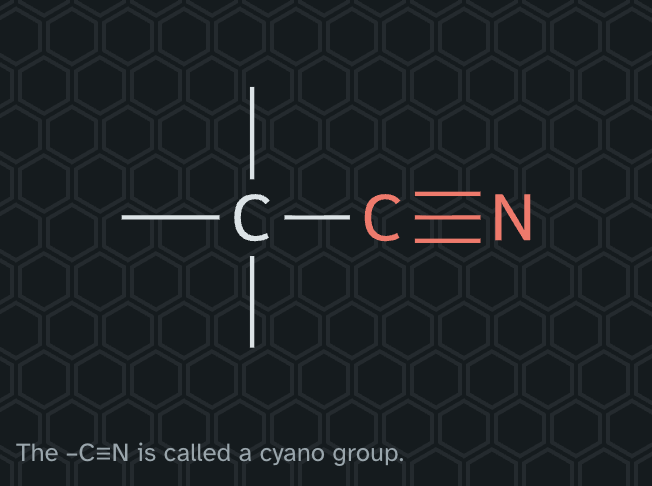
A compound containing a carbon–nitrogen triple bond (–C≡N). The –C≡N group is called a cyano group.

Naming: -nitrile suffix, cyano- prefix, -carbonitrile on a ring

Characteristics: The nitrile carbon and nitrogen are both sp: R–C≡N is linear (180°).

Polar

Examples: Acetonitrile (ethanenitrile), Acrylonitrile (propenenitrile), Benzonitrile (aromatic nitrile)

Quick ID: C≡N, Nitrogen, no C=O
<p>A compound containing a carbon–nitrogen triple bond (–C≡N). The –C≡N group is called a cyano group.</p><p>Naming: -nitrile suffix, cyano- prefix, -carbonitrile on a ring</p><p>Characteristics: The nitrile carbon and nitrogen are both <strong>sp</strong>: R–C≡N is <strong>linear (180°)</strong>.</p><p>Polar</p><p>Examples: Acetonitrile (ethanenitrile), Acrylonitrile (propenenitrile), Benzonitrile (aromatic nitrile)</p><p>Quick ID: <span>C≡N, Nitrogen, no C=O</span></p>
10
New cards

Ketone

A compound with a carbonyl group (C=O) whose carbon is bonded to two other carbons (R–CO–R′).

Naming: -one suffix, oxo- prefix

Characteristics: The carbonyl carbon is sp²: trigonal planar, 120°.

Polar

Examples: Acetone (propanone), Butanone (methyl ethyl ketone), Cyclohexanone (cyclic ketone)

Quick ID: C=O: look at the carbonyl carbon’s other two neighbors, two carbons

<p>A compound with a carbonyl group (C=O) whose carbon is bonded to two other carbons (R–CO–R′).</p><p>Naming: -one suffix, oxo- prefix</p><p>Characteristics: The carbonyl carbon is <strong>sp²</strong>: <strong>trigonal planar, 120°</strong>.</p><p>Polar</p><p>Examples: Acetone (propanone), Butanone (methyl ethyl ketone), Cyclohexanone (cyclic ketone)</p><p>Quick ID: C=O: look at the carbonyl carbon’s other two neighbors, two carbons</p>
11
New cards

Aldehye

A compound with a carbonyl group (C=O) whose carbon is bonded to at least one hydrogen (R–CHO). In formaldehyde both groups are H.

Naming: -al suffix, -carbaldehyde on a ring

Characteristics: The carbonyl carbon is sp²: trigonal planar, 120°, with a polar C=O just like a ketone.

Polar

Examples: Formaldehyde (methanal), Acetalhyde (ethanal), Benzaldehyde (almond flavor)

Quick ID: C=O: look at the carbonyl carbon’s other two neighbors, At least one H

<p>A compound with a carbonyl group (C=O) whose carbon is bonded to at least one hydrogen (R–CHO). In formaldehyde both groups are H.</p><p>Naming: -al suffix, -carbaldehyde on a ring</p><p>Characteristics: The carbonyl carbon is <strong>sp²</strong>: <strong>trigonal planar, 120°</strong>, with a polar C=O just like a ketone.</p><p>Polar</p><p>Examples: Formaldehyde (methanal), Acetalhyde (ethanal), Benzaldehyde (almond flavor)</p><p>Quick ID: C=O: look at the carbonyl carbon’s other two neighbors, <span>At least one H</span></p>
12
New cards

Carboxylic Acid

A compound containing a carboxyl group (–COOH): a carbonyl (C=O) and a hydroxyl (–OH) on the same carbon.

Naming: -oic suffix, -carboxylic acid on a ring, -oate suffix for salts

Characteristics: The carboxyl carbon is sp²: trigonal planar, 120°.

Polar (strongly)

Examples: Acetic acid (ethanoic acid), Butanoic acid (butyric acid), Benzoic (food preservative)

Quick ID: C=O: look at the carbonyl carbon’s other two neighbors, -OH

<p>A compound containing a carboxyl group (–COOH): a carbonyl (C=O) and a hydroxyl (–OH) on the same carbon.</p><p>Naming: -oic suffix, -carboxylic acid on a ring, -oate suffix for salts</p><p>Characteristics: The carboxyl carbon is <strong>sp²</strong>: <strong>trigonal planar, 120°</strong>.</p><p>Polar (strongly)</p><p>Examples: Acetic acid (ethanoic acid), Butanoic acid (butyric acid), Benzoic (food preservative)</p><p>Quick ID: <span>C=O: look at the carbonyl carbon’s other two neighbors, -OH</span></p>
13
New cards

Ester

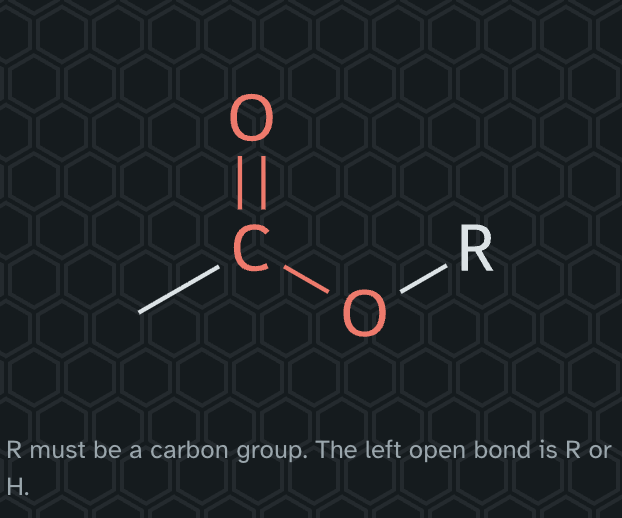
A compound in which a carbonyl carbon is bonded to an –OR group (an oxygen attached to another carbon): R–COO–R′. Esters form from a carboxylic acid and an alcohol.

Naming: -oate suffix

Characteristics: The carbonyl carbon is sp²: trigonal planar, 120°.

Polar

Examples: Ethyl acetate (ethyl ethanoate), Isoamyl acetate (banana flavor), Ethyl butanoate (pineapple flavor)

Quick ID: C=O: look at the carbonyl carbon’s other two neighbors, -O
<p>A compound in which a carbonyl carbon is bonded to an –OR group (an oxygen attached to another carbon): R–COO–R′. Esters form from a carboxylic acid and an alcohol.</p><p>Naming: -oate suffix</p><p>Characteristics: The carbonyl carbon is <strong>sp²</strong>: <strong>trigonal planar, 120°</strong>.</p><p>Polar</p><p>Examples: Ethyl acetate (ethyl ethanoate), Isoamyl acetate (banana flavor), Ethyl butanoate (pineapple flavor)</p><p>Quick ID: <span>C=O: look at the carbonyl carbon’s other two neighbors, -O</span></p>
14
New cards

Amide

A compound in which a carbonyl carbon is bonded to a nitrogen atom: R–CO–NR′₂, where each group on N can be H or carbon.

Naming: -amide suffix

Characteristics; The carbonyl carbon is sp²: trigonal planar, 120°.

Polar (strongly)

Examples: Acetamide (ethanamide), N-Methyllacetamide (peptide-bond model), DMF (N, N-dimethylformamide)

Quick ID: C=O: look at the carbonyl carbon’s other two neighbors, -N

<p>A compound in which a carbonyl carbon is bonded to a nitrogen atom: R–CO–NR′₂, where each group on N can be H or carbon.</p><p>Naming: -amide suffix</p><p>Characteristics; The carbonyl carbon is <strong>sp²</strong>: <strong>trigonal planar, 120°</strong>.</p><p>Polar (strongly)</p><p>Examples: Acetamide (ethanamide), N-Methyllacetamide (peptide-bond model), DMF (N, N-dimethylformamide)</p><p>Quick ID: <span>C=O: look at the carbonyl carbon’s other two neighbors, -N</span></p>



