Dynamics Exam 2
 Call Kai
 Learn
 Practice Test
 Spaced Repetition
 Match
 Flashcards
 Knowt Play
1/26

There's no tags or description
Looks like no tags are added yet.
27 Terms
Rossby number
When Ro << 1, the Coriolis force is very important
time scales: τEarth′s rotation/τmotion

geostrophic balance
when there's no friction, non-accelerating flow (d~u/dt = 0) implies balance between coriolis and PGF
Ro << 1 (large-scale synoptic flow)
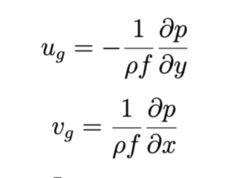
geostrophic wind in x and y coordinates
blows parallel to isobars
balanced circular flow
-circular flows in horizontal plane, using radial coordinate system, are subject to PGF, COR (from Earth's rotation), CF (from rotating flow)
-v is azimuthal (swirling/purely rotational) wind speed
- v>0 = counterclockwise
- 4 balances depending on strength of forces

gradient wind balance
Ro ∼ 1
balance bw PGF, COR, CF

other implications of gradient wind balance
-for same pressure and radius, gradient high has stronger winds
-for same wind speed, gradient low is deeper (larger pressure perturbations)
-gradient lows can (in theory) have counter clockwise or clockwise flow
-gradient highs can only have clockwise flow
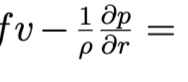
(circular) geostrophic balance
Ro << 1
balance bw PGF and COR
eqn = 0
cyclostrophic balance
Ro >> 1
balance bw PGF and CF
only supports low pressure systems (CCW or CW flow)

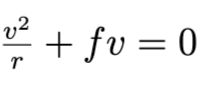
inertial balance
balance between COR and CF
PGF small or 0
subgeostrophic
flow around a (regular) gradient low
supergeostrophic
flow around a gradient high
coriolis direction
right of motion in NH
PGF direction
always high to low pressure
pressure gradient is opposite
centrifugal force direction
ALWAYS outward
circular balances force diagram
gradient balance-
high: hypothetical coriolis in geostrophic = PGF, fv > fvg, v > vg (supergeostrophic)
low : coriolis is weaker than PGF, fv < fvg, v< vg (subgeostrophic)
cyclostrophic balance-
high : not possible bc PGF and CF point outward
low : possible ccw and cw flows
inertial balance-
direction on flow dependent on hemisphere
NH : f > 0, Vin < 0, clockwise
SH : f < 0, Vin > 0, counterclockwise

solutions to gradient wind balance
positve root: regular soln
negative root: anomalous soln

gradient wind balance 4 ways
**using solution to gradient wind balance equation
regular low:
+ sq root → v > 0, counter clockwise
anomalous low:
- sq root → v < 0, clockwise
regular high:
+ sq root → v > 0, clockwise
anomalous high
- sq root → v < 0, clockwise
cannot be counterclockwise because coriolis must be directed inward (3 forces cannot be directed outwards)
cyclonic highs are not possible

surface friction
modulates balanced flows by reducing wind speed and turning flow to be cross-isobaric (towards lows, away from highs)
vorticity
a microscopic measure describing the spin of fluid particles

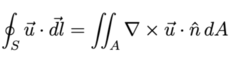
circulation
- macroscopic measure of the rotation of a flow field
- S is a closed path
- dl is a distance increment tangent to the path and CCW

Stokes Theorem
implies that circulation is equivalent to the area integral of the VORTICITY perpendicular to the surface enclosed by path S
when dl = Rdθ and in the same direction as wind, C = the integral of 0 to 2π of |u|→Rdθ. equal to average vorticity within the circle times πR^2
Bjerknes Circulation Theorem
governs evolution of circulation of the flow relative to Earth's rotation
AE = Asinφ, projection of the area enclosed by the material circuit onto the equatorial plane

(Bjerknes) coriolis term
generates circulation through
1) changes in A bc of divergence/convergence of flow
2) changes in latitude (therefore projection of area) by changing orientation of circuit relative to Ω→(via meridional motion).

(Bjerknes) Pressure gradient term
aka barolinic and solenoidal term
-generates circulation if pfg is non uniform
-doesn't generate circulation if atmo is barotropic
-generates circulation in baroclinic fluid

barotropic state
- density is a function of pressure only, ρ = ρ(p)
- parallel density and pressure contours
- ∇ρ × ∇p = 0
- Pressure gradient term is 0
- (density or temperature doesn't vary on pressure surface) no temperature gradient , thus no vertical wind shear ∂u→g/∂p=0
- no thermal wind
baroclinic state
- density is not a function of pressure only, ρ = ρ(p, x, y, t)
- ∇p is not parallel to ∇ρ (or ∇T)
- ∇ρ × ∇p ≠ 0
- pressure gradient term is non-zero
- (density and temperature vary on pressure surface) there is a temp gradient, thus there is vertical shear ∂u→g/∂p ≠ 0
- there is thermal wind
equivalent barotropic state
- temp contours constant along height surface but vary long p surface
- speed of u→g varies with height, not direction
*technically baroclinic