DNZ Unit 6/7
 Call Kai
 Learn
 Practice Test
 Spaced Repetition
 Match
 Flashcards
 Knowt Play
1/77

There's no tags or description
Looks like no tags are added yet.
78 Terms
What is the common lay term for Bovine Respiratory Disease Syndrome (BRDS)?
Shipping fever
In beef cattle, at what age is Bovine Respiratory Disease Syndrome most commonly observed?
Calves under 45 days of age
In dairy cattle, at what age is Bovine Respiratory Disease Syndrome most commonly observed?
Calves under 6 months of age
What three overarching categories of etiologic factors interact to cause Bovine Respiratory Disease Syndrome?
Viruses, bacteria, and environmental stress
Which viral pathogens are primary contributors to Bovine Respiratory Disease Syndrome?
Infectious Bovine Rhinotracheitis (IBR), Parainfluenza 3 (PI3), and Bovine Respiratory Syncytial Virus (BRSV)
Which bacterial organisms are primary contributors to Bovine Respiratory Disease Syndrome?
Pasteurella multocida, Pasteurella haemolytica (Mannheimia haemolytica), and Histophilus somnus
What type of nasal and ocular discharge is characteristic of Bovine Respiratory Disease Syndrome?
Mucopurulent discharge
Which diagnostic sampling procedure involves collecting respiratory secretions directly from the lower trachea in cattle?
Transtracheal aspirate
Which four specific broad-spectrum antibiotics are commonly utilized for treating Bovine Respiratory Disease Syndrome?
Florfenicol, Tilmicosin, Tetracycline, and Enrofloxacin
When a large proportion of a herd is affected by BRDS, how are antimicrobials efficiently mass-administered?
Addition of antimicrobials to the herd drinking water
What primary management practice is essential to prevent outbreaks of Bovine Respiratory Disease Syndrome?
Prevention of overcrowding (ensuring adequate housing space and ventilation)
Is Bovine Respiratory Disease Syndrome (BRDS) a reportable condition?
Yes, BRDS is classified as a reportable disease.
What is the common clinical name for Infectious Bovine Rhinotracheitis (IBR)?
Red Nose
What specific viral pathogen causes Infectious Bovine Rhinotracheitis?
Bovine Herpesvirus-1 (BHV-1)
How is Bovine Herpesvirus-1 transmitted among cattle?
Direct contact with respiratory secretions, aerosolization, saliva, and reproductive secretions
Besides upper respiratory tract signs, what systemic non-respiratory complications can Infectious Bovine Rhinotracheitis cause?
Encephalitis and abortions
What diagnostic molecular assay is used to definitively confirm Bovine Herpesvirus-1 infection?
Polymerase Chain Reaction (PCR)
How is primary viral Infectious Bovine Rhinotracheitis medically managed in an individual animal?
Supportive care, fluid therapy, and antibiotics to prevent secondary bacterial infections
Which respiratory virus in cattle replicates specifically in the lower respiratory tract, predisposing calves to severe secondary bacterial pneumonia?
Bovine Respiratory Syncytial Virus (BRSV)
What is the reported mortality rate associated with Bovine Respiratory Syncytial Virus (BRSV) infection in young cattle?
Approximately 20%
Which bacterial species involved in pasteurellosis primarily infects sheep and goats rather than cattle?
Pasteurella haemolytica (Mannheimia haemolytica)
Why do Pasteurella multocida and Pasteurella haemolytica readily cause pneumonia following viral infection or environmental stress?
They are normal commensals of the respiratory tract that proliferate opportunistically during immunosuppression or mucosal injury.
Which antibiotic administered via drinking water is indicated for herd management of Pasteurellosis?
Sulfonamides
Which parenteral antibiotic is specific for treating individual cases of Pasteurellosis?
Oxytetracycline
What pathogen causes Ovine Progressive Pneumonia (OPP)?
A Retrovirus
What respiratory and systemic clinical signs characterize Ovine Progressive Pneumonia?
Coughing, bronchial exudates, anorexia, fever, and depression
Which serological diagnostic tests are used to detect Ovine Progressive Pneumonia?
ELISA and Agar Gel Immunodiffusion (AGID)
What medical treatment exists for Ovine Progressive Pneumonia?
None (there is no curative treatment)
What management strategy is required to control Ovine Progressive Pneumonia in a flock?
Routine serological testing and culling of positive animals, plus maintaining a closed flock
What etiologic agent causes Bovine Tuberculosis?
Mycobacterium bovis
What key clinical signs are observed in cattle suffering from Tuberculosis?
Emaciation, progressive weakness, anorexia, low-grade fever, and lethargy
What diagnostic screening test is routinely used in vivo for Tuberculosis in cattle?
Intradermal tuberculin test (TB test)
Why is Tuberculosis classified as a critical public health concern in livestock management?
It is both ZOONOTIC and REPORTABLE.
What regulatory action is mandated when Tuberculosis is diagnosed in a herd?
Slaughter of affected animals (no treatment is permitted)
What pathogen causes Bluetongue disease in ruminants?
Orbivirus

Which viral vector-borne disease in sheep produces these classic nasal and oral mucosal ulcerations?
Bluetongue (caused by Orbivirus)
What severe congenital brain malformation is seen in lambs infected in utero with Bluetongue virus?
Pathology image of lamb brain showing large fluid-filled cerebral cavitations Hydranencephaly
What vector control measure is necessary to prevent the transmission of Bluetongue virus?
Insect control (mitigating Culicoides midge populations)
Is Bluetongue disease classified as a reportable animal disease?
Yes, Bluetongue is a reportable disease.
Which environmental and coliform bacterial pathogens cause bovine mastitis?
Klebsiella spp. and Enterobacter aerogenes
Which gram-positive bacterial species are major contagious causes of bovine mastitis?
Streptococcus agalactiae and Staphylococcus aureus
What local mammary gland changes characterize severe acute mastitis in cattle?
Hard, hot udder tissue with abnormal milk exudate
What systemic clinical signs accompany severe acute bovine mastitis?
Fever, anorexia, rumen stasis, dehydration, and diarrhea
What two physiological mechanisms produce Rumen Tympany (bloat)?
Free gas accumulation (eructation failure) and frothy gas entrapment (stable foam formation)
On physical examination of a bloated ruminant, on which side of the abdomen is anatomical distension primarily centered?
Goat with marked swelling in the left paralumbar area The left side (paralumbar fossa)

What diagnostic auditory sign is elicited during percussion of the left flank in a case of free gas bloat?
A high-pitched resonant "ping" sound
What respiratory sign develops in animals suffering from severe acute Rumen Tympany?
Dyspnea with open-mouth breathing (due to abdominal pressure restricting diaphragm excursion)
What initial therapeutic intervention is performed to decompress a ruminant with free gas bloat?
Passing an orogastric tube

What emergency surgical instrument shown here is placed through the left flank into the rumen to relieve refractory gas distension?
Bloat screw (or Trocar and Cannula)
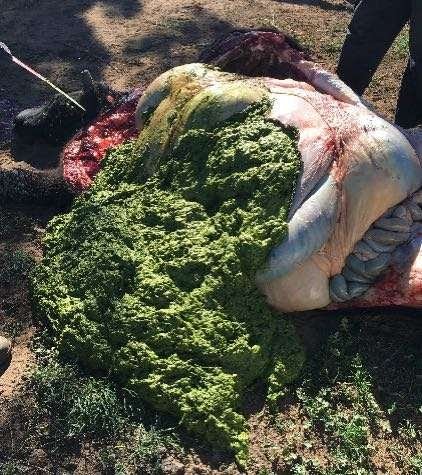
What fatal sequela of acute unmanaged Rumen Tympany is shown in this post-mortem examination?
Rumen rupture
What nutritional deficiency causes White Muscle Disease in young ruminants?
Deficiency of Selenium and Vitamin E
What distinctive postural abnormality affects the forelimbs in calves or lambs with White Muscle Disease?
"Flying scapula" (scapular elevation due to muscular weakness)
What neuromuscular signs are characteristic of White Muscle Disease?
Uncoordinated movement, lameness, and paralysis of the hindlimbs
How is acute White Muscle Disease treated medically?
Parenteral injection of Vitamin E and Selenium
What is the common name for the abomasal parasite Haemonchus contortus?
Barber Pole Worm
What are the common names for the gastric parasite Ostertagia ostertagi?
Brown Stomach Worm or Medium Stomach Worm
What is the common name for parasites belonging to Trichostrongylus spp. in ruminants?
Little Stomach Worm
Which clinical manifestation of severe hypoproteinemia is specifically associated with Haemonchus contortus infection?
Bottle jaw (submandibular edema)
Which diagnostic counting method quantifies parasite eggs per gram of feces in ruminants?
McMaster egg count
Which three classes/types of anthelmintics are commonly used to treat gastrointestinal endoparasitism in livestock?
Fenbendazole, Levamisole, and Ivermectin
What non-chemical pasture management strategy reduces gastrointestinal parasite larval buildup?
Pasture rotation
What etiologic agent causes Johne's Disease in ruminants?
Mycobacterium avium subsp. paratuberculosis (Mycobacterium paratuberculosis)
What are the four clinical stages of Johne's Disease progression?
- Silent, 2. Subclinical, 3. Clinical, 4. Advanced Clinical
What primary gastrointestinal clinical sign characterizes Stage 3 and Stage 4 Johne's Disease?
Profuse watery diarrhea
Why is Johne's Disease exceptionally difficult to eradicate from infected herds?
Infected animals shed bacteria continuously during long Silent and Subclinical stages without showing symptoms.
What regulatory and public health classifications apply to Johne's Disease?
It is ZOONOTIC and REPORTABLE.
What control measure is recommended for heifer calves born to cows infected with Johne's Disease?
Culling heifers from infected dams
Which viral pathogens are major primary causes of neonatal calf scours?
Rotavirus, Coronavirus, and Bovine Viral Diarrhea Virus (BVDV)
Which bacterial agents are common causes of infectious enteritis in young calves?
Escherichia coli, Salmonella spp., and Clostridium spp.
Which protozoal pathogens cause neonatal diarrhea in calves?
Coccidia and Cryptosporidium
What life-threatening systemic complications rapidly result from acute watery calf scours?
Severe dehydration, metabolic acidosis, hypoglycemia, hypothermia, and shock
What two critical solutes must be added to warm IV fluids when resuscitating weak, scouring calves?
Dextrose (to correct hypoglycemia) and Bicarbonate (to correct metabolic acidosis)
How should oral electrolyte administration be scheduled relative to normal milk feedings in scouring calves?
Oral electrolytes must be administered in between milk feedings, never mixed directly with milk.
Why is a skin protectant (e.g., Vaseline or zinc oxide ointment) applied to the rear legs of a scouring calf?
To prevent fecal scald and hair loss caused by chronic contact with watery diarrhea
What color is normal, healthy rumen fluid?
Olive or brownish green
What color shift occurs in rumen fluid in a cow suffering from severe grain overload?
Milky gray
What color shift in rumen fluid indicates prolonged rumen stasis or decomposition?
Dark green or black
How does the odor of rumen fluid change during grain overload compared to rumen stasis?
Grain overload produces an acidic odor, whereas stasis/decomposition produces a putrid odor.