Other conditions of the GI tract & body wall
 Call Kai
 Learn
 Practice Test
 Spaced Repetition
 Match
 Flashcards
 Knowt Play
1/29

There's no tags or description
Looks like no tags are added yet.
30 Terms
What is choke?
Oesophageal obstruction
What is choke usually due to?
Impacted food in oesophageal lumen
Prox cervical region
Distal cervical (thoracic inlet) region
Occ due to ingestion of objects
Sometimes ass. w/ extra-luminal masses/functional abnormalities of oesophagus
How is choke diagnosed?
Usually clinical signs are sudden in onset & ass. with eating
Coughing
Ptyalism
Dysphagia —> food and saliva evident at the nostrils
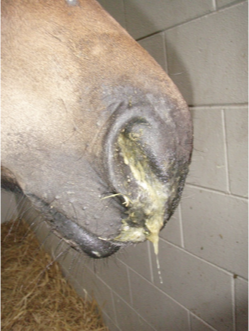
Repeated flexion & extension of neck
How should you initially manage choke?
Most episodes clear spontaneously
Take all feed & water away until cleared
Monitor for 30mins
If no improvement examine
If does resolve spontaneously provide water but wait 1-2hrs until feeding
start feeding with sloppy feeds / grass
Ask about dental hx / any evidence of quidding behaviour —> rule out dental problems
If you are called to a choke case what should you do initially?
Hx
Full clin exam —> palpate L cervical region
Sedate horse (a2 agonist/ butorphanol)
+/- butylscopolamine
helps keep calm & lowers head which reduces aspiration risk
+/- oxytocin
Pass nasogastric tube to confirm diag & identify level of obstruction
Never force tube —> perforation usually fatal
Lavage oeseophagus (warm water, stirrup pump better than using gravity)
Repeat until obstructed material all removed & tube can be passed into stomach
What aftercare is needed with choke?
Decide whether to give ABs
Risk of inhalational pneumonia in protracted cases
Provide water & gradually reintroduce feed over 24-48 hrs
sloppy feed / grass then gradually onto forage
Owner should monitor carefully for nasal discharge/ coughing/ dullness
Rule out underlying cause (e.g. dental)
Endoscopy if 2+ episodes
rule out underlying problem e.g. stricture
What should you do if you cannot clear an obstruction in choke?
Can repeat lavage in 4-8hrs
should not be left longer thsn this —> risk of inhalational pneumonia / dehyd
Endoscopic evaluation (may be required to remove FB)
Occ lavage under GA
Rarely oesophageal surgery required (high risk of complications)
What can cause oesophageal tears/ perforation
Can occur following trauma, secondary to oesophageal pathology (e.g. diverticulum) or be iatrogenic (stomach tubing)
When would you suspect oesophageal tear/ perofration?
What are the further investigations & prog?
Marked swelling and crepitus in the left cervical region
Horses CV parameters will deteriorate rapidly
Further investigations using endoscopy & rads (referral?)
Prog usually hopeless / guarded
What can occur following ingestion of large quantities of grain/ conc feed in horses?
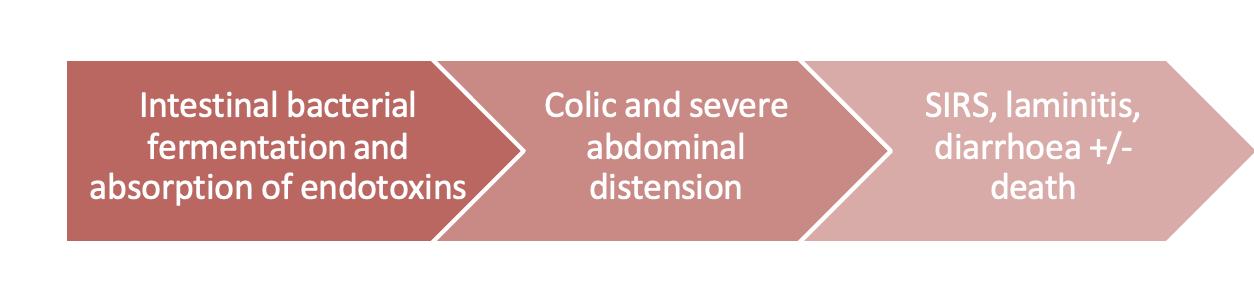
Early & aggressive tx essential
What initial info needs to be obtained from an owner regarding carb overload?
How much & what type of feed ingested?
When occurred?
If other horses could have accessed this
If there are other additives in the feed
How should you initially manage a carbohydrate overload?
Initial clin exam —> vitals, digital pulses, evidence of colic / abdo distension, pass stomach tube to check for reflux
Lavage gastric contents w/ warm water (within 1-2hrs of ingestion occuring) & continue until only water is retrieved
+/- administer activated charcoal (1- 3g/kg as slurry)
Flunixin 0.25mg/kg IV q.8hrs
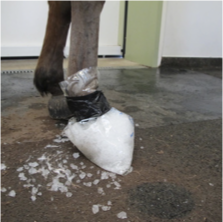
Perform cryotherapy (ice therapy) of the feet —> reduce risk of laminitis
How is carb overload managed in the later stages, once signs of SIRS have developed?
Referral or intensive medical (or occ surgical) management indicated
Prog generally poor if signs of colic / laminitis develop
What is dysphagia?
Dysphagia —> difficulty swallowing but usually expanded to incl difficulty eating
What are the three main groups of causes of dysphagia?
Pain
Neurogenic
Obstructive
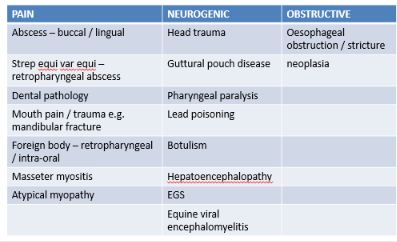
Offer feed to tell what cause is
What is your approach to diagnosing the cause of dysphagia?
Obtain full hx
Watch horse to detemine phase of problem appearing
oral or pharyngeal or oesophageal
Full CE
Neuro exam incl. cranial nerves
Intra oral exam (do not perform in rabies endeic areas i.e. where rabies may be potential cause)
Imaging if required (rads, endoscopy)
Haem/ biochem
Other lab tests (based on suspected cause)
What are the tx options for dysphagia?
Depends on underlying cause
Referral may be warranted in some cases
NSAIDS
Slurry feed / nasogastric intubation
+/- IV fluids
General nursing care & ongoing careful observation
What common traumas can you get to the head area?
Lip laceration —> suture with good cosmetic & functional outcome using local anaesthetic nerve blocks
Tongue injuries —> more common in working equids due to inappropriate tack / tongue twitches applied
Rostral section to frenulum actually not needed always
partial thickness lacerations → conservative management
full thickness lacerations → suturing required
Mandibular fractures- not common- can look alarming
How can you fix a mandibular fracture?
Sedate & examine to determine configuration
Fractures of incisive plate can be treated in field
Sedation & nerve blocks
Intra-oral wiring

List some possible causes of rectal prolapse
Usually secondary to prolonged straining:
D+
Colic
Heavy parasite burden
Proctitis / mass in the rectum
Other causes of repeated straining —> dystocia, retained foetal membranes
How do you manage rectal prolapse according to grades?
Grades I, II (less severe) & III (looks like GII but intussusception of large colon internally)
Reduce prolapsed tissue
Address underlying cause
Grade IV (large colon comes through rectum)
Surgical management (poor prog)
What are the possible consequences of trauma to the abdomen?
Rupture of abdominal viscus
Body wall tears / rupture
Diaphragmatic tears
Abdominal haemorrhage
Peritonitis

How is trauma to the abdomen assessed?
Obtain full hx
Perform full clin exam —> check for other traumatic injuries
± abdominocentesis
Tx based on assessment of degree of trauma / repair of wounds / suspicion of internal organ damage
Referral?
What can cause a haemoabdomen?
Secondary to abdominal trauma:
Splenic rupture / tear
Uterine tear (pregnant mare)
Following parturition:
Rupture of the middle uterine artery
How do you diagnose haemabdomen?
Painful —> can show colic signs
Abdominocentesis useful but be careful of intro of bacteria (blood good medium for bacteria)
U/S
(may need to refer but transport may be contraindicated in some cases)
What can occur secondary to a body wall hernia?
Can result in colic if intestine becomes entrapped
can be difficult to repair if extensive
How does an incisional hernia differ to a body wall hernia?
Relatively uncommon complication following colic surgery (laparotomy) —> incr risk in horses that devekop incisional infection
Often do not cause problems —> cosmesis is an issue
Large hernia → risk of trauma to viscera sitting within hernia

How do you treat an incisional hernia?
Conservative tx initially
Prolonged box rest in some cases
Use of a commercial hernia belt
Surgical repair may be required in some
Repair not performed until 4-6 months after initial surgery
Prosthetic mesh placement
What can thoracic wall injuries lead to?
Penetration of thoractic wall can cause pneumothorax & resp distress
Potential consequences —> intr-thoracic haemorrhage, pleuropneumonia
What do you need to assess when there has been a thoracic wall injury?
Assess for respiratory distress
Full clin exam incl thoracic auscultation
X-ray can tell you if there is a pneumothorax
Determine what structures affected & depth / extent of injuries
If wound suspect has penetrated body wall, wrap cling film around —> wound management can be performed once horse stabilised