W5 Primary Visual Cortex
 Call Kai
 Learn
 Practice Test
 Spaced Repetition
 Match
 Flashcards
 Knowt Play
1/23

There's no tags or description
Looks like no tags are added yet.
24 Terms
How does autoradiograhy work?
Inject a radioactive tracer into a live mammal
Lab animal is shown stimulus
Euthanise animal and take slice of brain
What is retinotopic mapping?
Areas in the visual field are represented next to each other by the receptive fields of the ganglion cells- that same pattern (retinotopic map) is transferred into the LGN
This same pattern is seen in V1
What’s the structure of a simple cell?
Still has varying excitatory and inhibitory regions but no longer has circular receptive fields- RF is elongated outwards
What’s the function of simple cells?
Good at detecting bars of light
Can also detect edges
What is orientation tuning?
Simple cells are selective for certain orientations and respond maximally to specific orientations
What’s the role of receptors?
Interference from the bipolar cells feeds in to create excitatory centre and inhibitory surrounding
What are the first cells we find in V1?
Why does the excitatory centre not cancel out the inhibitory surround?
Excitatory centre is very peaked whereas inhibitory surround is shallowed
Do cortical cells have a firing rate?
A little/none at all
How is a simple cell receptive fields made?
Overlapping LGN cells with different inhibitory/excitatory regions form
Which diagrams indicate whether we get inhibition/excitatory response?

What is the cells preferred orientation?
Stimulus orientation that matches the oriented structure of the cells receptive field
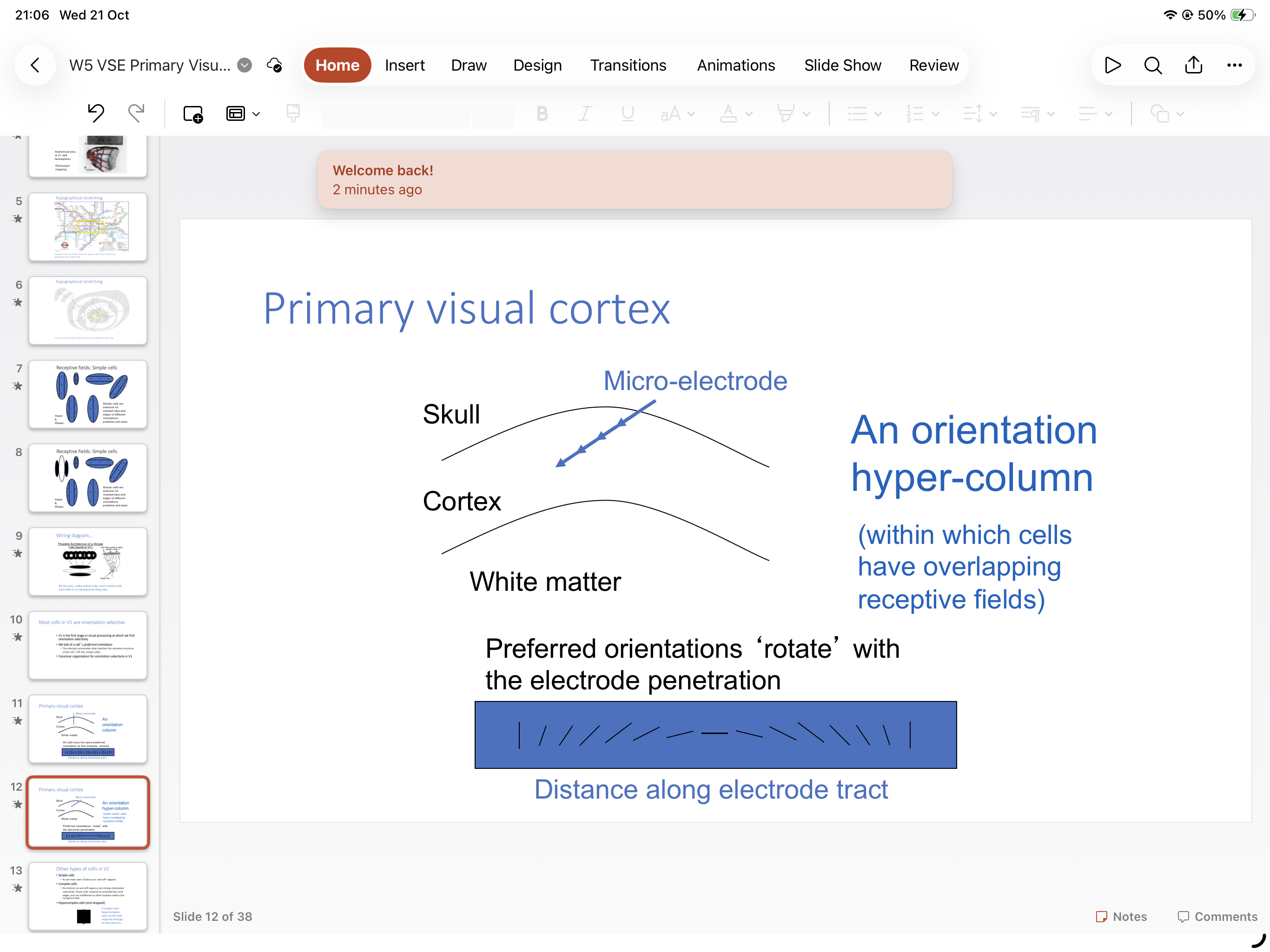
If we inserted a micro-electrode 90 degrees to the primary cortex what would happen?
This is referred to as an orientation column- orientation preference of the cells along the electrode track are all the same (for example, all vertical)- all cells respond preferentially to the same orientation

What would happen if we inserted the micro-electrode at an angle?
As we go along the cortex, we get rotation of the preferred orientation- this is an orientation hyper-column- cells have overlapping receptive fields
What are the other types of cells we have in V1?
Simple cells- distinct on and off regions
Complex cells- no distinct on and off regions but strong orientation selectivity- doesn’t matter where the bar/edge falls as no such inhibitory/excitatory region exists
Hyper complex cells (end stopped)- if a stimulus goes outside the receptive fields, HCC wont respond- only complex cells
What is the hierarchal model of vision (often associated with Hubel and Wiesel)?
In retina and LGN- cell detects edges and bars
V1- simple cells detect oriented edges and bars
V1- complex cells detect oriented edges and bars but not location
V1- end-stopped cells act as corner detectors
Beyond V1- grandmother cells receive so much input from lower levels cells receptive field will instantly recognise stimulus

What is response ambiguity?
Simple cells are not sufficiently specific- edge detectors will respond to bars of both polarities
What are problems regarding the feed-forward hierarchies?
Simple cells are not sufficiently specific
Not enough cells in the brain
Disregard for top-down processing
Emphasis is no longer on feature detection but population codes
What are examples of responses ambiguity?
Medium contrast at preferred orientation gives a medium response- however high contrast off preferred orientation gives medium response
Medium contrast at off orientation will give a weak response
The response of a single simple cell cannot be used to code orientation- its RESPONSE is AMBIGUOUS

How can we tell the difference between contrast?
High contrast, high firing rate and vice versa
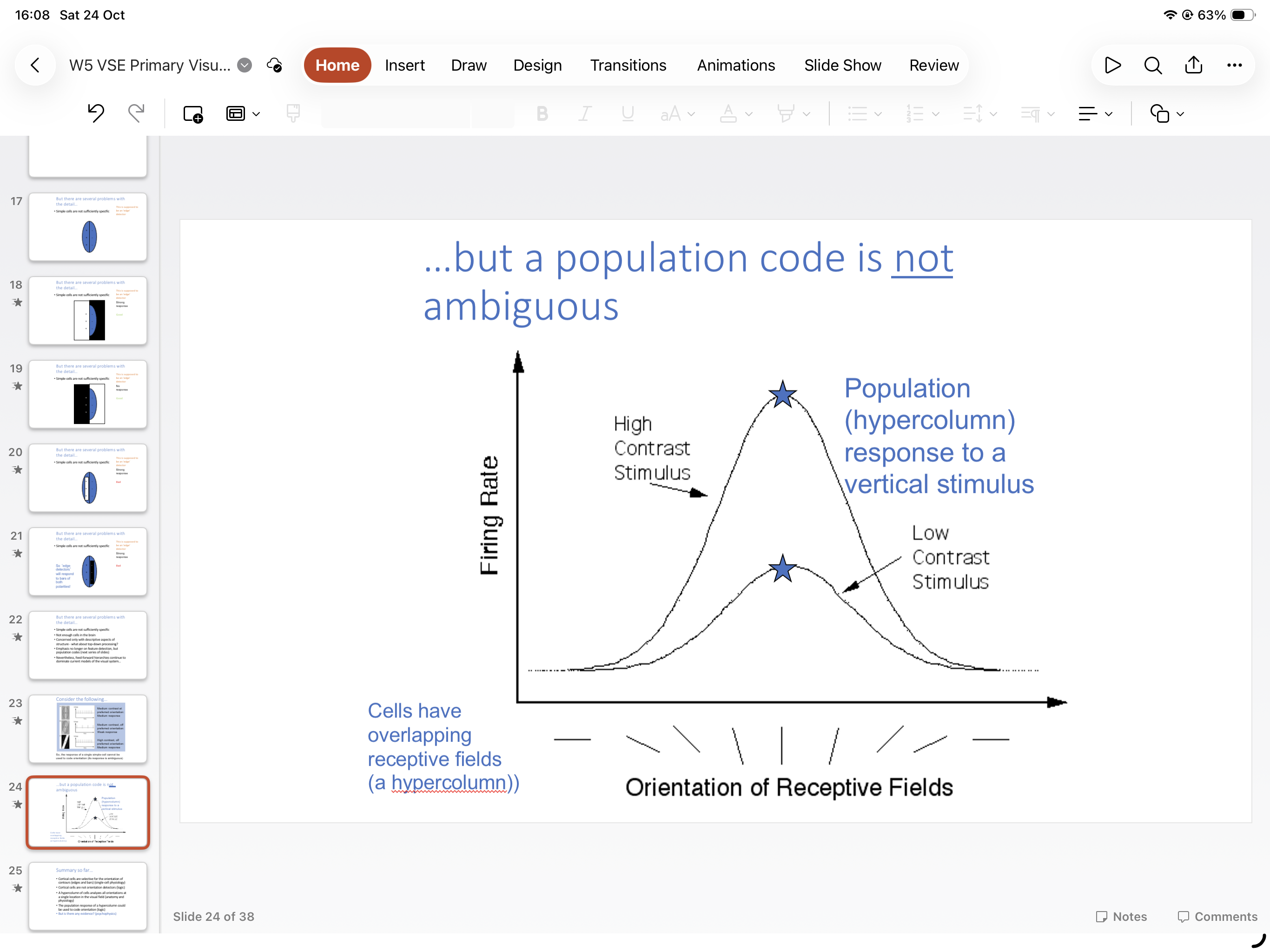
Whats a hypercolumn?
When cells have overlapping receptive fields- population response of a hypercolumn could be used to code orientation (unlike simple cells)
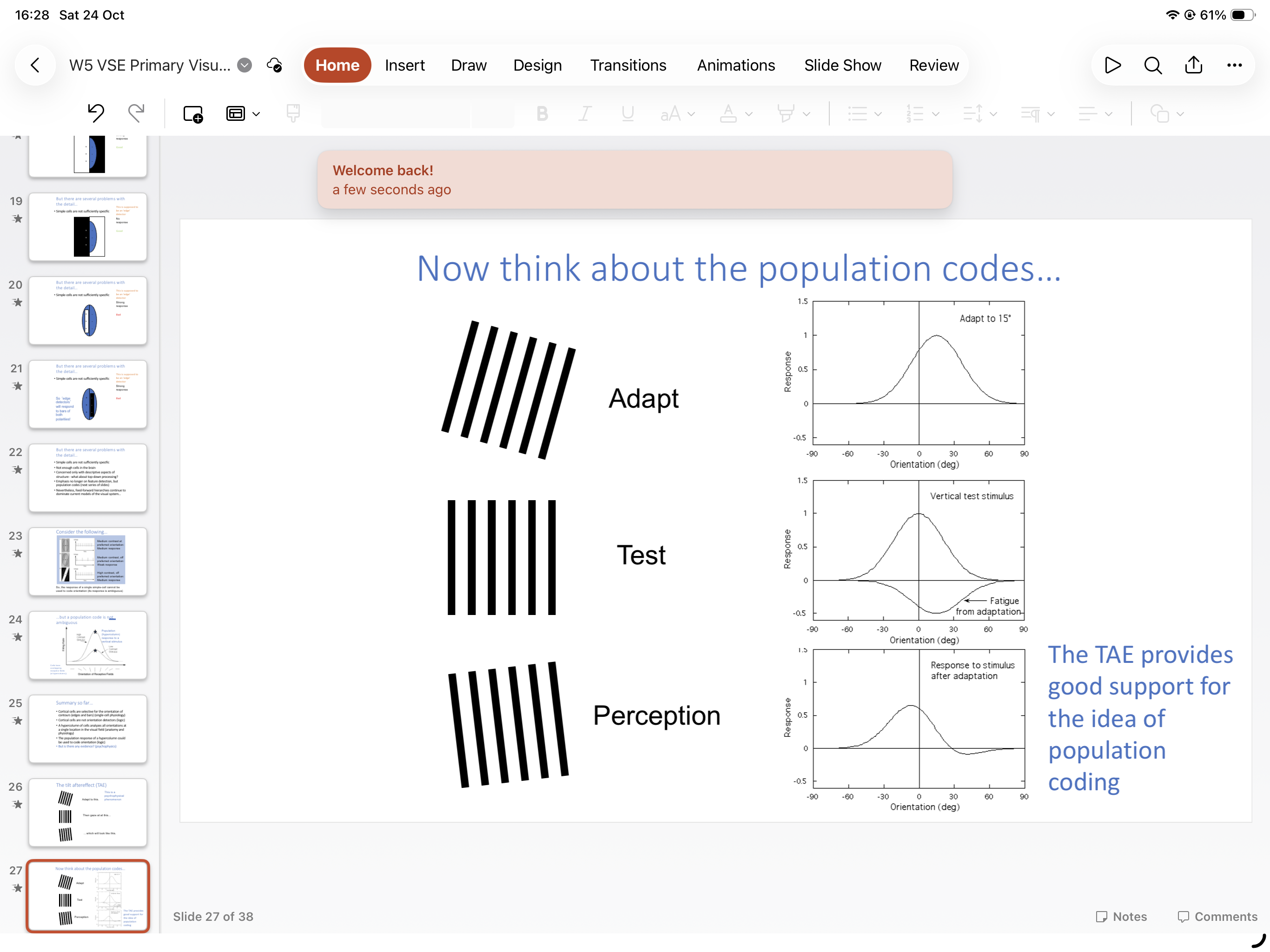
What is the tilt after effect (TAE)?
Cells get maximally fatigued- ones at the peak previously
Peak response shifts to the left
Supports idea of population coding
What are blob cells?
Found in V1, they’re found in the centre of the ocular dominant centres, and they respond to colour (colour selective)- (red/green or blue/yellow)
Whats the organisation of modular (columnar) cells?
100,000 cells per module and 2500 modules in V1
