Exam 3 Comprehensive Health Assessment IU Indianapolis
 Call Kai
 Learn
 Practice Test
 Spaced Repetition
 Match
 Flashcards
 Knowt Play
1/157

There's no tags or description
Looks like no tags are added yet.
158 Terms
accommodation
the process by which the eye's lens changes shape to focus near or far objects on the retina
cataracts
clouding of the lens
consensual reaction
pupillary constriction in the opposite eye
constriction/dilation of pupils
opening and closing of pupil
exophthalmos
abnormal protrusion of the eyeball
glaucoma
increased intraocular pressure
Hirschberg test
Corneal light reflex examination checking for ocular alignment
hyperthyroidism
excessive activity of the thyroid gland
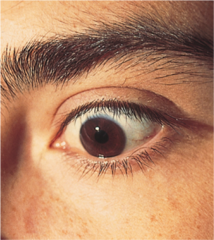
hypothyroidism
A disorder caused by a thyroid gland that is slower and less productive than normal
myopia
nearsightedness
nystagmus
Involuntary rapid eye movements
palpebral fissure
opening between eyelids

PERRLA
pupils equal, round, reactive to light and accommodation
pinna
outer ear

peripheral vision
ability to see objects as they come into the outer edges of the visual field
presbyopia
impaired vision as a result of aging
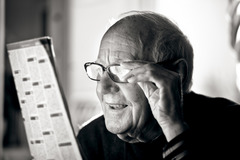
Rinne test
hearing test using a tuning fork; checks for differences in bone conduction and air conduction

strabismus
crossed eyes
tonsils
masses of lymphatic tissue in the back of the oropharynx
visual acuity (distance)
ability of the eye to distinguish shapes and the details of objects at a given distance

Weber test
Test done by placing the stem of a vibrating tuning fork on the midline of the head and having the patient indicate in which ear the tone can be heard.

Achilles reflex
Foot plantar flexing againist your hand is the normal response

Babinski reflex
is the upward movement of your baby's toes when you stroke the bottom of their foot. This reflex disappears by age 2. If the Babinski sign is still present during childhood or appears in adulthood, it may indicate an underlying central nervous system condition or injury.

brachioradialis reflex
is a deep tendon reflex that is elicited by tapping the biceps tendon, c5-c6

biceps reflex
is the same as brachioradialis reflex

Cranial nerve I
Olfactory - smell (sensory)

Cranial Nerve II
Optic - vision (sensory)
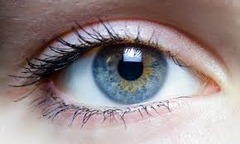
Cranial nerve III
oculomotor -motor eye movement (motor)
Cranial nerve IV
Trochlear - eye movement (motor)
Cranial Nerve V
Trigeminal - chewing face & mouth touch & pain (motor and sensory)

Cranial Nerve VI
Abducens - eye movement (motor)
Cranial Nerve VII
Facial - controls most facial expressions & secretion of tears & saliva & taste (motor and sensory)

Cranial Nerve VIII
Vestibulocochlear - hearing and balance (sensory)

Cranial Nerve IX
Glossopharyngeal - taste & senses carotid blood pressure (sensory and motor)
Cranial Nerve X
Vagus - senses aortic blood pressure & slows heart rate & stimulates digestive organs & taste (sensory and motor)
Cranial Nerve XI
accessory - movement of head and shoulders (motor)

Cranial Nerve XII
Hypoglossal - tongue movement (motor)

dermatome
Area of skin supplied by a single spinal nerve
dysphagia
difficulty swallowing
dysphasia
difficulty speaking
gag reflex
vomiting or retching that results when something is placed in the back of the pharynx. This is tied to the swallow reflex.
graphesthesia
ability to recognize writing on the skin purely by the sensation of touch

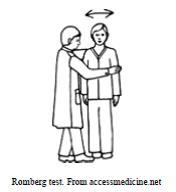
Romberg test
assesses ability of vestibular apparatus in inner ear to help maintain standing balance
stereognosis
ability to recognize objects by feeling their form, size, and weight while the eyes are closed
triceps reflex
The triceps reflex is a deep tendon reflex that elicits involuntary contraction of the triceps brachii muscle. assess the sensory and motor pathways within the C7 and C8 spinal nerves

Epistaxis
nosebleed
Stroke affects?
a lower end on one side of the face
Cover-uncover test is used to detect?
strabismus

Coloboma
A congenital defect of the eye; notch on the outer area of the lower lid.

Ptosis
drooping

Exomphalos
outie belly button
Conjunctivitis
Pink eye
Leukoplakia
thickened, white, leathery-looking spots on the inside of the mouth that can develop into oral cancer
What is erythroplakia?
A clinical term used to describe an oral mucosal lesion.
How does erythroplakia typically appear?
As a smooth red patch or granular red and velvety patch.
The "ah" test what cranial nerve?
Vagus X
What is a common physical characteristic of a patient with hypothyroidism?
They may be overweight.
What is a common physical characteristic of a patient with hyperthyroidism?
They may be very thin.
Malignant
cancerous
Benign
not cancerous
Gynecomastia
Abnormal development of breast tissue in males
Subareolar masses
Unilateral or bilateral; generally transient and disappear within a year; firm and sometimes tender
Breast cancer can be
painless, hard, irregular, no movement
Benign breast disorders
Fibroadenoma, fibrocystic breast disease, mastitis
Fibroadenoma
benign breast mass
fibrocystic breast disease
the presence of single or multiple benign cysts in the breasts
mastitis
inflammation of the breast
What is culture?
Knowledge, beliefs, art, morals, laws, customs, and other capabilities and habits acquired by a person as a member of society.
Ethnicity
Characteristics that a group may share in some combination, such as language, history, lifestyle, and religion
Race
Group of genetically related people who share certain physical characteristics
Spirituality
"A search for the sacred"
Religion
An organized system of beliefs, rituals, and practices in which an individual participates
Cultural awareness
self examination of own cultural background
cognition
process of acquiring knowledge and understanding through thoughts experiences, and senses
psychosis
state of impaired cognitive function
cerebrum
functions are primarily responsible for a persons mental health
parietal lobe
receives and processes sensory input
Frontal lobe
governs decision making, problem solving, concentration, and short term memory
Temporal lobe
responsible for perception and interpretation of sounds
Occipital lobe
interprets visual images
Limbic system
regulates memory and basic emotions
Neurotransmitters
deliver chemicals to provide synaptic transmissions of messages from neuron to neuron or to muscle cells
Self conception
how one describes themself to others
Mood disorders
Major depression, postpartum depression, bipolar disorder, suicide
Psychotic disorders
schizophrenia
Anxiety disorders
generalized anxiety disorder, OCD, PTSD
Intercranial regulation
mechanisms that facilitate or impair neurologic function
central nervous system
brain and spinal cord
Diencephalon
thalamus and hypothalamus
basal ganglia
structures in the forebrain that help to control movement
brainstem
responsible for automatic survival functions
Cerebellum
Balance and coordination
What does the spinal cord conduct?
Sensory and motor nerve impulses to and from the brain.
Dysphagia
difficulty swallowing
peripheral nervous system
the sensory and motor neurons that connect the central nervous system to the rest of the body
What is the autonomic nervous system?
The part of the peripheral nervous system that controls the glands and the muscles of the internal organs.
What does the sympathetic division of the autonomic nervous system do?
It arouses the body.
What does the parasympathetic division of the autonomic nervous system do?
It calms the body.
Multiple sclerosis
myelin sheath destruction. disruptions in nerve impulse conduction
meningitis
inflammation of the meninges