Lecture 8: T cell Development 1
 Call Kai
 Learn
 Practice Test
 Spaced Repetition
 Match
 Flashcards
 Knowt Play
1/37

There's no tags or description
Looks like no tags are added yet.
38 Terms

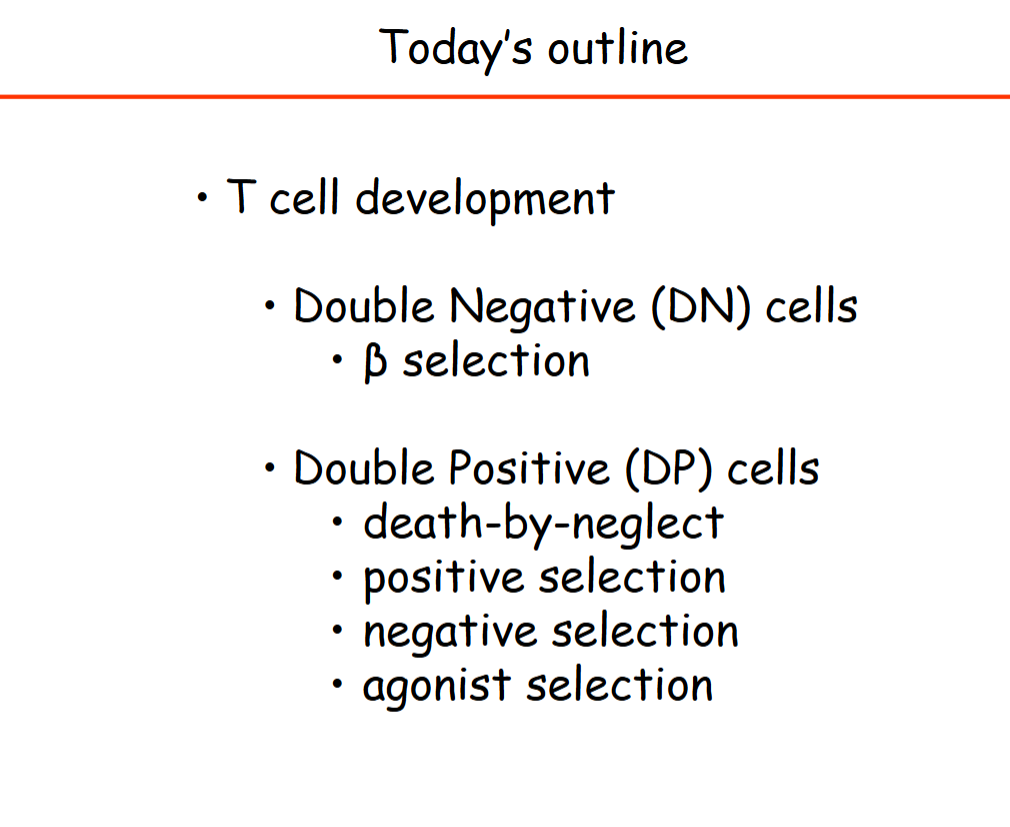
COMPARE with B cell development
***T cell precursors originate in the _____ and develop in the _____
precursors originate in the bone marrow and develop in the thymus
The thymus is located above the heart
• fully formed at birth and at greatest size at puberty
• atrophies (shrinks) as you age but retains some T cell development throughout life
**Developing T cells in the thymus are termed ?
thymocytes
are immature immune cells (specifically, T-cell precursors) that develop inside the thymus before turning into mature T cells (T lymphocytes)
How long does T cell development take?
1-3 weeks
****In the thymus what do T cells undergo?
Where do T cells see and respond to FOREIGN Ag?
In the thymus, T cells undergo “education”
T cells see and respond to foreign Ag in the periphery
*****What are the 3 different sections/structure of a THYMUS LOBULE?
Capsule (outside) separates each lobule
Cortex
Medulla (center)

******T cells at Different stages of development are associated with specific regions
WHAT IS THE DIRECTION OF DEVELOPMENT in the THYMUS aka. which sections does early development occur and which do late?
Where do early hematopoietic precursors from the bone marrow first enter?
Hematopoietic progenitor cells (pro-thymocytes) arrive from the bone marrow via the bloodstream and enter the thymic parenchyma at the CMJ (corticomedullary junction) before migrating outward to the cortex
Development in the thymus goes from cortex → medulla

*****T cell development is split into EARLY + LATE stages:
What occurs during the EARLY stages?
involvement with TCR?
TCR independent (TCR hasn’t undergone TCR rearrangement)
precursors come from bone marrow and develop in the thymus
TCR rearrangements begin and occur in an ordered progression
like B cells, must make a functional rearrangement
**TCR rearrangements occurs in an ordered progression
What is the order?
• Beta chain before a chain
*****T cell development is split into EARLY + LATE stages:
What occurs during the LATE stages? (there are 3 events that occur)
involvement with TCR?
TCR dependent (α/β T cells) (90% of T cell bind classic MHC)
positive selection: selection for cells whose TCRs can interact with self-MHC/self peptide with intermediate affinity
receive survival signals
negative selection: selection against cells with TCRs that strongly interact with self MHC/self peptides*
lineage commitment: thymocytes become CD4+ or CD8+ cells (next day!)
*****What are T cell precursors?
what are they also known as?
What are they defined by?
What occurs at this stage?
Aka. DN1 = Double negative 1 cells
Double negative (DN) stages are defined by lack of CD4 and CD8
expression (i.e. double negative)
T cell precursors leave the bone marrow
thymus-settling progenitors (TSPs)
directed to the thymus via chemokines
*How many DN stages are there?
what are the distinguished by?
There are FOUR
DN1 → DN4
Distinguished by cell surface markers
******List the LOCATION + DESCRIPTION of what occurs at each DN stage
from 1→4
DN1
Location: Corticomedullary junction (CMJ) Bone marrow → thymus
Description = MIGRATION to thymus
DN2
Location: Cortex/subcapsular cortex
Description = TCR gamma, delta + B chain rearrangement + T-cell lineage commitment
DN3
Location: Cortex/subcapsular cortex
Description: Expression of pre-TCR; Beta-selection
DN4
Location = Subscapsular cortex to cortex
Description = proliferation, allele exclusion of B chain, alpha chain rearrangment begins, becomes DP thymocyte

******DN cells can give rise to other lineages up until what stage?
LATE DN2 stage
*****Commitment to T cell lineage is associated with expression/activation of what?
Activation of transcription factors
*****What 2 transcription factors are expressed in association with commitment to T cell lineage?
Notch and GATA-3
*****When do Beta, gamma and delta chains rearrange?
Beginning at the DN2 and into the DN3 stage is when the β, γ, and δ chains rearrange
******what does a T cell becoming α/β or y/delta T cell largely depends on?
are there more α/β or y/delta T cell?
Depends on which receptor functionally rearranges first
if β chain functionally rearranges before delta and gamma then the T cell will become an α/β T cell and vice versa
Much fewer cells become gamma/delta T cell
***If a functional Beta chain rearrangement has been made, the thymocyte expresses what?
Which DN stage does this occur?
Expresses pre-TCR (starts at DN3 stage and continues into the DN4 stage)
***What are the components of a PRE-TCR?
Pre-TCR: β chain, pre-Tα, CD3 components (contains ITAM motif = that are required to initiate T cell activation.)
***What is Beta selection that occurs in the DN3 stage?
selection for a functional beta chain that can form the pre-TCR
***If a functional B chain rearrangement has been made, the thymocyte expresses the pre-TCR (starts at DN3 stage and continues into the
DN4 stage)
• β selection: selection for a functional B chain that can form the pre-TCR
WHAT STAGE OF B CELL DEVELOPMENT DOES THIS RESEMBLE?
PRE-B cell stage:
functional heavy chain made
+ surrogate light chain (V pre B - variable + Lambda 5 - constant)
***true or false: Like the Pre-BCR, the functional assembly of the pre-T cell results in Signalling critical for development?
TRUE
Autonomous Signaling: The receptor does not require a foreign ligand (antigen) to bind; its mere physical assembly on the cell surface is sufficient to fire a signal inside the cell.
similar to pre-BCR but pre BCR = self aggregation
***********What are the 4 main signals sent by the Pre-TCR?
Enabling \(\alpha \)-chain rearrangement: Giving the cell the green light to build the second half of its permanent receptor.
Inducing Coreceptors: Stimulating the expression of both CD4 and CD8 surface markers.
Driving Proliferation: Causing the developing pre-T cell to rapidly divide.
Enforcing Allelic Exclusion: Halting further rearrangement of the TCR \(\beta \)-chain locus to ensure the cell expresses only one specific type of \(\beta \) chain.

******What are DP thymocytes?
WHERE in the THYMUS are the located?
Double Positive
a/B TCR expressed on the surface with both CD4 and CD8 (double positive)
• most prominent thymocyte population (~80%)
• present primarily in the cortex
*****What are the 3 important development checkpoints at the DP stage?
multiple important development checkpoints at the DP stage
• Selection for “useful” T cells (Positive Selection)
• Elimination of strongly self-reactive T cells (Negative Selection)*
some are not deleted but transition to another fate
• CD4 or CD8 single positive cell (Lineage Commitment) – next day
*****How does the RECOGNITION of Ag in T cells differ from B cells?
B cells = recognize ”free” Ag
T cells = recognize Ag in the context of self MHC
****How does the way T cells recognize Ag relate to POSITIVE + NEGATIVE selection
T cells = recognize Ag in the context of self MHC
• therefore, T cells must have TCRs that can bind self MHC to some
degree, but not too strongly to cause autoimmunity
*****When they say T cells undergo EDUCATION in the thymus? what does it refer to?
Positive + negative selection
Selection for TCRs that can bind self MHC to some degree but not too strongly to cause autoimmunity
******POSITIVE SELECTION
What is selected for? what type of AFFINITY?
what cells mediate this selection?
WHERE is this selection
Positive selection selects for thymocytes that interact with intermediate affinity with self-MHC + self peptide
provides survival signals for continued development
mediated by cortical thymic epithelial cells (cTECs) in the cortex
developing thymocytes “learn” what is self MHC and learn MHC restriction
****What is MHC restriction?
Thymocytes become restricted to recognize peptides ONLY in the context of self MHC
******NEGATIVE SELECTION
What is selected against? what type of AFFINITY?
what cells mediate this selection?
WHERE is this selection
selects against thymocytes that interact too strongly with self-MHC + self peptide (central tolerance)
Central Tolerance
Location: Primary lymphoid organs—the thymus for T cells and the bone marrow for B cells.
Timing: Occurs during the early developmental and maturation stages of lymphocytes
Primarily mediated by dendritic cells and macrophages in the cortex
*************TCR affinity model for DP thymocyte fate: DP thymocytes have four fates depending on their TCR’s affinity for self MHC + self peptide
What are the 4 fates?

***Why are so many thymocytes lost by death by neglect?
T cell gene rearrangement = random
High likelihood that a TCR will have little to no affinity for self MHC + peptide
How do we know which cells mediate MHC restriction (T cell only recognize peptide in association with MHC)
hematopoietic or non-hematopoietic cells?
******What was the experiment done? what was the set up?
A mouse what created with a/b MHC
these mice have the machinery to recognize both \(H2^{a}\) and \(H2^{b}\) MHC molecules
Thymus was removed
Hematopoietic stem cells were removed
Transplant a b/b thymus
Inject NEW a/b hematopoietic stem cells
Infect with LCMV (virus)
Observe what haplotype a or b or a/b CD8 cells are generated


*****from the results of this experiment: Which cells mediate MHC restriction
NON-hematopoietic cells in the THYMUS → CTEC cells
if it were hematopoietic stem cells there would be both a + b strain killing
No Killing of Strain A Cells: The T cells cannot kill infected Strain A (H2^a) cells. express haplotype a MHC 2 because cannot recognize peptides not associated with the correct MHC
Killing of Strain B Cells: The T cells successfully kill infected Strain B (\(H2^{b/b}\)) cells.
Even though the developing T cells were genetically capable of recognizing both H2a and H2b, they were forced to mature inside a Strain B thymus. During positive selection, only the T cells that could bind to the H2b MHC molecules on the thymic epithelial cells were allowed to survive. As a result, the entire T-cell repertoire became restricted exclusively to H2b
Summary