lec 12 plant bio
 Call Kai
 Learn
Learn Practice Test
 Spaced Repetition
 Match
Match Flashcards
 Knowt Play
1/78

There's no tags or description
Looks like no tags are added yet.
Name | Mastery | Learn | Test | Matching | Spaced | Call with Kai | Chat |
|---|
No analytics yet
Send a link to your students to track their progress
79 Terms
name of early seed plants
seed ferns
— appear by the late Carboniferous
Conifers
—- dominated through the age of dinosaurs
Gymnosperms
what were the two problems still faced by ferns and friends
• Sperm must swim to the egg
• Spores carry no food and little protection
what carries sperm to the egg through the air: no water needed
pollen
an embryo packed with food inside a protective coat
seeds
= gymnosperms + angiosperms
Seed plants
Gymnosperms: about
1,100 species
Angiosperms (flowering plants): about
300,000 species
Relatively few ——- species, but they dominate —- areas of forest
gymnosperm, huge
what parts of seed plants is shared with all land plants
• Embryo kept inside and fed by the parent plant
• Alternation of generations
• Sporopollenin (now in the pollen wall)
• Cuticle, stomata
what parts of seed plants is shared with all vascular plants
• Dominant sporophyte
• Lignified xylem and phloem
• True roots and leaves (euphylls)
synapomorphies of vascular plants
• lignified xylem and phloem
• dominant sporophyte
what do ovules in seed plants become
seeds
a male gametophyte carried to the ovule
pollen
from secondary growth (not all seed plants)
wood
seed plant synapomorphies is built on ———, which also evolved separately in some lycophytes and water ferns
heterospory
angiosperm synapomorphies
flowers, fruit, double fertilization
Gymnosperms are ——, supported mostly by DNA
monophyletic
gnetophytes were angiosperms’ closest relatives • Both have vessels, flower-like cones, and a kind of double fertilization
“anthophyte hypothesis”
gymnosperms are a clade
Genome-scale data
Cycads + Ginkgo are sisters; gnetophytes sit inside —-, sister to the pine family
conifers
— and double —— evolved independently in gnetophytes and angiosperms, which is kind of bonkers
vessels, fertilization
which stage in gymnosperms is • DIPLOID • The dominant, long-lived stage: the tree itself • Makes pollen cones and seed cones
Sporophyte (2n)
which stage in gymnosperms is • HAPLOID • Microscopic, and dependent on the sporophyte • Male gametophyte = pollen grain • Female gametophyte = inside the ovule, on a cone scale
Gametophytes (n)
Male gametophyte =
pollen grain
Female gametophyte =
inside the ovule, on a cone scale
Megaspores (large, few) →
female gametophytes
Microspores (small, many) →
male gametophytes
what are the two different types of spokes
megaspores and microspores
Seed plants make use of heterospory to solve the issue of needing —- for fertilization
water
Extremely mobile male gametophyte:
pollen
heterospory is not a true ——
synapomorphy
Pollen grain =
an immature male gametophyte in a tough sporopollenin wall
pollen is made in ——- on pollen cones: meiosis, then a few mitoses
microsporangia
Pine pollen: only a few cells, plus two —- for floating in the wind
air sacs
pollen reaches the ovule opening
Pollination
what pulls the pollen inside the ovule
pollination drop
The pollen grain grows a ———- toward the egg
pollen tube
Pollination —— fertilization: in pine they are about a year apart
doesn’t
The mobile —- gametophyte (pollen) allows it to be transferred directly to the —- gametophyte
male, female
Each spore is one —-; the ——- grows from it by mitosis
cell, gametophyte
Male: meiosis →
4 microspores
what are the 4 microspores in pollen
2 prothallial cells (die off), a tube cell, and a generative cell
The generative cell produces 2 ——- via mitosis (No flagella on the sperm)
sperm cells
The tube cell generates the ——- via cell expansion (cell growth, not mitosis)
pollen tube
Female: meiosis →
4 megaspores; 3 die
what happens during meiosis of the female gametophyte
• The survivor divides into thousands of cells
• Most store food (later, the seed’s food)
• 2 or 3 archegonia, each with one large egg
After ———, the male gametophyte grows the pollen tube to deliver the sperm
pollination
The tube carries the sperm to an ——-
archegonium
megasporangium + protective integument, with a small opening (micropyle)
ovule
Meiosis makes 4 megaspores; only — survives
1
the surviving megaspore after meiosis grows into a large, many-celled ———- with archegonia
female gametophyte
After fertilization, the ovule becomes a
seed
the new sporophyte
Embryo (2n)
the female gametophyte
Food(n)
from the integument, the parent’s tissue
Seed coat(2n)
ovules sit exposed on a cone scale
“Naked seed”
The nutritive tissue for the developing gymnosperm embryo is literally the ———- (megagametophyte) • This means the baby plant eats the flesh of its mother (haploid maternal relative) for nutrition
female gametophyte
four branches of gymnosperms
• Coniferophyta (conifers, including pine trees and relatives)
• Cycadophyta (cycads: look like palms)
• Ginkgophyta (ginkgo: lots of these on campus)
• Gnetophyta (a mixed bag of very different plants)
which plants were Dominant until the Cretaceous: mostly what dinosaurs ate
gymnosperms
4 types of gymnosperms
conifers, cycads, ginkgo, and gnetophytes
Seed plants started out with —— sperm
swimming
which types of gymnosperms still have swimming sperm (Pollen tube absorbs nutrients, then releases large, many flagellated sperm that swim a short way inside the ovule)
Cycads and Ginkgo
which types of gymnosperms have no flagella on their sperms (Pollen tube delivers the sperm straight to the egg)
Conifers and gnetophytes
Angiosperms lost —— too, independently
flagella
pines, bald cypress, sequoias, yews, larches, etc. (largest group of gymnosperms)
Needle-like leaves with thick cuticle and sunken stomata: tolerate drought and cold
Includes the tallest (coast redwood) and oldest (bristlecone pine) trees
Economically very important
conifers
coniferophyte is usually
evergreen
Pollen and seeds in separate ——-: spirals of often woody scales
cones
Pine: about — years from young cone to mature seed
two
which type of gymnosperm is Nitrogen-fixing cyanobacteria in special coral-like roots
Look like palms (monocots), but with cones
Many are pollinated by insects (beetles, thrips), not wind
About two-thirds of species are threatened
Once a major part of the flora in the age of dinosaurs; now mostly tropical and often rare
Cycadophyta
what do cycad leaves do when young like ferns
Circinate vernation (leaves spiral when young just like ferns)
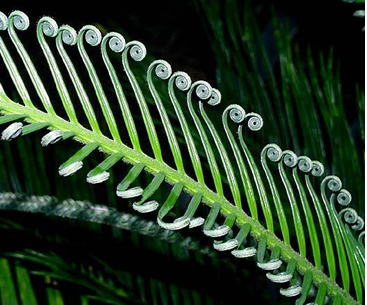
what is this leaf pattern
Circinate vernation
what type of gymnosperm has Only one living species
Commonly planted; possibly wild populations survive in China
The bad-smelling “fruits” are fleshy seeds
Closest living relatives: cycads
Sperm flagellated
ginkgophyta, Ginkgo biloba
Ginkgophyta is an example of what
dioecy • Separate male and female plants
how do ginkgophytes reproduce
Male cones produce pollen, female cones receive it and produce seed once fertilized
what is monoecy
plants produce both female and male cones or flowers. Cones are still separate: two kinds on same plant
what type of gymnosperms have Three very different genera, about 110 species
Sperm with no flagella
A second fertilization in Ephedra and Gnetum
Vascular system with vessels
gnetophyta
what factors do gnetophyta share with angiosperms
• Similar broad leaves (Gnetum)
• Similar fruit-like fleshy seeds
• Vessels and double fertilization