Spatial Resolution (RAD 1102)
 Call Kai
 Learn
 Practice Test
 Spaced Repetition
 Match
 Flashcards
 Knowt Play
1/166

There's no tags or description
Looks like no tags are added yet.
167 Terms

Photographic Properties
visibility of detail is brightness and contrast

Geometric Properties
sharpness of detail is spatial resolution and distortion
spatial resolution
ability of an imaging system to accurately display objects in two dimensions

What does spatial resolution refer to that can be detected in an image?
smallest object

The ability of a radiographic image to demonstrate ______ ______ determines the quality of the spatial resolution, and there will always be some loss of resolution
sharp lines
Spatial resolution is determined by:
- matrix size
- number of pixels
- gray scale bit depth
- Detector Elements (DEL)
- sampling frequency (CR)
- pixel size
- pixel pitch

Spatial resolution is determined by...
matrix size
matrix
series of square boxes giving form to an image

How is the matrix laid out?
by rows and columns

What is each box inside the matrix called?
a pixel
Each pixel is a single numeric which is represented as a single brightness level on the monitor

Each pixel corresponds to a shade of gray representing an area in the patient. This is called a what?
voxel or volume element

A voxel (volume element) is...
3D

A voxel is converted into a __________ value contained in each pixel
numerical

What limits spatial resolution?
pixel size

Is there a digital system that can resolve an object that is smaller than the pixel size? If so, what is it called?
no, there is no digital system that is able to make out objects that are smaller than the pixel size
Spatial resolution is determined by...
the number of pixels
pixel density
number of pixels/mm in an image
A matrix size of 1024 x 1024 contains 1,048,576 pixels while a 2048 x 2048 matrix contains 4,194,304 pixels. The amount of pixels is known as the....
pixel density
The matrix size and pixel density have a(n) ______ relationship
direct
If the matrix size is increased, the number of pixels will __________ which will __________ spatial resolution
increase; increase
↑ matrix size = ↑ # of pixels (pixel density) = ↑ spatial resolution
What determines pixel density?
pixel pitch

An increase in pixel density results in a(n) _________ in number of pixels which ____________ resolution
increase; increases


Which image has the most pixel density?
C

Which image has the least pixel density?
A
pixel pitch
space from the center of a pixel to the center of the adjacent pixel

pixel size
physical size of the pixel square

Spatial resolution is determined by...
bit depth
Each pixel in an image is represented by what?
a series of bits

How many bits are in 1 byte in each pixel of an image?
8 bits

Bit depth is determined by...
ADC (analog to digital converter)
pixel bit depth
the number of bits that have been made available in the digital system to represent each pixel in the image

Pixel bit depth = ______ of bits/pixel
number

Bit depth determines...
the amount of shades of gray available to display

The formula for bit depth is...
2^n
If the pixel depth is increased to 8 bits (2^8), what happens to the pixel and spatial resolution?
the pixel can now have 256 different gray values available to it which increases the gray values resulting in better (more) spatial resolution

Bit depth and spatial resolution have a(n) ________ relationship
direct
↑ bit depth = ↑ spatial resolution
If there is an increase number of bits, the signals from the detector are...
more accurately digitized
The numerical size of an image is the product of what?
number of pixels (pixel length x width of image)
and bit depth (bits per pixel = (m)(n) (bit depth))

Effects of Pixel Size and Bit-Depth

Spatial resolution is determined by...
DEL or Detector Element
DEL (or Detector Element)
flat panel system that is the pixels on the image in which the number of DEL's corresponds to the number of pixels

The number of DEL's and pixels as well as spatial resolution have a(n) _________ relationship
direct
↑ DELs = ↑ # of pixels = ↑ spatial resolution
Spatial resolution is measured by:
- point spread function
- spatial frequency
- modulation transfer function (MTF)
point spread function (or line spread function)
measurement of spatial resolution that expresses the boundaries of an image and measures the amount of blur (penumbra)

spatial (sampling) frequency
measurement of spatial resolution that measures the distance between pairs of lines that can be imaged as distinct from one another
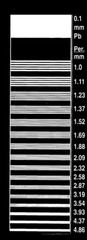
↑ spatial (sampling) frequency = ↑ recorded details/spatial resolution
The more samples available equals better spatial resolution
modulation transfer function
measurement of spatial resolution that measures the accuracy of an image compared to the original object on a scale of 0-1

↑ modulation transfer function = ↑ recorded details/spatial resolution
The more efficient the overall system is equals better spatial resolution
If the modulation transfer function is measured at 1, that means the image is ____________ ___________. Is a measurement of 1 realistic? Why or why not?
completely perfect but is impossible to do as noise and such is also converted into the image
system noise
background information that the image receptor receives
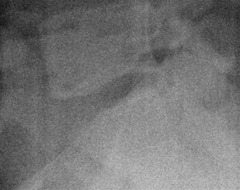
Noise and spatial resolution have a(n) __________ relationship
indirect
If there is an increase in noise, the spatial resolution of an image is __________
decreased

↑ noise = ↓ recorded details/spatial resolution
Digital imaging systems sample the incoming signal at discrete points. This requires that the spatial resolution frequency signal be sampled twice from each cycle.
Nyquist Criterion
the processing algorithm that averages the incoming analog by using the distance between the imaging detector elements
Motion Sharpness
Categories of Recorded Detail
1. Motion (i.e. involuntary & voluntary)
2. Geometric (i.e. OID & SID)
3. Intrinsic
The biggest detriment to recorded detail is....
motion
What are types of motion?
involuntary and voluntary
How do you control involuntary motion?
- knowledge of system
- vary exposure time (decrease exposure time = alleviate motion of patient)

How do you control voluntary motion?
- patient cooperation
- immobilization of part
- suspension of respiration
- short exposure time (to do so, use high mA causing short time, increase KV 15%, or decrease SID)

Example Photo of Motion in A Chest X-ray

When trying to obtain a short exposure time in order to control voluntary motion, you can use a _______ mA technique cause of mA & time's inverse relationship
high

When trying to obtain a short exposure time in order to control voluntary motion, a 15% __________ of KV can be used as this technique uses half the amount of mAS used for an exposure
increase

When trying to obtain a short exposure time in order to control voluntary motion, you can ________ the SID to do so
decrease

Motion causes what of the part in an image? How does this affect recorded detail?
blurring of the part which causes a decrease of recorded detail

↓ exposure time (shortest) = ↑ mA or KV & ↓ SID = ↓ motion = ↑ recorded detail
Geometric Sharpness
Geometric Unsharpness
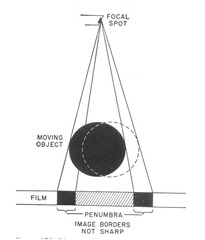
- penumbra
- umbra

penumbra
blur at edge of a structure
umbra
image proper
Penumbra and recorded detail have a(n) __________ relationship
inverse
If there is an increase in penumbra, there is a(n) _________ in recorded detail
decrease
penumbra = blur = unsharpness

↑ penumbra = ↓ recorded detail (causing unsharpness of image)
Geometric unsharpness occurs when the part to be radiographed is _________ or ___________
magnified or distorted
Geometric sharpness is affected by:
1. OID (object image distance)
2. FSS (focal spot size)
3. SID (source image distance)

OID (object image distance) affects _________ _________
geometric sharpness
OID and penumbra have a(n) __________ relationship
direct
When OID is increased, there is a(n) ___________ in penumbra
increase

OID and recorded detail have a(n) __________ relationship
inverse
When the OID increases so does penumbra, this will result in a(n) __________ in recorded detail
decrease

↑ OID = ↑ penumbra = ↓ recorded detail (causing unsharpness of image)
OID also includes _________ _______
patient size
When a patient is larger, there is a(n) ___________ in OID. Why is this?
increase because the part being examined is farther from the IR
In order to reduce OID or magnification of an examine part, you want to place the part as _________ as possible to the IR
close
↑ patient size = ↑ OID = ↑ penumbra = ↓ recorded detail (causing unsharpness of image)
Focal spot size (FSS) affects _______ ________
geometric sharpness
focal spot size
source of x-ray beam is at the target (anode) in the tube in which it is an area on the target rather than a single point at which the x-rays are formed
Focal spot size and penumbra have a(n) __________ relationship
direct
When the focal spot size is increased, the penumbra will ____________
increase
Focal spot size and recorded detail have a(n) __________ relationship
inverse
When focal spot size increases so does the penumbra, there will be a(n) ________ in recorded detail
decrease
When a small focal spot is used, there is _______ recorded detail in an image in comparison to a large
better
Ideally, would you want to use a small focal spot or large focal spot for an image? Why?
small focal spot as it has better recorded detail in an image
↓ focal spot size = ↓ penumbra = ↑ recorded detail (sharper image)