Chapter 6- Enzymes'
 Call Kai
 Learn
Learn Practice Test
 Spaced Repetition
 Match
Match Flashcards
 Knowt Play
1/31

There's no tags or description
Looks like no tags are added yet.
Name | Mastery | Learn | Test | Matching | Spaced | Call with Kai | Chat |
|---|
No analytics yet
Send a link to your students to track their progress
32 Terms
What are Enzymes
Enzymes are Catalysts- increase reaction rates without being used up
Most enzymes are globular proteins but some are RNA
The study of enzymatic processes is the oldest field of biochemisty- late 1700
The study of ezymes has dominated biochemistry in the past and continues to do so
Biocatalysis vs Inorganic Catalysts
Greater reaction specificity: Avoid side products
MIlder Reaction Conditions: Conductive to conditiond in cells (pH 7, 37C)
Higher Reactions Rates: in biologically useful timeframe
Capasity for regulation: Control of biological pathways
Metabolites have many potential pathways of decompositiion
Enzymes make the desired product the most favorable
How to Lower Delta G
Uncatalyzed biomolecular reactions
Two free reactants go to a single restricted transition state- conversion is entropically unfavorable
Uncatylyzed Unimolecular reactions
Flexible reactant goes to ridig transition state
- transition is entropically unfavorable for flexible reactants
Catalyzed reactions
The enzyme uses the binding energy of substrates to organize the reactats to a fairly rigid ES complex
The entropy cost is paid during binding
Rigid reactant complex goes to transition state and conversion is entropically neutral
Transition States
Transition state is the point right before the substrate turns into products
Linus Pauling- Enzymes bind transition states best
enzyme active sites are complimentary to the transition state of the reaction
enzymes bind transition states better than substrates
stronger/additional interactions with the transition state as compared with the ground state lower the activation barrier
What is Enzyme Kinetics
Kinetics is the study of the rate at which compounds react
Affected by:
Enzyme Concentraction
Substrate concentration
Effectors ( examples- Inhibitors and magnessium)
Temperature
Michaelis Mention Equation
Assumptions:
[ES] is constant - formation = breakdown
[P] is negligent at Vo
[S] is much greater from [E]
![<p>Assumptions:</p><ul><li><p>[ES] is constant - formation = breakdown</p></li><li><p>[P] is negligent at Vo</p></li><li><p>[S] is much greater from [E]</p></li></ul><p></p><p></p>](https://assets.knowt.com/user-attachments/1811ee34-8d5f-4ed4-bd05-1c6d78743ab0.png)
kcat
Turnover Number
How many subtrate molecules one enzyme molecule can convert per second
Km
Michaelis Constant
An approximate measure of a substrates affinity for an enzyme
Lower number when more affinity
Vmax
During steady state occurs when all of the enzyme is in the Es complex and is dependent on the breakdown of that complex
Lineweaver-Burk Plot
Linearized plot that is good for analysis of two-substrate data or inhibition
a non linear MM plot should be used to calculate parameters for Km and Vmax

Specificity
kcat / Km
diffusion from the active site limits the maximum values for specificity
can gain efficiency by having a high velocity or affinity for substrate
2-Substrate Reactions
Kinetic mechanism: the order of binding of substrates and release of preoducts
Sequencial vs Ping Pong

Sequencial Kinetic Mechanism Graph
Cannot easily distinguish random from ordered
Normally Random mechanisms will give the intersection point at the y-axis
Lineweaver-Burk Plot: Lines intersect

Ping-Pong Kinetic Mechanism Graph
Lineweaver-Burk: Lines are parallel

Enzyme Inhibition
Inhibitors are compounds that decrease an enzymes activity
Irreversible inhibitors react with the enzyme
one inhibitor molecule can permanently shit off one enzyme molecule
they are often powerful toxins but also may be used as drugs
Reversible inhibitors bind to and can dissociate from the enzyme
they are oten structural analogs of substrates or products
they are often used as drusg to slow down a specific enxyme
Can bind to the free enzyme and prevent binidng of the substrate or bind to the ES complex and prevent the reaction
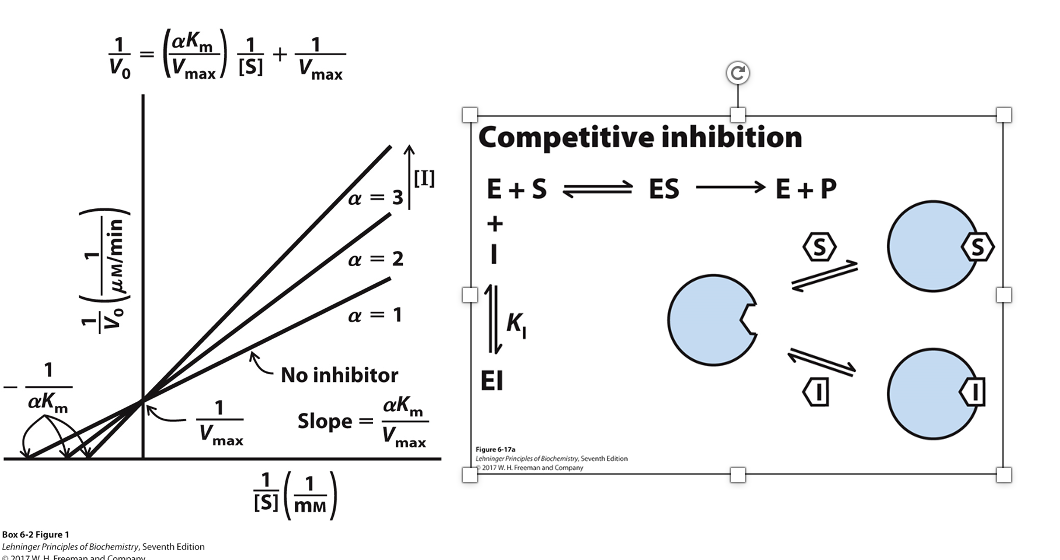
Competitive Inhibition
Competes with substrate for binding
binds with the active site
does not effect catalysis
No change in the Vmax
Apparent increase in Km
LWB: Lines intersect at the y-axis
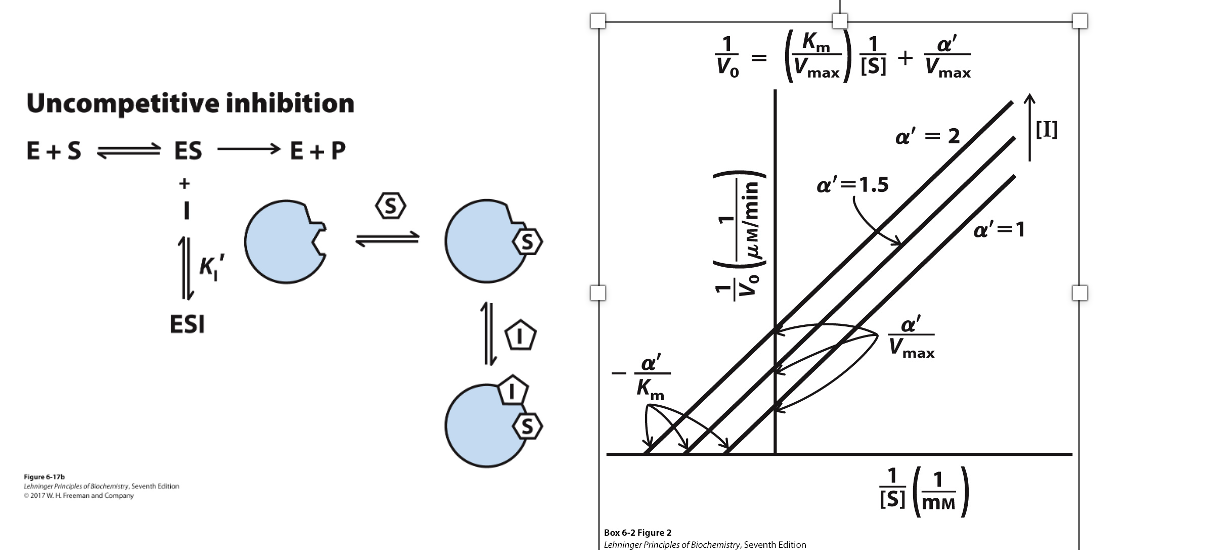
Uncompetitive Inhibition
Only binds to ES complex
does not effect substrate binding
inhibits catalytic function
Decrease in Vmax
Apparent decrease in Km
No change in Vmax / Km
LWB: lines are parallel to each other
Mixed Inhibition
Binds with enzyme with or without substrate
binds to regulatory site
inhibits both substrate binding and catalysis
Decrease in Vmax
Change in Km
LWB: lines intersect at a point left of the y-axis
Noncompetitive are mixed inhibitors but with no change in Km

Noncovalent Modification
Allosteric Regulators
are generally small chemicals
can be positive or improve ezymatic catalysis
can be negative and reduce enzymatic catalysis
Enzyme Activity Regulation
Noncovalent Modification- Allosteric
Irreversible Covalent Modification- Zymogens
Reversible Covalent Modification- Phosphorylation Adenylylaiton
Catalytic Mechanisms
Enzymes may us one or more of the following
Acid-base catalysis: give and take protons
Covalent catalysis: change reaction paths
metal ion catalysis: use redox cofactors and pKa shifters
Amino Acids in Acid-Base Chemistry
Glu/Asp ; COOH to COO-
Tyr/Ser ; OH to O-
Lys/Arg ; NH3+ to NH2
His ; NH+ to N
Cys: SH to S-
Nucleophile
Donated a pair of electrons to form a covalent bond
Example: O- to OH
Electrophiles
Accpets an electron pair to form a colalent bond

Chymotrypsin
Needs Asp, His, and Ser - called proteases catalytic triad

Peptidoglycan and Lysozyme
petidoglycan is a polysaccharide found in many bacterial cell walls
Clevage of the cell wall leads to the lysis of bacteria
Lysozyme is an antibacterial enzyme
Peptidoglycan and lysozyme Mechanism
Asp acts as a nucleophile to attack the anomeric carbon in the first SN2 Step
Glu acts as a Gerneral Acid and protonates the leaving group in the transition state
Water Hydrolyzes the covalent glycosyl-enzyme intermediate
Glu 35 acts as a general base to deprotonate water is the second SN2 Step

Sn1 vs Sn2
SN1:
Two Steps- leaving group leaves then nucleophile attacks
SN2:
One step- Nucleophile attacks and leaving group attacks at the same time
Cross Linking Peptidoglycan
Polysaccharides and peptides cross-linked via transpeptidase reaction

Beta Lactamase
When Beta- lactamase bind to penicillin it causes the penicillin to become inactive by adding an oxygen
When Beta Lactamase binds to Clavulanic acid BL gets inactivated
Cofactors
Molecules that bind to an enzyme and are required for catalytic activity
Metals- Fe, Mn, Co, Cu, Zn, Mo
Coenzymes- small organic molecules that are often derived from vitamins
May loosly bind and be released
May bind tightly / permanetly (prostetic groups)
Apoenzymes vs Holoenzymes
Apo- ezymes that do not have required cofactors ( can work without one)
Holo- enzymes that have a required cofactor (Need it to work)