Eduqas A-Level Biology Core Concepts
 Call Kai
 Learn
 Practice Test
 Spaced Repetition
 Match
 Flashcards
 Knowt Play
1/94

There's no tags or description
Looks like no tags are added yet.
95 Terms
What is the role of Mg2+ in cells
Component in chlorophyll so is essential for photosynthesis
What is the role of Fe2+ in cells
Component of haemoglobin which transports oxygen inside red blood cells
What is the role of PO4 3+ in cells
Used for making nucleic acids and a component of phospholipids
What is the structure of water
2 hydrogen atoms and 1 oxygen atom covalently bonded to each other.
Oxygen end is slightly negative and hydrogen is slightly positive so water is a polar molecule
2 water molecules form a weak hydrogen bond between each other due to opposing charges attracting
Hydrogen bonds are weak but many form a strong lattice
What are the properties and importance of water
Surface tension- Cohesion between water molecules creates surface tension which supports aquatic animals and plants (pond skaters)
Universal Solvent- Water is polar so will attract and dissolve other charged particles so act as a good transport medium in animals and plants
Metabolite- Reactant in photosynthesis and hydrolysis. Produced in aerobic respiration and condensation reactions
High specific heat capacity- Lots of energy needed to break bonds and heat water by 1 degree C. Provides stable environment for aquatic organisms and allows enzymes to catalyse reaction efficiently
High latent heat capacity- Lots of energy needed to break many hydrogen bonds and change water's state. Body uses sweating to cool down as energy is used to evaporate water on skin
Density- Water is less dense than ice. Ice floats on water and forms insulating layer which allows aquatic organisms to survive in water under ice
Transparency- Water is transparent so allows aquatic organisms to photosynthesise
What is a monosaccharide
Singular monomers that form building blocks for larger carbohydrates
Soluble in water so can easily dissolve in bloodstreams of animals

What is a disaccharide
2 monosaccharides joined together in a condensation reaction

What is a polysaccharide
3 or more monosaccharides linked together by glyosidic bonds formed by a series of condensation reactions

Draw the structure of alpha glucose

Draw the structure of beta glucose

What is starch and its properties
Starch is an energy storage polysaccharide in plants made of thousands of alpha glucose monomers
Amylose- Straight chained helical polymer containing a1-4 glycosidic bonds
Amylopectin- Branched polymer containing a1-4 and a1-6 glycosidic bonds
Starch is insoluble and compact
What is glycogen and its properties
Glycogen is an energy storage monosaccharide in animals made from many alpha glucose molecules
Its highly branched to allow quick release of glucose from the ends of branches to be used in respiration. It has both a1-4 and a1-6 bonds
Glycogen is compact and insoluble
What is cellulose and its properties
Cellulose is a structural polysaccharide in plants made up of beta glucose monomers, linked by b1-4 glycosidic bonds
Each adjacent monomer is rotated 180 degrees to each other forming straight chains. Hydrogen bonds form between the OH groups of the chains which forms a strong microfibril that combines with others to form a strong cellulose bundle
Cellulose is strong, rigid and permeable
What is chitin and its properties
Chitin is similar in structure to cellulose but some OH groups on each molecule are replaced with nitrogen containing acetyl amine groups making chitin a muco-polysaccharide
Chitin is strong, lightweight and waterproof creating good exoskeletons for arthropods (insects, arachnids etc.)
What are triglycerides and how are they formed
Made from fatty acids and glycerol, formed in a reaction where 3 fatty acids link to one glycerol by an ester bond

What are phospholipids
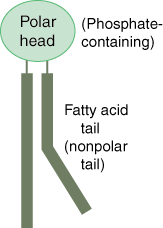
They contain a glycerol, 2 fatty acids and a phosphate group
Their fatty acid tails are hydrophobic (repel water) and their polar head group is hydrophilic (attracted to water)
What is a saturated fatty acid (makes saturated triglyceride chain)
Contains no carbon to carbon double bonds
Maximum number of hydrogen atoms bound to carbon atoms
Straight chain formed
What us an unsaturated triglyceride (makes unsaturated triglyceride chain)
One or more carbon to carbon double bonds
Doesn't contain the maximum number of hydrogen atoms
Chain formed has kinks
How does saturated and unsaturated fat affect human health
Saturated- Transported on LDL's and blocks major arteries causing harm
Unsaturated- Transported on HDL's and carry harmful fats away to the liver
Describe the primary structure of a protein
The number and sequence of amino acids in a polypeptide chain
Variety achieved by:
Total number of amino acids
Type of amino acids
Order of amino acids
Peptide bonds between amino acids
Describe the secondary structure of a protein
Primary structure of polypeptide chain coiled to form an alpha helix (collagen, keratin) or beta pleated sheet (silk)
Structures stabilised by hydrogen bonds
Describe the tertiary structure of a protein
Secondary structure folded to create complex 3D shapes e.g. Globular proteins (enzymes, hormones, plasma and cell membrane proteins)
Structure held in shape by following bonds and interactions between R-groups of amino acids:
Hydrogen bonds between O and OH
Ionic bonds between oppositely charged R groups
Disulphide bridges between S atoms
Hydrophobic R group interactions on inside of protein
Hydrophobic R group interactions on outside of protein
Describe the quaternary structure of a protein
More than one polypeptide chain, each with a tertiary structure, combine to form large protein complex. Bonds are similar to tertiary structure
E.g. Haemoglobin
What is a fibrous protein and how is it suited to its function
3 alpha helix polypeptide chains twisted into rope like strands held together by hydrogen bonds
They're:
Tough
Non Specific
Insoluble
What is a globular protein and how is it suited to its function
Tertiary or quaternary proteins that are:
Compact and spherical
Specifically shaped
Soluble in water
Name properties of lipids
Insoluble in water but soluble in organic solvents (ethanol etc.)
Fats are solid at room temperature
Oils are liquid at room temperature
Name functions of lipids
Energy storage
Protection of vital organs
Thermal insulation
Buoyancy
Metabolic water
Waterproofing
What is the structure of an amino acid

What is a dipeptide
2 amino acids joining in a condensation reaction between amino group of one acid and carboxyl group of another
Peptide bond formed
What is a polypeptide
Many amino acids joined together by peptide bonds
Mitochondria
Mitochondria releases energy in the form of ATP during photosynthesis
Features:
Double membrane with intermembrane space
Cristae increase surface area
Matrix contains chemical compounds for aerobic respiration
DNA for self replication

Rough endoplasmic reticulum
Internal system of flattened membrane sacs (cisternae) covered in ribosomes
Synthesizes and transports proteins

Smooth Endoplasmic Reticulum
Similar to RER (contains cisternae) but with no ribosomes
Synthesizes and transports lipids
Ribosomes
Made up of a small and large sub-unit made of rRNA and protein
Used for protein synthesis by providing the code for a sequence of amino acids

Golgi Body
Interconnected membranous sacs (cisternae)
Functions:
Modifying and packaging proteins into secretory vesicles
Secreting carbohydrates
Producing glycoprotein
Transporting and storing lipids
Forming lysosomes

Lysosomes
Made by golgi body and contain digestive enzymes for:
Breaking down worn-out organelles
Digesting material that has been taken into the cell

Centrioles
Found only in animal cells
2 rings of microtubules arranged in hollow cylinders which migrate to opposite sides of the cell during mitosis

Vacuoles
Plant cell:
Large permanent fluid filled sac bound by a single membrane (tonoplast). Contain cell sap which stores chemicals e.g. glucose, amino acids, minerals + vitamins. Also supports soft plant tissue
Animal cell:
Small temporary vesicle that may occur in large numbers, formed by phagocytosis

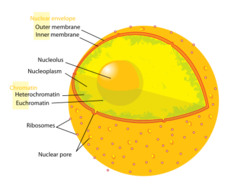
Nucleus
Retains genetic information (DNA) which codes for protein synthesis
Features:
Nuclear envelope- Double membrane with pores to allow transport of mRNA and ribosomes
Nucleoplasm- Cytoplasm like material that contains chromatin
Chromatin- Coils of DNA bound to histone protein. Condenses to form chromosomes during cell division
Nucleolus- Synthesize rRNA
Chloroplast
Only found in plant cells as they are the site for photosynthesis.
Features:
Chlorophyll- Photosynthetic pigment found in thylakoids
Stroma- Colorless matrix containing ribosomes (70S), circular DNA for self replication and lipid+ starch grains
Grana- Flattened sacs called thylakoids are stacked to form grana, which are connected to each other by lamellae

Plasmodesmata
Narrow pores in the cell wall where fine strands of cytoplasm pass through, connecting one cell to another
Structure of a prokaryote
Single celled organisms lacking membrane bound organelles (nuclei) with DNA free in the cytoplasm
Features:
Pili- Short hairs with protective, reproductive or signaling functions
Capsule/Slime layer- Protection
Meosome- Infoldings of cell membrane where reproduction occurs
Photosynthetic membranes- Only in green/blue algae and used for photosynthesis
Plasmid- Transfers genetic information from one cell to another
Flagellum- Cell movement

Structure of viruses
Acellular organisms (not made of cells).
Contain no organelles, chromosomes, have no metabolism and cytoplasm. Hijack hosts metabolism to multiply inside host cell when it hijacks it
Made of nucleic acid surrounded by a protein coat. Viruses either have DNA or RNA

Epithelial tissue
Forms a continuous layer covering or lining internal and external surfaces of the body
Squamous Epithelical Cells- Flattend cells found lining body cavities (mouth and alveoli)
Cubodial Epithelium- Cube shaped cells found lining kindey tubules and gland ducts
Simple Columnal Epithelium- Elongated column shaped cells that are found lining the stomach and intestines
Ciliated Epithelium- Column shaped cells with fine hair like projections on the surface e.g. in the trachea or oviduct
Cell Membrane
Principle components are phospholipid and protein molecules
Intrinsic Protein: Goes all the way through protein (channel or carrier proteins)
Extrinsic Protein: Associated with one layer only. May act as receptors for hormones.
Also contains carbohydrates (attaches to proteins to form glycoproteins and to phospholipids to form glycolipids) and cholesterol which holds together the fatty acid tails

Why is a cell membrane reffered to as the fluid mosaic model
Cell membrane and components are freely moving. Proteins are located at random points of cell membrane
What factors affect permeability of a plasma membrane
Temperature- Increase in temperature leads to increase in permeability because phospholipids have higher kinetic energy
Organic Solvents- When they dissolve in phospholipids they denature proteins, creating gaps so permeability increases
Diffusion
Passive movement of a molecule or ion down concentration gradient
Rate increases if:
Concentration gradient increases
Thickness of surface decreases
Surface area of membrane increases
Size of diffusing molecule decreases
Lipid soluble molecules are being transported (water soluble are polar)
Temperature increases
Facilitated Diffusion
Passive transfer of polar molecules or charged ions down a concentration gradient in channel or carrier proteins e.g. Na+ and glucose
Channel Proteins- Filled with hydrophilic pores
Carrier Proteins- Polar molecule attaches to binding site causing protein to change shape and release molecule on other side
Co Transport
A type of facilitated diffusion that brings molecules and ions into cells together on the same transport protein molecule
Passive
Down concentration gradient
E.g. Na+ and glucose
Active Transport
Transport of ions and molecules against concentration gradient
Uses energy from hydrolysis of ATP and requires carrier protein which acts as pump.

Exocytosis
Substances leave cell though cytoplasm in a vesicle
Vesicle produced in cytoplasm (budding off one end of Golgi body) and migrates to plasma membrane, which fuses with it and secretes its contents outside of the cell
Active so requires ATP

Endocytosis
Membrane folds around particle, creating vesicle with particle trapped inside
2 types of endocytosis:
Phagocytosis: Uptake of solids
Pinocytosis: Uptake of liquids
Active so requires ATP

Osmosis
Diffusion of water from an area of high water potential to an area of low water potential across selectively permeable membrane
Passive so doesn't require ATP
What is water potential
The tendency for water to leave a cell or solution by osmosis
Water moves from an area of high potential to an area of low potential
Measured in kPA
Highest value for water potential is 0 kPa (only pure water has this)
When you add solute to a solution, water potential decreases
State what hypertonic, hypotonic and isotonic solutions are
Hypotonic- Water potential higher outside cell so water moves into cell
Hypertonic- Water potential is higher inside cell so water moves out
Isotonic- Water potential is equal so no net movement of water
How does water potential affect plant cells
Hypotonic Solution- Water moves into cell, making it turgid. Cell doesn't burst because of cell wall
Hypertonic- Water moves out of cell causing vacuole to shrink and cytoplasm + cell membrane withdraw from cell wall causing the plant cell to become plasmolyzed.
When 50% of cells are plasmolyzed, its called incipient plasmolysis
How does water potential affect animal cells
Hypotonic- Water moves in through osmosis and cell will eventually burst (lyionsis) because it has no cell wall to support it
Hypertonic solution- Water will move out through osmosis and cell will shrink (crenation)
How do enzymes speed up the rate of metabolic reactions
Lowering the activation energy
What is an anabolic reaction
Builds larger molecules from smaller molecules and requires energy e.g. condensation, photosynthesis
What is a catabolic reaction
there is a breakdown of macromolecules into smaller molecules; releases energy e.g. hydrolysis, respiration
Explain the lock and key model
Substrate is complimentary to shape of active site
Product is formed, no longer fits in the active site, and is released
Explain the induced fit model
Substrate and active site aren't complimentary
Active site changes shape when substrate molecule binds to it so fits around the molecule
When active site shape changes, it distort a particular bond which lowers the activation energy
The active site returns to its original shape after the molecule has left
Name 3 properties of enzymes
Specific
High turnover number
Soluble
What's the effect of temperature on enzyme activity
As temperature increases so does rate of reaction, until temperature becomes too high and breaks the hydrogen bonds in the enzyme, causing the active site to change shape

Whats the effect of PH on enzyme activity
Small deviations in PH can cause reversible changes in enzyme structure
Large deviations can cause permanent damage
Extreme changes can alter electrostatic charges on the side chains of amino acids in the active site which can lead to repulsion of the substrate

Whats the effect of substrate concentration on enzyme activity
As substrate concentration increases so does rate of reaction, until all active sites are full

Whats the effect of enzyme concentration on enzyme activity
As enzyme concentration increases, there are more active sites available so rate of reaction increases of
Rate of reaction is limited by substrate concentration
What is enzyme inhibition
When an active enzyme is prevented from combining with its substrate
What is competitive inhibition
Inhibitor is complementary to the shape of the active site
Inhibitor binds to active site of enzyme and prevents substrate molecules forming enzyme-substrate complex
If substrate concentration increases, effectiveness of inhibitor is reduced

What is non competitive inhibition
Not complimentary to active site so attaches to allosteric site
When it binds to site, it changes to the shape of active site, denaturing it
Increasing substrate concentration doesn't affect the effectiveness of the inhibitor

What is an immobilised enzyme
Enzymes that are fixed, trapped or bound on an inert matrix
What are advantages of immobilised enzymes
Easily recovered for re-use
Product not contaminated with enzyme
Increased stability over a range of PH and temperature values
Several enzymes with different optima can be used for one process
What are nucleotides made of
Pentose sugar (deoxyribose or ribose), phosphate group, nitrogenous base

What are pyrimidine and purine bases with examples
Pyrimidine- Single ringed bases e.g. Thymine, Cytosine, Uracil
Purine- Double ringed bases e.g. Adenine, Guanine
What is DNA
Deoxyribonucleic acid
Stable and large
Found as chromatin in nucleus of eukaryotic cells
Also found in mitochondria and chloroplasts
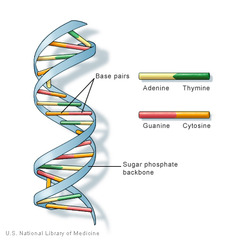
Consists of 2 antiparallel polynucleotide strands, twisted to form a double helix
Nucleotides contain pentose sugar (deoxyribose), and one of four nitrogenous bases- Adenine, Thymine, Guamine, Uracil.
What is the function of DNA
Codes for production of proteins
Undergoes replication for inheritance
How are nucleotides joined together
Within each strand, there are bonds betwen the phosphate groups on the 5th and 3rd carbon atoms on seperate pentose sugars.
The end that finishes on carbon 5 is the 5 prime end and for 3, the 3 prime end

What is RNA
Ribonucleic acid
Short lived molecule found in cytoplasm and nucleus
Single stranded polynucleotide
Nucleotide contains pentose sugar (ribose) and 1 of 4 bases- Adenine, Thymine, Cytosine and Uracil

How is RNA involved in protein synthesis
mRNA- Carries genetic code for specific protein from DNA in nucleus to ribosomes in cytoplasm
tRNA- Transfers specific amino acids to ribosome in groups of 3 (codon). Forms a clover leaf shape, held together by hydrogen bonds to do this
rRNA- Forms ribosomes with a protein. Ribosomes then translate genetic code and join amino acids together to make polypeptides
Describe transcription- protein synthesis
Occurs in nucleus
DNA read by enzymes and used to make mRNA molecule that leaves nucleus through nuclear pores into cytoplasm or RER, where it travels to a ribosomes
Describe translation- protein synthesis
Occurs at ribosome
mRNA attaches to ribosomes and tRNA brings specific amino acids complimentary to mRNA chain. Ribosomal enzymes catalyse formation of peptide bonds between adjacent amino acids to form primary structure of new polypeptide
What is ATP
Adenosine Triphosphate
Made of 3 phosphate groups, a ribose pentose sugar and adenine
ATP is released through the oxidation of glucose by respiration
Its a universal energy currency as all organisms use it in all of their cell in most of their chemical reactions

What are uses of ATP
Transportation of substances
Mechanical work
Chemical work
Electrical work
How is ATP formed and hydrolyses
Formation
Enzyme ATP synthase combines ADP and inorganic phosphate (P) in condensation reaction. Requires 30.6 kJ mol-1 of energy so the reaction is also endergonic.
Hydrolysis
Enzyme ATPase hydrolysis phosphate bond, forming ADP and P. 30.6 kJ mol-1 of energy is released so reaction is also exergonic
Why is ATP more useful than glucose
Many enzymes needed to release glucose but only one needed to release ATP
Lots of unwanted energy released when using glucose but small manageable amounts released when using ATP
Glucose only released through respiration but ATP is universal
Glucose is a large polar molecule but ATP is easily transported across membanes
Why does DNA replication occur
So each daughter cell receives an exact copy of the genetic information. Takes place in the nucleus during interphase
Explain the process of DNA replication
1. DNA unwinds
2. Hydrogen bonds holding complimentary base pairs break, catalysed by DNA helicase, and the 2 strands seperate
3. Each DNA strand acts as a template
4. Free DNA nucleotides align opposite their complimentary bases
5. DNA polymerase catalyses the condensation reaction between 2 DNA nucleotides. This occurs from the 5 prime to the 3 prime end of the chain
6. Each new DNA molecule is made from one original template strand and one newly synthesised strand. This is known as semi-conservative replication
What are the 3 theories for DNA replication
Conservative- Parent DNA molecule breaks into double-stranded segments which are copies using new nucleotides. Old and new segments reassemble randomly into two new daughter molecules
Semi-Conservative- Parent DNA molecule separates into 2 strands. Each strand acts as a template for a new complimentary strand. Daughter molecules consist of one strand of original DNA and one strand of newly synthesised DNA (correct theory)
Dispersive- Parent DNA molecule unchanged. New daughter molecule assembled from entirely new nucleotides

Explain the evidence for semi-conservative replication
THE MESELSON-STAHL EXPERIMENT
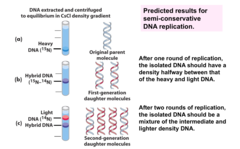
- E.coli grown in a medium containing amino acids made with the heavy isotope 15N. Bacteria produced nucleotides containing 15N
- Bacteria washed then transferred to a medium containing amino acids with the lighter isotope 14N. Allowed to divide once then DNA was extracted and suspension then centrifuged (separated)
- Bacteria allowed to divide again in the 14N medium and DNA centrifuged again
Provides evidence for semi conservative because (using diagram) after one generation, conservative replication would not give a band in the middle, only a band at the top and bottom. Dispersive would've only produced a band which got progressively higher up the tube
List the stages of protein synthesis, where they occur and what they form
DNA -->(transcription in the nucleus)= mRna -->(translation at the ribosome)= Protein/polypeptide
Explain the process of transcription
- DNA helicase (enzyme) breaks down hydrogen bonds holding together the base pairs in a specific region of the DNA molecule and the two strands unwind
- The enzyme RNA polymerase binds to the template strand at the beginning of the sequence to be copied
- Free RNA nucleotides align to opposite complementary bases on the template strand
- RNA polymerase moves along the template strand, catalysing the addition of RNA nucleotides to each other until it reaches a stop codon. Behind the RNA polymerase, the original DNA strands rewind, leaving the newly formed mRNA strand
- mRNA leaves via a nuclear pore and travels into the cytoplasm
Complimentary DNA/RNA nucleotides
DNA = RNA
Adenine= Uracil
Thymine= Adenine
Cytosine= Guanine
Guanine= Cytosine

How is mRNA modified after transcription
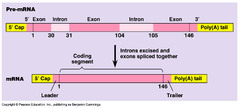
- The initial mRNA molecule produced by transcription is longer than the final mRNA translated at the ribosome
- Initial mRNA (pre-mRNA) needs sequences of bases to be removed
- Introns= non-coding nucleotide sequences in mRNA removed after transcription by the enzyme endonuclease
Exons= Coding sequences which are left behind and spliced together by ligase enzymes to form the final mature mRNA
What does translation form
What are the roles of tRNA and ribosomes in translation
The sequence of codons on the mRNA is translated into a sequence of amino acids to form a polypeptide. Takes place on a ribosome and involves tRNA
tRNA:
- Has clover leaf shape which carries specific amino acids to the ribosome
- Anti-codon determines which amino acid the tRNA molecule will carry
- tRNA attaches to the amino acid in the cytoplasm. Process requires ATP and is called 'amino acid activation'
Ribosome:
- Ribosome made from protein and rRNA. Either free in cytoplasm or attached to rough ER
- Each ribosome consists of a small and large subunit
- Large subunit has two attachment sites for tRNA molecules. Smaller subunit binds to mRNA
Explain the process of translation
INITIATION:
- Ribosome attaches to a start codon on the mRNA
- First tRNA binds to first attachment site. Anti-codon on tRNA joins to the complementary codon on the mRNA by hydrogen-bonds, forming a codon-anticodon complex
- Second tRNA forms a codon-anticodon complex at the second attachment site
ELONGATION:
- A ribosomal enzyme catalyses the formation of a peptide bond between the adjacent amino acids
- First tRNA leaves Site 1 and returns to the cytoplasm
- Ribosome moves down the mRNA one codon so that the second tRNA moves from Site 2 to Site 1
- New tRNA binds to Site 2
Termination
- Sequence repeats until a stop codon is reached
- Ribosome-mRNA-polypeptide complex separates
