biochem L3L5 oxidative phosphorylation (ATP synthase)
 Call Kai
 Learn
 Practice Test
 Spaced Repetition
 Match
 Flashcards
 Knowt Play
1/14

There's no tags or description
Looks like no tags are added yet.
15 Terms
Locations:
glycolysis
CAC
ETC
inter membrane space v. matrix
inner membrane
inner membrane v. outer membrane permeability
why isn’t the cytosol very acidic if we are constantly pumping out H+ and the outer membrane is permeable to H+
glycolysis = cytosol
CAC = mitochondrial matrix
ETC = mitochondrial matrix
inter membrane space = high H+, matrix = low H+
inner membrane = Q pool, also ETC complexes
inner is impermeable to H+, outer is permeable to H+
cytosol already has a ton more H+
oxidative phosphorylation v. photophosphorylation:
e- source
ultimate e- acceptor
E of what used to phosphorylate ATP
oxidative phosphorylation = euks
NADH or FADH2
O2
E from oxidation
photophosphorylation = chlorophyl
H2O
NADP+
light E + chlorophyll
chemiosmotic theory:
what is it
requires what membrane
2 coupled reactions
ADP phosphorylation theory
needs a topologically closed membrane (inner membrane) to hold H+ gradient
2 coupled reactions = ETC e- transfer to oxygen coupled w/ ATP synthesis
ETC: membrane proteins to couple e- transfer (favorable) to proton pumping (unfavorable)
ATP synthesis: membrane proteins to provide H+’s a path down gradient (favorable) and couple it to ATP synthesis (unfavorable)

what happens if ETC is impaired/stops? why?
what happens if ATP synthesis is impaired/stopped? why?
short circuit =
what happens
if ETC stops = no ATP made bc no protons pumped, so no gradient for ATP synthesis
if ATP synth stops = ETC stops bc gradient builds up until gradient too hard to pump across
short circuit = ETC and ATP synthesis reactions are uncoupled
electron transport (and O2 consumption) continues, but no ATP is made
how are ETC and ATP synthesis uncoupled (short circuited)
chemical uncouplers = what do they do
structure
natural uncouplers
ionophores (valinomycin) =
protein uncouplers (thermogenin) =
chemical uncouplers = dissipate proton gradient
hydrophobic weak acids
hydrophobic = diffuse across membrane
weak acid = give up a proton
natural uncouplers
ionophores (valinomycin) = dissipate electrical component of proton gradient (Dpsi)
protein uncouplers (thermogenin) = proton channels that dissipate proton gradient
useful for newborns / athletes = have brown adipose tissue w/ thermogenin decoupler to generate heat
what is the physiological mechanism of the weightless drug dinitrophenol (DNP)
why does it make people lose weight?
why does it give people a fever?
uncouples ETC and ATP synthesis by turning ATP synthesis off
no ATP is made
permanently low energy signals = oxidizing e- (consuming energy) at a very high level
no ATP is being stored
fever bc H+ gradient buildup and has no pathway to be used, so the protons dissipate as heat
Mitochondrial ATP Synthase Complex (F1Fo ATP synthase):
F1
5 subunits
3 conformations
B subunits
acts as an ____ on its own
Fo
inhibited by _____
3 subunits
proton channel =
F1
5 subunits = alpha, beta, gamma, delta, epsilon
3 conformations
B subunits = catalytic activity
acts as an ATPase on its own
Fo
oligomycin sensitive (it blocks proton transport)
a b and c
proton channel = rotating ring of c subunits
Mitochondrial ATP Synthase Complex (F1Fo ATP synthase):
structure
F1 and Fo =
stalk =
rotor =
how rotate
strucutres
F1
stator = a3b3 head fixed in place by stalk, doesn’t rotate
stalk = long gamma stalk connects a3b3 of F1 to c ring of Fo, rotates
rotor (Fo) = rotating c subunit
mechanism
proton movement b/t c chambersdrives rotation of c ring
proton flow is not direct
c ring rotation drives rotation of gamma stalk (a3b3 don’t rotate)
binding change model (rotational catalysis):
what is it
B subunits identical in ____ but differ in _____
3 B subunit conformations = what is the order?
loose (L) = B-ADP, binds ADP + Pi
tight (T) = B-ATP, binds ATP tightly
open (O) = B-empty, very low affinity
3 step mechanism..
why isn’t it smooth?
what is it
B subunits identical in structure but differ in conformatio
3 B subunit conformations = always L → T → O
loose (L) = B-ADP, binds ADP + Pi
tight (T) = B-ATP, binds ATP tightly
open (O) = B-empty, very low affinity
mechanism =
gamma rotates and contacts w/ different B subunits
contact causes B to go from T to O
not smooth bc T conformation is most stable and needs to be contacted by gamma stalk to “knock it out”
T → O releases ATP

ATP synthase:
reverse
how much ATP do you produce?
how many protons to make ATP
what is 1 of them used up for
when it runs in reverse efficiency approaches 100%
produce your body weight in ATP each day
4 H+ = 1 ATP, BUT
1 of those H+ is used up to pump Pi into matrix AND pump ATP into inter membrane space
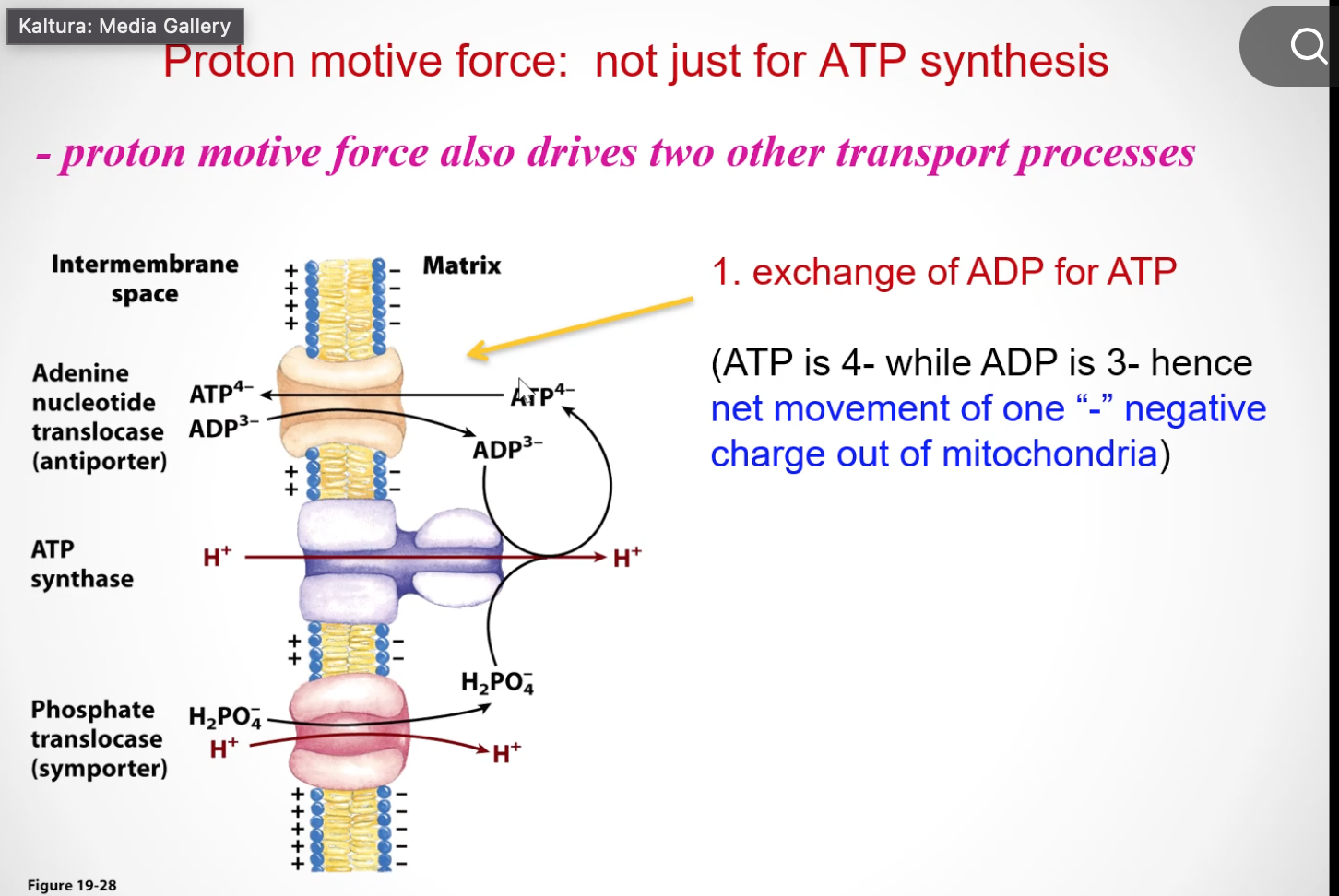
Proton motive force drives 3 things:
ATP synthesis
enzyme
how involved with othersexchange of ADP (going inside) for ATP (going outside)
enzyme =
sym or anti
net movement =
why
import of organic phosphate
enzyme
sym or anti
net movement
ATP synthesis
ATP synthase
adds phosphate from H2PO4 to ADP
exchange of ADP (going inside) for ATP (going outside)
enzyme = adenine nucleotide translocase (antiporter)
net movement = 1 (-) charge out of mitochondria
ATP is 4- (out) and ADP is 3- (in)
import of organic phosphate
enzyme = phosphate translocase (symporter)
directly uses proton gradient and brings 1 (-) charge inside mitochondria

Why does the 2 NADH from glycolysis (cytosolic) yield 3 or 5 ATP?
malate aspartate shuttle = ___ ATP
3 steps
NADH → ?
why do cells keep different “pools'“ = ___ ATP
NADH → ?
3 or 5 because cytosolic NADH can enter mitochondria 2 ways:
malate aspartate shuttle = NADH → NADH
conserves cytosolic NADH as mitochondrial NADH, which then enters the ETC via complex 1
10 H+ pumped = 2.5 ATP x2 (2 glycolysis NADH)
glycerol 3-phosphate shuttle = NADH → FADH
converts cytosolic NADH into mitochondrial FADH2, which enters complex 2 to reduce Q → QH2
6 H+ pumped = 1.5 ATP x2 (2 glycolysis NADH)

why do cells keep different “pools” of certain metabolites
NADH pool in cytoplasm v. matrix
why
different reactions needed in different places
NADH kept low in cytoplasm bc it signals high E and inhibits glycolysis. Need NAD+ to run glycolysis
NADH shuttled to mitochondria fast to keep it inhibiting glycolysis in cytoplasm
acceptor control of respiration =
mass-action ratio =
why don’t ATP levels fluctuate?
how do these influence ATP production:
Pi AMP ADP ATP
citrate , acetyl CoA
NAD, NADH
acceptor control of respiration = amount of free ADP drives ATP synthesis
no ADP no synthesis
mass-action ratio = ratio of [ATP] / ( [ADP][Pi] ) greatly favors ATP
if ATP used, ADP generated, which fuels more ATP production = always making more to replace what you use
ATP levels CONSTANT
controls
low E = produce more
Pi AMP ADP NAD FAD
high E = stop producing
citrate, acetyl CoA, ATP, NADH, FADH2,

a.
b. Rxn 1: 1 NADH = 1.5 or 2.5 ATP (because cytosolic has 2 diff shuttles)
Rxn 2: 1 NADH = 2.5 ATP (mitochondria)
Rxn 3: 1 acetyl-CoA = 3 NADH (7.5 ATP), 1FADH2 (1.5 ATP), 1 GTP (1 ATP)
d Total = 14 or 15 ATP
d. “actual cost” = 2 ATP. 14 or 15 - 2 = 12 or 13 ATP