Normal Walking Gait & Gait Deviations
 Call Kai
 Learn
 Practice Test
 Spaced Repetition
 Match
 Flashcards
 Knowt Play
1/65

There's no tags or description
Looks like no tags are added yet.
66 Terms
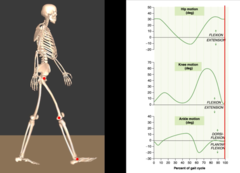
Describe the kinematics @ the pelvis, hip, knee, ankle, foot & subtalar joints during initial contact (0-2% of the gait cycle; heel contact to foot flat).
Pelvis: posterior pelvic tilt and internal rotation (CCW turn when on R), swing leg drop
Hip: 30 deg flexion, adduction (pelvic on femoral), external rotation (moving quickly into IR)
Knee: 5 deg flexion
Ankle: 0-5 deg PF
Foot & subtalar: inversion w/ rapid eversion into foot flat
Describe which muscles are active during initial contact.
Pelvis: ES stabilizes and controls forward momentum
Hip: extensors (con) extend to prepare for weight acceptance & prevent jackknifing, abductors (ecc) control frontal plane movements, adductors co-active to assist hip and pelvic movements
Knee: flexors (ecc) decelerate knee extension just before contact, extensors (ecc) control knee flexion
Ankle, foot, & subtalar: dorsiflexors (ecc) control ankle PF and foot pronation

Describe the kinetics @ the pelvis, hip, knee, ankle, foot & subtalar joints during initial contact (0-2% of the gait cycle; heel contact to foot flat).
Hip: hip extension (con), abduction (ecc), external rotation (ecc)
Knee: large extension torque to control knee flexion
Ankle, foot, & subtalar: small DF torque (ecc)
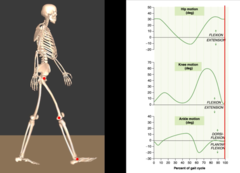
Describe the kinematics @ the pelvis, hip, knee, ankle, foot & subtalar joints during loading response (2-12% of the gait cycle; foot flat to opposite toe off).
Pelvis (same as IC): posterior tilt, contralateral leg drops, IR
Hip (same as IC w/ possibly less flexion): 25-30 deg flexion, adduction, ER (moving quickly into IR)
Knee (more flexion than IC): continues to flex an additional 10-15 deg
Ankle: flat foot, slight PF
Foot & subtalar: everting

Describe which muscles are active during loading response.
Pelvis: hip abductors (ecc) control contralateral hip drop, hip ER (ecc) control pelvic IR
Hip: extensors (con)
Knee: quads (ecc)
Ankle, foot, & subtalar: ankle PF (ecc) controls DF, posterior tibialis (ecc) controls pronation, peroneals (con) to counteract post. tib
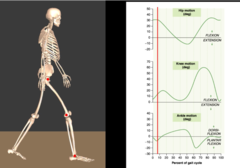
Describe the kinetics @ the pelvis, hip, knee, ankle, foot & subtalar joints during loading response (2-12% of the gait cycle; foot flat to opposite toe off).
Hip: extension (con), abduction (ecc), ER (ecc) torques
Knee: large extension torque to control knee flexion
Ankle, foot, & subtalar: PF torque to control DF, small eversion torque
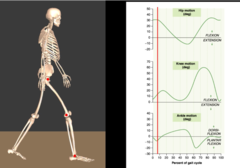
Describe the kinematics @ the pelvis, hip, knee, ankle, foot & subtalar joints during midstance (12-31%; point at which the body's weight passes directly over the supporting LE and the contralateral foot is side-by-side).
Pelvis: ANTERIOR tilt (different than IC or LR), contralateral side moves into elevation and approaches neutral, ER (different than IC or LR, contralateral ASIS moves FORWARD)
Hip: neutral flex/ext (transitioning from flexion --> extension), approaching neutral abd/add, IR (different than IC or LR)
Knee: approaches full extension (transitioning from flexion --> extension)
Ankle: up to 10 deg DF
Foot & subtalar: eversion (reaching near maximal)

Describe which muscles are active during midstance.
Pelvis: hip IR (con) - movement of contralateral pelvis forward
Hip: extensors (con) support BW and hip extension, abductors (con) raises hip
Knee: quads (con) extend
Ankle, foot, & subtalar: ankle PF (ecc) control of DF, posterior tib (con) supinates

Describe the kinetics @ the pelvis, hip, knee, ankle, foot & subtalar joints during midstance (12-31%; point at which the body's weight passes directly over the supporting LE and the contralateral foot is side-by-side).
Hip: hip extension (con), abduction (con), IR (con)
Knee: net internal flexion torque despite knee extending, abduction torque counters varus torque, ER
Ankle: PF torque (ecc) to control DF, small inversion torque (con)

Describe the kinematics @ the pelvis, hip, knee, ankle, foot & subtalar joints during terminal stance (31-50% gait; initial contract from opposite foot as the heel of the heel of the stance leg starts to lift off).
Pelvis: posterior tilt (different than midstance), approx. neutral abd/add, ER (contralateral ASIS moves forward)
Hip: 10 deg max extension, approx. neutral abd/add (continued movement toward contralateral elevation), IR
Knee: reaches full extension --> starts to flex towards max 35 degrees by toe-off, 5 deg knee adduction/varus
Ankle: 10 deg max DF
Foot & subtalar: neutral -- moving into inversion (transitioning from eversion --> inversion)

Describe which muscles are active during terminal stance.
Pelvis: hip IR (con) as contralateral pelvis moves forward
Hip: flexors (ecc) control hip extension, hip abductors (con), no sig. hip extensor (con) activation
Knee: **minimal muscular activity at this time**
Ankle, foot, & subtalar: ankle PF (con) -- large activation at heel off

Describe the kinetics @ the pelvis, hip, knee, ankle, foot & subtalar joints during terminal stance (31-50% gait; initial contract from opposite foot as the heel of the heel of the stance leg starts to lift off).
Hip: hip flexion torque to decelerate hip extension & initiate hip flexion, hip abd (con), IR (con)
Knee: knee flexion, abduction to counter varus, IR
Ankle, foot, & subtalar: PF torque (con), return to eversion torque

Describe the kinematics @ the pelvis, hip, knee, ankle, foot & subtalar joints during pre-swing (50-60% gait; opposite initial contact to toe off).
Pelvis: posterior tilt (same as terminal stance), contralateral side higher, ER (ipsilateral ASIS behind contralateral ASIS)
Hip: flexion is initiated, becoming abducted relative to contralateral hip, starts to ER as ipsilateral LE is advanced forward
Knee: 35 deg flexion
Ankle: 15-20 deg PF (max)
Foot & subtalar: 45 deg MTP extension, inversion

Describe which muscles are active during pre-swing.
Pelvis: ES controls forward momentum, rectus abdominis provides a more stable fixation for hip flexors
Hip: flexors (con) w/ hip adductors (con)
Knee: **knee flexion is passive result of hip flexion and min. gastric activation**
Ankle, foot, & subtalar: peak ankle PF (con) -- dropping rapidly to zero

Describe the kinetics @ the pelvis, hip, knee, ankle, foot & subtalar joints during pre-swing (50-60% gait; opposite initial contact to toe off).
Pelvis: ipsilateral hip ER (con)
Hip: flexion torque (con)
Knee: small extension torque to control knee flexion
Ankle, foot, & subtalar: PF torque (con)

Describe the kinematics @ the pelvis, hip, knee, ankle, foot & subtalar joints during initial swing (62-75% gait; involves acceleration & lasts from toe off to max swing knee flexion).
Pelvis: anterior tilt, ipsilateral pelvis drops and is in ER but moving forward towards IR
Hip: flexes, initial relative abduction --> moving toward adduction, ER as ipsilateral LE advances forward
Knee: 35 deg flexion at toe off --> continues to flex, some valgus, IR moving toward ER
Ankle: PF --> DF to neutral
Foot & subtalar: slightly inverted --> moving towards eversion

Describe which muscles are active during initial swing.
Pelvis: B ES controls forward angular momentum of trunk, RA start to kick in as hip flexors actively flex hip
Hip: flexors (con) initiate hip flexion just before toe off --> early swing
Knee: **passively moved through swing phase w/ small amount of knee flexor (con) activation)
Ankle, foot, & subtalar: ankle DF (con) DF and toe extension to clear toes

Describe the kinetics @ the pelvis, hip, knee, ankle, foot & subtalar joints during initial swing (62-75% gait; involves acceleration & lasts from toe off to max swing knee flexion).
Hip: small hip flexion torque
Knee: not much torque present
Ankle, foot, & subtalar: small DF torque
Describe the kinematics @ the pelvis, hip, knee, ankle, foot & subtalar joints during mid-swing (75-87% of gait; involves the period from max swing knee flexion to tibia perpendicular to ground).
Pelvis: anterior tilt, ipsilateral pelvis rises to neutral and moves forward into IR
Hip: continues to flex, relative abduction moving towards adduction, ER but beginning to IR as ipsilateral LE advances forward
Knee: reaches max knee flexion @ 60 deg, max valgus, slight ER
Ankle: neutral
Foot & subtalar: inverted --> moving towards eversion

Describe which muscles are active during mid-swing.
Pelvis: B ES controls forward angular momentum of trunk, RA reaches peak activation as fixation point
Hip: flexors (con) activation ceases; movement more of a result of forward momentum
Knee: **minimal muscular activity at this time**
Ankle, foot, & subtalar: ankle DF (con) DF and toe extension to clear toes

Describe the kinetics @ the pelvis, hip, knee, ankle, foot & subtalar joints during mid-swing (75-87% of gait; involves the period from max swing knee flexion to tibia perpendicular to ground).
Small DF torque

Describe the kinematics @ the pelvis, hip, knee, ankle, foot & subtalar joints during terminal swing (87-100% of gait; involves deceleration & occurs when tibia perpendicular to floor to foot touching ground).
Pelvis: transitioning from anterior --> posterior tilt for IC, ipsilateral pelvis continues to rise and move forward into IR
Hip: reaches max hip flexion slightly >30 deg, approx. neutral abd/add, slight hip ER w/ movement into IR
Knee: just short of full extension, slight valgus, ER
Ankle: neutral
Foot & subtalar: inverted but moving toward eversion

Describe which muscles are active during terminal swing.
Pelvis: B ES activated slightly before heel contact to prevent jackknifing and in prep for opposite swing
Hip: hip extensors (ecc) decelerate hip flexion and prepare for weight acceptance
Knee: knee extensors (con) extend the knee in preparation for heel strike, knee flexors (ecc) to check knee extension prior to IC
Ankle, foot, & subtalar: ankle DF (con) DF and toe extension

Describe the kinetics @ the pelvis, hip, knee, ankle, foot & subtalar joints during terminal swing (87-100% of gait; involves deceleration & occurs when tibia perpendicular to floor to foot touching ground).
Hip: extensor torque to decelerate hip flexion & initiate hip extension
Knee: internal knee flexion torque to decelerate knee extension until initiating knee flexion just before next HC
Ankle, foot, & subtalar: small DF torque to clear toes

ROM: in the stance phase, the joints move according to which ranges?
Ankle: 20 deg DF to 20 deg PF
Knee: extension to 50 deg flexion
Hip: 30 deg flexion to 10 deg extension
ROM: in the swing phase, the joints move according to which ranges?
Ankle: remaining in a neutral position
Knee: 50 deg flexion to extension
Hip: neutral position to 30 deg flexion
Muscle function: ankle
DF (tibialis anterior) allows the heel contact first and keeps the ankle in a neutral position during the swing phase
PFs (triceps surae) push the leg and body forward during the heel and toe-off phases
Lateral stabilizers (tibialis posterior, peroneus longus and brevis): stabilize the ankle, esp. on uneven ground
Muscle function: knee
Extensors help absorb the shock during heel strike and stabilize the knee during stance
Flexors stabilize the knee during the stance phase and shorten the leg by flexing the knee during swing
Muscle function: hip
Extensor (glut max) allows anterior rotation of the pelvis and and ensures the stability of the hip during stance
Flexors initiate swing
Abductor (glut med) ensures the frontal stability of the pelvis during stance
Trunk muscles provide the stability of the trunk on the pelvis and the hips
______: distance b/w successive heel contacts of the same foot
Stride length

______: distance b/w heel contacts of different feet
Step length

What is an average cadence?
110-120 steps/min or 3 mph
State phases and % of walking vs. running.
Walking: 60% stance, 40% swing
vs.
Running: 40% stance, 60% swing
______: heel strike
Initial contact
______: foot flat; moment b/w initial contact and beginning of swing on other leg
Loading response
______: other foot is off the floor until directly over the stance limb
Midstance
______: heel begins to come off to opposite foot initial contact
Terminal swance
______: toe-off and opposite loading response/foot flat
Pre-swing
______: acceleration phase of swing
Initial swing
______: max knee flexion until vertical tibia
Midswing
______: deceleration phase of swing
Terminal swing
List the characteristics of antalgic gait.
Reduced stride length, step length on opposite side, cadence, and single-limb support on ipsilateral side
Sagittal plane: ROM requirements/norms for normal gait
Pelvis: 5 deg ant & post tilt
- DL support = posterior pelvic tilt
- SL support = anterior pelvic tilt
Hip: 30 deg flexion-10 deg extension
- 30 deg flexion @ IC & loading
- neutral @ midstance
- 10 deg extension @ toe-off
Knee: 60 deg flexion-0 deg extension
- 5-10 deg flexion @ IC
- additional 10-15 deg flexion @ loading response
- full extension @ terminal stance
- 35 deg flexion @ toe-off
- max 60 deg flexion @ mid-swing
Ankle: 10 deg DF-20 deg PF
- 0-5 deg PF @ IC
- slight PF @ loading response
- 10 deg DF @ midstance
- 15-20 deg PF @ heel-off
- neutral @ swing
Describe periods of activation and type of muscle activity: hip extensors
MOST active at terminal swing (ecc) and IC (con)
Terminal stance --> mid-swing = "hanging out"
Describe periods of activation and type of muscle activity: hip flexors
MOST active at the end of stance (ecc) into initial swing (con)
IC --> midstance, terminal swing = "hanging out"
Describe periods of activation and type of muscle activity: hip abductors
MOST active in stance phase to control the pelvis (ecc during drop, con during elevation)
- IC, LR = ecc
- MS, TS = con
Describe periods of activation and type of muscle activity: hip adductors
Adductor longus assists the flexors or extensors depending on position
Describe periods of activation and type of muscle activity: hip rotators
IC, LR = ER (ecc)
Midstance --> pre-swing = IR (con)
Frontal plane: ROM requirements/norms for normal gait
Pelvis +/- 1.5 cm
- IC = contralateral hip drop
- Midstance = elevation to neutral
- Toe-off = contralateral hip hike
- Swing = drops
Hip 5 deg relative abd/add
- IC = ipsi adduction
- Toe-off = ipsi abduction
Subtalar 6 deg inversion-2 deg eversion
- IC = 2-3 deg inversion
- Midstance = 3 deg eversion
- Toe-off = 6 deg inversion
- Swing = everting
Describe periods of activation and type of muscle activity: knee extensors
IC, LR = ecc
Midstance --> heel-off = con
Much less active afterwards
Describe periods of activation and type of muscle activity: knee flexors
MOST active during terminal swing and early stance due to their role as hip extensors
- IC = con (hip)
- Swing = very small torque
- Terminal swing = ecc (hip)
Describe periods of activation and type of muscle activity: ankle DF
IC = ecc
Swing = con
Describe periods of activation and type of muscle activity: ankle PF
Controls DF beyond IC (ecc) then switches to concentric activation to push-off -- MOST ACTIVE AT HEEL-OFF
- IC, LR = ecc
- Late stance = con
Provide possible gait deviations: ankle DF weakness
1. Vaulting (contra)
2. Circumduction
3. Excess hip and knee flexion
4. Foot slap
5. Drop foot --> toe drag
6. Forefoot landing
Provide possible gait deviations: ankle DF ROM limitations
1. Toeing out
2. Genu recurvatum w/ forward lean
3. Bouncing gait
Provide possible gait deviations: decreased hip or knee flexion
1. Vaulting (conta)
2. Hip hiking
3. Hip circumduction
Provide possible gait deviations: quad weakness
Forward trunk lean (early stance)
Provide possible gait deviations: weak hip extensors
Backward trunk lean/gluteal lurch
Provide possible gait deviations: weak hip abductors
1. Trendelenburg (opp. side hip drop)
2. Compensated Trendelenburg (shift trunk to ipsi side)
Provide possible gait deviations: hip flexor tightness/contracture
1. Forward trunk lean
2. Crouched gait
3. Excessive lumbar lordosis
Compare the following in running vs. walking: anterior pelvic tilt
Walking = 5 deg
Running = 15-20 deg
Compare the following in running vs. walking: hip flexion and extension
Walking = 30 flex, 10 ext
Running = 35 flex, 0-5 ext
Compare the following in running vs. walking: knee flexion at IC and midstance
Walking = 5 IC, additional 10-15 at midstance (15-20 deg)
Running = 20 IC, 45-50 mistance
Compare the following in running vs. walking: DF at IC and midstance
Walking = slight PF IC, 10 DF at midstance
Running = 0-5 DF, 30 DF at midstance
Compare the following in running vs. walking: peak eversion at midstance
Walking = 2 deg
Running = 5-20 deg
What are the possible effects on injury susceptibility in rearfoot vs. forefoot strike patterns?
Rearfoot = more susceptibility to injury @ knee (stress fracture, plantar fasciitis, PFPS)
Forefoot = not asking as much @ the knee and hip BUT Achilles tendinopathies and MT injuries are more common