BIOL 100 Biochemistry HW 4
 Call Kai
 Learn
 Practice Test
 Spaced Repetition
 Match
 Flashcards
 Knowt Play
1/18

Earn XP
Description and Tags
19 Terms
For
glutamate + NH3 ⇌ glutamine
ΔrG° = +14.2 kJ/mol
Calculate Keq and give the result in the form of Keq = ɑ x 10n , where n is an integer and ɑ is a real number.
With
ΔrG° = -2.3RTlog(Keq)
it follows that
Keq = e-ΔrG°/(RT) = e-5.68 = 10-5.68/ln(10) = 10-2.7 = 10-2 × 10-0.47
= 3.3 × 10⁻³
Decompose the glutamine synthetase reaction,
glutamate- + ATP4- + NH3 ⇌ glutamine + ADP3- + Pi2- ,
into an energy receiving and energy donating reaction and calculate its standard Gibbs reaction energy, given that:
glutamate + NH3 ⇌ glutamine ΔrG° = +14.2 kJ/mol
ATP ⇌ ADP + Pi ΔઠG° = -30.5 kJ/mol
The energy receiving reaction is
glutamate + NH3 ⇌ glutamine ΔpG° = +14.2 kJ/mol
The energy donating reaction is
ATP ⇌ ADP + Pi ΔઠG° = -30.5 kJ/mol
Thus, the standard Gibbs reaction energy of the glutamine synthetase reaction, an energy coupling reaction, is
ΔζG° = ΔpG° + ΔઠG° = 14.2 kJ/mol - 30.5 kJ/mol = -16.3 kJ/mol


Name differences between energetic and metabolic coupling.
Two reactions are metabolically coupled when the products of one reaction partially overlap with the substrates of the other reaction; both reactions occur and tend to equilibrium together; there is no transfer of energy between the two. Two energetically coupled reactions are coupled by virtue of a third reaction, the coupling reaction; neither one reaction of the couple occurs (the coupling reaction does); free energy is transferred from one reaction to the other (i.e., as one reaction tends to equilibrium, the other is driven away from equilibrium); there is no overlap between the substrates of one and the products of the other.
What is the mechanism by which glutamine synthetase couples amide bond formation to the cleavage of ATP into ADP and phosphate?
The reaction proceeds in two steps: in the first step, the enzyme catalyzes the transfer of a phosphate group from ATP to glutamate, forming a mixed anhydride, glutamyl-phosphate. In a second step, phosphate is displaced by ammonia.

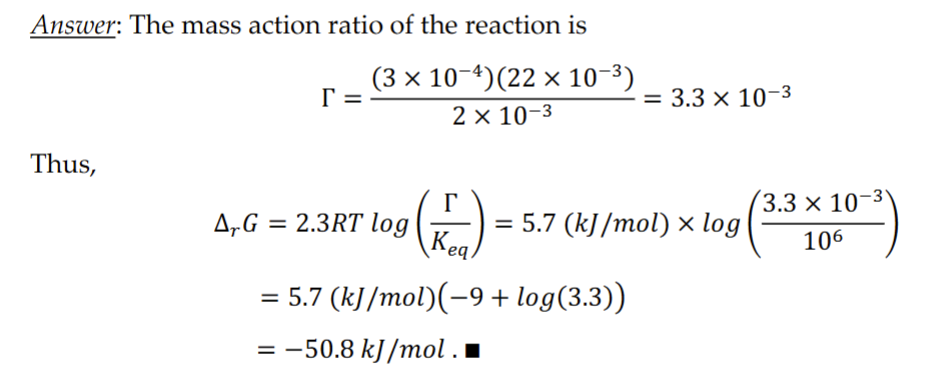
What alone determines the ability of the ATP hydrolysis reaction to perform (positive) work?




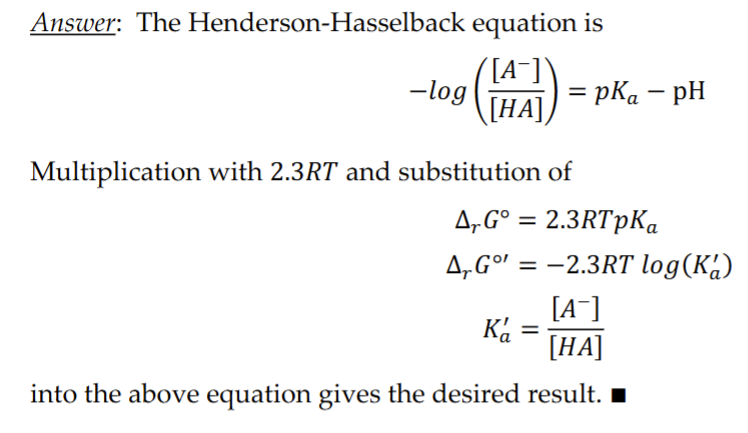


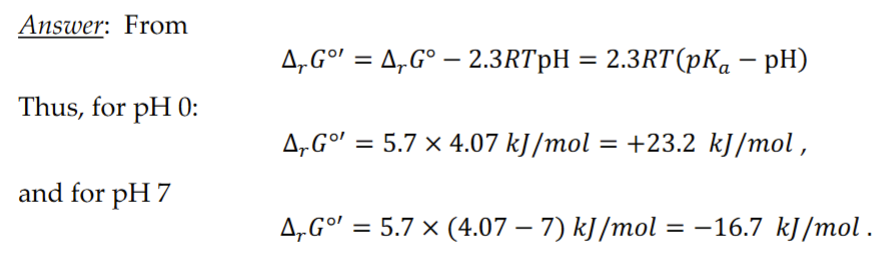

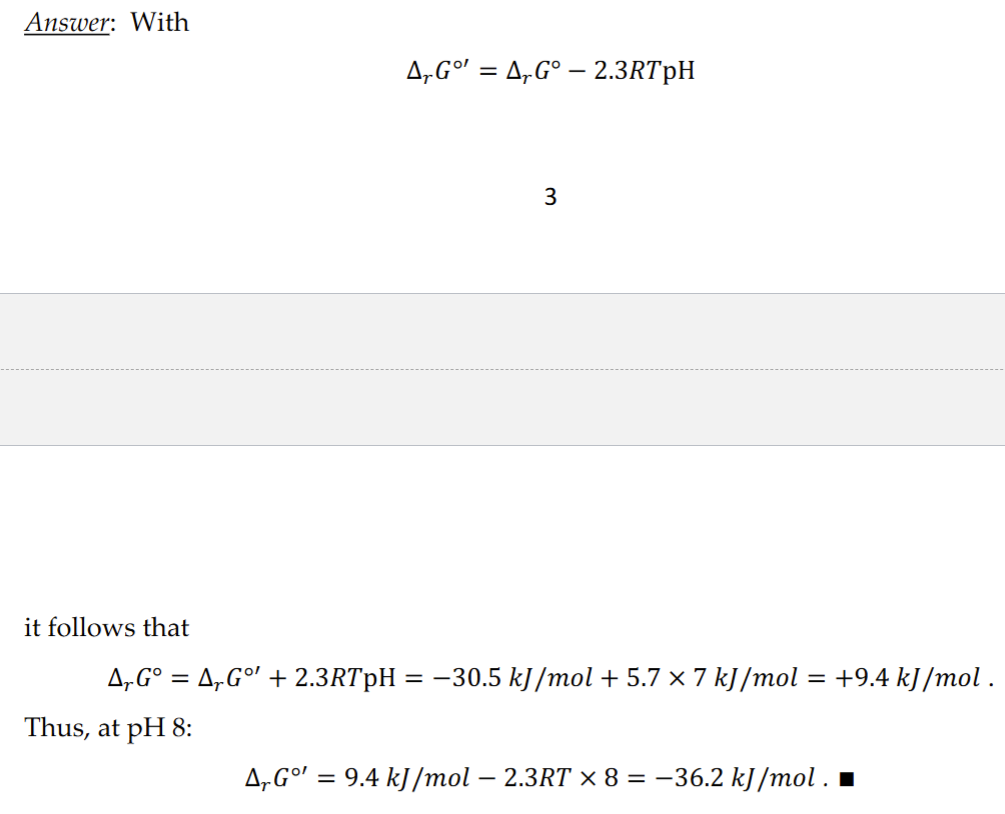

In this pH range, their is no net release of protons.




The building blocks of DNA are deoxynucleoside monophosphates. Yet DNA polymerases use deoxynucleoside triphosphates as substrates. What is the reason?
With dNTPs as substrates, rather than dNMPs, DNA polymerases bypass the strongly endergonic condensation reaction: not water is released but pyrophosphate which exchanges a phosphoanhydride bond for a more stable ester bond and releases a product whose concentration can be kept low (pyrophosphate); the polymerization reaction thus becomes exergonic.
In principle, DNA could proceed from 3’ to 5’. But without exception, DNA polymerases catalyze phosphoester bond formation from 5’ to 3’. What might explain this preference?
Polymerization from 5’ to 3’ facilitates exonucleolytic proofreading.

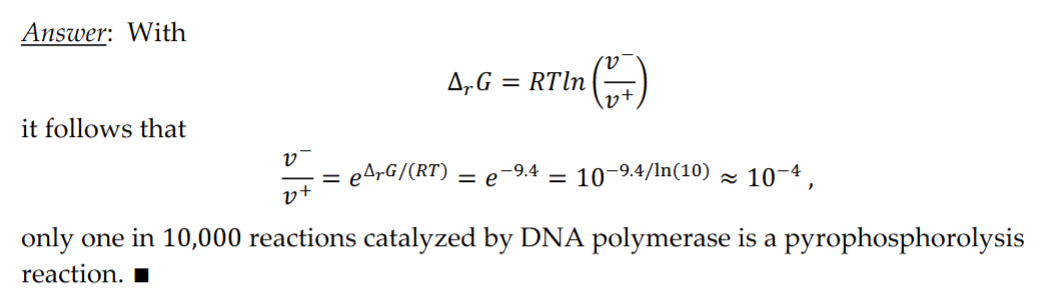
Why is it physiologically important that DNA polymerization dissipates a large amount of energy (i.e., proceeds far from, and not close to, equilibrium)?
The expenditure of energy is required to make certain that a defined polymer length is reached within a given number of reaction steps (i.e., time window).