A2 principle of optical fibres
 Call Kai
 Learn
Learn Practice Test
 Spaced Repetition
 Match
Match Flashcards
 Knowt Play
1/31

There's no tags or description
Looks like no tags are added yet.
Name | Mastery | Learn | Test | Matching | Spaced | Call with Kai | Chat |
|---|
No analytics yet
Send a link to your students to track their progress
32 Terms
refractive index
number representing the bending of light the it passes from one medium to another because the. medium has gone denser
equation of refractive index
sin I / sin r (sin I is angle of incidence and sin r is the angle of refraction)
or
c / v (c is speed of light in vacuum, v is speed of light in material)
total internal reflection
hen light is completely reflected inside the medium instead of the light leaving the medium
when does total internal reflection occur
the light travels from a higher refractive index to a lower refractive index OR when the angle of incidence is greater than the critical angle
critical angle
the incidence angle that produces a refracted ray that refracts 90 degrees to the normal
critical angle fornula
sin (C) = 1 / n
(C is critical angle)
(N is refractive index)
optical fibre
a very thin stand of glass or plastic that carries light signals
what is the optical fibre made up of
core (the centre where the light travels)
cladding (the outer layers surrounding the core)

why is cladding used
since the cladding has a lower refractive index than the core, this is the conditions for the total internal reflection.
how is optical fibres used in engineering (+ benefits)
used in
inspections inside aircraft engines
inspecting pipes
inspecting machinery
benefits
flexible
can reach to difficult areas
how is optical fibres used in communication (+ benefits)
used in
internet
telephone network
broadband
benefits
high bandwidth
fast data transfer
low signal loss
how is optical fibres used in medicine (benefits)
used for
doctors can see what is inside the patient without doing a major surgery
benefits
minimally invasive
flexible
produces clear image
analogue signal
a continuously varying signal
characteristics of analogue signal
smooth waveform
affected by noise
quality decreases over distance
Digital signal
uses binary (010011010)
characteristic of digital signal
less affected by noise
can be regenerated
more reliable for communication
how fast does an electromagnet waves travel at a vacuum?
3.0 × 10⁸ m/s
inverse square law
I = intensity (watts per square meter, W m-2)
R = the distance from the source (meters, m)
K = constant that stays a constant as long as the source stays the same (if constant then k is 1)
as the distance increases the intensity decreases

electromagnetic spectrum from lowest frequency to highest freqneyc
radio waves
microwaves
infrared radiation
visible light
ultraviolet
x rays
gamma rays
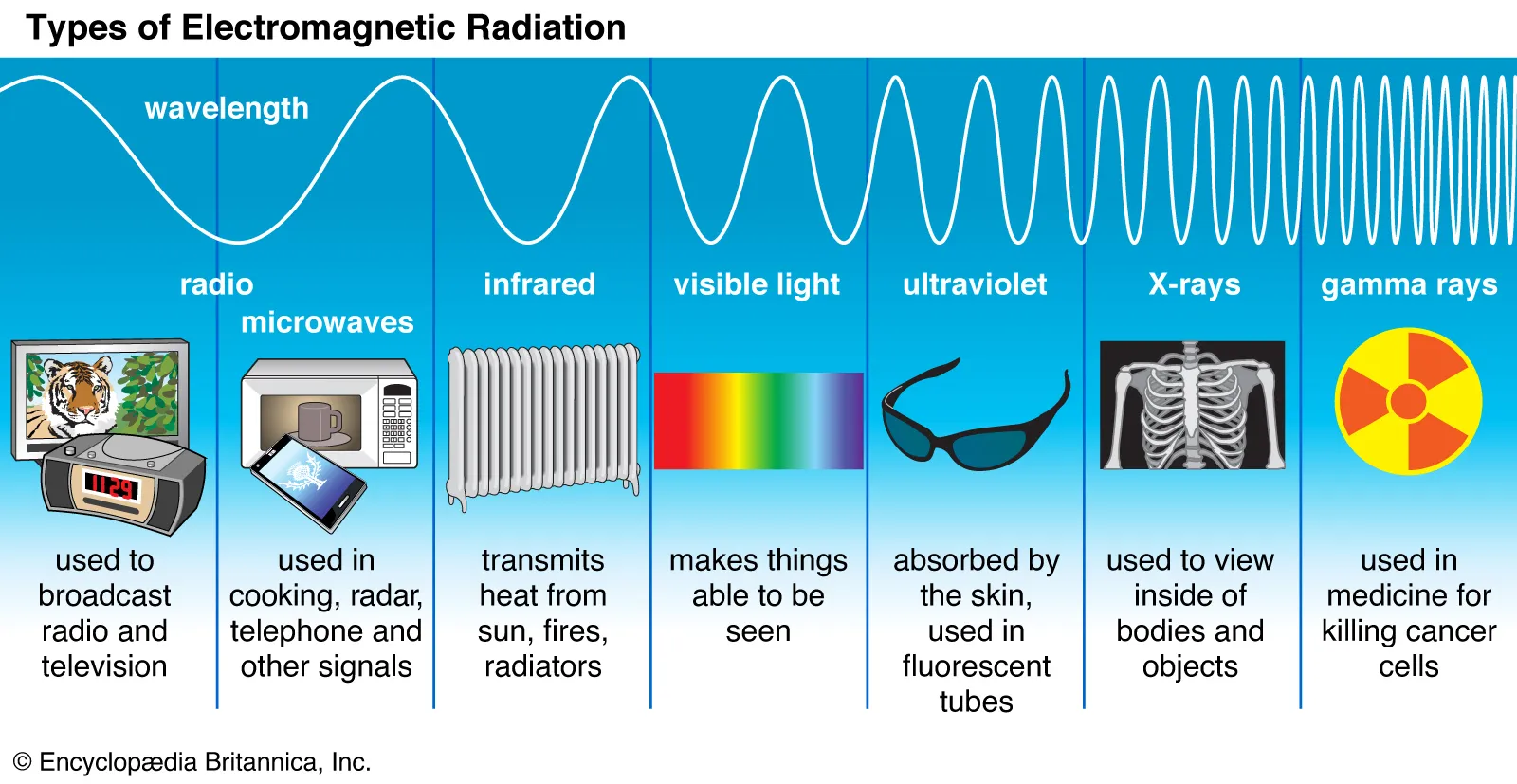
what is the relationship between frequency, energy and wavelength)
as the frequency increases, the energy increases and the wavelength decreases.
what wave is used for satellite communication and GPS
microwaves
why do we use microwaves for satellite communication and GPS
because microwaves can pass through the atmosphere and can carry large amounts of data
what wave is used for mobile phones
microwaves / radio waves
why do we use microwaves and radio waves for mobile communication?
can carry digital information and can communicate with nearby cell towers
what wave do we use for bluetooth
radio waves in the microwaves regions
why do we use radio waves in the microwaves region for bluetooth?
short range communicate
what things uses bluetooth?
headphones
keyboards
speakers
what is infrared raditation used for and why
TV remote controls because it is suitable for short range communication
characteristics of infrared radiation
requires line of sight
does not travel through walls well
what type of EM waves is used for wifi and why
microwaves because microwaves have higher frequency than radio waves, as well as it can carry digital data wirelessly.
benefits of wifi
allows wireless communication
allows multiple devices to connected to the internet
fast data transfer over short distances
no physical cable requires
limitations of wifi
limited range compared with mobile phone networks
signal strength decreases when distance away from the wifi sources increase
walls and other obstacles can weaken the signal
can experience interference from other wireless devices.