6 - Ag presentation
 Call Kai
 Learn
 Practice Test
 Spaced Repetition
 Match
 Flashcards
 Knowt Play
1/73

There's no tags or description
Looks like no tags are added yet.
Name | Mastery | Learn | Test | Matching | Spaced | Call with Kai | Chat |
|---|
No analytics yet
Send a link to your students to track their progress
74 Terms
pathways of Ag processing
cytosolic
intravesicular
extracellular pathogens + toxins
cytosolic pathogens
degraded in:
peptides bind to:
prsented to:
effected on presenting cell:
degraded in: cytosol
peptides bind to: MHC-1
presented to: CD8
effect on presenting cell: cell death
intravesicular pathogens
degraded in:
peptides bind to:
prsented to:
effected on presenting cell:
degraded in: endocytic vesicles
peptides bind to: MHC-2
presented to: CD4
effect on presenting cell: activation to kill intravesicular bacteria + parasites
extracellular + toxins pathogens
degraded in:
peptides bind to:
prsented to:
effect on presenting cell:
degraded in: endocytic vesicles
peptides bind to: MHC-2
presented to: CD4
effect on presenting cell: activation of B cells to secrete Ig to eliminate extracellular bacteria/toxins
MHC-1
peptide binding domain:
nature of peptide-binding groove:
general size of bound peptides:
peptide binding domain: α1/α2
nature of peptide-binding groove: closed at both ends
general size of bound peptides: 8-10 AAs
MHC-2
peptide binding domain:
nature of peptide-binding groove:
general size of bound peptides:
peptide binding domain: α1/β1
nature of peptide-binding groove: open at both ends
general size of bound peptides: 13-18 AAs
general step of endogenously derived peptide presentation by MHC-1
recognizes Ub or damaged proteins
Ag processing through immunoproteasome
peptide-MHC association by TAP
expression on cell surface
immunoprotease function
deegrades cytosolic proteins into small peptide fragments
immunoprotease particle types
19S and 20S
19S regulatory particle
recognizes Ub-proteins, feeds into catalytic core
on either side of immunoproteasome
20S core particle
cleaves Ub-proteins into peptide fragments
where does TAP shuttle peptides into?
the RER lumen and the peptide loading complex (PLC)
PLC parts
calnexin
calreticulin
ERp57
tapasin
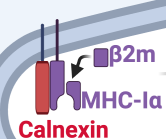
calnexin
stabilizes MHC-1α chain prior to addition of β2m
calreticulin
stabilizes MHC-1α/β2m prior to peptide loading

ERp57
promotes MHC-1 folding and links w/ tapasin

tapasin
forms bridge btw MHC-1 and TAP

PLC function
stabilizes MHC-1 and ensures proper folding and peptide loading
how long are the peptides that immunoproteasomes make?
btw 3-22, 8-12 most common
how long a chain does TAP preferentially transport?
8-16 AAs
ERAAP
edits peptides to 8-10 AAs
then transported to cell surface
general step of exogenously derived peptide presentation by MHC-2
Ag uptake
antigen processing through endosome
peptide-MHC association via Ii/CLIP
expression on cell surface
how are exogenous Ags digested
intravesicular proteases
how are B cells digested exogenously?
BCR crosslinking induces endocytosis
end up in an endosome
how mononuclear phagocytes digested exogenously
phagocytosis internalizes or cell debris
end up in a phagosome
what does acidification from Ag processing activate
proteases that degrade cargo into peptides
lysosomes
Ii/CLIP
stabilize MHC-2 chains prior to Ag loading
Ii/CLIP stabilization general steps
new MHC-2 binds to Ii
Ii cleaved into CLIP in MIIC
CLIP replaced w/ Ag peptide

Ii
first chaperone that new MHC-2 binds to
prevents premature peptide loading
where is the Ii cleaved into CLIP
in the MHC-2 loading compartment
what cleaves the Ii?
pH-dependent endosomal proteases
when is CLIP replaced with an Ag peptide?
after fusion of MIIC w/ endo/phagolysosome
HLA-DM and HLA-DO
chaperones that regulate peptide loading
HLA-DM mechanism
facilitates exchange of CLIP for Ag peptide
presentation of Ag peptide
HLA-DO mechanism
co-chaperone inhibits HLA-DM
display of CLIP on cell surface
types of gene structure of MHC
polymorphism
polygeny
both
polymorphism
multiple unique alleles
polygeny
multiple copies of MHC
NOT multiple alleles
HLA complex
codes MHC genes
HLA complex
class 1
loci: A, B, C
MHC isotypes: HLA-A, HLA-B, HLA-C
HLA complex
class 2
loci: DPα + DPβ, DQα + DQβ, DRα + DRβ
MHC isotypes: HLA-DP, HLA-DQ, HLA-DR
HLA complex
class 3
non-MHC immune genes
complement, TNF-family cytokines
gene structure of HLA complex on chromosome 6
—class 2—————-class 3—————-class 1—————
what are the three highly polymorphic MHC-1 isotypes
HLA-A, HLA-B, HLA-C
which MHC-1 isotypes are oligomorphic
HLA-D, HLA-F
which MHC-1 isotypes are monomorphic
HLA-E
MHC-2 polymorphic isotypes
HLA-DP, HLA-DQ— both chains
MHC-2 oligomorphic isotypes
HLA-DM
MHC-2 HLA-DO
monomorphic α and oligomorphic β
MHC-2 HLA-DR
oligomorphic α and highly polymorphic β
which is more polymorphic, MHC-1 or MHC-2
MHC-1 classic
which MHC genes are deemed as “classic”
the most polymorphic in each type
where is the highest variability on MHC molecules
right in the cleft!
diverse for different peptides
humans who are heterozygous for all 3 classical MHC-1 genes express how many isoforms?
6
humans who are heterozygous for all 6 classical MHC-2 genes express how many isoforms?
12
which chromosome has the MHC/HLA complex
chromosome 6
why is recombination for the HLA complex rare?
the HLA complex is gene-dense
what is caused by the low recombination?
linkage disequilibrium from MHC alleles
linkage disequilibrium
MHC alleles are not independently assorted
ALWAYS as a set from mat + pat chromosomes
so how are MHC alleles inherited?
in “blocks” known as haplotypes
haplotype
particular combination of MHC alleles found on single chromosome
PERSIST OVER TIME
strong selective pressures maintain what
that certain allele combinations that work well together
reinforces persistence of specific haplotypes over time
evolutionary adaptive haplotype
bind distinct, non-overlapping sets provide broader Ag coverage + more advantageous evolutionarily
evolutionarily maladaptive haplotype
redundant specificities cover a smaller total fraction of possible nonself Ags
host more vulnerable to pathogens
high polymorphism of HLA
promotes broad Ag coverage in outbred populations
inbreeding
leads to homozygosity of MHC alleles
decreases fitness even when haplotypes are otherwise adaptive
balancing selection
type of natural selection that maintains multiple alleles w/in a population rather than favoring a single one
mechanisms of balancing selection for MHC genes
heterozygote advantage
frequency-dependent selection
pathogen-mediated selection
heterozygote advantage
individuals with 2 different MHC alleles can present a wider variety of Ags, giving them stronger and more flexible immune responses against diverse pathogens
frequency-dependent selection
rare MHC alleles provide a temporary advantage bc pathogens adapt to evade common alleles, causing alleles frequencies to cycle over time and preserving diversity
pathogen-mediated selection
different environments favor different MHC alleles depending on local pathogen pressures, leading to distinct allele patterns across populations
trans-species polymorphism
MHC allelic lineages shared across species
why does trans-species polymorphism occur
balancing selection preserves multiple alleles over millions of years, preventing them from being lost during evolution
what does the presence of shared MHC lineages show
that immune diversity predates human speciation
maintained by long-term selection pressures from pathogens