Auditory Physiology Lecture 12
 Call Kai
 Learn
 Practice Test
 Spaced Repetition
 Match
 Flashcards
 Knowt Play
1/69

There's no tags or description
Looks like no tags are added yet.
70 Terms
Functions of Auditory System: What are the three functions of the outer ear?
Collects sound
Resonance
Localization

Functions of Auditory System: What is resonance?
The outer ear helps amplify certain sound frequencies through resonance.

Functions of Auditory System: What is localization?
The ability to determine where a sound is coming from.
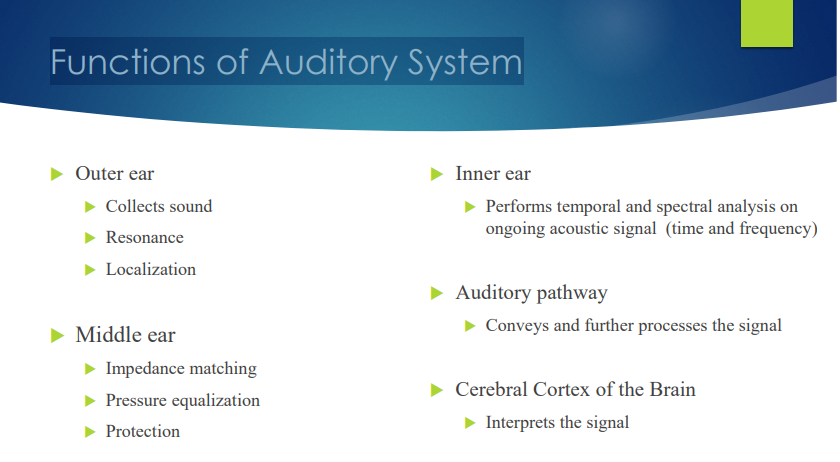
Functions of Auditory System: What are the three functions of the middle ear?
Impedance matching
Pressure equalization
Protection

Functions of Auditory System: What is impedance matching?(Middle Ear)
What is pressure equalization?
What is protection?
The middle ear helps transfer sound energy efficiently from the air to the fluid-filled inner ear.
Maintaining equal air pressure between the middle ear and the atmosphere.
The middle ear helps protect the inner ear from loud sounds.
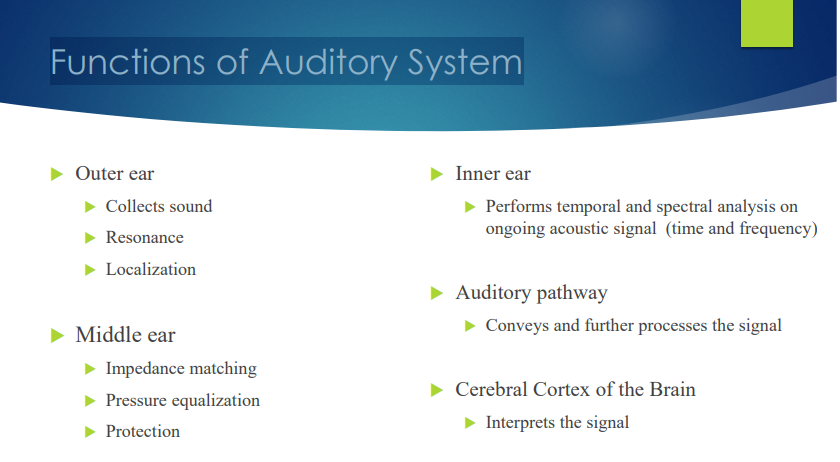
Functions of Auditory System: What is the function of the inner ear?
What is temporal analysis?
What is spectral analysis?
Performs temporal and spectral analysis on the ongoing acoustic signal (time and frequency).
Analyzing the timing of sound.
Analyzing the frequency components of sound.

Functions of Auditory System:
What is the function of the auditory pathway?
What is the function of the cerebral cortex?
Conveys and further processes the signal.
Interprets the signal.

Outer Ear: What is the primary function of the outer ear?
The outer ear is primarily seen as the collector of sound.
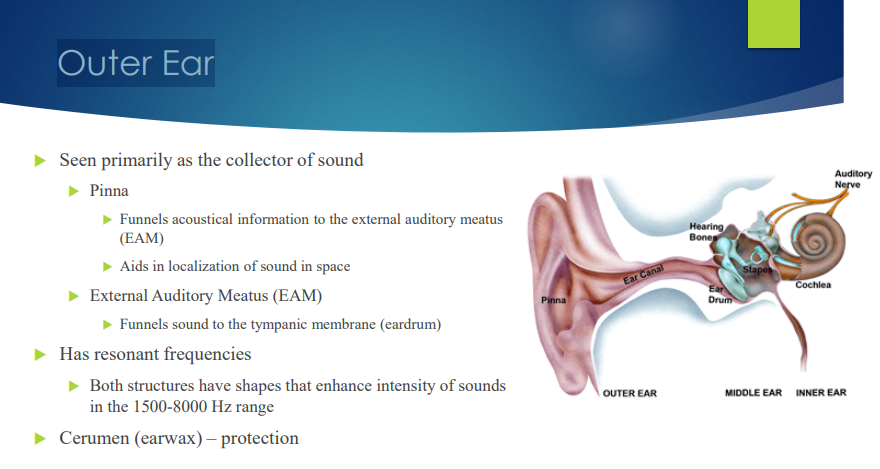
Outer Ear: What are the two main structures of the outer ear?
Pinna
External Auditory Meatus (EAM)

Outer Ear: What does the pinna do?
How does the pinna help with hearing?
It funnels acoustical information to the external auditory meatus (EAM).
It aids in the localization of sound in space.

Outer Ear: What does the external auditory meatus (EAM) do?
It funnels sound to the tympanic membrane (eardrum).

Outer Ear: What is cerumen, and what is its function?
Cerumen is earwax, and its function is protection.

Middle Ear: What does the middle ear do?
Why does the middle ear need to increase pressure?
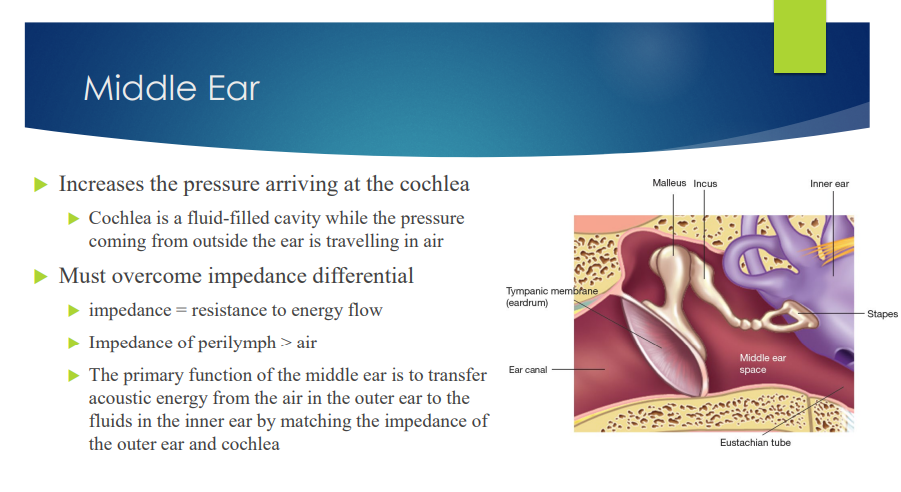
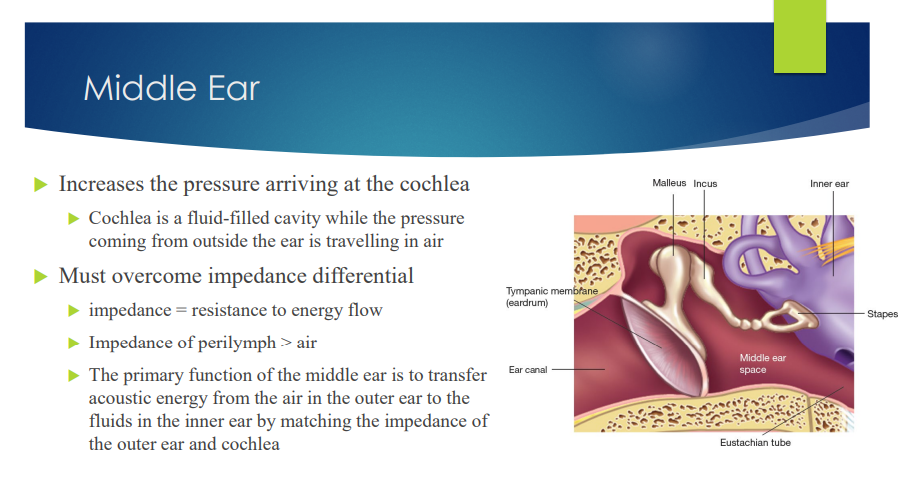
It increases the pressure arriving at the cochlea.
It boosts the pressure reaching the cochlea because the cochlea is filled with fluid, while sound travels through air outside the ear.
Middle Ear: What must the middle ear overcome?
What is impedance?
It must overcome the impedance differential.(The difference in resistance to sound energy between air and fluid.)
Impedance is resistance to energy flow.
Middle Ear: How does the impedance(resistance) of perilymph compare to air?
What is the primary function of the middle ear?
The impedance of perilymph is greater than air./ Perilymph has higher impedance than air, meaning it resists the movement of sound energy more.
To transfer acoustic energy from the air in the outer ear to the fluids in the inner ear by matching the impedance of the outer ear and cochlea.

Impedance Matching: How many impedance matching functions does the middle ear have?
What are the three impedance matching functions of the middle ear?
There are 3 impedance matching functions.
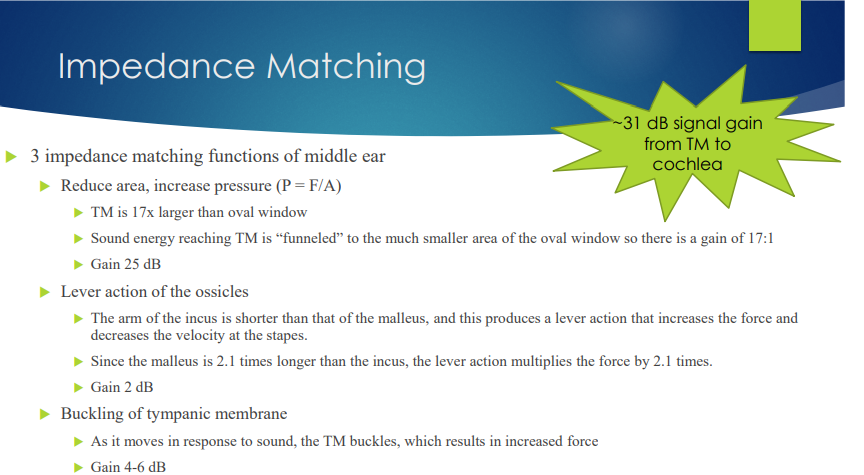
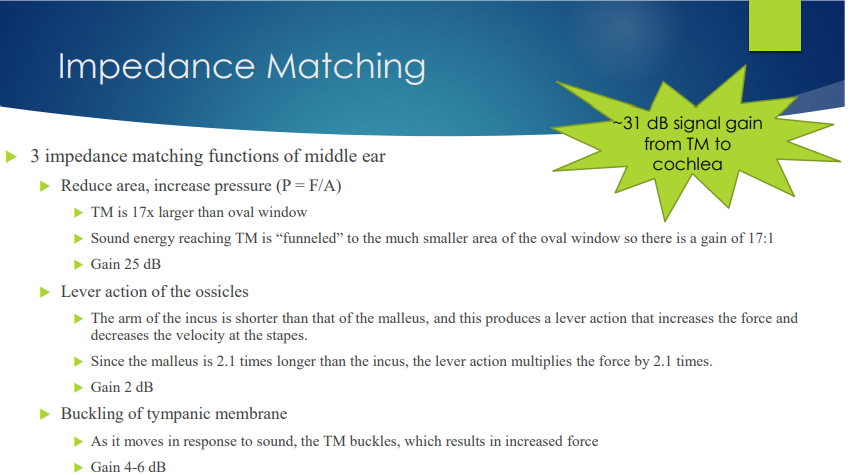
Reduce area, increase pressure (P = F/A).
Lever action of the ossicles.
Buckling of the tympanic membrane.

Impedance Matching: How does the lever action of the ossicles work?
The arm of the incus is shorter than that of the malleus, producing a lever action that increases force and decreases velocity at the stapes.
Impedance Matching: What happens to the tympanic membrane when it moves in response to sound?
The TM buckles, which results in increased force.
Middle Ear: What are the functions of the Eustachian tube?
What does the Eustachian tube connect?
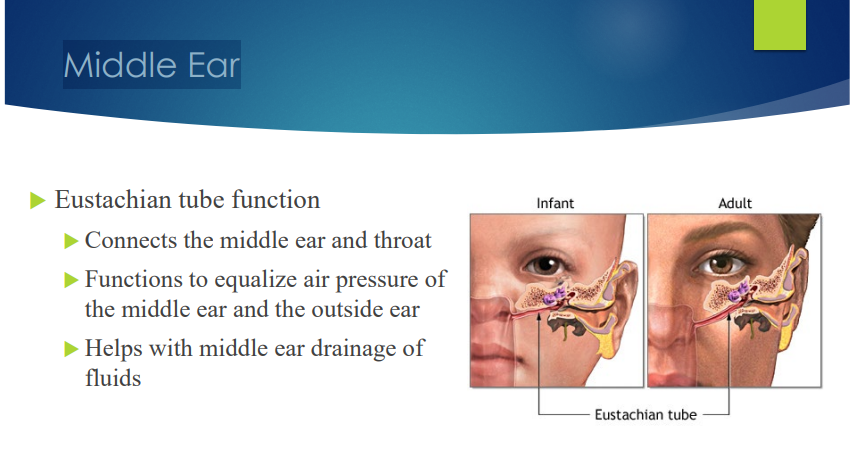
Connects the middle ear and throat.
Equalizes air pressure between the middle ear and outside ear.
Helps with middle ear drainage of fluids.
It connects the middle ear and throat.

Middle Ear: What is the Eustachian tube's role in pressure equalization?
How does the Eustachian tube help with drainage?
It equalizes air pressure between the middle ear and the outside ear.
It helps with the middle ear drainage of fluids.
Middle Ear: What are the functions of the middle ear muscles?
How do the middle ear muscles help protect the inner ear?
Suspend ossicles.
Protect the inner ear from noise damage.
They produce a reflex in response to loud sounds.
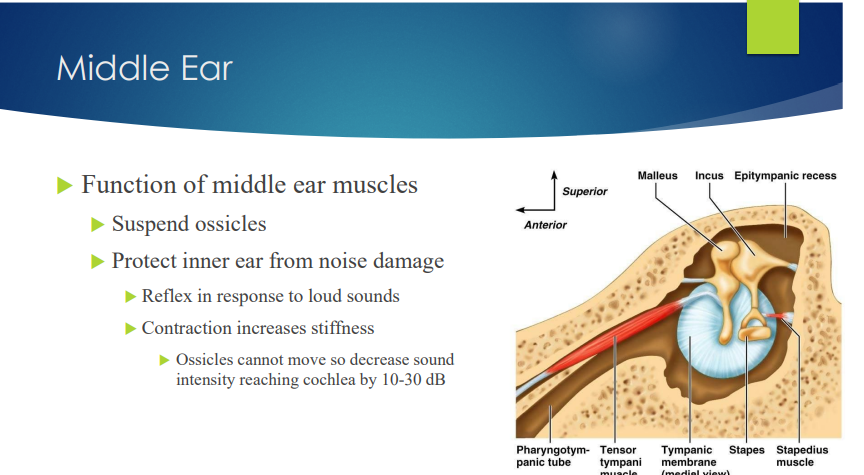
Middle Ear: What happens when the middle ear muscles contract?
Contraction increases stiffness.
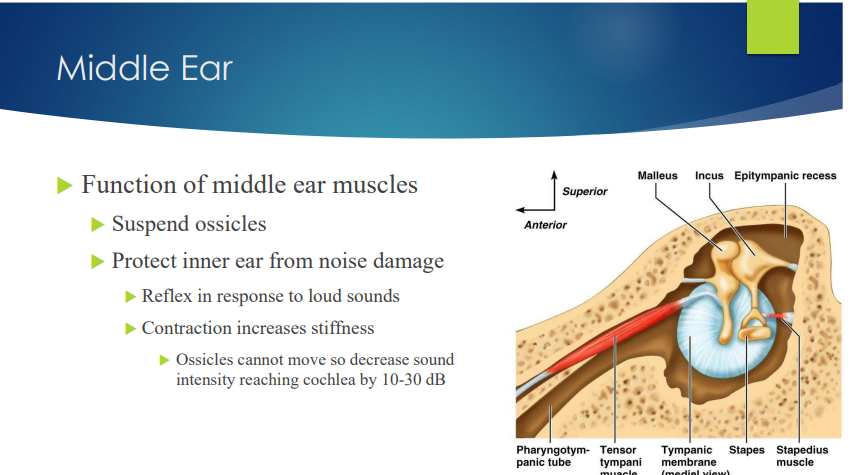
Middle Ear: What happens to the ossicles when the middle ear muscles contract?
The ossicles cannot move as easily, decreasing sound intensity reaching the cochlea by 10–30 dB.

Inner Ear: What does the inner ear do?
What are the two components of inner ear function?
It performs frequency (pitch) and temporal acoustic analysis of the incoming acoustical signal.
Vestibular mechanism
Auditory mechanism

Inner Ear: What happens to mechanical events in the inner ear?
Mechanical events are converted into:
Electrical events
Neural responses
Auditory pathway responses
Mechanical movement → Electrical signals → Nerve signals → Brain processes sound.
A: Mechanical vibrations are converted into electrical signals and neural responses that travel through the auditory pathway to the brain.
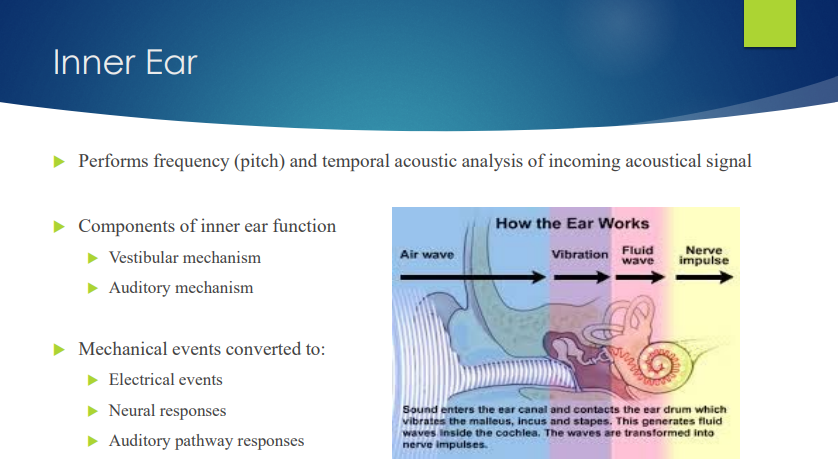
Inner Ear: What is frequency (pitch) analysis?
What is temporal acoustic analysis?
It is the analysis of the pitch or frequency of incoming sound.
It is the analysis of the timing of incoming sound.

Vestibular System: What does the vestibular system control?
What does damage to the vestibular system usually result in?
It controls balance.
It usually results in vertigo.
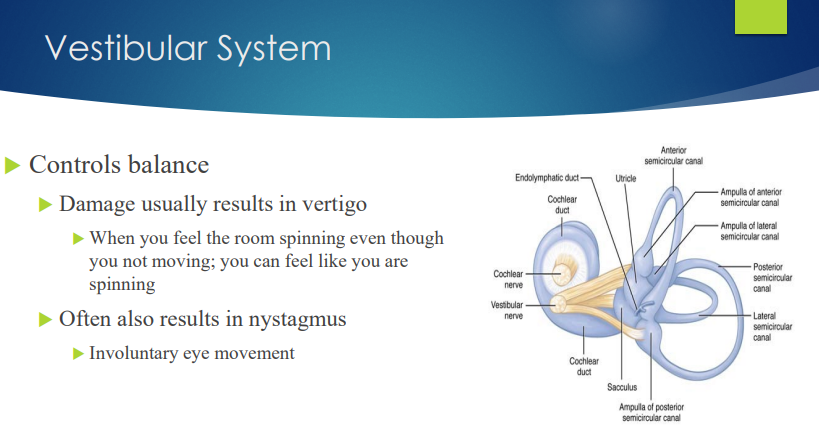
Vestibular System: What is vertigo?
What is another condition that can result from vestibular system damage? What is nystagmus?
Vertigo is when you feel like the room is spinning even though you are not moving. You may feel like you are spinning.
Nystagmus, Involuntary eye movement.

Cochlear Function: What are the three main functions of the cochlea?
Determines frequency components of the signal (perception of pitch).
Determines amplitude of the signal (perception of loudness).
Identifies temporal aspects of the signal (timing/duration of signal).
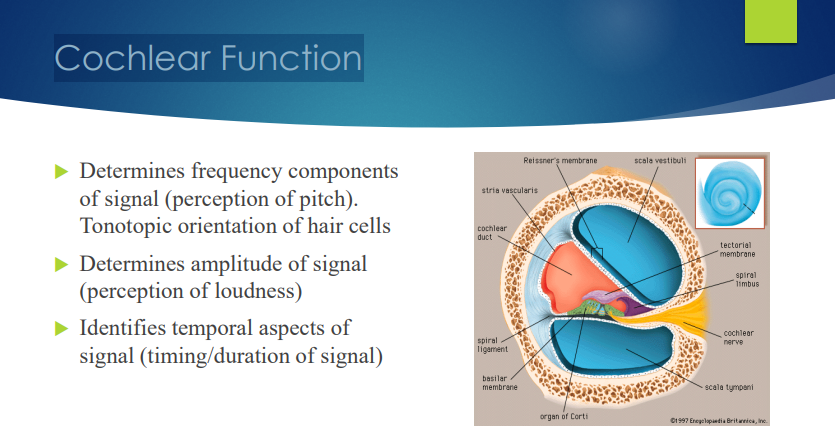
Cochlear Function: What does the cochlea determine about frequency?
What is tonotopic orientation of hair cells?
It determines the frequency components of the signal, which allows us to perceive pitch.
The organization of hair cells according to the frequencies they respond to.

Cochlear Function: What does the cochlea determine about amplitude?
It determines the amplitude of the signal, which allows us to perceive loudness.

Cochlear Function: What temporal aspects of the signal does the cochlea identify?
The timing and duration of the signal.

Mechanical Events: What does sound cause?
What happens when the TM moves?
A disturbance in air that causes the tympanic membrane (TM) to move.
The stapes footplate moves in the oval window.

Mechanical Events: What happens when the stapes compresses perilymph?
Reissner's membrane moves toward the scala media.
Basilar membrane moves toward the scala tympani.
Mechanical Events: What initiates the traveling wave?
The disturbance at the basilar membrane.
Mechanical Events: How is sound frequency determined?
By the number of vibrations per second.

Mechanical Events: What happens with a 100 Hz signal?
The stapes footplate moves inward and outward 100 times per second.

Prepost: When the stapes footplate strikes the oval window, it compresses the _____________. This in turn causes the __________________ to be displaced, initiating a ______________________.
Perilymph → Basilar membrane → Traveling wave.
Prepost Question: What provides an impedance matching system?
C. Middle ear
Prepost Question: What funnels acoustical information?
B. Outer ear
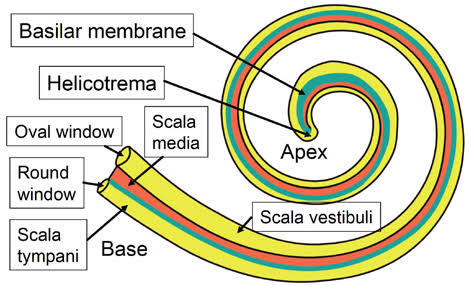
Mechanical Events – Properties of the Basilar Membrane: What happens to the basilar membrane from base to apex?
Less stiff
Wider
More massive

Mechanical Events – Properties of the Basilar Membrane: Why do different places on the basilar membrane respond to different sound frequencies?
Because of tonotopic organization.(aka how the hairs are organizatied)

Mechanical Events – Properties of the Basilar Membrane: Where are high-frequency sounds processed?
Near the base of the cochlea.
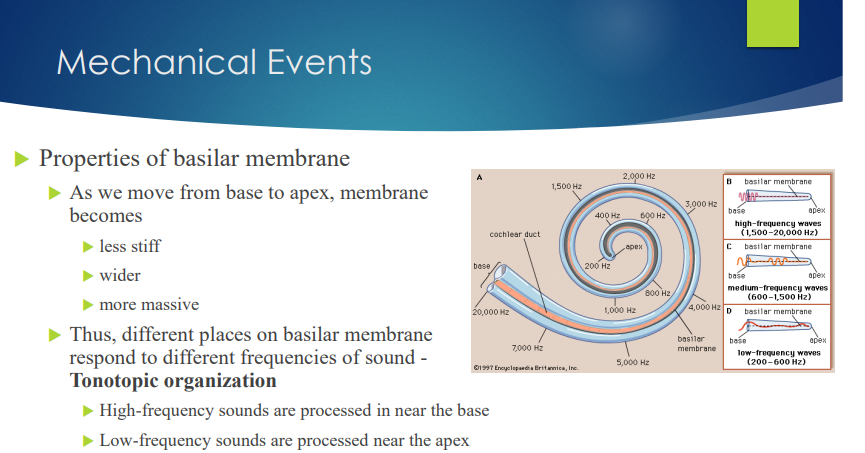
Mechanical Events – Properties of the Basilar Membrane: Where are low-frequency sounds processed?
Near the apex of the cochlea.
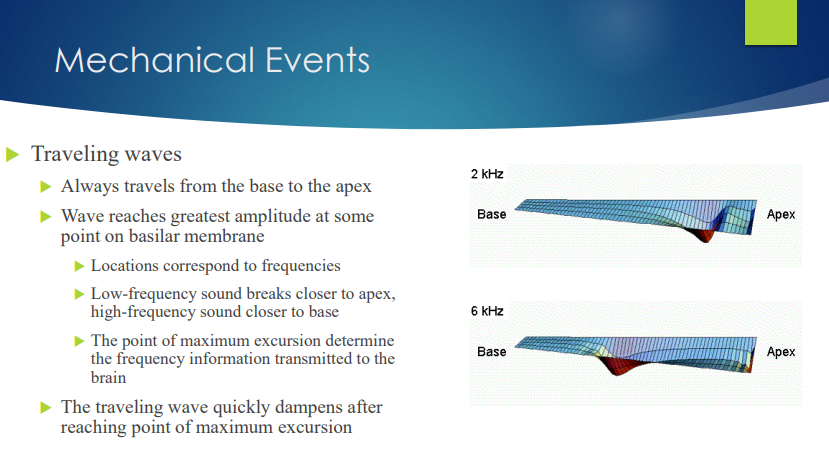
Mechanical Events – Traveling Waves: What happens after the traveling wave reaches maximum excursion?
After the traveling wave reaches its highest point of movement, it quickly loses strength and fades away.

Mechanical Events – Traveling Waves: What does the point of maximum excursion determine?
The frequency information transmitted to the brain.

Mechanical Events – Traveling Waves: Where do low- and high-frequency sounds reach maximum amplitude?
Low frequency → Closer to the apex.
High frequency → Closer to the base.

Mechanical Events – Traveling Waves: What determines the location of greatest amplitude?
The location corresponds to the frequency of the sound.
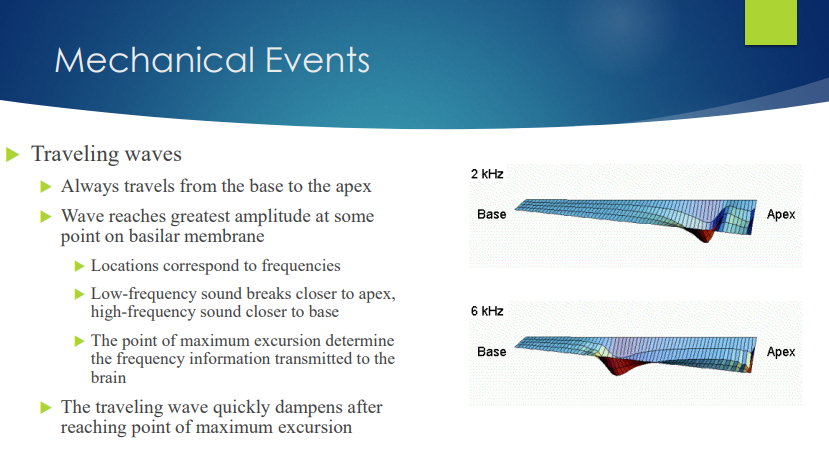
Mechanical Events – Traveling Waves: In which direction do traveling waves move?
Always from the base to the apex.
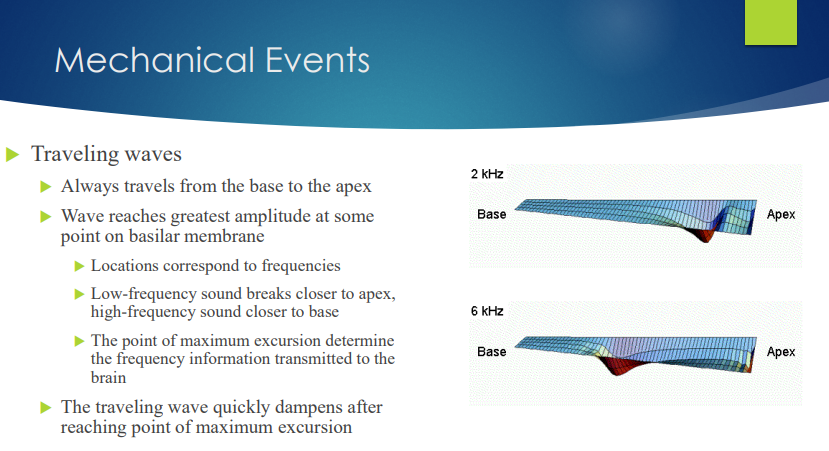
Mechanical Events – Traveling Waves: Where does a traveling wave reach its greatest amplitude?
At a specific point on the basilar membrane.
Mechanical Events – Excitation of Hair Cells: How are outer hair cells (OHCs) excited?
Their stereocilia are embedded in the tectorial membrane.
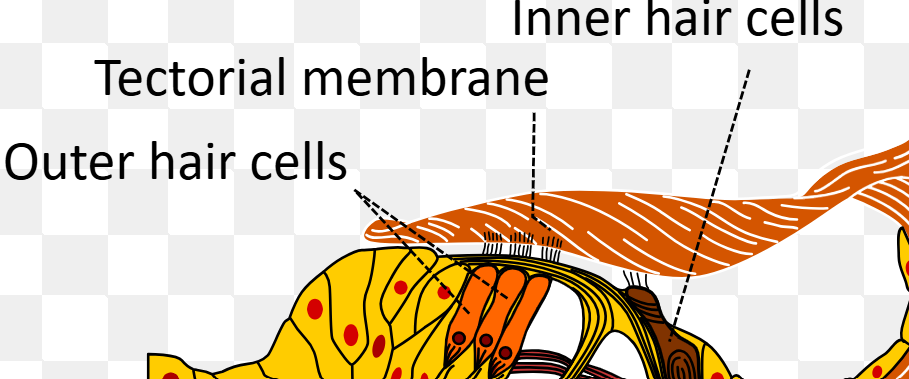
Mechanical Events – Excitation of Hair Cells: What happens when the traveling wave moves along the basilar membrane?
Hair cells are displaced relative to the tectorial membrane, producing a shearing action.
Mechanical Events – Excitation of Hair Cells: . Are inner hair cells (IHCs) directly connected to the tectorial membrane?
No, they are not directly connected.
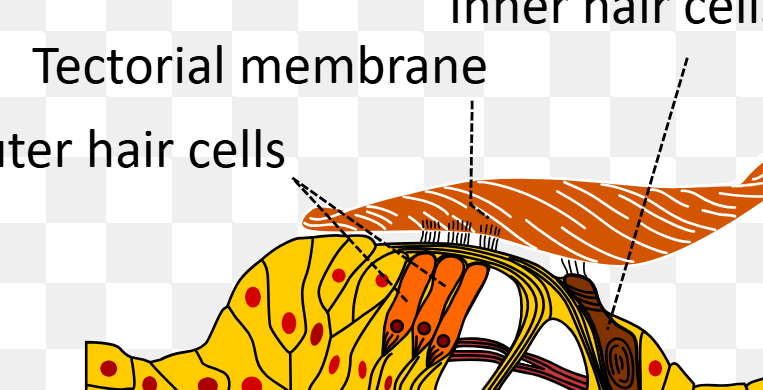
Mechanical Events – Excitation of Hair Cells: How are inner hair cells acivated?
Their stereocilia(surface of hair cells) are excited by fluid motion and turbulence of endolymph.
Mechanical Events – Excitation of Hair Cells: What is the function of outer hair cells (OHCs)?
They act as cochlear amplifiers.
Mechanical Events – Hair Cell Function: What happens when outer hair cells are excited?
They contract.
Mechanical Events – Hair Cell Function: When is basilar membrane vibration enhanced?
When the movement happens at the same frequency that a specific part of the basilar membrane naturally responds to.
Mechanical Events – Hair Cell Function: What type of nerve connection do outer hair cells use?
Motor – Efferent
Descending
Sends information from the brain to the cochlea.
Mechanical Events – Hair Cell Function: What is the function of inner hair cells (IHCs)?
They send sensory information up the auditory pathway.

Mechanical Events – Hair Cell Function: What type of nerve connection do inner hair cells use?
Sensory – Afferent
Ascending
Sends information from the cochlea to the brain.
Function of Auditory Cortex: What is the auditory cortex probably necessary for?
Analysis of complex sounds.
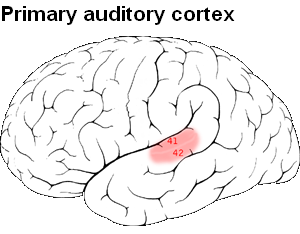
Function of Auditory Cortex: Why is the auditory cortex important for attention
It helps selectively attend to sound sources based on their location.
Function of Auditory Cortex: What is the auditory cortex involved in?
What else is the auditory cortex important for?
What is the auditory cortex necessary for?
Coding sound source location.
Identification of auditory stimuli.
Completing complex auditory tasks.
Regarding the basilar membrane, where are high-frequency sounds processed?
B. Base
Regarding the basilar membrane, where are low-frequency sounds processed?
A. Apex
What provides a means of identifying location of head/body in space?
C. Vestibular system
Where does the first opportunity for frequency analysis take place?
B. Cochlea

label them
Helix — D
Concha — E
Lobule — C
Tragus — B
Antihelix — A
Prepost Question: High frequency sounds are processed at the _________ of the basilar membrane.
C. Base
Prepost Question: Low frequency sounds are processed at the _________ of the basilar membrane.
D. Apex