GW BGZ2026 Case 6 - Big pharma business - from “blockbusters” to “niche busters”
 Call Kai
 Learn
 Practice Test
 Spaced Repetition
 Match
 Flashcards
 Knowt Play
1/21

There's no tags or description
Looks like no tags are added yet.
22 Terms
What is first-order elimination?
First-order elimination means that a constant fraction (percentage) of the drug is eliminated per unit of time.
The rate of elimination depends on the drug concentration: the higher the concentration, the faster the drug is eliminated.
The drug's half-life remains constant because the same percentage is removed over time.
Most drugs follow first-order kinetics under therapeutic conditions because the enzymes responsible for metabolism are not saturated.
What is zero-order elimination?
Zero-order elimination means that a constant amount of drug is eliminated per unit of time, regardless of the drug concentration.
This occurs when the enzymes responsible for metabolism become saturated and are working at their maximum capacity.
Because elimination is no longer proportional to the drug concentration, the half-life is not constant and increases as drug concentration rises.
Small increases in dose can lead to large increases in plasma drug concentration, increasing the risk of toxicity.
What are the main differences between first-order and zero-order elimination?
First-order elimination removes a constant percentage of the drug, whereas zero-order elimination removes a constant amount.
In first-order kinetics, the elimination rate is proportional to drug concentration; in zero-order kinetics, the elimination rate is independent of drug concentration.
First-order elimination has a constant half-life, while zero-order elimination has a variable half-life.
Most drugs follow first-order kinetics, whereas only a few drugs (ethanol) exhibit zero-order kinetics when metabolic enzymes become saturated.
What is a patent?
A patent is an exclusive legal right granted by a government that gives an inventor or pharmaceutical company the right to prevent others from making, using, selling, or importing an invention without permission for a limited period.
In the pharmaceutical industry, patents are essential because they protect new medicines and allow companies to recover the enormous costs of research and development.
A patent creates a temporary monopoly, meaning that no competitor can legally market the same invention while the patent is active.
Pharmaceutical patents can protect:
Active pharmaceutical ingredients (APIs)
Drug formulations (e.g., tablets, capsules, sustained-release products)
Manufacturing processes
Drug delivery systems
Methods of treatment
New medical indications for existing drugs
Without patent protection:
Generic companies could immediately copy a newly developed medicine.
Pharmaceutical companies would have little financial incentive to invest billions of dollars in developing innovative drugs.
A patent is therefore essential for balancing innovation with public disclosure, because companies must fully describe their invention in exchange for legal protection.
Why are patents important in the pharmaceutical industry?
Patents encourage innovation by rewarding companies that successfully develop new medicines.
Developing a new drug is:
Very expensive (approximately $800 million–$1.7 billion per drug).
Time-consuming (typically 10–15 years).
Highly risky, since most drug candidates fail before reaching the market.
Patent protection allows companies to:
Recover research and development costs.
Generate profit to fund future research.
Attract investors who are willing to finance expensive pharmaceutical research.
Patents also benefit society because:
Companies must publicly disclose how their invention works.
After the patent expires, this knowledge becomes available for everyone to use.
Generic manufacturers can then produce affordable versions of the medicine.
Without patents:
Innovation would decrease.
Companies would struggle to recover their investments.
Fewer new medicines would likely be developed.
What are the different types of pharmaceutical patents?
Pharmaceutical companies usually build a patent portfolio, protecting several aspects of a medicine instead of relying on a single patent.
The main types of pharmaceutical patents are:
Compound (ingredient) patent
Protects the active pharmaceutical ingredient (API) itself.
Usually the strongest form of patent protection because competitors cannot market the same molecule.
Example: Atorvastatin (Lipitor).
Formulation patent
Protects how the drug is formulated.
Examples include:
Sustained-release tablets
Controlled-release capsules
Orally disintegrating tablets
Liposomal formulations
Process patent
Protects the manufacturing method used to produce the drug.
Competitors may still manufacture the same medicine only if they develop a different production process.
Method-of-use patent
Protects the use of a medicine for treating a specific disease.
If researchers discover a new therapeutic use, the company may obtain an additional patent.
Administration patent
Protects a new route of administration or dosing schedule.
Examples:
Oral tablet instead of injection.
Weekly dosing instead of daily dosing.
Combination patent
Protects a product containing two or more active ingredients combined into one medicine.
Often improves patient adherence and may qualify for new patent protection.
When is a patent filed during drug development, and why is early filing important?
Pharmaceutical companies usually file a patent before entering Phase I clinical trials.
Filing early establishes the priority date, which legally protects the invention before information becomes public.
Early filing is essential because:
Clinical trial registration makes information publicly available.
Scientific publications and conference presentations may reveal important details.
Public disclosure before filing can prevent a valid patent from being granted.
After the initial patent application, companies often file additional patents during development for:
Improved formulations
New manufacturing methods
New therapeutic indications
Different dosing regimens
Combination therapies
Filing patents early ensures that companies maintain intellectual property protection throughout the lengthy drug development process.
How long does a pharmaceutical patent last, and what is the effective patent life?
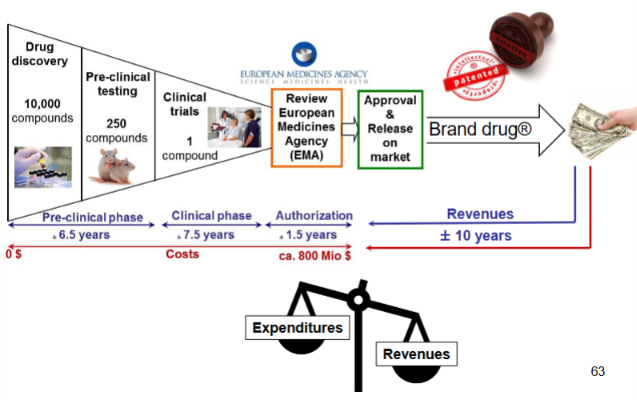
A pharmaceutical patent usually lasts 20 years from the filing date.
However, companies do not enjoy 20 years of market exclusivity because patents are filed very early during drug development.
Drug development typically requires:
3–6 years for discovery.
1–2 years of preclinical testing.
6–8 years of clinical trials.
1–2 years of regulatory review.
As a result, much of the patent period is consumed before the medicine reaches the market.
The effective commercial patent life after approval is therefore often only 5–10 years (sometimes 8–12 years, depending on development time).
To compensate for this lost time, many countries allow:
Patent Term Extensions (PTEs).
Supplementary Protection Certificates (SPCs) in the European Union.
These extensions help restore part of the patent protection lost during lengthy clinical development and regulatory approval.
What does "coming off patent" mean?
Coming off patent means that the patent protecting a medicine has expired, so the original pharmaceutical company no longer has exclusive rights to manufacture and sell the drug.
Once the patent expires:
Generic manufacturers can apply for regulatory approval to produce the same medicine.
Competition in the market increases significantly.
The price of the medicine usually falls sharply.
The original manufacturer's market share decreases.
Healthcare systems and patients benefit from lower drug prices.
Generic drugs contain the same active pharmaceutical ingredient (API) and must demonstrate bioequivalence to the original medicine before they can be approved.
Patent expiry does not mean the medicine is discontinued. Instead, it becomes available from multiple manufacturers.
For pharmaceutical companies, coming off patent often results in a major loss of revenue, especially if the drug was a blockbuster medicine.
What is the patent cliff, and what are its consequences?
The patent cliff refers to the sudden and significant loss of revenue that occurs when one or more blockbuster drugs lose patent protection and face competition from generic manufacturers.
It is called a "cliff" because sales often drop very rapidly, rather than gradually.
Why does the patent cliff occur?
Generic drugs enter the market after patent expiry.
Generic medicines are:
Therapeutically equivalent to the branded drug.
Much cheaper, making them the preferred option for patients, healthcare providers, insurers, and governments.
Many countries encourage:
Generic substitution
Reference pricing
Reimbursement of generic medicines
As more companies produce the same medicine, competition shifts primarily to price, causing the original manufacturer's sales to decline.
Consequences for pharmaceutical companies
Loss of billions of dollars in annual sales
Reduced profit margins
Increased pressure to develop new medicines
Possible restructuring and workforce reductions
Greater dependence on innovation and pipeline development
Consequences for healthcare systems and patients
Lower medicine prices
Increased patient access to treatment
Reduced healthcare expenditure
Improved affordability of long-term therapies
What strategies do pharmaceutical companies use to avoid the patent cliff?
Because patent expiry is inevitable, pharmaceutical companies use life-cycle management strategies to extend the commercial value of their medicines and reduce revenue loss.
Common strategies include:
Drug repurposing (drug repositioning)
Finding a new therapeutic indication for an existing drug.
A new indication may qualify for a new patent.
New route of administration
Developing a different method of delivering the medicine.
Examples:
Injection → oral tablet
Tablet → inhaler
Oral medication → transdermal patch
New formulations
Creating improved versions such as:
Extended-release tablets
Sustained-release capsules
Liposomal formulations
These may improve patient adherence and qualify for additional patent protection.
Drug combinations
Combining two or more active ingredients into a single medicine.
Fixed-dose combinations improve convenience and may receive new patents.
Single enantiomer (chiral switch)
Developing only the active mirror-image molecule from a racemic drug.
Example:
Omeprazole → Esomeprazole
Polymorph patents
Patenting a different crystal form of the same drug.
Business strategies
Acquiring biotechnology companies.
Investing in biologics and specialty medicines.
Strengthening the research pipeline.
Diversifying product portfolios.
These strategies do not extend the original patent, but instead create opportunities for new patents covering innovative improvements.
What is a blockbuster drug?
A blockbuster drug is a medicine that generates more than US$1 billion in annual sales.
Blockbuster drugs usually treat common diseases that affect millions of people worldwide.
Their success is based on high sales volume, rather than an extremely high price per patient.
Characteristics of blockbuster drugs
Treat large patient populations
Often require lifelong treatment, leading to continuous sales.
Are prescribed by many physicians worldwide.
Usually have extensive marketing campaigns.
Generate enormous revenue that can fund future drug development.
Advantages
Very high revenue
Economies of scale reduce manufacturing costs.
Large amount of clinical evidence due to widespread use.
Worldwide availability
Disadvantages
Highly vulnerable to the patent cliff
Strong competition from other drugs.
Expensive and risky to develop.
Companies may become too dependent on a single product.

What is a niche buster?
A niche buster is a medicine developed for small, highly specific patient populations, but it still generates substantial revenue because of its high price per patient.
Niche busters often target:
Rare diseases (orphan diseases)
Cancer
Genetic disorders
Personalized medicine
Unlike blockbuster drugs, they rely on high therapeutic value rather than treating millions of patients.
How do niche busters generate revenue?
The number of patients is relatively small.
However, treatment costs are often very high.
Even with only a few thousand patients, annual sales can reach billions of dollars.
Why are niche busters becoming more common?
Advances in genetics.
Precision medicine.
Better diagnostic tests.
Regulatory incentives for orphan drugs.
Declining success of the traditional blockbuster model.
Advantages
Less competition.
Greater clinical benefit for selected patients.
Regulatory incentives.
Longer commercial sustainability.
Disadvantages
Very expensive treatments.
Smaller markets.
Ethical concerns about affordability.
Specialized diagnostic testing is often required.
What are the main differences between blockbuster drugs and niche busters?
Feature | Blockbuster | Niche Buster |
|---|---|---|
Patient population | Large | Small |
Disease type | Common diseases | Rare or genetically defined diseases |
Revenue model | High sales volume | High price per patient |
Competition | High | Usually limited |
Treatment approach | Standardized | Personalized |
Marketing | Broad | Specialized |
Blockbusters earn money by treating millions of patients.
Niche busters earn money by charging higher prices for treatments aimed at small patient groups.
Modern pharmaceutical companies increasingly combine both strategies by expanding indications for successful niche drugs.
What is Lipitor (atorvastatin) and what is the mechanism of action?
Lipitor is the brand name for atorvastatin, a statin developed by Pfizer.
It became one of the best-selling medicines in history.
Mechanism of action
Inhibits HMG-CoA reductase, the rate-limiting enzyme in cholesterol synthesis.
As a result:
LDL ("bad") cholesterol decreases
Triglycerides decrease
HDL ("good") cholesterol slightly increases
Risk of cardiovascular disease is reduced.
Clinical uses
Hypercholesterolaemia.
Familial hypercholesterolaemia.
Prevention of heart attacks.
Prevention of strokes.
Prevention of cardiovascular disease in high-risk patients.
Why was Lipitor a blockbuster?
High cholesterol is extremely common.
Patients often take statins for life.
Strong evidence showed reduced cardiovascular events.
Worldwide marketing by Pfizer.
What is Plavix (clopidogrel) and what is the mechanism of action?
Plavix is the brand name for clopidogrel, an antiplatelet drug developed by Sanofi and Bristol-Myers Squibb.
It prevents blood clot formation and reduces the risk of heart attacks and strokes.
Mechanism of action
Clopidogrel is a prodrug.
It must first be activated in the liver, mainly by the enzyme CYP2C19.
The active metabolite:
Irreversibly blocks the P2Y12 ADP receptor on platelets.
Prevents platelet activation and aggregation.
Reduces arterial blood clot formation.
Important facts
Poor CYP2C19 metabolizers produce less active drug.
This leads to:
Reduced antiplatelet effect.
Increased risk of thrombotic events.
Platelet inhibition lasts 7–10 days because binding is irreversible.
There is no antidote.
Clinical uses
Acute coronary syndrome.
Previous myocardial infarction.
Previous ischaemic stroke.
Peripheral arterial disease.
Coronary stents (often with aspirin).
Main adverse effect
Bleeding

What are bioequivalence studies?
Bioequivalence studies are clinical studies designed to demonstrate that a generic medicine behaves the same in the body as the original (reference) medicine.
They compare:
Rate of absorption
Extent of absorption
If two medicines are bioequivalent, they are expected to have:
The same therapeutic effect.
The same safety profile.
Why are they important?
Generic manufacturers do not need to repeat expensive Phase II and Phase III clinical trials.
Instead, they prove that their medicine performs the same as the original product.
This:
Reduces development costs.
Speeds up approval.
Increases access to affordable medicines.

How are bioequivalence studies performed?
≤ 12 healthy volunteers, preferably men
≥ 18 years
BMI 18.5 – 30 kg/m2
Non-smokers, no history in alcohol and drug abuse
Preferably cross-over design to exclude variability between subjects
Smaller group → higher statistical power with cross-over
Study design
Usually a randomized crossover study.
Conducted in healthy volunteers.
Each participant receives:
The reference (brand) medicine.
The generic (test) medicine.
A washout period separates the two treatments.
Key pharmacokinetic parameters
AUC (Area Under the Curve)
Measures total drug exposure.
Reflects the extent of absorption.
Cmax
Maximum plasma concentration.
Reflects the rate of absorption.
Tmax
Time required to reach Cmax.
Provides supportive information.
Regulatory requirement
The 90% confidence interval for AUC and Cmax must fall within 80–125%.
This statistical range demonstrates therapeutic equivalence, not that the drugs differ by 25%.
Importance
Successful bioequivalence studies allow approval of generic drugs without repeating full clinical efficacy trials, making medicines much cheaper and more widely available.

What are orphan drugs?
Orphan drugs are medicines developed to treat rare diseases that affect only a small proportion of the population.
Because so few patients need these medicines, pharmaceutical companies often have little financial incentive to develop them without government support.
Although each rare disease affects relatively few people, there are thousands of rare diseases worldwide, and together they affect millions of patients.
Definition of a rare disease
European Union (EU):
A disease affecting fewer than 5 in 10,000 people.
United States (US):
A disease affecting fewer than 200,000 people.
Why are orphan drugs important?
Many rare diseases previously had no effective treatments.
Orphan drugs provide therapies for patients who would otherwise have limited or no treatment options.
They have become increasingly important due to advances in:
Genetics
Precision medicine
Biotechnology
What challenges are involved in developing orphan drugs?
Developing orphan drugs presents several scientific, financial, and clinical challenges.
Scientific and clinical challenges
Very small patient populations make it difficult to recruit participants for clinical trials.
Limited understanding of many rare diseases.
Difficulty collecting enough evidence to demonstrate efficacy and safety.
Financial challenges
Drug development remains:
Expensive
Time-consuming
High risk
Because relatively few patients will use the medicine, companies may struggle to recover development costs.
Commercial challenges
Limited market size.
Lower potential sales volume.
High development costs per patient.
Without government incentives, many orphan drugs would never be developed because they would not be commercially profitable.
What incentives are available to encourage orphan drug development?
Governments introduced special incentives to encourage pharmaceutical companies to develop medicines for rare diseases.
European Union incentives
10 years of market exclusivity
Reduced regulatory fees
Scientific advice (protocol assistance) from the EMA.
Access to the centralised approval procedure.
United States incentives (Orphan Drug Act)
7 years of market exclusivity
Tax credits for clinical trials.
Grant funding
Fast-track regulatory support
Assistance during drug development.
Why are these incentives important?
They help:
Reduce financial risk.
Encourage investment in rare disease research.
Increase the number of available treatments.
Improve patient access to therapies that otherwise would not exist.
What happened in the Martin Shkreli (Daraprim) case, and why is it important?
The Martin Shkreli case is one of the best-known examples of controversy surrounding drug pricing and pharmaceutical ethics.
What happened?
In 2015, Turing Pharmaceuticals, led by Martin Shkreli, purchased the rights to Daraprim (pyrimethamine).
Daraprim is used to treat toxoplasmosis, particularly in:
Patients with HIV/AIDS
Other immunocompromised patients
After acquiring the drug, the company increased the price:
From approximately US$13.50 per tablet
To approximately US$750 per tablet
This enormous price increase caused worldwide criticism.
Why was this possible?
Importantly, Daraprim was NOT protected by a patent.
Instead, the company benefited from:
Very limited competition
A small patient population
Few manufacturers producing the medicine.
Limited therapeutic alternatives.
The largely unregulated US drug pricing system.
This created a de facto monopoly, even without patent protection.
Ethical issues
The case raised major concerns about:
Access to essential medicines
Profit versus public health
Whether pharmaceutical companies should prioritise:
Shareholder profits
Patient welfare
Legal outcome
Martin Shkreli was convicted of securities fraud in 2017.
His conviction was not related to the Daraprim price increase.
The price increase itself was legal, illustrating that legal pricing practices can still be ethically controversial.
Why is this case important?
The Daraprim case demonstrates that:
High drug prices are not always caused by patents.
Market conditions alone can create monopoly power.
It sparked international discussions on:
Drug pricing regulation.
Generic competition.
Price transparency.
Access to essential medicines.