Unit 2 Pre Calc Test
 Call Kai
 Learn
 Practice Test
 Spaced Repetition
 Match
 Flashcards
 Knowt Play
1/158

There's no tags or description
Looks like no tags are added yet.
159 Terms
How do you find x intercepts?
Let y = 0 and solve for x.
On calculator:
y = 2nd - trace - 2:zero
left and right of intersection
How do you find y intercepts?
Let x = 0 and solve for y.
On calculator:
y = 2nd - trace - value
x = 0
How do you find x axis symmetry?
Replacing y with −y yields an equivalent equation. (x, y) -> (x, -y)

How do you find y axis symmetry?
Replacing x with −x yields an equivalent equation. (x, y) -> (-x, y)
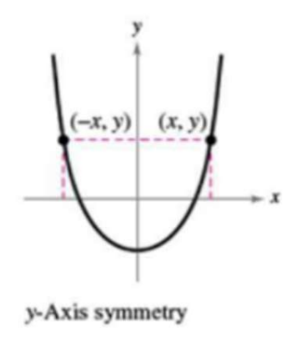
How do you find origin symmetry?
Replacing both x and y with their negatives yields an equivalent equation.
(x, y) -> (-x, -y)

Find the intercepts and test for symmetry for y = x2 − 4.

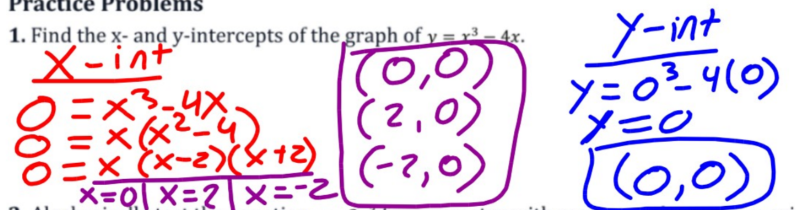
Find the x- and y-intercepts of the graph of y = x3 − 4x.
Find the x- and y-intercepts of y = √(x + 4).

Find the intercepts of y = |x − 3| − 2.

Convert y − 5 = 2(x + 3) to slope-intercept form.

Write the equation of a horizontal line passing through (−8,5).

Find the slope-intercept form of the equations of the lines that pass through the point (−4,1) and are (a) parallel to and (b) perpendicular to the line 5x − 3y = 8.

The simple interest I on an investment varies directly as the amount P invested. If $5000 earns $200 interest, how much does $8000 earn?

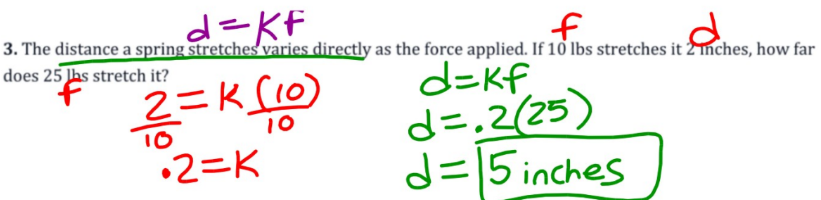
The distance a spring stretches varies directly as the force applied. If 10 lbs stretches it 2 inches, how far does 25 lbs stretch it?
Does y = 2x + 1 represent direct variation? Explain.
No, it must have the form y=kx with no added constant. Must pass through the point (0,0)
The weight of an object on the moon varies directly as its weight on Earth. If a 150 lb person weighs 25 lbs on the moon, find the moon weight of a 60 lb child.

What is inverse variation?
Describes a relationship between two variables where one increases while the other decreases, keeping their product constant
As x increases, y decreases. (ex. If x doubles, y halve)
The graph is a hyperbola.

The time t required to complete a job varies inversely as the number of people n working. If 3 people take 8 hours, how long do 4 people take?

The volume of a gas varies inversely as the pressure. If volume is 100 at 20 psi, find volume at 50 psi.

Does the table {(1,12), (2,6), (3,4)} represent inverse variation?

One input cannot have two __________.
outputs (x values cannot repeat)
Vertical line test: to determine if it is a function, it cannot intersect at more than 1 point)

What is the domain and the implied domain of a function?


Find the domain of f(x) = 3/(x-2)


Find the domain of f(x) = √(x − 4)
x >= 4
x-4 can’t be negative

1. Determine if x2 + y2 = 4 is a function.

Find the domain of g(x) = x2 + 4.

Find the range of f(x) = |x|.


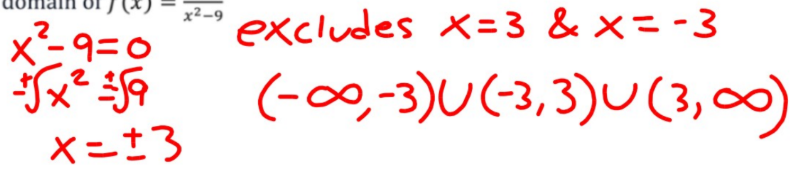

Find the domain of h(x) = √(9 − x).

Find the domain of f(x) = 10.

Steps to Graph Inequalities - Representing Solutions

Graphing <, >
dashed line
Graphing <=, =>
solid line
Graphing >, =>
shade above
Graphing <, <=
shade below
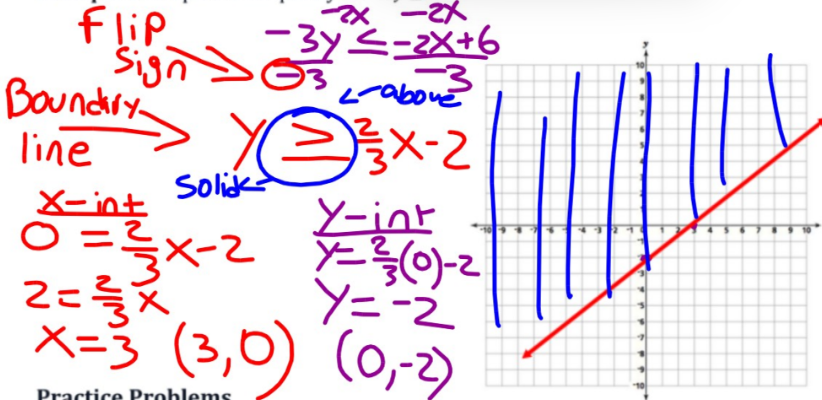
Graph the inequality 2x − 3y ≤ 6.
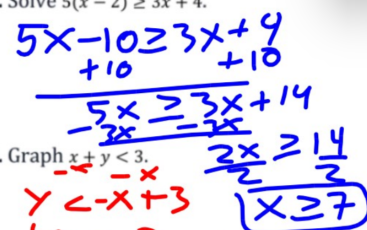
Solve 5(x − 2) ≥ 3x + 4.
Solve −3 < 2x + 1 ≤ 9.

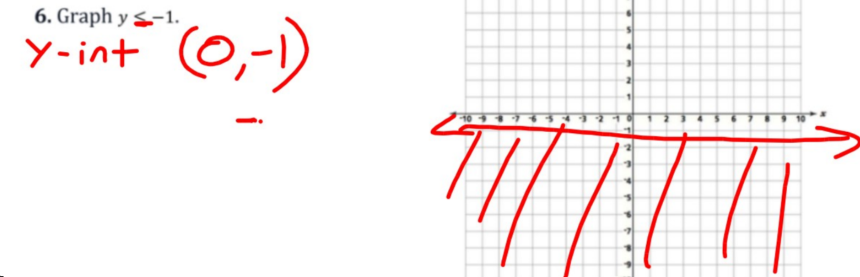
Graph y ≤ −1.
Algebraically find the x and y intercepts of the graph y = √(x + 4)

Find the slope-intercept form of the equation of the line that passes through the point (-4, −5) and is perpendicular to the line 4x − 8y = 3.



What are zeros?
The x-intercepts of the graph.
If the graph of a function of x has an x-intercept at x = a, then a is a zero of the function.
The zeros of a function f(x) are the values of x for which f(x) = 0.
To find the zeroes of a function, set the function equal to 0 and solve for the independent variable.
What does a graph look like when it is increasing?

What does a graph look like when it is decreasing?

What does a graph look like when it is constant?

What is relative maximum?

What is relative minimum?

Determine the intervals where f(x) = x2 is increasing and decreasing.

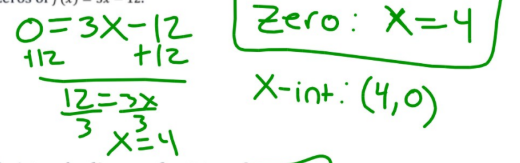
Find the zeros of f(x) = 3x − 12.
Identify the intervals of increase for f(x) = −x2

Find the zeros of f(x) = x3 − x.

Find the relative minimum of the function f(x) = 3x2− 4x − 2

Find the zeros of f(x) = √(x − 4).
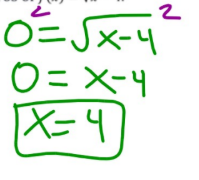
Find the zeros of f(x) = x2− 5x + 6.

Determine the open intervals on which each function is increasing, decreasing, or constant.

Identify intervals of decrease for f(x) = (x − 1)2
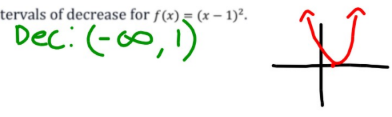
Where is f(x) = x3 increasing?

Find the zeros of f(x) = |x| − 3.

Find the relative maximum of the function f(x) = −4x2 − 7x + 3

Find the zeros of f(x) = x2 − 9.

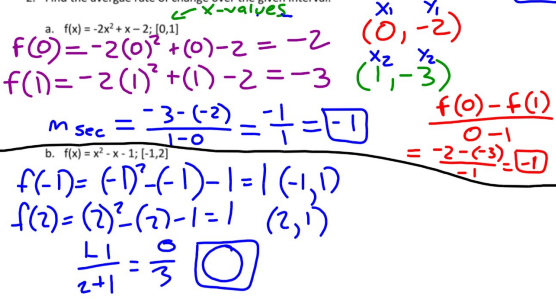
The average rate of change of f from a to b is given by:

Find the average rate of change of f(x) = x3 − 3x (a) from −2 to −1 and (b) from 0 to 1.

Find the average rate of change over the given interval.
a. f(x) = -2x2 + x – 2; [0,1]
b. f(x) = x2 - x - 1; [-1,2]
A function whose graph is symmetric with respect to the y-axis is an…
even function
A function y = f(x) is _____ when for each x in the domain of f, f(-x) = f(x)
even
A function whose graph is symmetric with respect to the origin is an…
odd function
A function y = f(x) is ____ when for each x in the domain of f, -f(x) = f(-x)
oodd

Determine whether the function is even, odd, or neither.


Determine if the function is even, odd, or neither


Find the average rate of change.


What is a piecewise defined function?
A function defined by at least two equations (“pieces”), each of which applies to a different part of the domain
Piecewise defined functions can take on a variety of forms. Their “pieces” may be all linear, or a combination of functional forms such as constant, linear, quadratic, cubic, square root, cube root, exponential, etc.
Due to this diversity, there is no parent function for piecewise defined functions


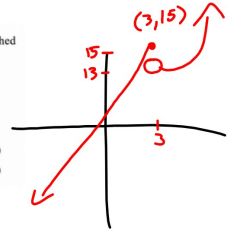
Graph the following piecewise function


Graph the following piecewise function


A closed circle at (3, 15) and an open circle at (3, 13)
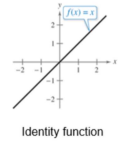
What is the f(x) = x parent function?
What is the f(x) = x2 parent function?

What is the f(x) = x3 parent function?

What is the f(x) = √x parent function?

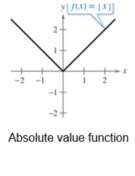
What is the f(x) = |x| parent function?
What is the f(x) = 1/x parent function?

Identify the domain and range of the parent square root function.

What is the domain of f(x) = 1/x?

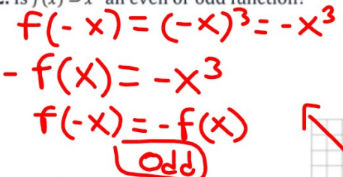
f(x) = x3 an even or odd function?
What is the range of f(x) = x2?
Identify the parent function of g(x) = (x − 2)2 + 3.

What is the domain of f(x) = √x?

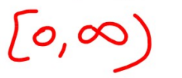
What is the range of f(x) = |x|?

Identify the parent function of h(x) = √(x + 1).

Is f(x) = x2 symmetric to the origin?

(f + g)(x) =
f(x) + g(x)
(f − g)(x) =
f(x) − g(x)
(fg)(x) =
f(x) ⋅ g(x)

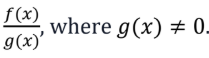
(f/g)(x) =
(f(x))/(g(x)), where g(x) is not equal to 0.
If f(x) = x2 and g(x) = x − 3, find (fg)(x).

Find (f − g)(x) for f(x) = 2x, g(x) = x + 1.


