Chapter 10 interactions with matter
 Call Kai
 Learn
 Practice Test
 Spaced Repetition
 Match
 Flashcards
 Knowt Play
1/90

There's no tags or description
Looks like no tags are added yet.
91 Terms
What are the five types of X-ray interactions with matter?
Coherent scattering Compton effect
Photoelectric effect
Pair production
Photodisintegration
Which two X-ray interactions are of concern to diagnostic radiology?
Photoelectric effect and Compton effect.
The conditions that govern Photoelectric effect and Compton scattering control ________ ________ , which determines the degree of contrast of an x-ray image
differential absorption
Electromagnetic radiation interacts with structures that are similar in size with .....?
the wavelength of radiation
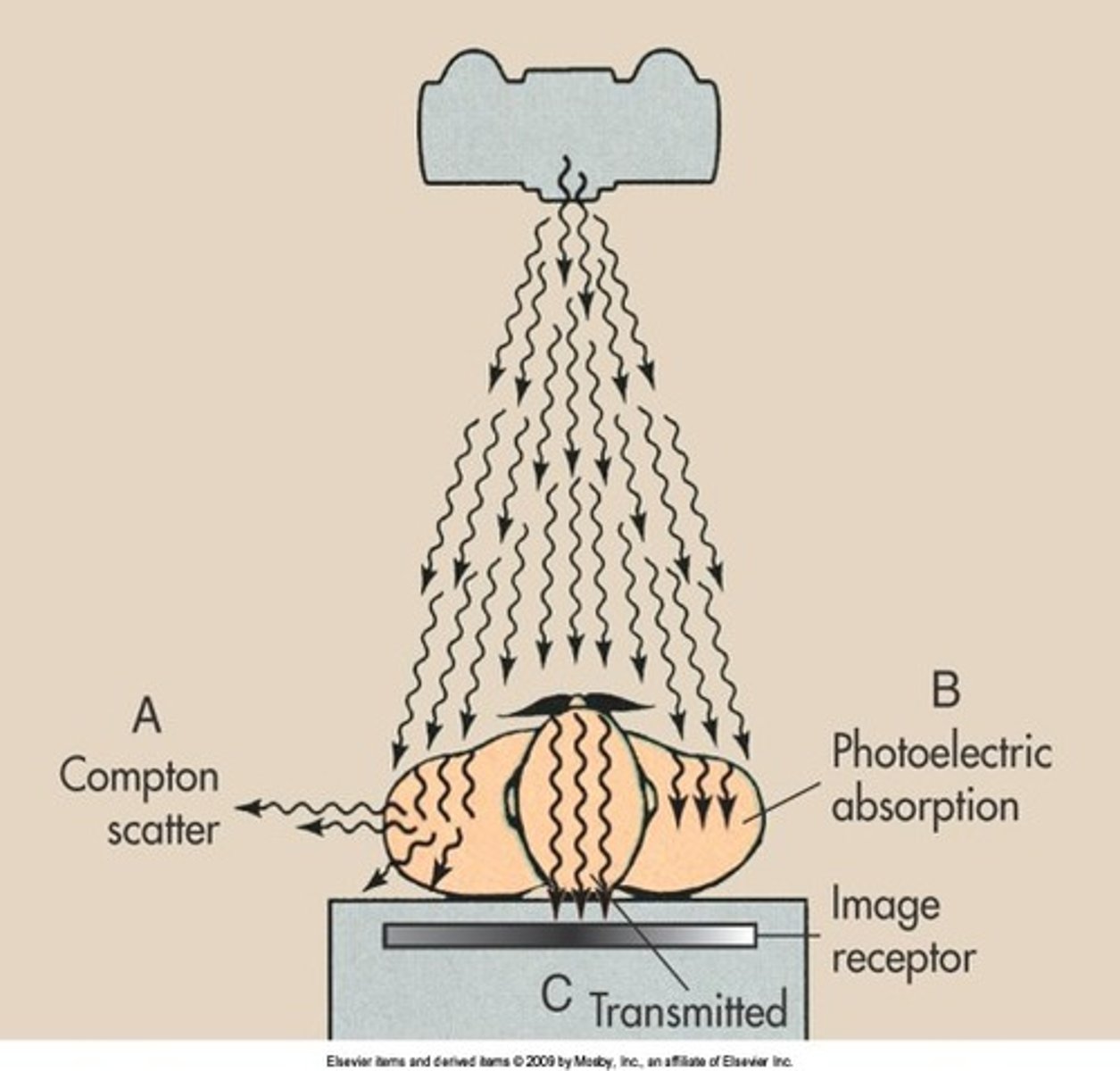
What are the 3 possibilities for a photon?
absorption (PE)
scatter (compton)
transmission
What is another name for coherent scattering?
Classical
unmodified
thompson Scattering
(think CUT)
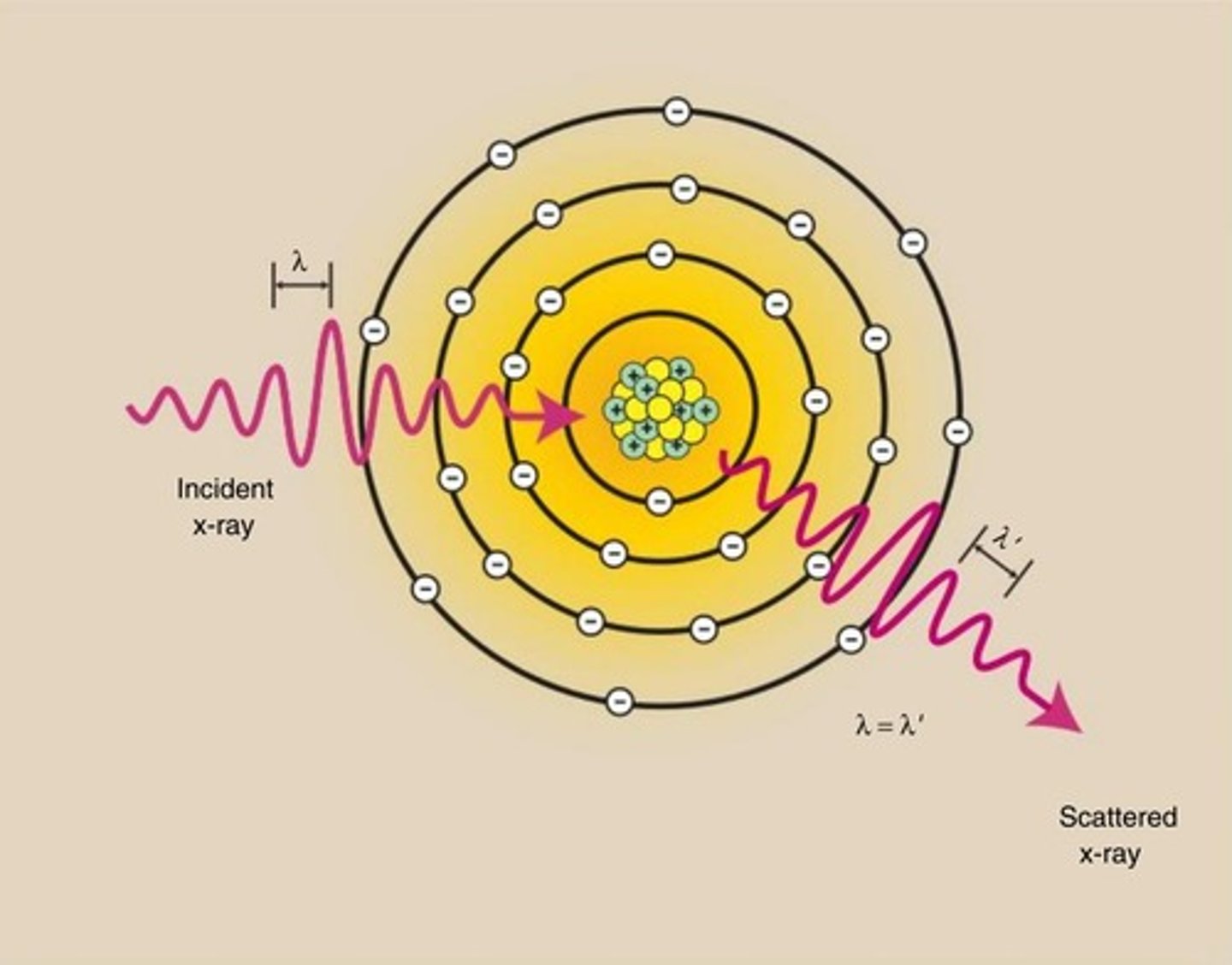
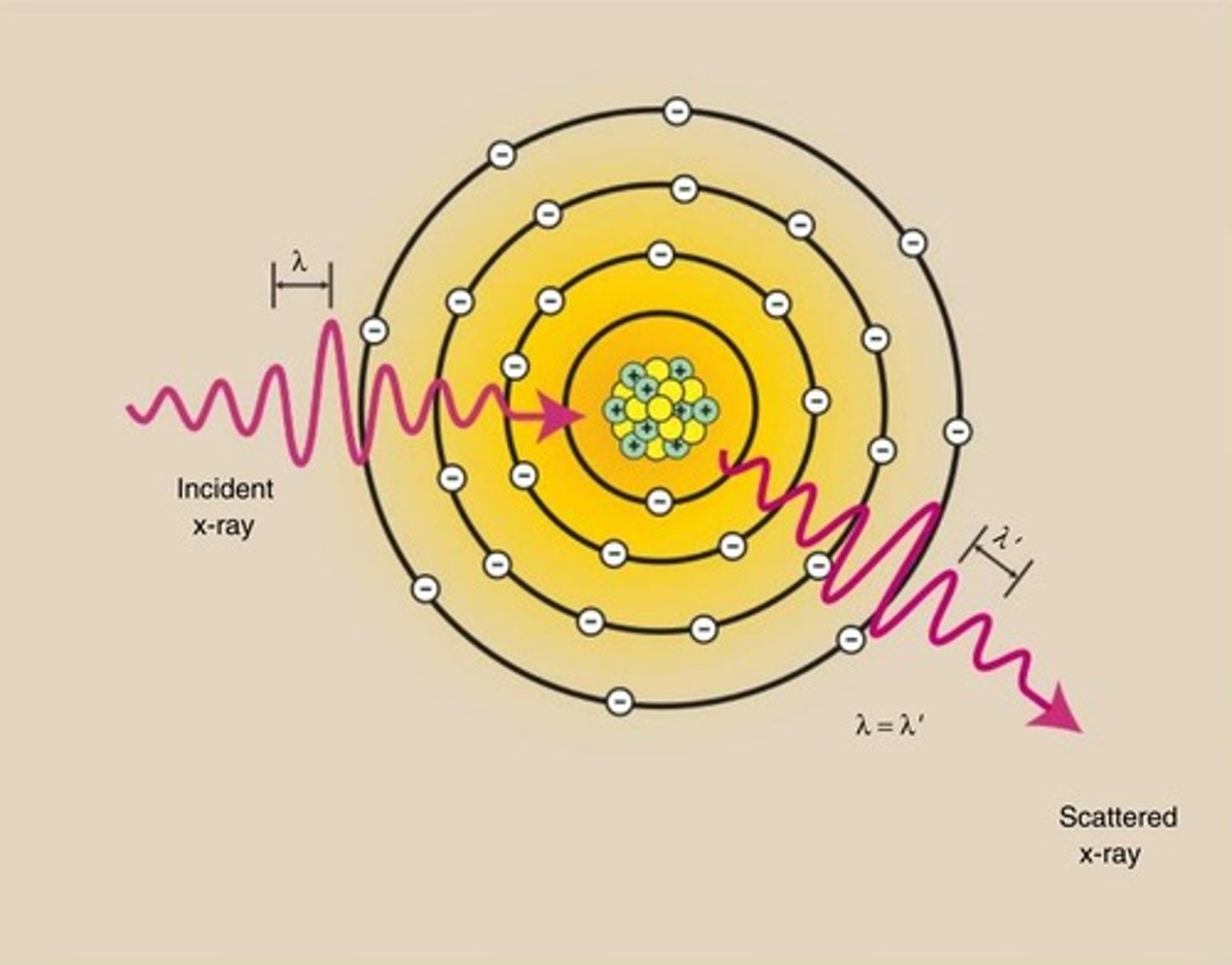
What is coherent scattering?
A type of scattering where the X-ray excites the target atom, releasing a scattered X-ray with equal energy and wavelength as the incident X-ray.
At what energy levels does coherent scattering primarily occur?
Mostly below 10 KeV.
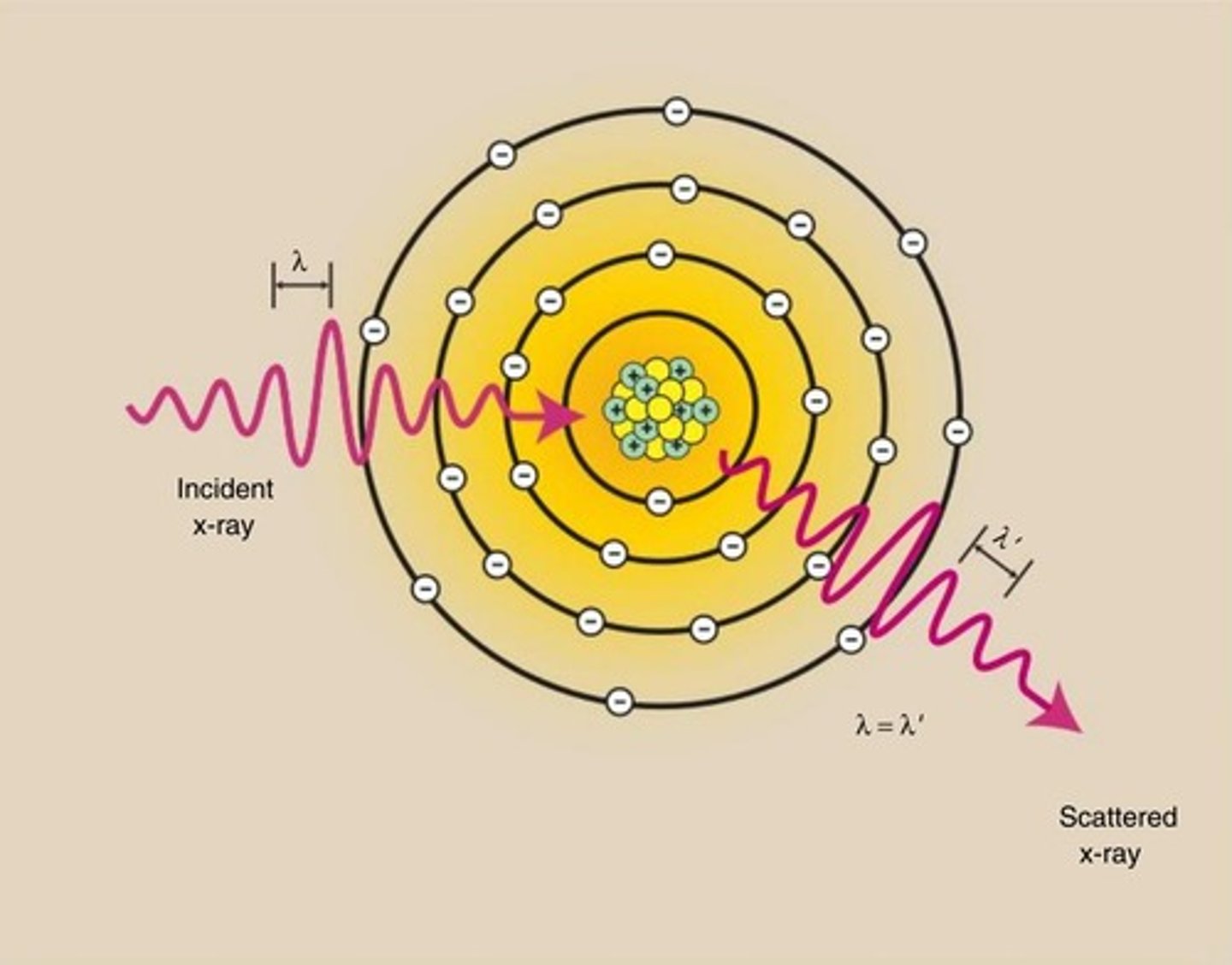
What effect does coherent scatter have on diagnostic imaging?
Since coherent scattering occurs mostly at low energy x-rays, it has little effect
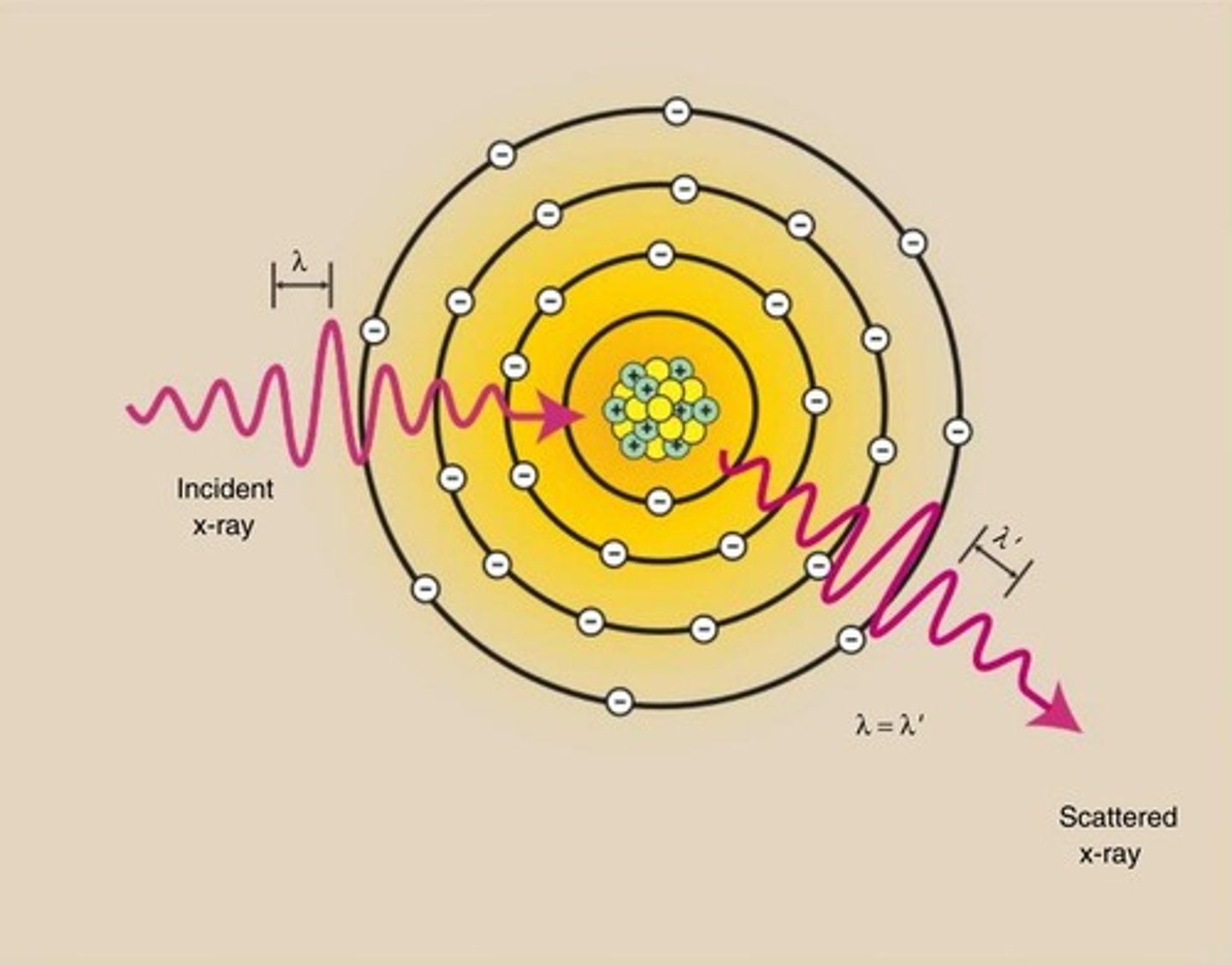
What is the significance of photon wavelength in coherent scattering?
Photons interact most easily when the matter is approximately the same size as the photon wavelength.
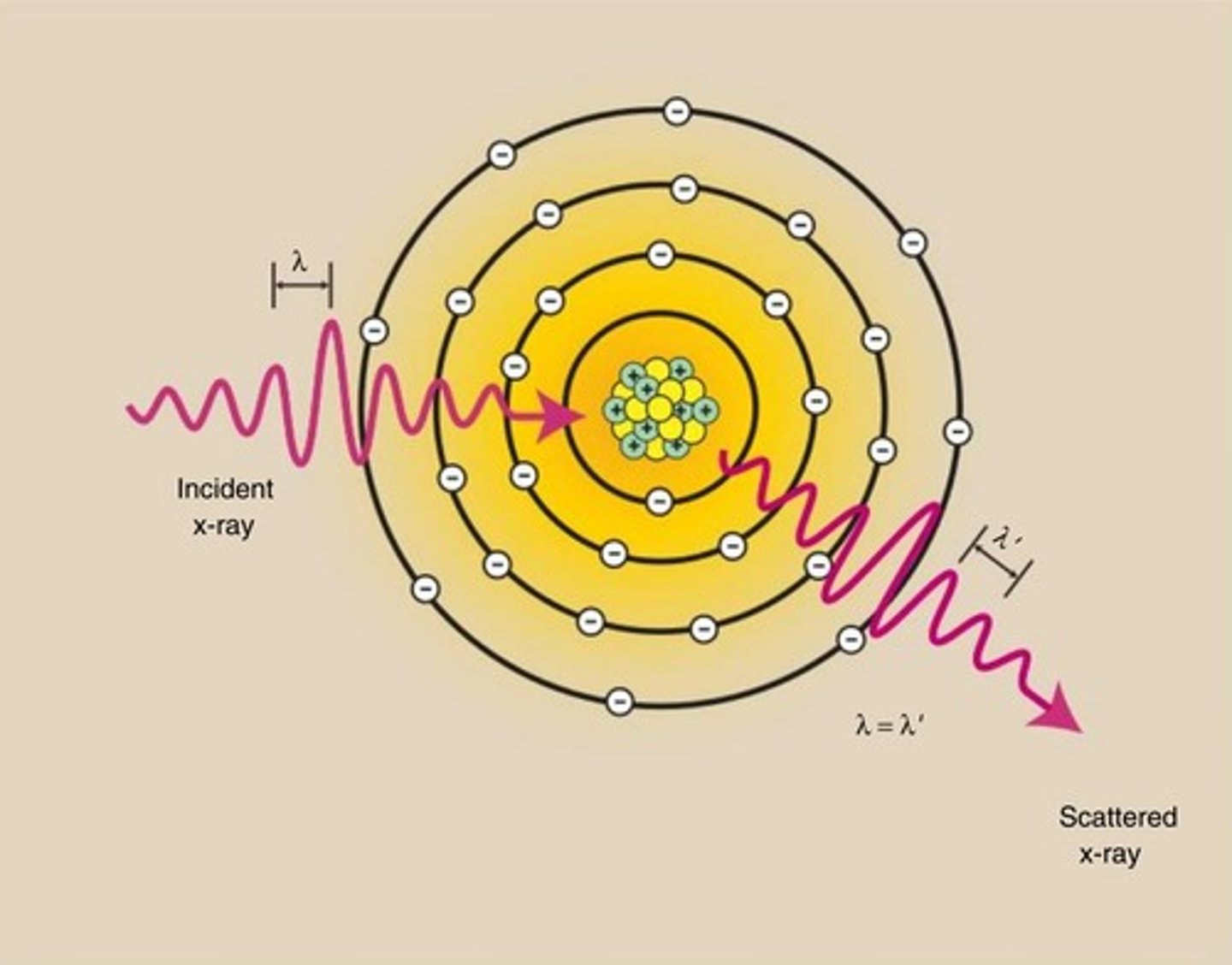
What is the result of coherent scatter?
A change in the direction of the x-ray without a change it it's energy.
(no transfer in energy, no ionization)
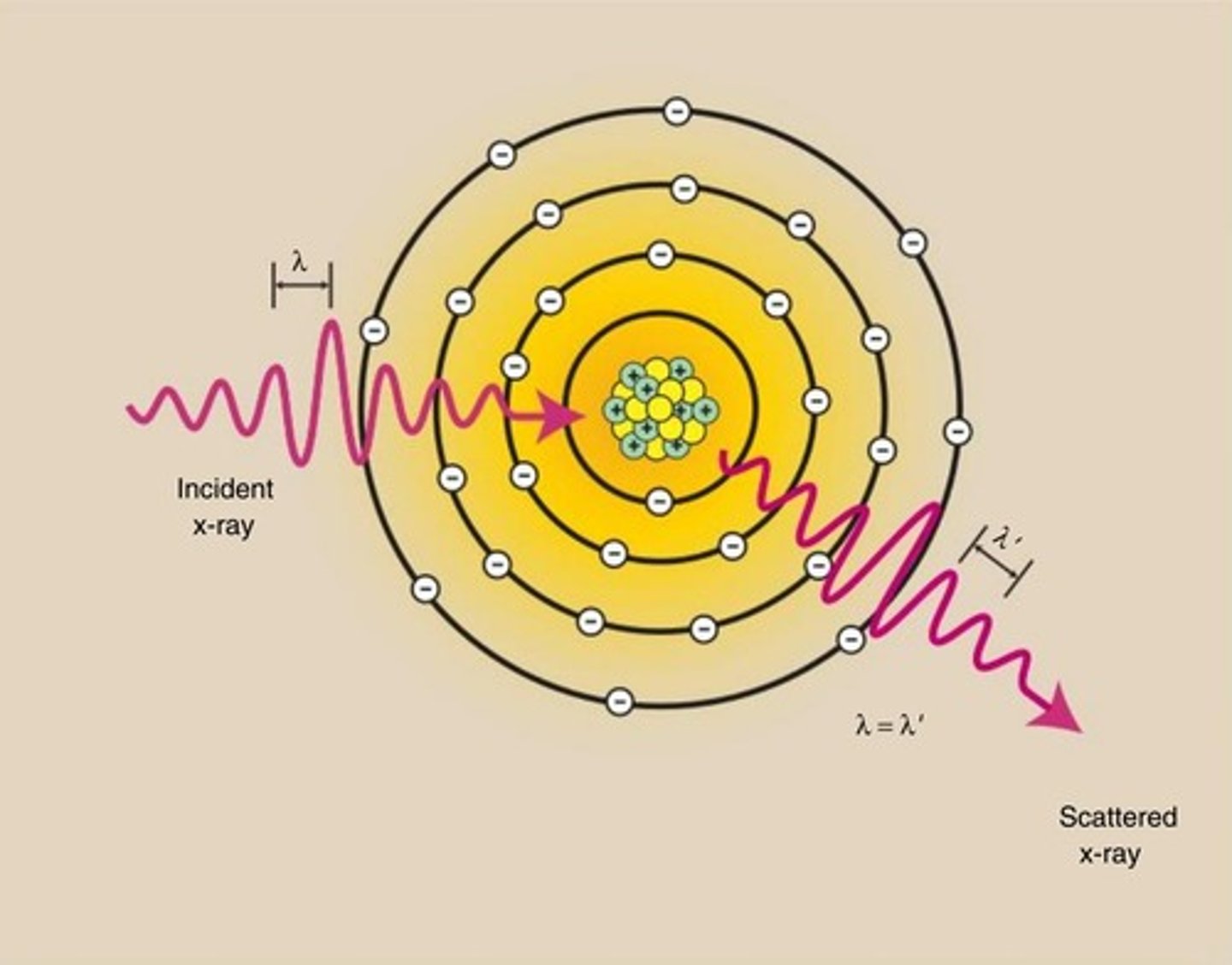
At 70kVP, a small percentage of xrays scatter coherently, which contributes slightly to what?
image noise, the general graying of an image that reduces contrast
What is Compton scatter?
Photon interaction occurs with outer-shell electrons that not only scatters the x-ray but reduces its energy and ionizes the atom as well
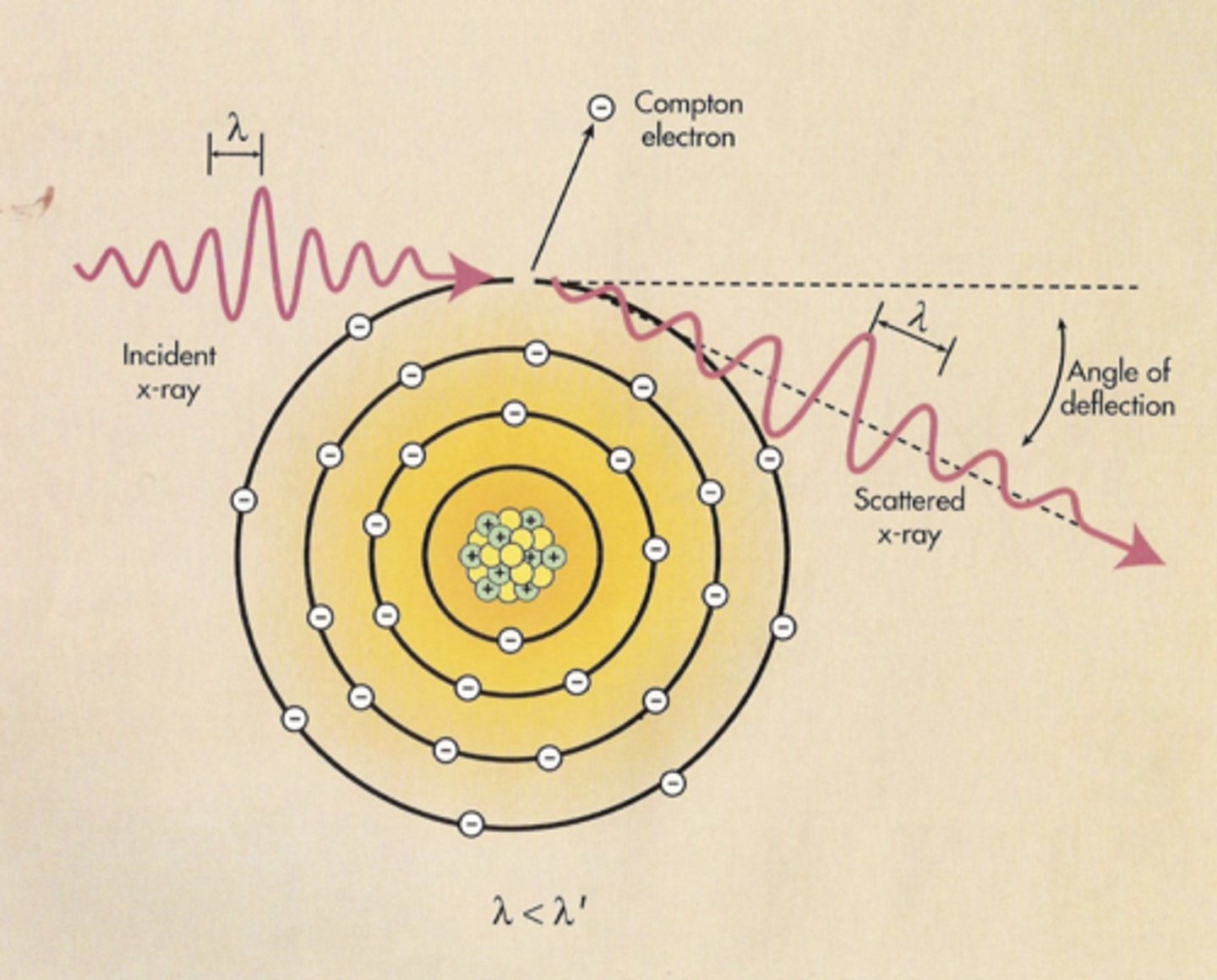
What happens during Compton scatter?
an incident x-ray interacts with an outer-shell electron and ejects it from the atom, thereby ionizing the atom. the x-ray continues in a different direction with less energy
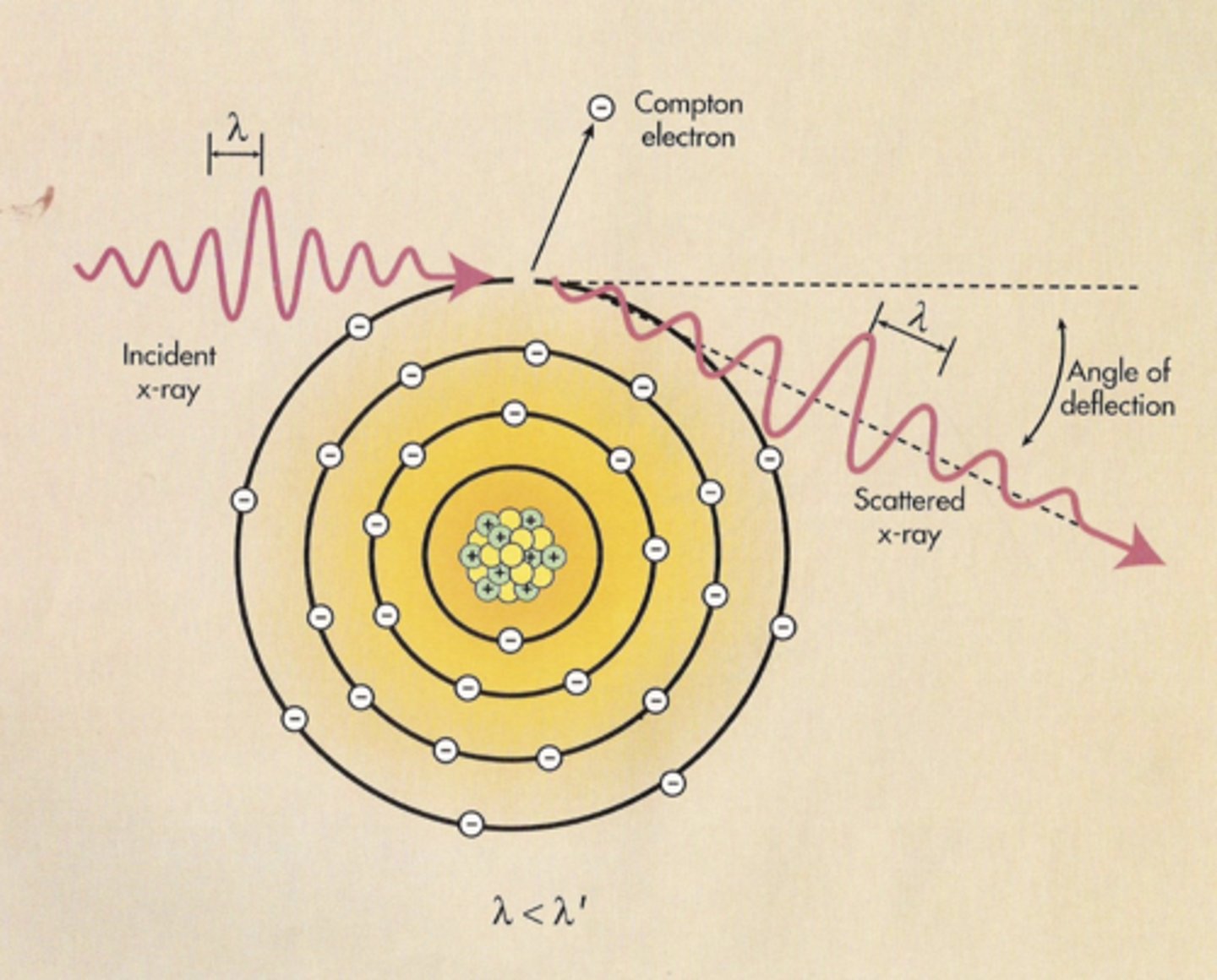
What is the ejected electron in Compton scatter called?
Compton electron --> secondary
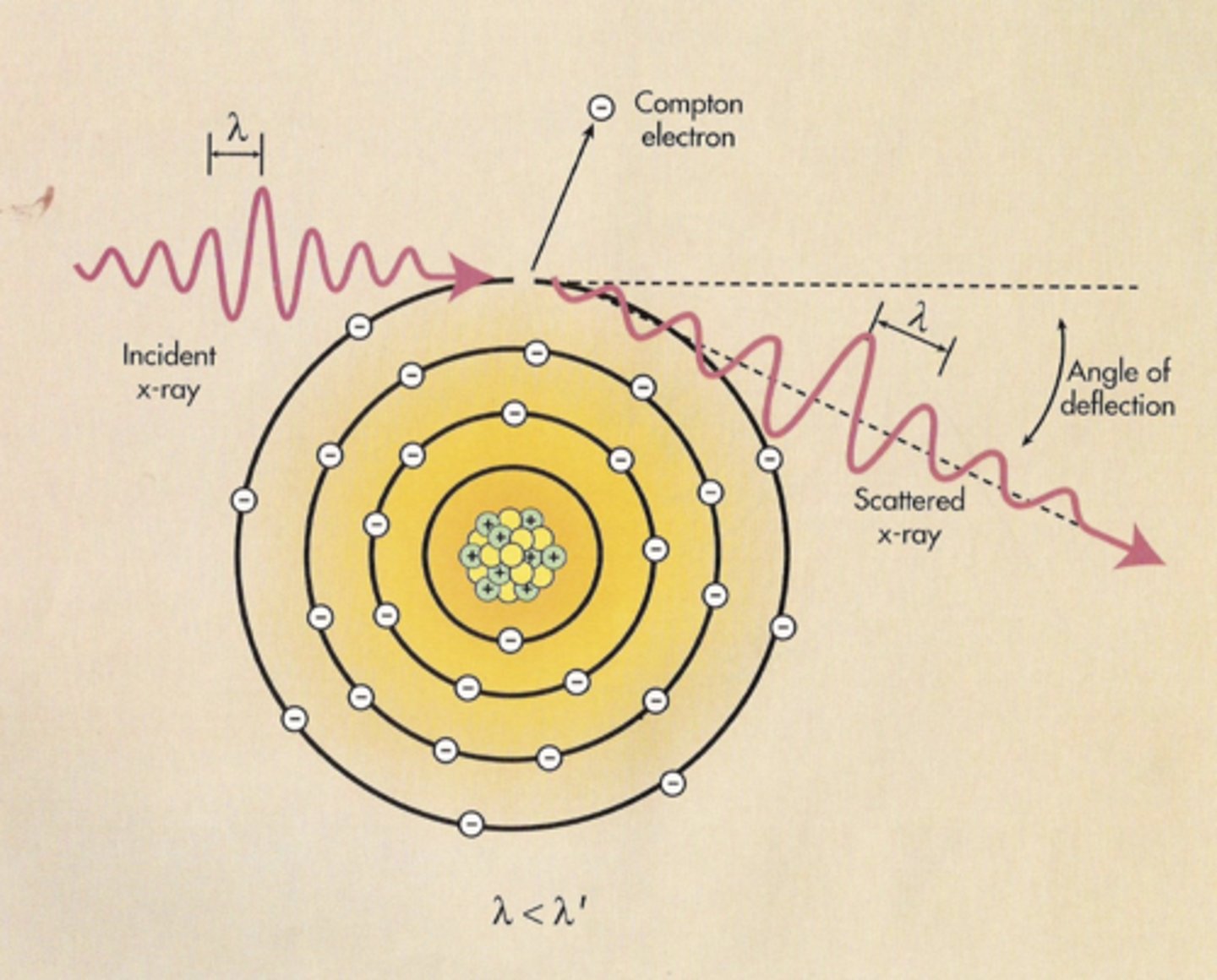
What is the Compton effect formula?
Ei= Es+ (Eb+ EKE)
Ei is the incident x-ray
Es is the energy if the scatter x-ray
Eb is electron binding energy
EKE is kinetic energy of the scattered electron
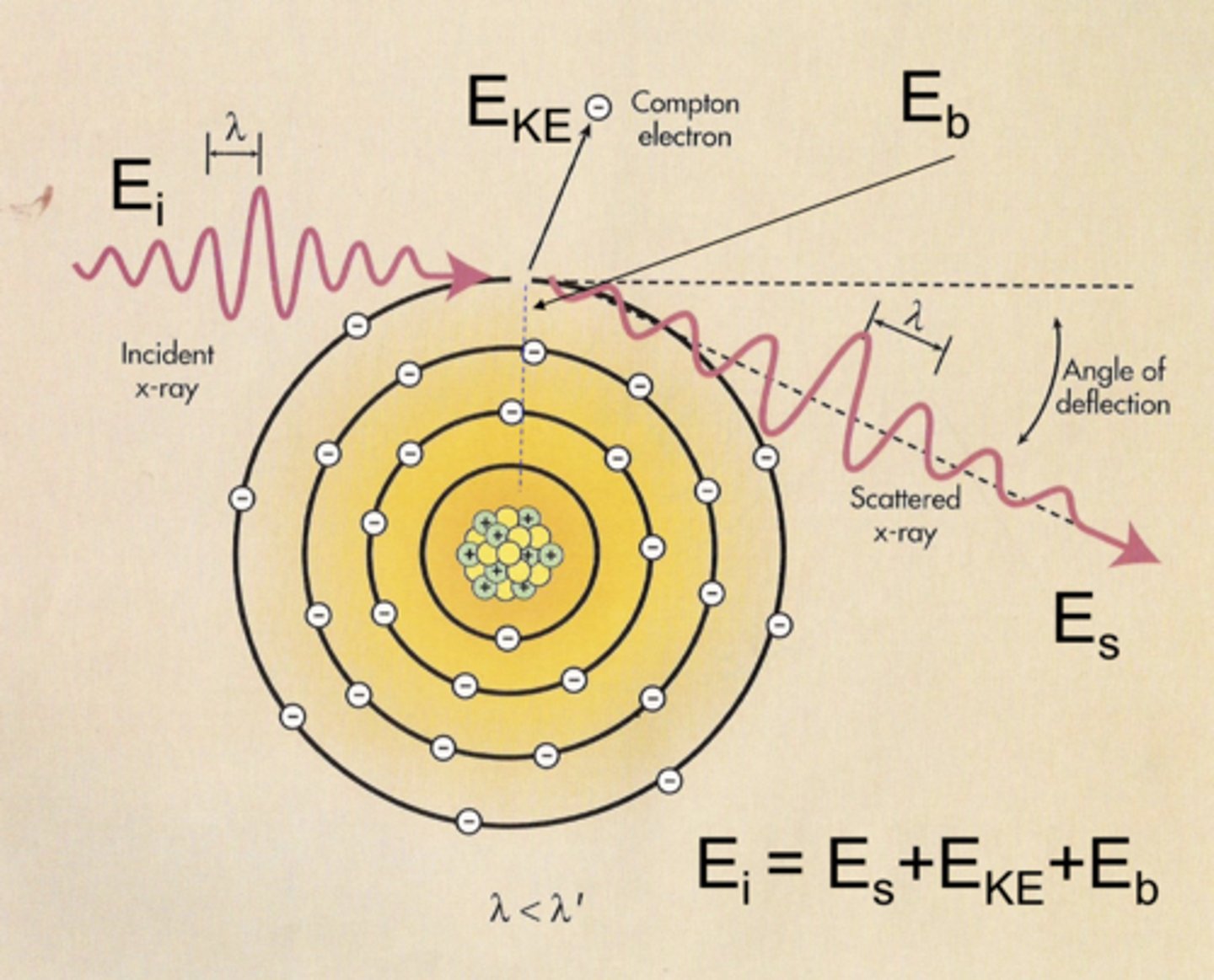
The energy of the Compton-scattered x-ray is equal to what?
difference between the energy if the incident x-ray and the energy of the ejected electron
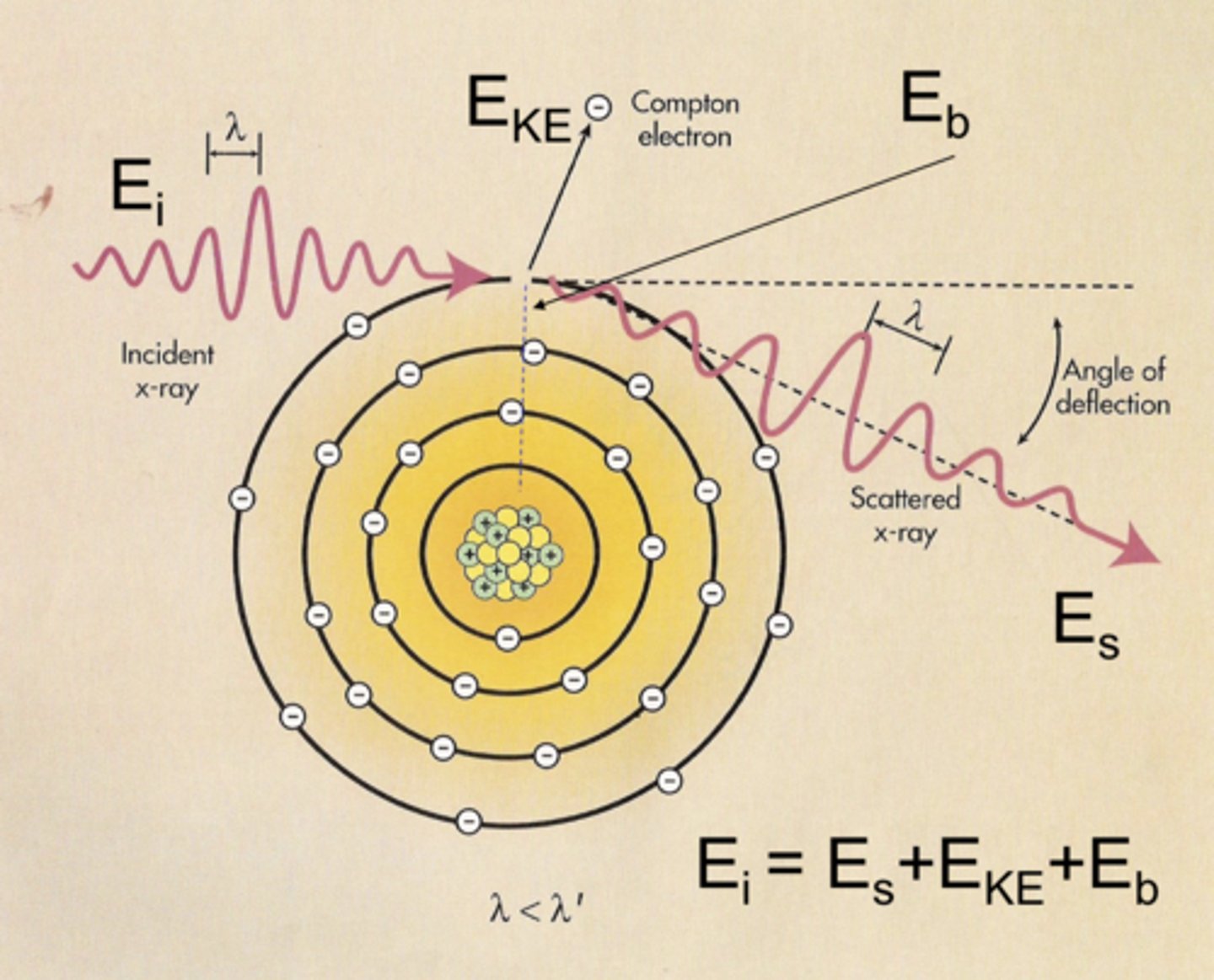
They energy of the ejected x-ray in Compton scatter is equal to what?
its binding energy plus the KE with which it leaves the atom
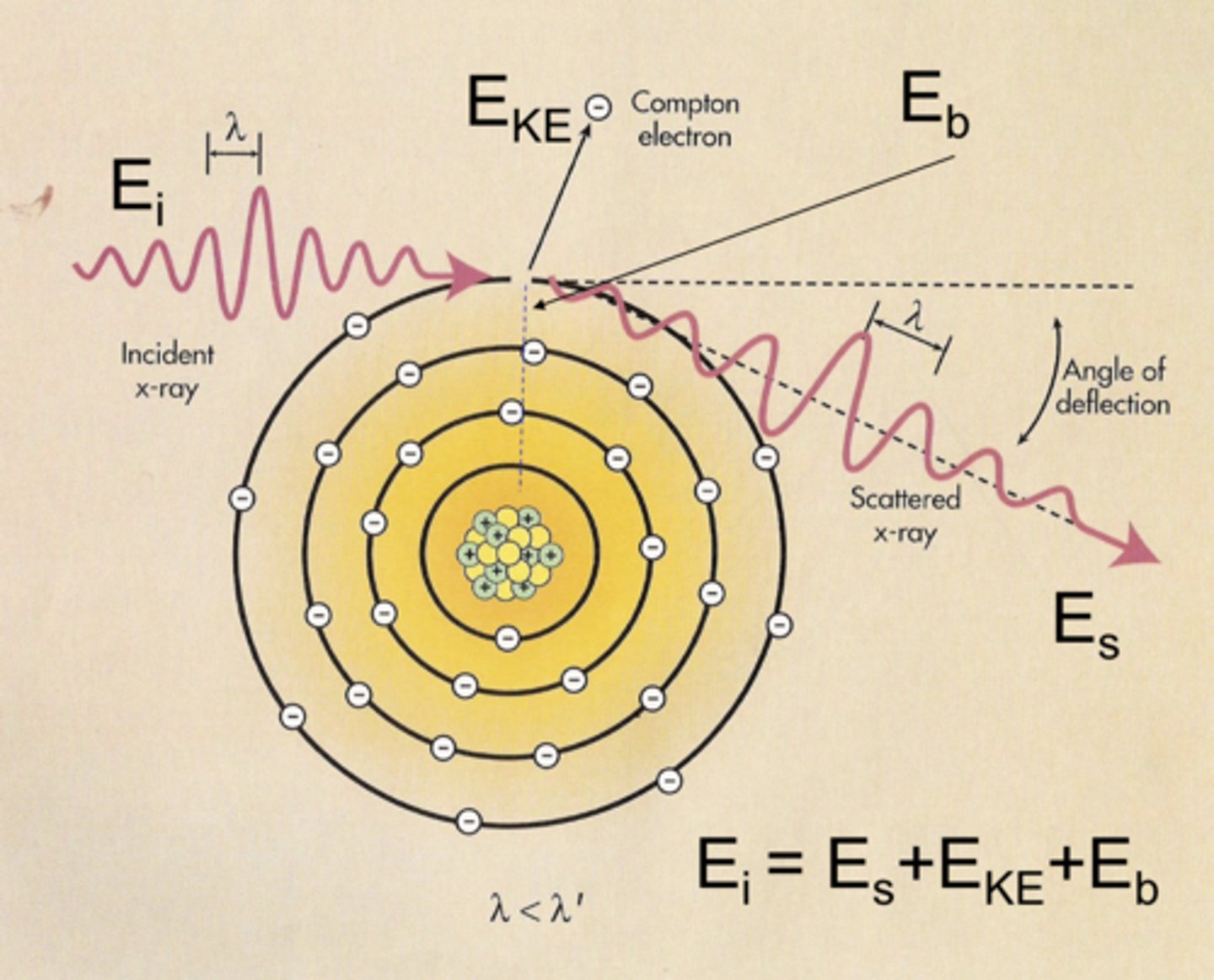
How does the energy of the scattered X-ray relate to the incident X-ray?
The energy of the scattered X-ray is equal to the energy of the incident X-ray minus the binding energy and kinetic energy of the ejected electron.
What is backscatter radiation?
x-rays scattered back in the direction of the incident x-ray beam (180 degrees)
Outer shell electrons have what kind of binding energy?
low
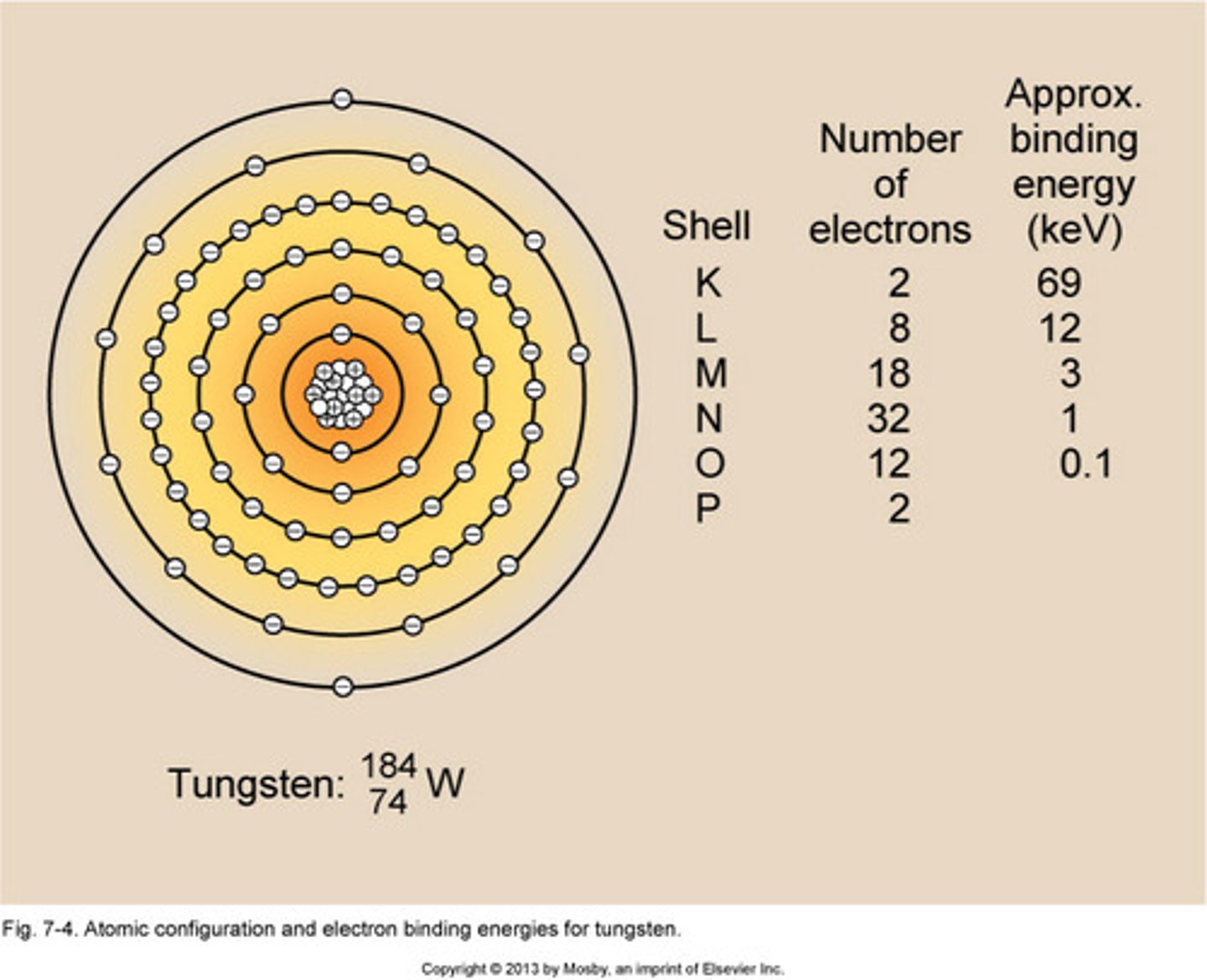
Inner shell electrons have what kind of binding energy ?
high
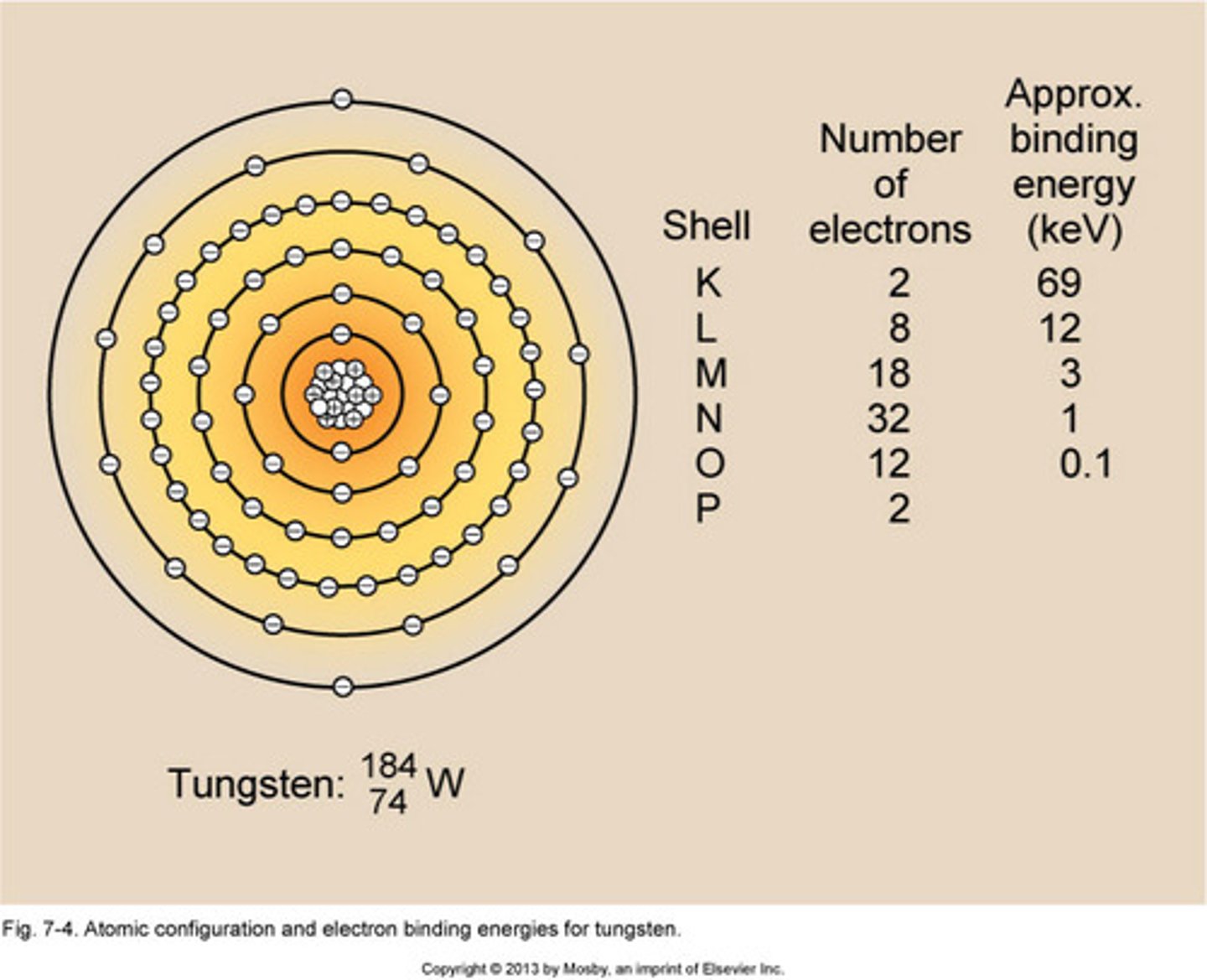
High binding energies like K-shell depends on what?
atomic #
What does Compton scatter reduce?
image contrast
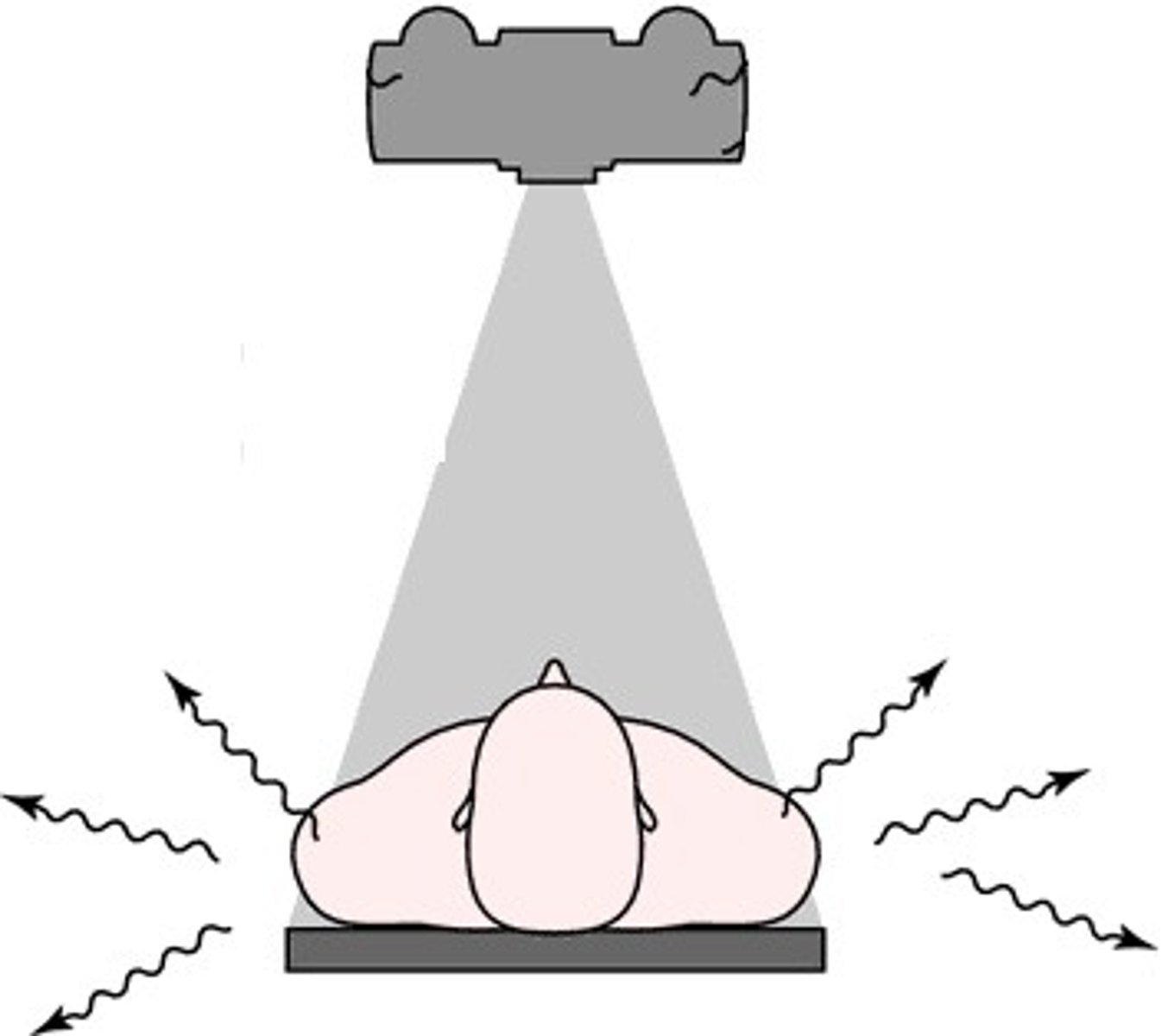
What is the relationship between photon energy and the probability of Compton scattering?
The probability of Compton scattering is inversely proportional to x-ray energy (1/E)
The probability of Compton scattering decreases as x-ray energy?
increases
The probability of Compton scattering does not depend on what?
atomic # of the atom involved
What factors influence the probability of Compton scattering?
Density of the material and photon energy.
In the Compton effect, what happens at zero-degree deflection?
No energy is transferred to the Compton electron.
What happens at 180-degree deflection during Compton scattering?
Maximum energy transfer occurs to the Compton electron.
What is the significance of the atomic number in Compton scattering?
The probability of Compton scattering does not depend on the atomic number.
What is the binding energy of an electron?
The energy required to remove an electron from its shell in an atom.
What is the formula for the energy of a scattered X-ray?
Es = Ei - (Eb + EKE), where Es is the energy of the scattered X-ray, Ei is the energy of the incident X-ray, Eb is the binding energy, and EKE is the kinetic energy.
How does the density of a material affect Compton scattering?
Higher density increases the probability of Compton scattering.
What is the effect of increasing the thickness of a material on Compton scattering?
It leads to a proportional increase in Compton scattering.
What is the relationship between the energy of a Compton electron and its binding energy?
The energy of the Compton electron is equal to its binding energy plus its kinetic energy.
Compton scatter is most likely to occur with what?
outer-shell electrons and loosely bound electrons
What happens to Compton scatter as mass density of absorber increases?
there is a proportional increase in Compton scatter
As x-ray energy increases, Compton scatter is?
reduced
What is the photoelectric effect?
The process of X-rays undergoing ionizing interactions with inner shell electrons of an atom resulting in the total absorption of the x-ray
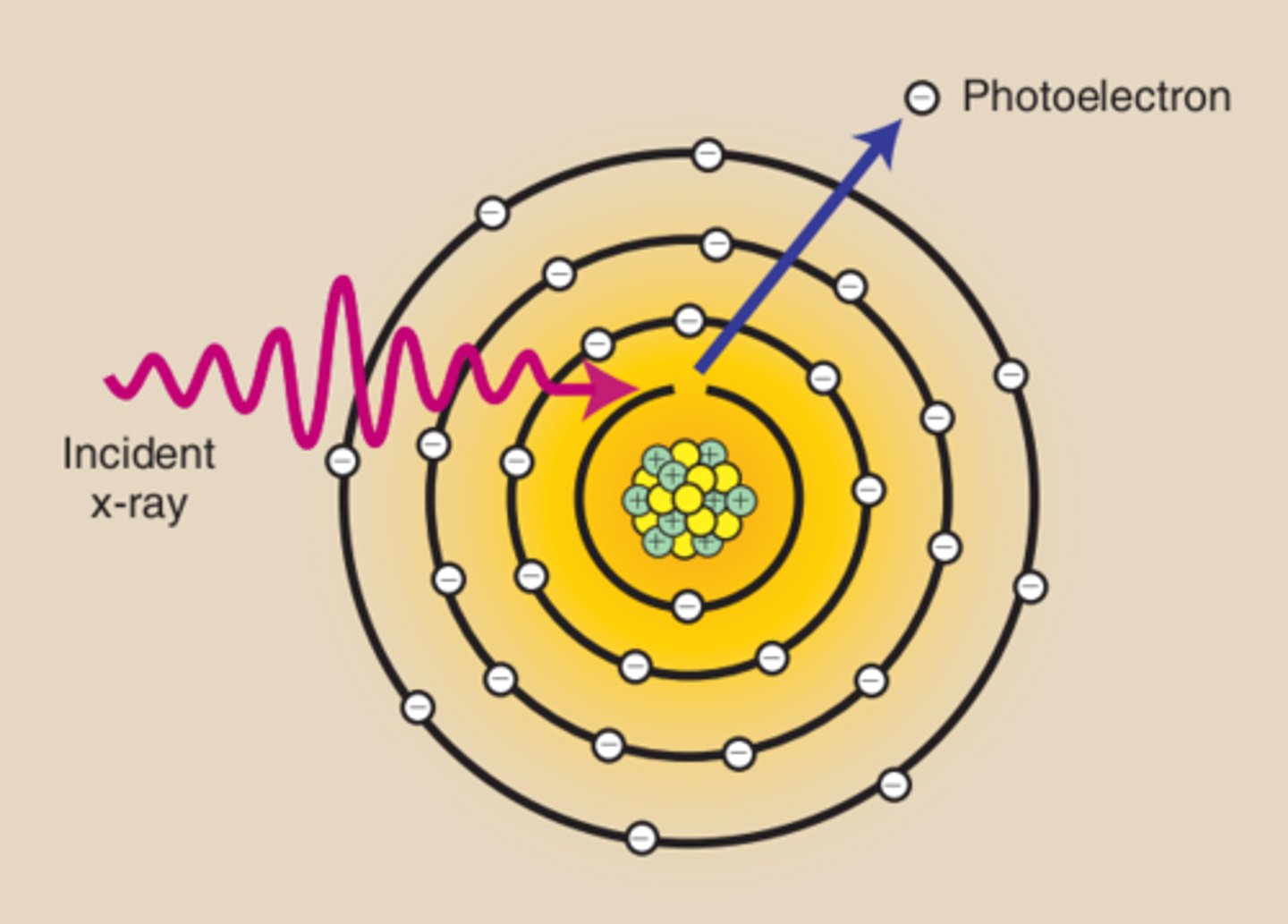
What happens to a photon during the photoelectric effect?
The photon is absorbed, resulting in the ejection of an electron.
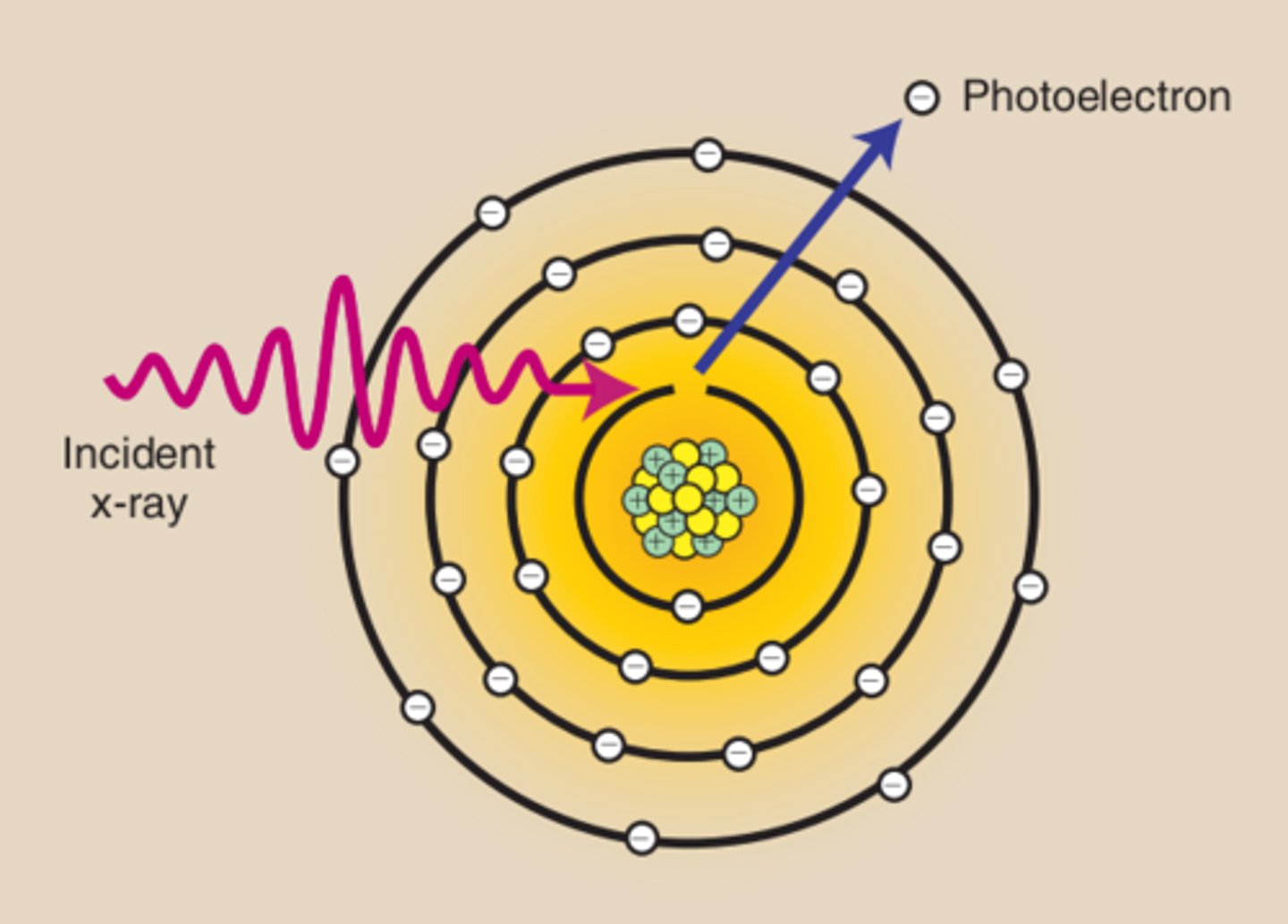
What happens to the x-ray in the photoelectric effect?
the x-ray is not scattered but is totally absorbed
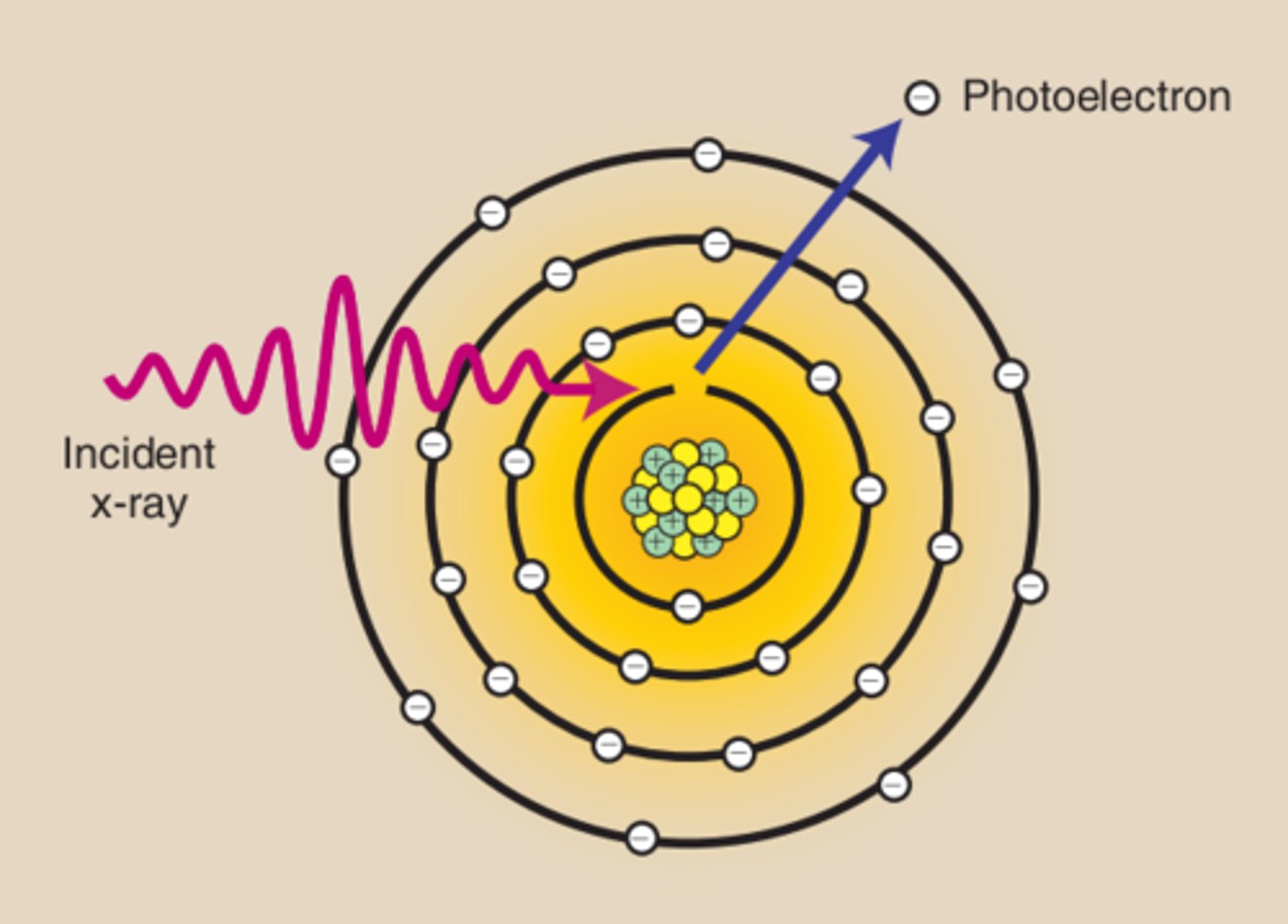
What is a photoelectron?
An electron that is ejected from an atom during the photoelectric absorption process.
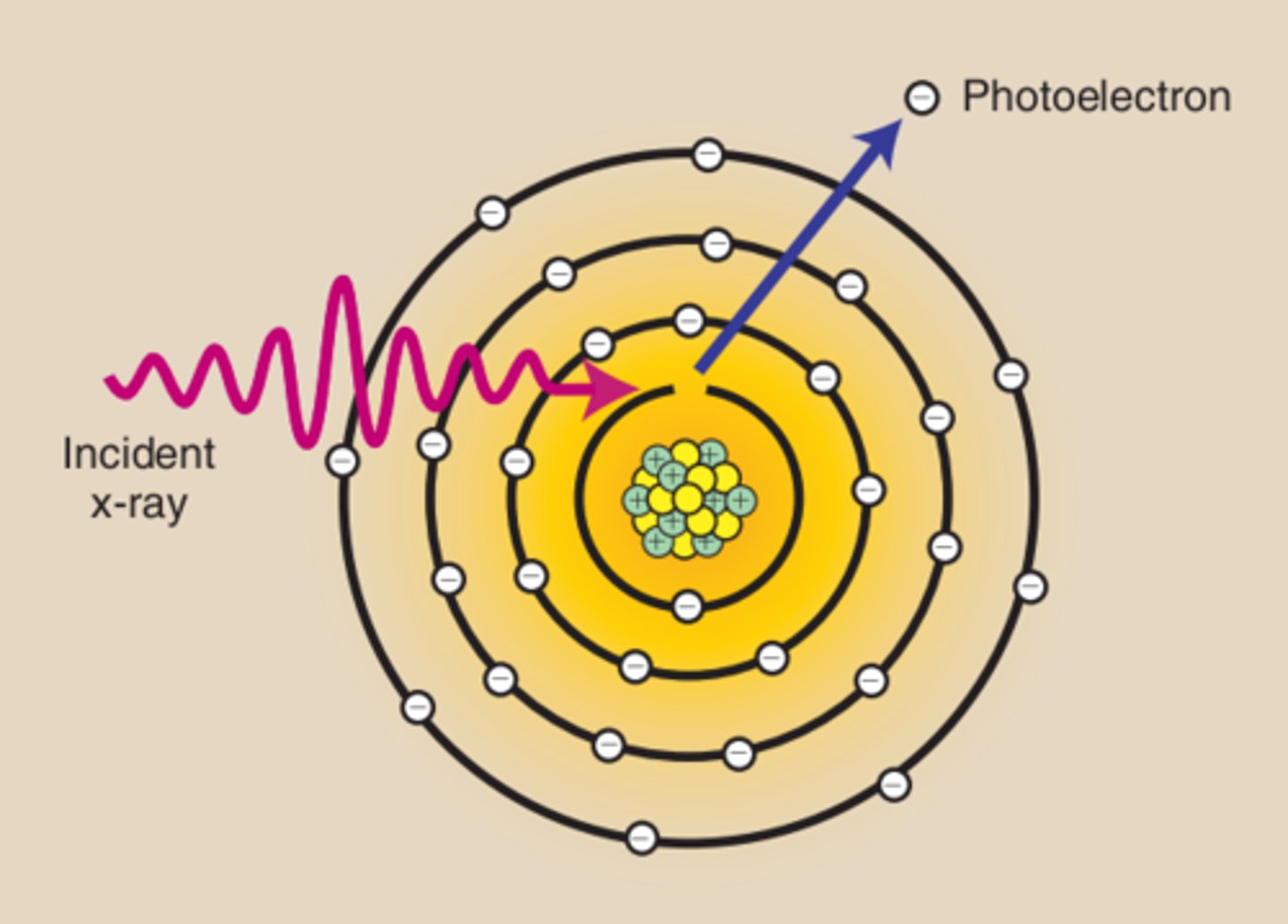
What must the energy of an incident photon be for photoelectric absorption to occur?
It must be equal to or greater than the binding energy of the electron.
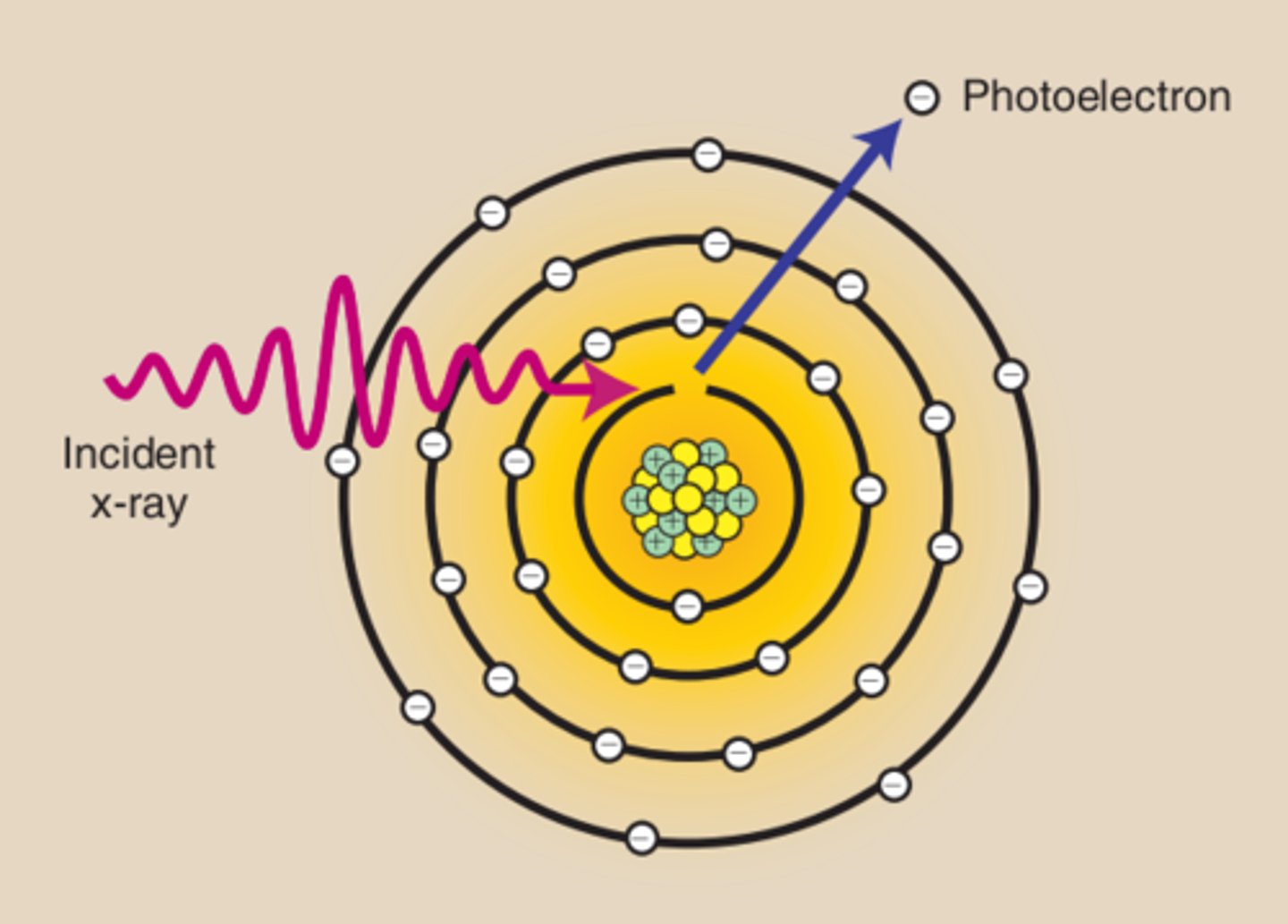
What type of electrons are more likely to undergo photoelectric absorption?
Tightly bound inner-shell electrons, especially in elements with high atomic numbers.
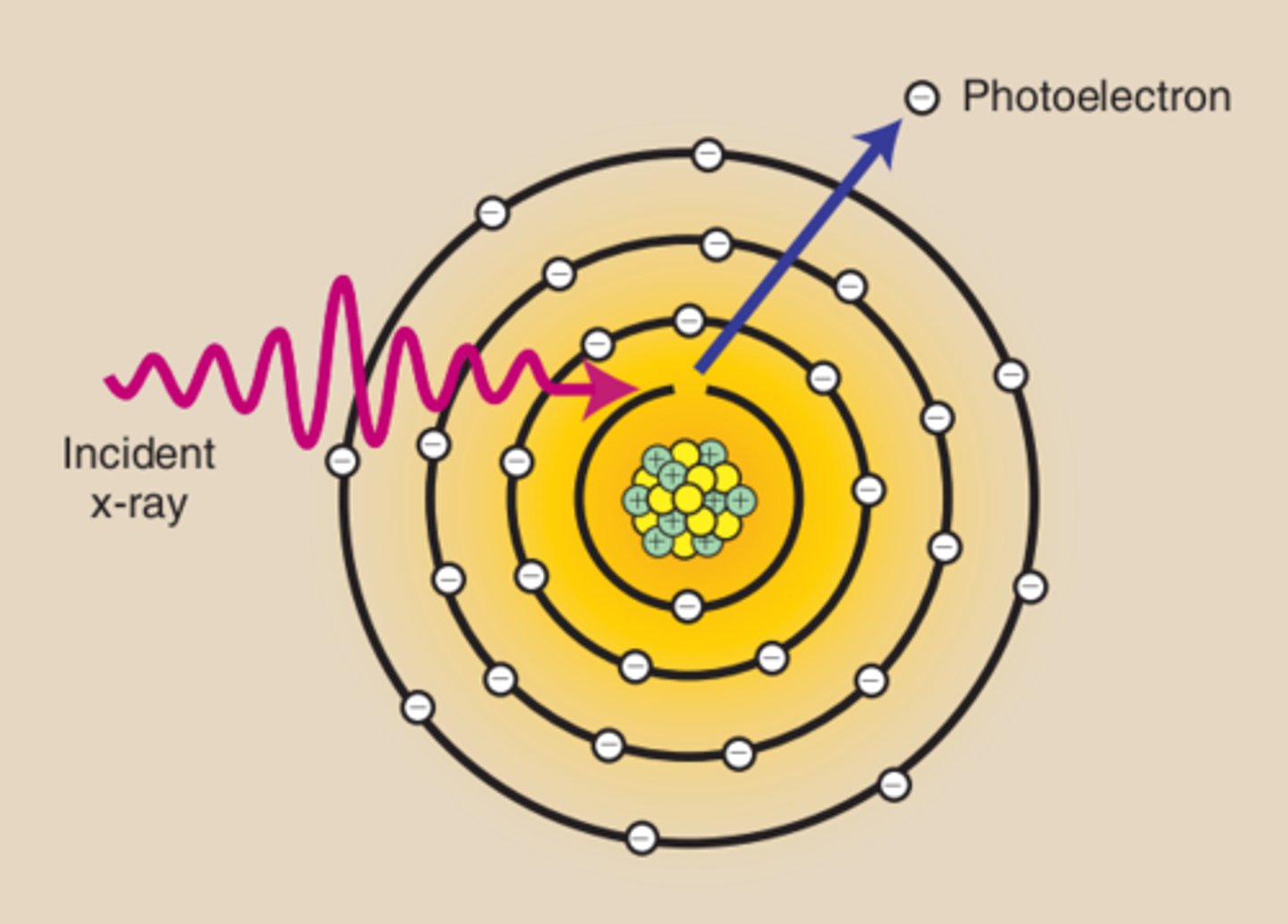
What is the equation for the photoelectric effect?
Ei = Eb + EKe
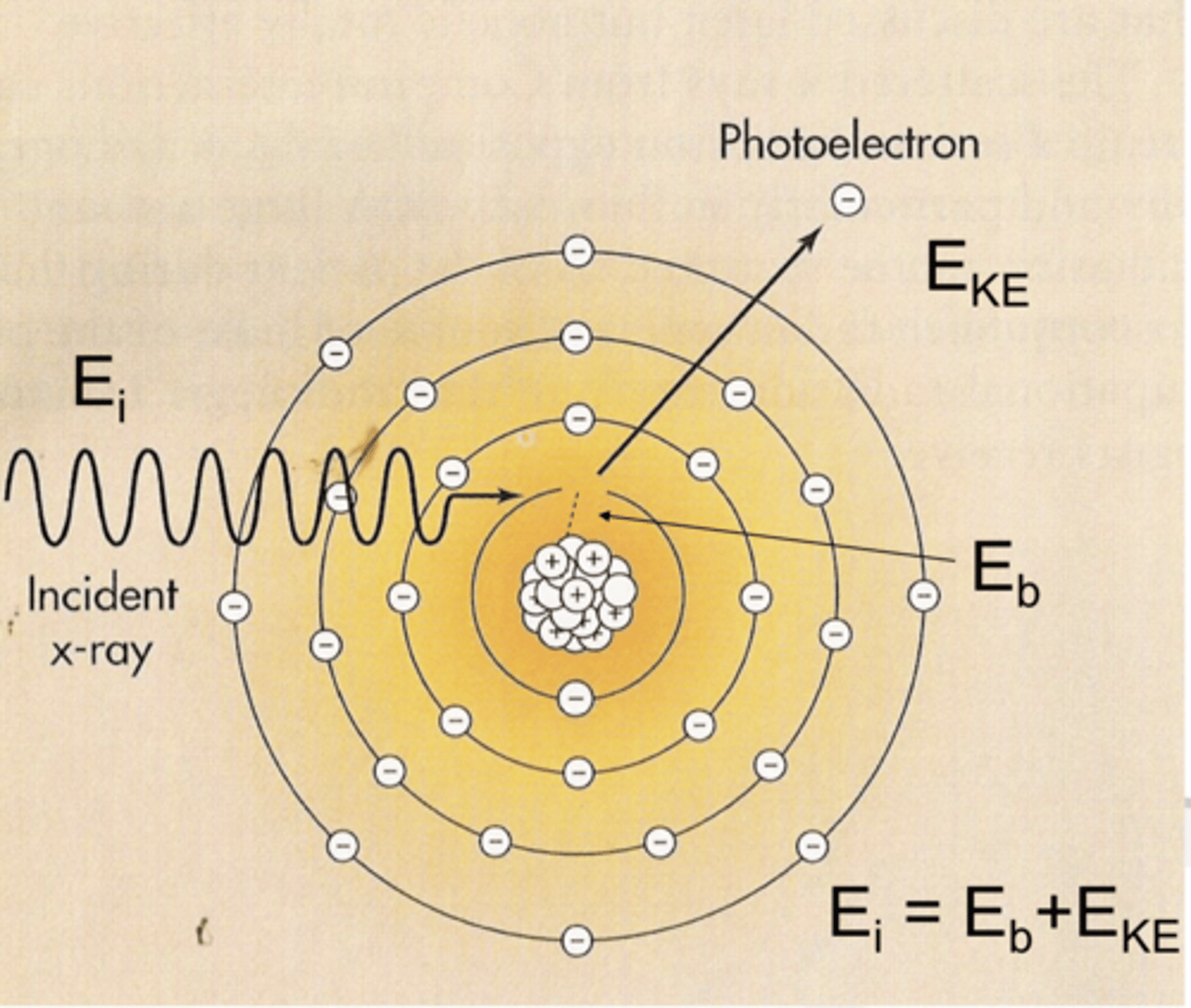
For low atomic # atoms, soft tissue, the binding energy of even K-shell electrons is low. Therefore the photoelectron is released with KE nearly equal to what?
the energy if the incident xray
Characteristic x-rays are produced after what?
photoelectric interaction
The probability of the photoelectric effect is inversely proportional to what?
the third power of the x-ray energy (1/E)^3
What is the probably of photoelectric effect is directly proportional to what?
the third power of the atomic # of the absorbing material (Z^3)
More matter equals.....?
more scatter
more absorption
As energy increases there is less absorption meaning what?
more transmission and more reaches the IR
If density increases than what happens to photoelectric effect or compton?
both increase proportionally
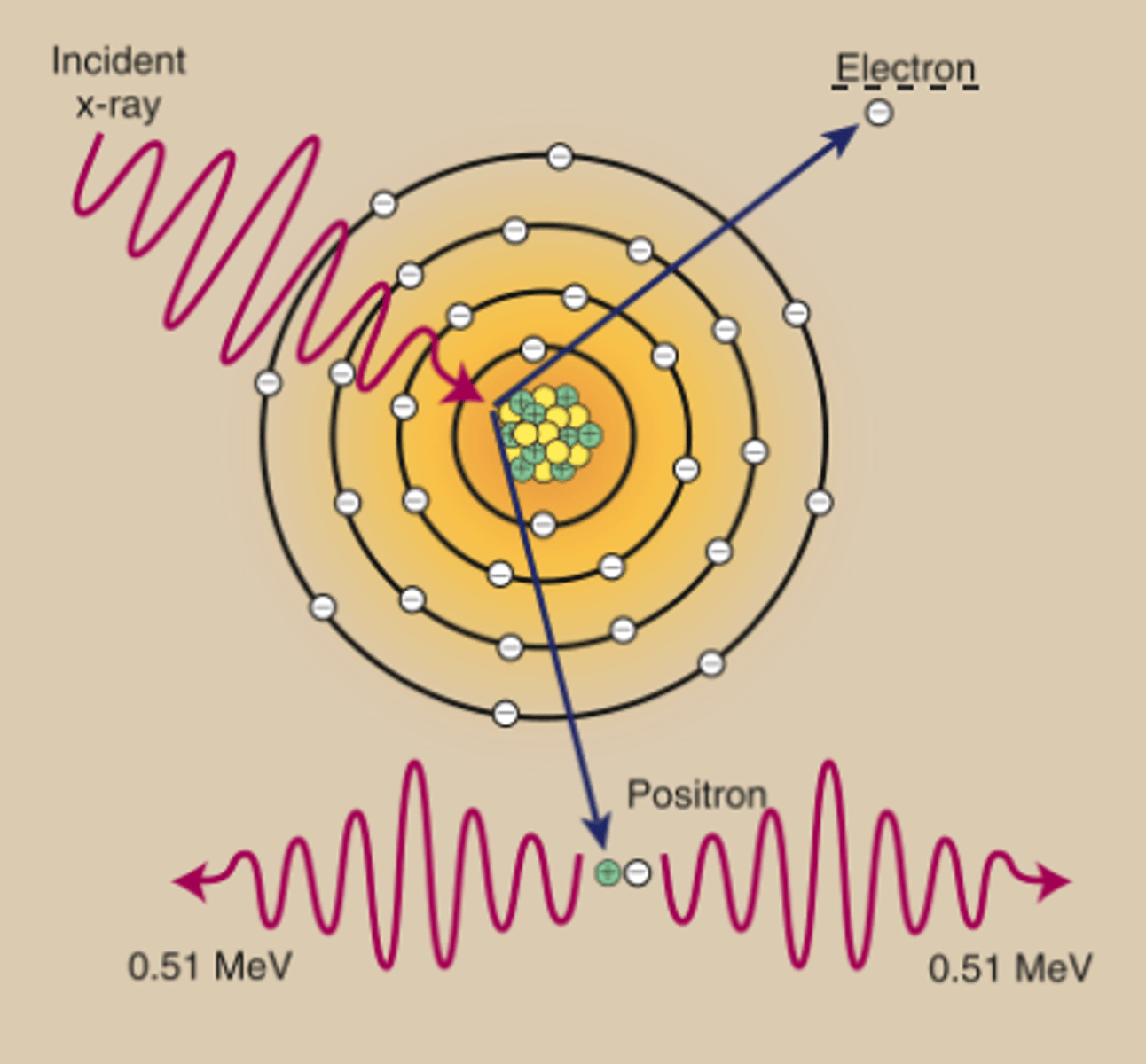
What is pair production
when a photon interacts with a nucleus and produces a particle and antiparticle.
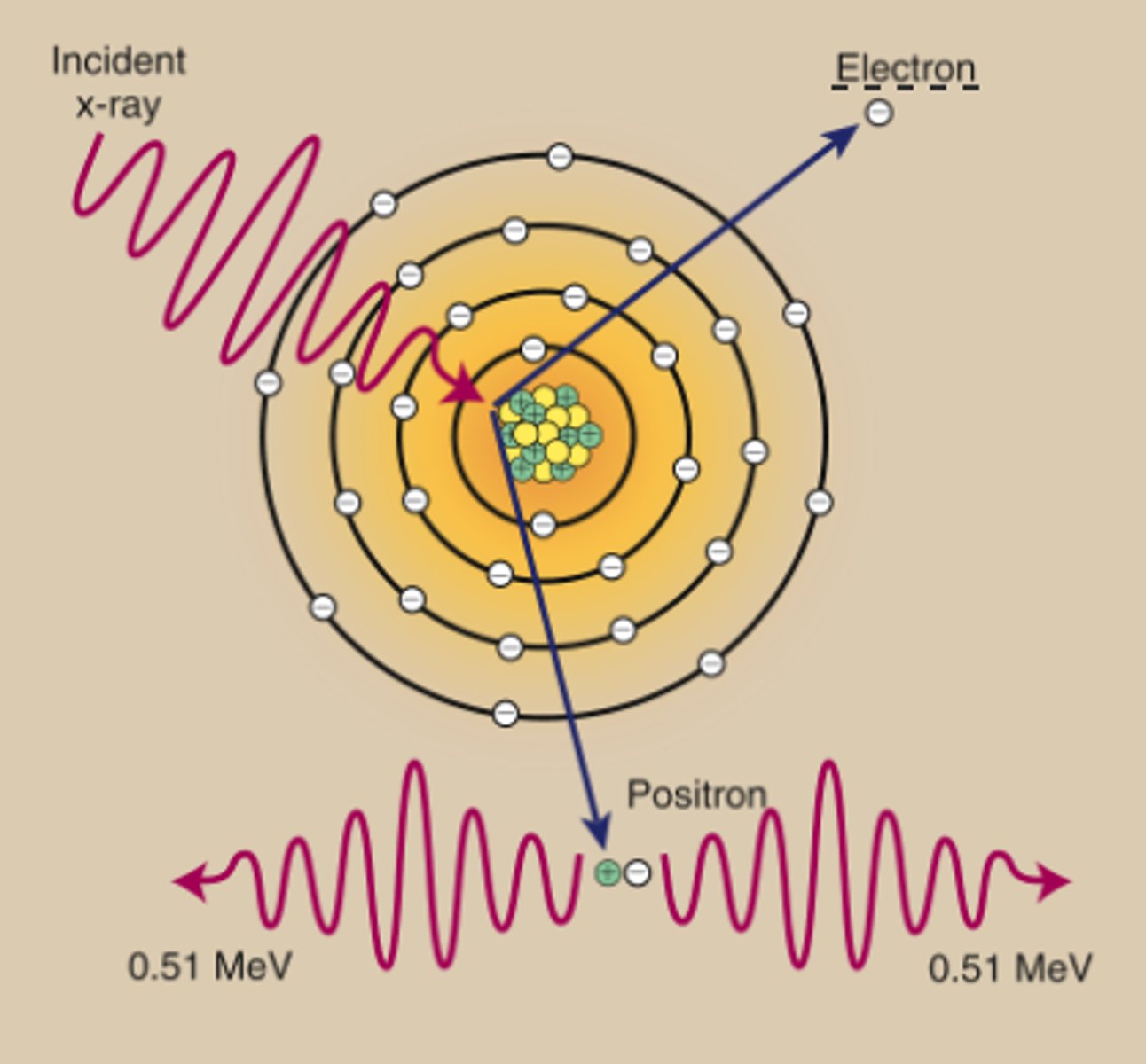
Pair production does not occur during what?
x-ray imaging
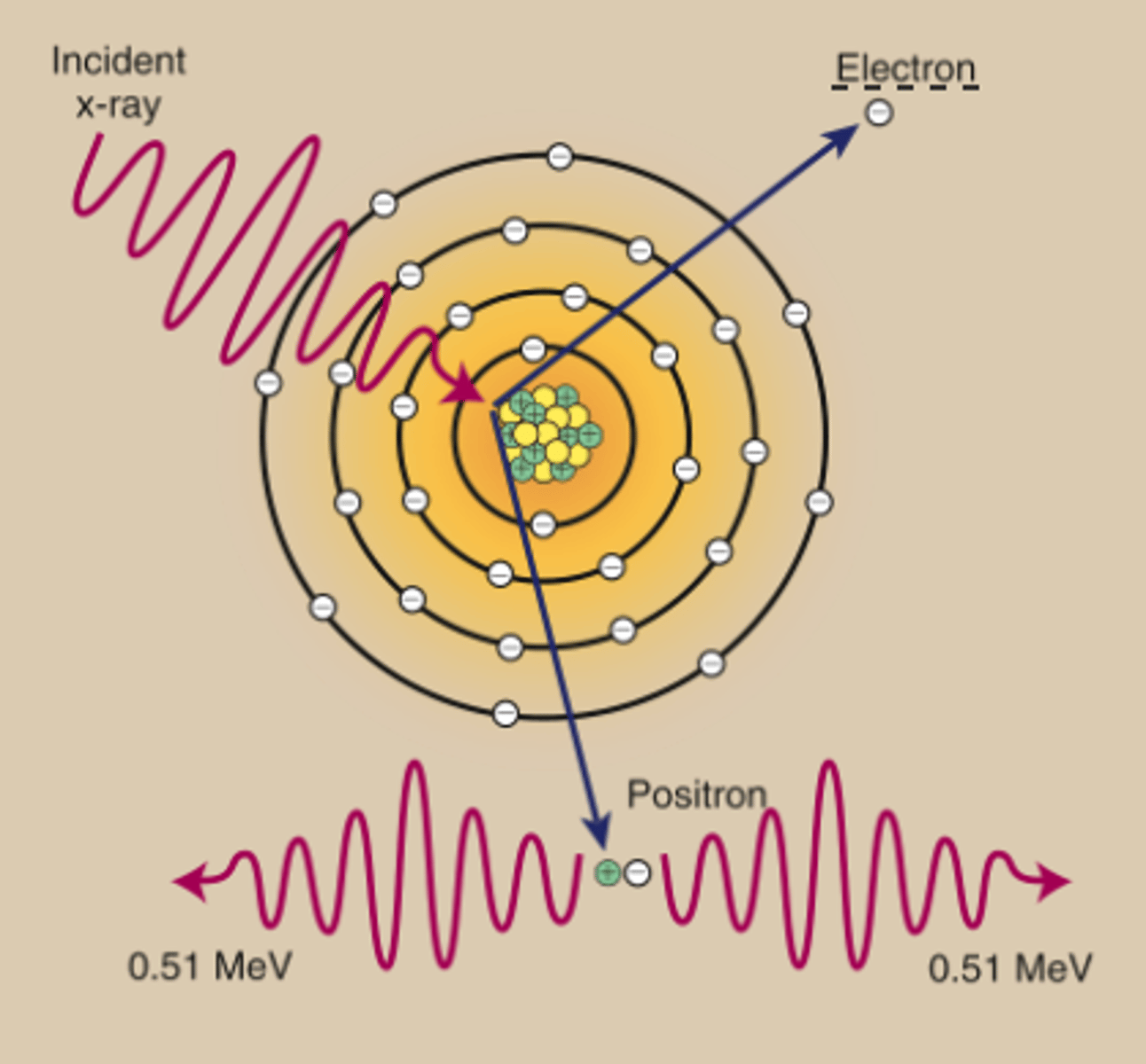
What is annihilation radiation?
The Positron unites with a free electron, and the mass of both particles is converted to energy.
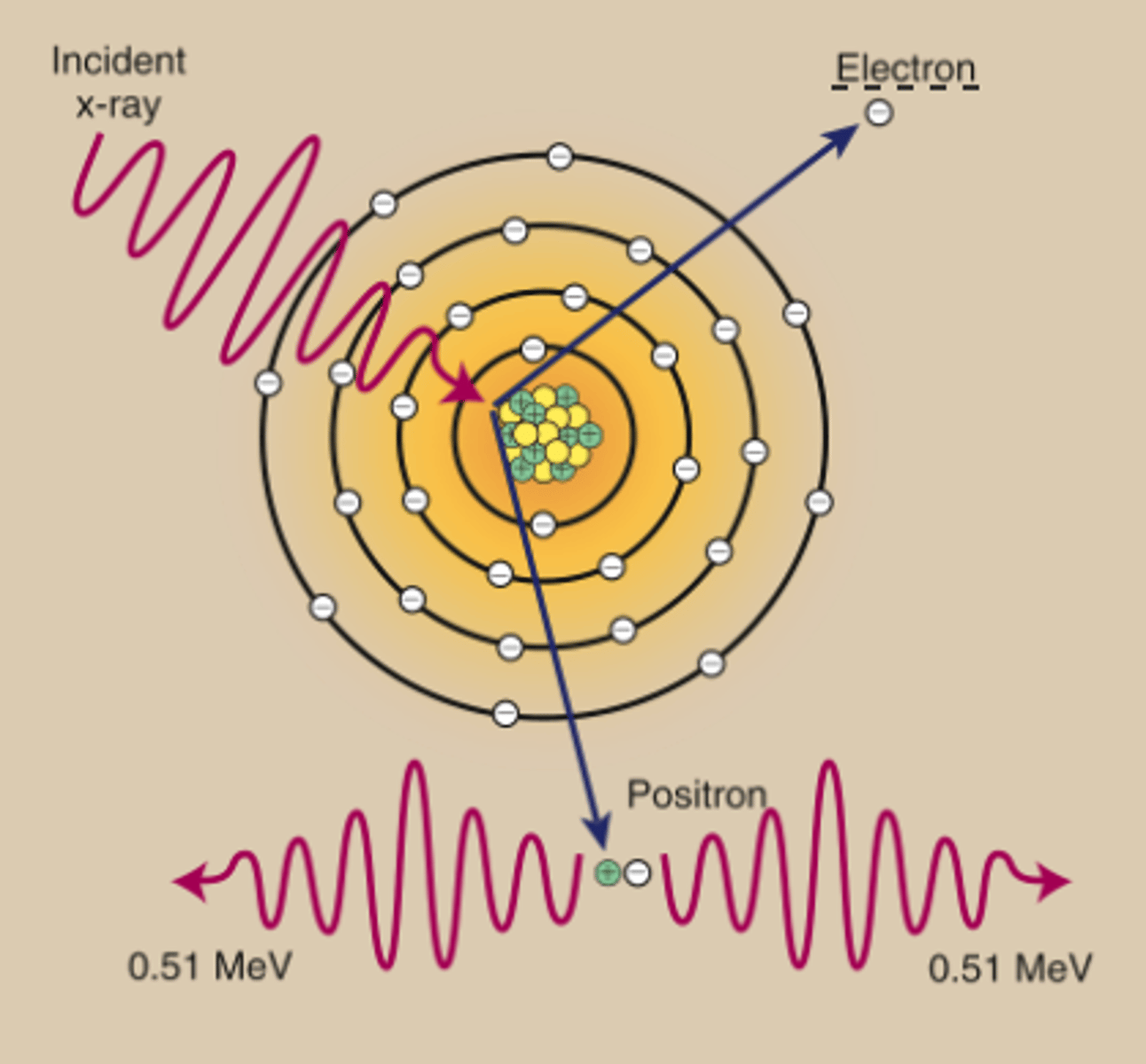
Pair production requires _______ x-ray energy ?
1.02 Mev
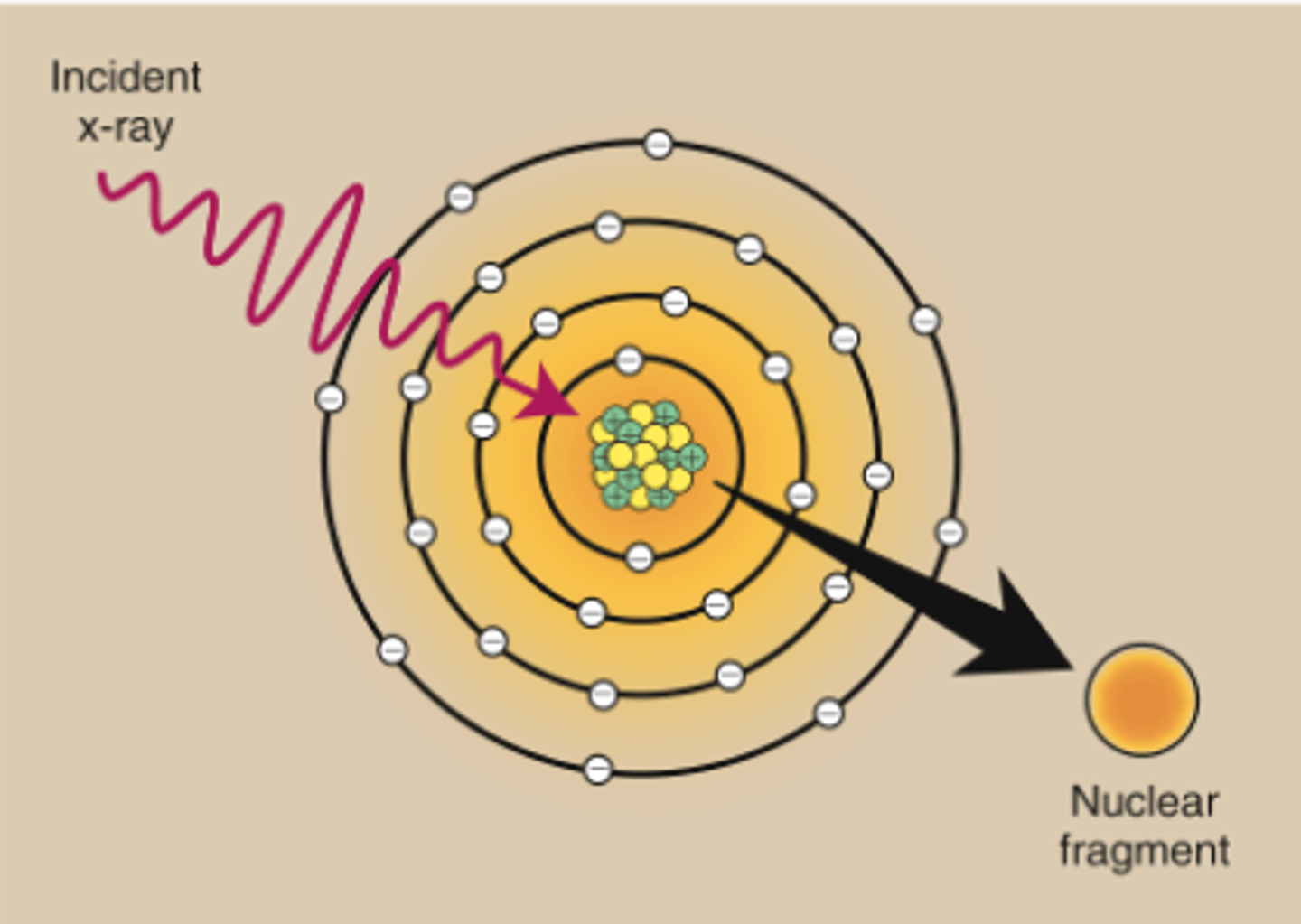
What is photodisintegration?
an interaction between an extremely high energy photon above 10MeV. The photon strikes the nucleus and all the energy is absorbed by the nucleus emitting a nuclear fragment
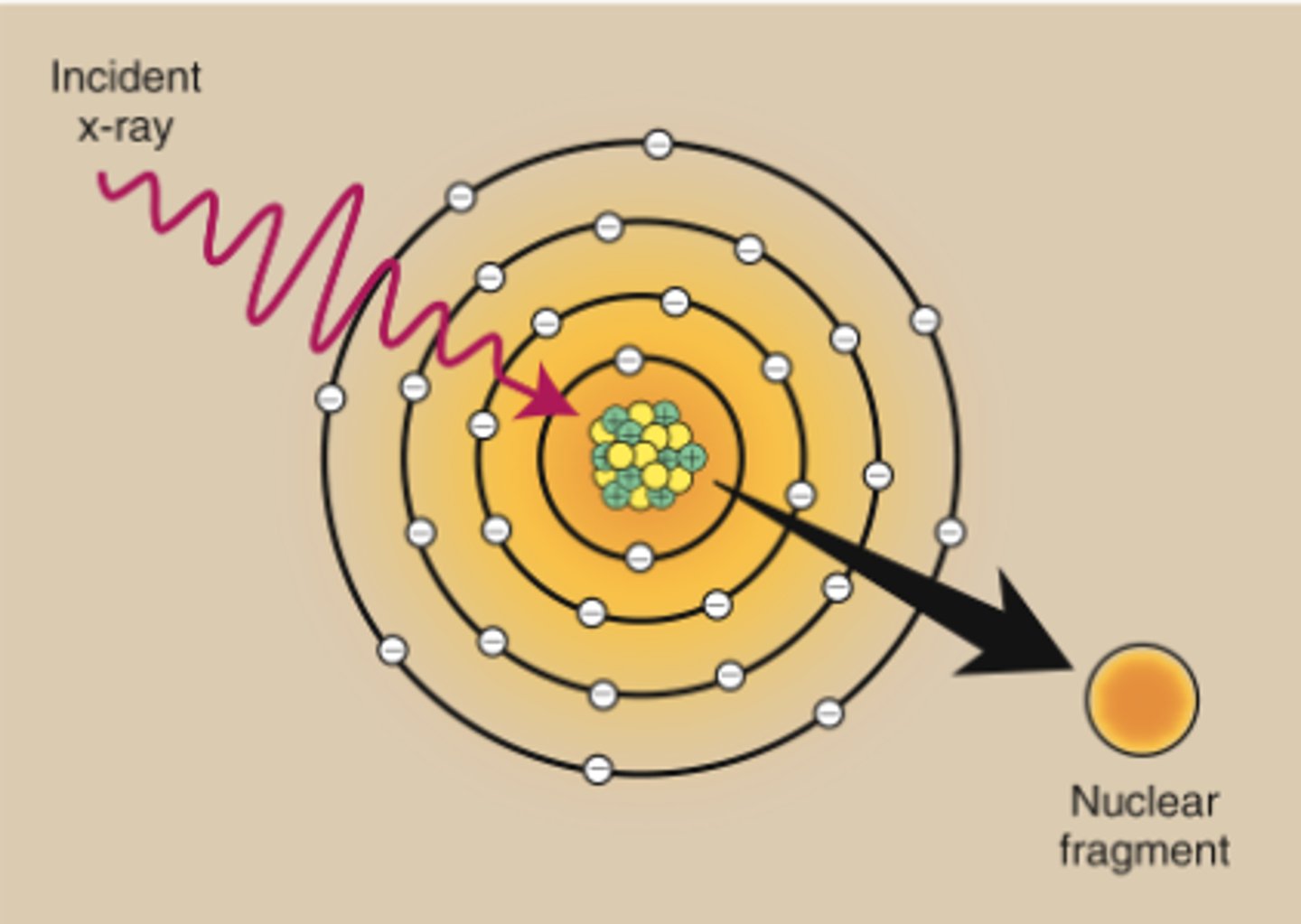
Photodisintegration does not occur in what?
x-ray imaging
What is characteristic radiation?
Radiation produced when outer-shell electrons fill vacancies left by ejected photoelectrons.
What is the role of outer-shell electrons in scattering?
They are primarily responsible for scattering interactions in X-ray physics.
What happens to the kinetic energy of a photoelectron?
It is equal to the difference between the energy of the incident X-ray and the binding energy of the electron.
What type of radiation is produced when outer shell electrons fill vacancies left by inner shell electrons?
Characteristic Radiation
What is the relationship between photon energy and the probability of photoelectric absorption?
Probability is inversely proportional to the third power of the x-ray energy (1/E^3).
How does atomic number affect the probability of photoelectric absorption?
Probability is directly proportional to the third power of the atomic number of the absorbing material (Z^3).
What is the effect of density on the probability of photon interactions?
The probability of a photon being scattered or absorbed depends on the density of the material; more density increases interaction chances.
How does doubling the density of a material affect x-ray interactions?
It doubles the chance for either photoelectric or Compton interactions.
What is conditional probability?
The probability of two events occurring is equal to the product of their individual probabilities: P(a and b) = P(a) x P(b).
What is the probability of hitting a male student if 1/8 of the area is occupied by students?
P(hitting a male) = (1/8) x (number of male students / total students).
What is the relationship between the probability of photon absorption and atomic number?
The probability of a photon being absorbed by a single atom is proportional to the cube of the atomic number (Z^3).
What happens to a photon as it enters the body?
It may bypass all atoms or be absorbed depending on the density of the body part.
Why does pair production not occur during diagnostic X-ray imaging?
Because the energy levels required (at least 1.02 MeV) are not present in diagnostic X-ray imaging.
What is the probability of a photon being absorbed in a sample of material?
It is proportional to the density of the material times the probability of the photon being absorbed by an atom (P(Abs) = P(d) x P(z)).
What is the significance of the k-shell in X-ray interactions?
Ejection of an inner shell electron creates a vacancy filled by outer shell electrons, resulting in characteristic radiation.
What is the kinetic energy of an electron ejected from the k-shell of a Barium atom if the binding energy is 37 keV and the incident photon energy is unknown?
The incident energy of the photon can be calculated using Ei = Eb + EKE.
What type of radiation is produced by photoelectric interactions?
Characteristic radiation, also known as secondary radiation.
What is the effect of density on the interaction of X-rays with tissue?
The interaction is proportional to the density of the tissue, affecting both photoelectric and Compton interactions.
How does the density of bone compare to that of soft tissue?
Bone has a density of about 1850 kg/m³, significantly higher than soft tissue's 1000 kg/m³.
Energy levels for all 5 things?
pair, photo,
does the scatter photon retain all of the energy, most, or none?
retains most
As KvP increases absorption goes ...?
down because transmission goes up
There is more absorption and scatter in bone than what?
soft tissue
The word coherent means what?
same therefore unmodified
Attenuation is the product of what?
absorption and scattering
Secondary x-rays refer to what?
happens after PE absorption
60 kVp, whats the peak energy?
60 kev
whats the averag 1/3 so about 20
Anything that is not transmitted is what ?
attenuation
What is differential absorption ?
The difference between x-ray photons that are absorbed and those that penetrate the body
X-rays transmitted without interaction contribute to
the radiographic image
At energies below 40 keV, the predominant x-ray interaction in soft tissue and bone is ______________.
photoelectric absorption
Coherent scattering is an interaction between _______ x-rays and atoms.
low-energy