20th Century Mexican Art Midterm
 Call Kai
 Learn
 Practice Test
 Spaced Repetition
 Match
 Flashcards
 Knowt Play
1/65

There's no tags or description
Looks like no tags are added yet.
66 Terms

Miguel Cabrera, casta series, 1763
These are paintings from New Spain (colonial mexico) that visually captured the racial mixing (mestizaje) between Spaniards, Indigenous Americans, and Africans. The paintings typically depict a family unit that is identified by what type of racial mixing they represent. The series aimed to systematize a rigid racial hierarchy that puts Spaniards at the top. Several of these paintings were exported to europe who were curious about the diversity of the New World. Romanticized and setereotyped colonial life. Man usually has higher status, life size so you can identify yourself in the painting.

Jose Joaquin Fabregat, View of the Main Plaza ZOcalo of Mexico City 1797
Neoclassical urban planning under late Bourbon colonial rule. Comissioned by the VIceroy of New Spain, it’s suppsoed to celebrate the remodeling of the Zocalo. At the time, this plaza was really a chaotic, bustling market filled with vendors and diverse social classes, but Fabregat re-did the plaza as a utopian public space that was cleaned of it’s inhabitants. The print emphasizes architectural immensity and dicipline under the Spanish Crown. Style rejects Baroque ornamentation in favor of strict geometry, greeka dn roman motifs, and subdued elegance.

Manuel Vilar Tlahuicole, The Tlaxcalan General Doing Battle on the Gladiator Stone of Sacrifice.
This is a Tlaxcalan general who was captured by the Mexica/Aztecs. He requested a warrior’s death, and he became a symbol of honor, dignity and courage. This sculpture memorializes him using greek and roman hero aesthetics to shape modern mexican national identity. It was the first major artowrk at Mexico’s art academy to depict the pre-hispanic past. It elevates Mexico’s history in a western style, indigenism and realism.

Jose Obregon, Discovery of Pulque
One of the first major academic paintings to reject traditional european subjects in favor of a distinctly mexican national theme. Celebrates Mexico’s pre-hispanic history and constructs a unified identity. A young woman named Xochitl and her parents present the new drink to the Toltec King. Pulque is a sacred alcoholic beverage fermented from agave. The king likes the drink and the woman, and marries her. Mexican indigenism, framing the nations glorious past in european aesthetics. Barbarism gives way to civilization. Lo nuestro.

Rodrigo Gutierrez, The Deliberation of the Senate of Tlaxcala
Political role in shaping Mexico’s modern national identity. Elevates indigenous ancestors to heroes of classical nobility rather than portraying them as primitive figures. They are all debating whether to accept the alliance offered by Hernan COrtes to overthrow the Mexica empire. In 1867 Benito Juarez expels France from Mexico by executing Napolean III, so they wanted a cohesive national narrative, they encouraged artists to look at teh country’s pre-hispanic history to create patriotism and separate Mexican identity from european colonial roots.

Jose Agustin Arrieta, Market Scene: La sopresa
Definitive example of costumbrismo painting, an artistic movement dedicated to illustrating the daily lives, outfits, and cultural traditions of ordinary citizens, but also exemplifying the heterogeneity of Mexico’s society. Complex socio-political reflection of post-independence Mexico. Artists begin to discard european aesthetics, there is a transition from casta to costumbrismo, gathering a multitude of diverse socioeconomic and racial classes onto one canvas to capture Mexico’s chaotic reality.

Arrieta, Tertulia de pulqueria
The political awakening of the working class. Lower classes drink pulque because it won’t make them sick, they can’t afford to get water from new pipes that aren’t contaminated. The figures are engaged in a passionate discussion about political newspapers and pamphlets, the woman is dressed as a china poblana. Arrieta contradicts elite perceptions by depicting the lower classes as literate, they are becoming more dangerous becuase they are gaining a political conscious. But like also, not everyone can read, so this is like a meeting palce to share ideas. China poblana is a social class of mestizo working women living in urban centers, sometimes of asian descendence. They had personal freedom but artists usually idneitfy them with provocative clothing, associated with loose morals. In this painting, she is an active partiicpant however, and includes herself in teh shifting, chaotic politics of post-independnece mexico.

Leandro Izaguirre, Torture of Cuauhtemoc
The last aztec emperor was captured by conquistadors, tortured to reveal the location of hidden Aztec gold. This was painted during the POrfiriato, the dictatorial regime of President Porfirio Diaz. The government’s goal was to create a unified national identity, but ironically, the regime was romanticizing old Aztec emperors in grand history paintings, but they were marginalizing and displacing living indigenous populations in the name of modernization. Makes the spaniards look bed, and Cuauhtemoc looks like a symbol of bravery and indigenous resistance. Scale, the emperor actually looks pretty big compared to the european soldiers.

Jose Maria Velasco, Valley of Mexico from Santa Isabel Hill
Vistas of mexico, you can see the causeway in the middle that takes you to mexico city, it’s not the focus, just a locator. The message is to foreign investors, look at everything we have to offer you resource wise. You can see the paddle cactus and an eagle, which is the national emblem, it was foretold, here lies a great city and it will be founded over and over again. Also porfirio diaz regime of progress and industrialization. The two volcanoes which is a romantic aztec story, an aztec princess falling in love with a courageous warrior.

Palacio de Bellas Artes
Turbulent 30 year construction, originally was constructed under Porfirio Diaz who wanted to have a big event for the 100th anniversary of Mexico’s independence from Spain, which would pose Mexico as a sophisitcated, europeanized nation. However, Porfirio caused major uproar when he decided to run for president again and continue his dictatorship instead of stepping down, causing the mexican revolution to begin, and the building stood abandoned for years until Federico Mariscal took it over in teh 1930s and finished it. Two different styles, white marble facades and grand columns are neoclassical, while the interior is modernist art deco with onyx accents and fancy lighting fixtures.

Agustin Casasola, Villa en la Silla Presidencial
Northern revolutionary leader Francisco Pancho VIlla sitting in the presidential chair at the National Palace in Mexico city while southern agrarian leader Emiliano Zapata sits to his left. They had just overthrown VIctorian Huerta, and there is a chair that used to be Benito Juarez’s, they sit in it. The central seat of Mexican governance is now occupied by the rural poor. Demystifying the absolute authority of the presidency based on their postures. But enither villa nor zapata actually wanted to be an absolute leader, so there was a power vacuum left in Mexico. Obregon and Carranza come back in later, with their ideas for a constitution and ideas for statecraft, and basically take everyone out.

Geronimo Hernandez, Soldaderas at the Buenavista Train Station
Buenavista station was a major transport hub during the mexican revolution, and the soldaderas were vital to the survival of the armies. They smuggled weapons, hauled ammunition, took up arms, and help set up military camps. After the revolution, many soldaderas were denied military pensions and pushed back into traditional domestic roles. There is a cropped version and a non cropped version, the cropped emphasizes femeninity and vulnerability, while the uncropped shows everyone is calm and lugging stuff, so the first diminishes their contributions.
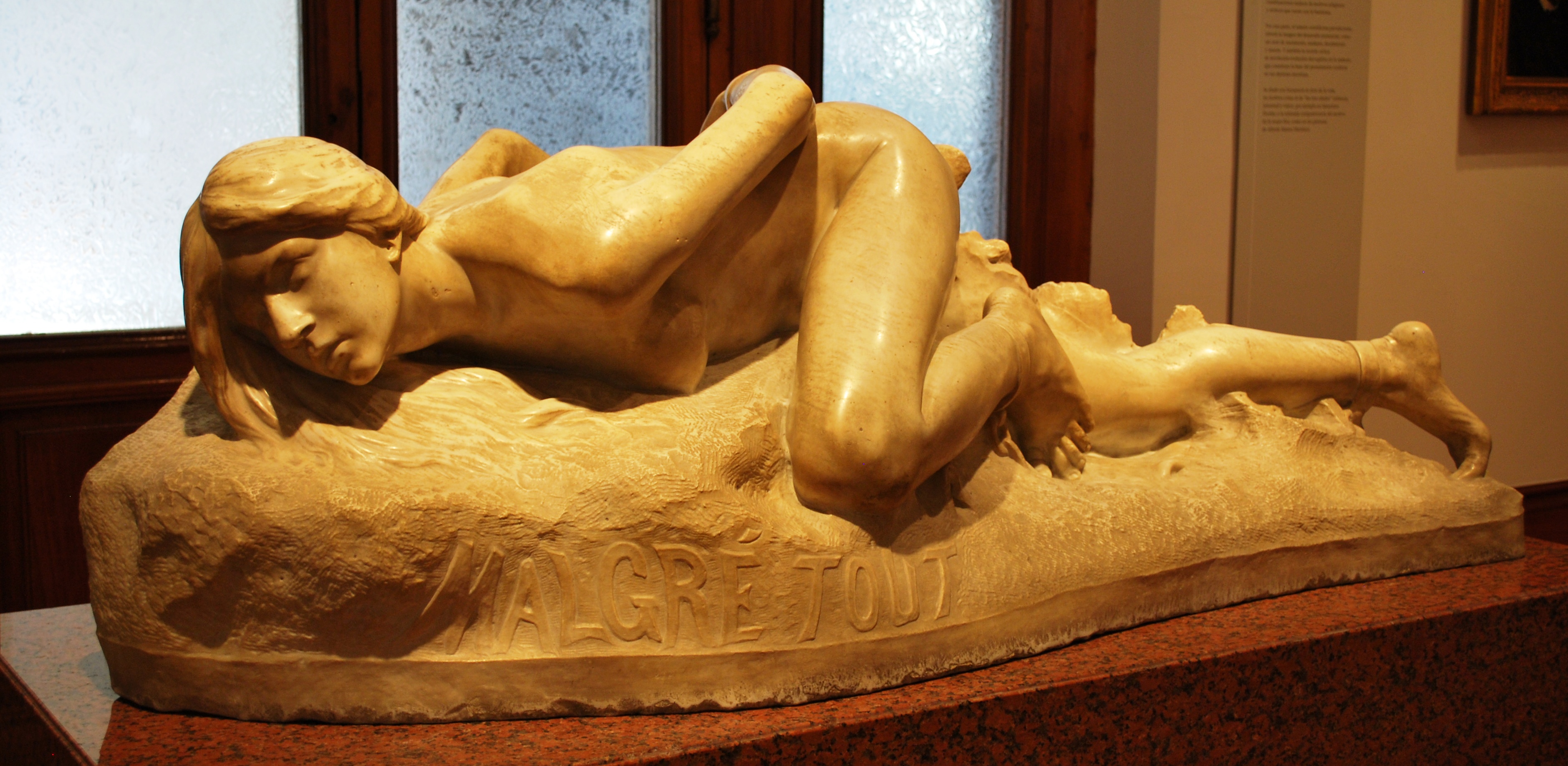
Jesus Contreras, Malgre Tout
In spite of everything. Contreras got cancer in his right arm and sculpted this using only his left hand. Defiance against teh body’s limitations. Face tilted upward in a fierce yearning for freedom. Created during the porfiriato era, he was so focused on foreign powers, so there is definitely french influence in the title. This piece was at the 1900 Paris Universal Exhibition. Mexico is developing into a modern, culturally sophisticated nation. Maybe Mexican revolutionary spirit?

Saturino Herran, Our God: the old gods, the new gods, and coatlicue
Early visual expression of mestizaje, the blending of indigenous and European cultures to form the modern Mexican Identity. Center panel is a curcified jesus christ superimposed onto the torso of coatlicue, the Aztec goddes of earth, life, and death. Both indigenous Aztecs and SPanish conquistadors are offering gifts from their separate panels. Herran isn’t showing one culture conquering the other, instead, he argues that modern Mexicans are the product of both psiritualities combined into a unified cultural soul.


The pimps hour, jose clemente orozco
Orozco was one of the tres grandes, he worked as a political caricaturist as well. While Rivera studied european art abroad, Orozco stayed in mexico and witnessed brutal war time. Thus, he focused his art on the dark, marginalized, and seedy underbelly of Mexico city. Even though the elite favored sanitized, eurocentric art, Orozco broke from the tradition by painting pimps and prositutes. But he doesn’t portray them as moral failures, he is very empathetic. He captures the exploitation, psychological exhaustion and humanity of individuals that are caught in society.

Dr. Atl, Popocatepetl
This is smoking mountain, and he was obsessed with it. He was anti european trends, so he turned the majestic mexican landscape into a symbol of national pride. He inspired the big three muralists. The strength of nature against man.

Diego Rivera, Escena Nocturna
Murky scene, artificial light sources illuminate a group dancing. Appreciation for european master artists of night scenes. Dancing figures are rendered with loose, expressive brushstrokes. COntrasts heavily with the rigid academic modeling RIvera learned in Mexico City. He painted this in paris, and this is very parisian night. He was obsessed with how crowds would move and would revisit it in his future paintings.
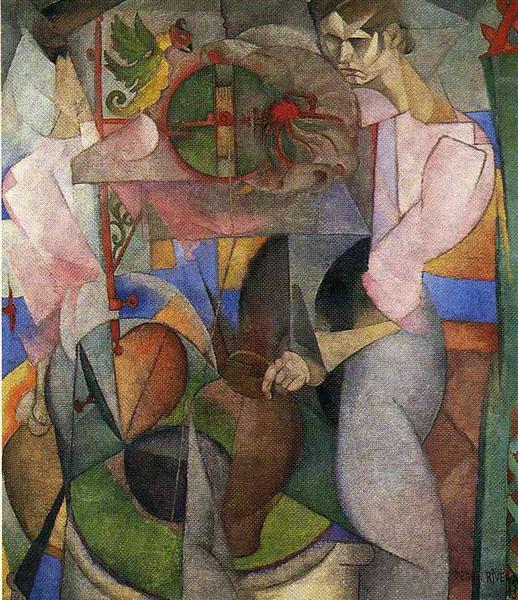
Diego Rivera, Woman at the Well
Rivera practices cubism, while including indigenous themes. A working class woman is given a very onumental presence. Zapatista landscape is on the other side. This is a manner of depicting everyday life, it is appreciating costumbrismo. Cubism simplifies what you see, multiple perspectives on one plane.
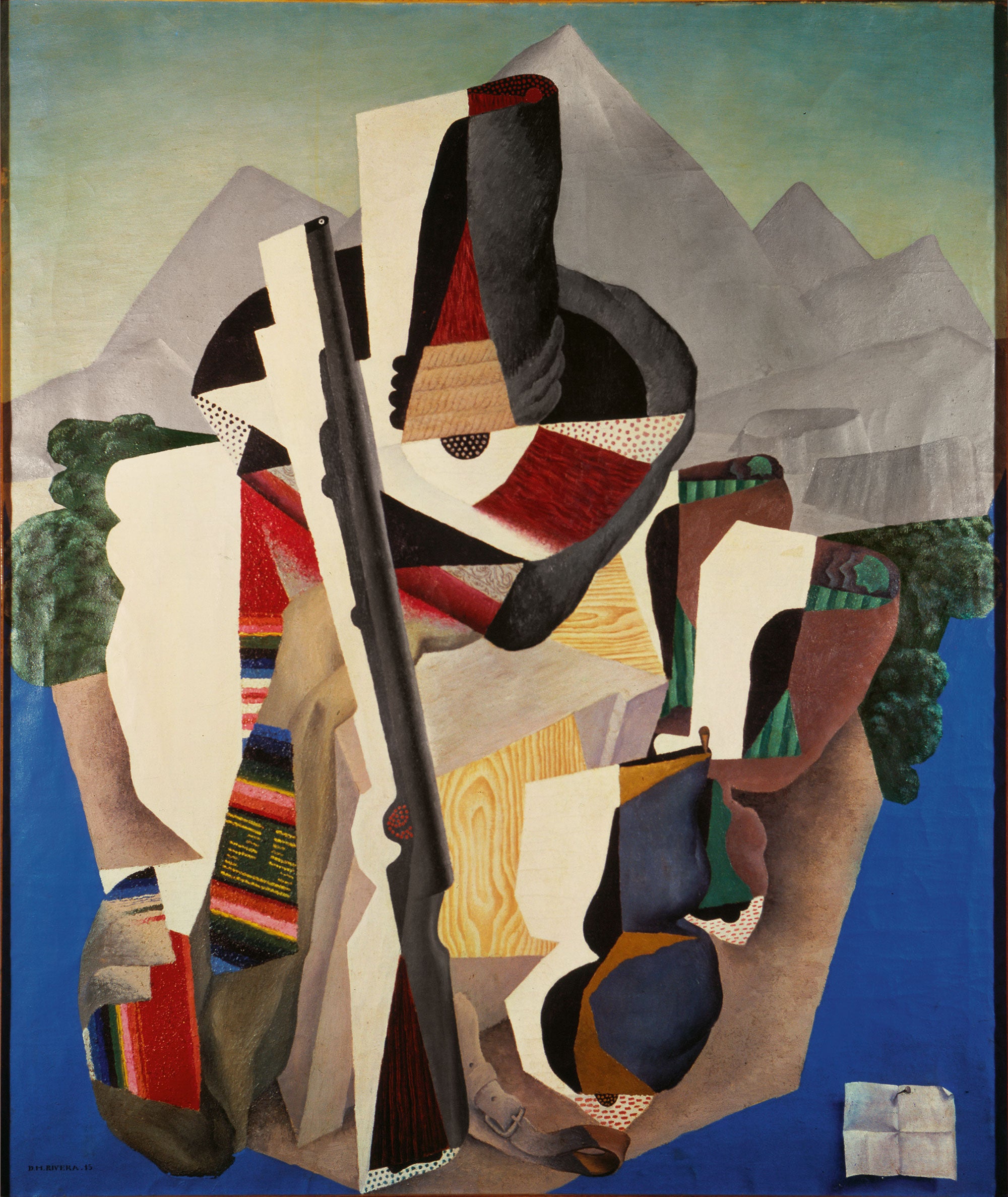
Rivera, Zapatista Landscape
Cubist painting. Has a gun, mountains, sombrero, serape, gear of a peasant soldier. Irony is that Rivera wasn’t even there for the revolution. Piece of paper pinned at the bottom, it is not real, trompe l’oeil. Reference to artists in this period who were tacking things to the vancas. He was a fan of Emiliano Zapata. Took the European movement of cubism and applied it to the bloody, political, Mexican revolution. By not writing anything on the piece of paper, he was declaring the visual power of mexican identity, weaponry, and land, there was no need to put a manifesto on it.

Rivera, Creation
Rivera’s first public mural, launching the Mexican Mural movement. After the devastation of the Mexico Revolution, the new minister of public education Jose Vasconcelos wants to use art as a tool to unify the country, he wants to educate the masses. Rivera comes back from italy and he paints this. There’s not really a ton of political ideology, left side is emmenations of women, right side is of men. Blending european traditions with a mexican perspective. Lots of mestizaje. Adam and Eve, the theological virtues, and the nine muses. Encaustic painting, not a good medium for a fresco, because it is temperature sensitive. Time of experimentation.

Fernando Leal, Feat of the Black Christ of Chalma
Also an encaustic mural in the same building as Rivera. Indigenismo, a philosophy celebrating the social, cultural, and historical contributions of Mexico’s indigenous population. Chalma is a real place where at that time they still celebrated a lot of pre-hispanic rituals in coexistence with catholic worship. He places indigenous instruments right alongside european instruments. He does not focus the audience’s view on the catholic icon of black christ, but instead of the energy of the indigenous people. This mural is directly across the staircase from Jean CHarlot’s Massacre at the templo mayor, so while this mural represents mexico’s present diverse traditions, Charlot’s represents its traumatic colonial past.

Jean Charlot, Massacre at the Templo Mayor
basically the conquistadors granted the aztecs permission to hold their sacred holiday, but in the middle of the feast, the solider surrounded them, blocked the exits and slaughtered them. Fresco, not encaustic. Charlot modeled the conquistadors as rigid, metallic, almost robotic machines charging on horseback, they are rendered in harsh geometric angels. In contrast, the Aztec victims are painted with softer, organic shapes, symbolizing the clash between cold destruction and living culture. Frames spaniards as barbarians.

Fernando Leal, Zapatista Encampment
Post revolution, trying to create a unified identity for Mexico. Education Minister JOse Vasconcelos visits the open-air art school that Leal is leading, and he likes thi s painting. Realistic indigenous imagery. Emiliana Zapata at a rural campsite. Sombrero has the image of the virgin of guadalupe. Leal paints realistic, everyday Mexican campesinos who were part of Zapata’s army. He treats teh struggles of ordinary people, indigenous identity, and land reform as subjects worthy of artistic devotion. Message of peace, that the zapatistas don’t want to battle anymore. Audience is people who are afraid of zapatistas and indigenous people. Pacifying painting persuading bourgeousie that they can all be part of the same nation.

David Alfaro Siqueiros, The Elements (the spirit of the west)
Painted on a stairwell ceiling staring down at you. Encaustic mini mural. Goddess of vicotyr or mother nature with her four natural elements. Very abstract representation of the elements. Alfaro wasn’t super into easel painting, becuase he thought it was a bourgeois commodity, so you liked utilizing architectural surfaces like walls and ceiling that force teh viewer into a dynamic, physical relationship with the art, many people can see it.
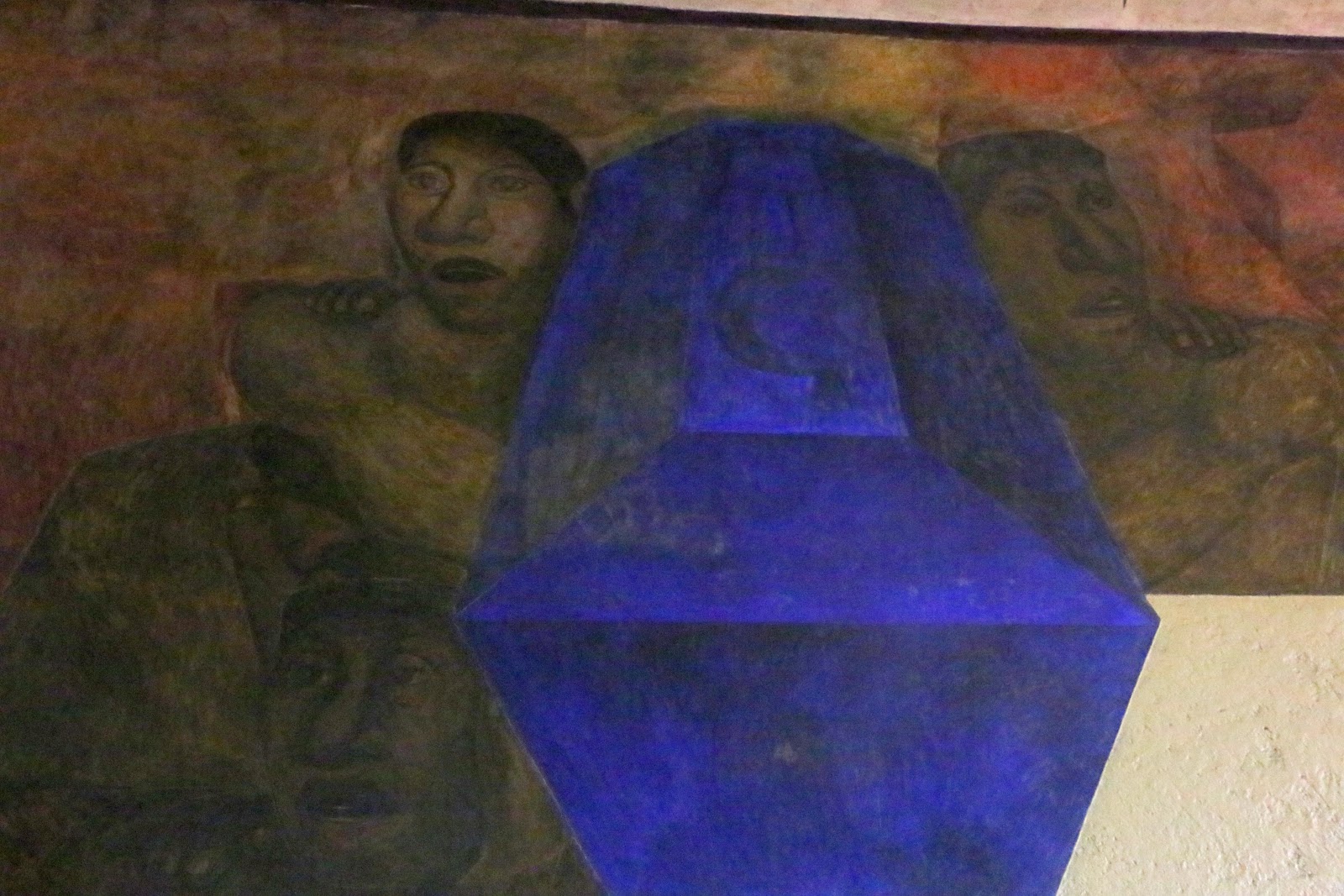
Siqueiros, Burial of the Sacrificed Worker
Rather than depicting a specific individual, the sacrificed worker represents the collective proletariat and indigenous peasantry who gave thier lives during the social upheals of the revolution. The coffin has a hammer and sickle on it, along with a red-painted woman with broken chains symbolizing liberty and resistance. But same idea of the post-revolution formation of a national identity through art. The population is largely illiterate, so you must educate through imagery.

Jose Clemente Orozco, the trench
Orozco lived through the revolution and witnessed its violence firsthand. Same idea of unifying the public through large scale didactic public art. While Rivera and Siquieros painted hopeful, industrial, or Marxist-forward visions of Mexico’s future, Orozco rejected official propaganda and glorification of war. Very sculptural forms and play of lighting. Humanizing sacrifice, evokes the idea of the crucifixion of christ. Instead of celerbating military victory, he places the focus on raw human sorrow. Violent red background, sharp, dagger-like diagonal composition.

Orozco, Maternity
Same idea of unifying the pubilc through a national identity and art about history. Conservative groups thought the imagery was profane, and it was vandalized many times. European style blonde features. Shift towards humanisms, not just political propaganda. Mexico needs mother to repopulate after the losses during the Revolution. Jesus is a girl, regeneration of humanity, rather than continuing a male-dominated poltiical dynasty. Matrilineal space.
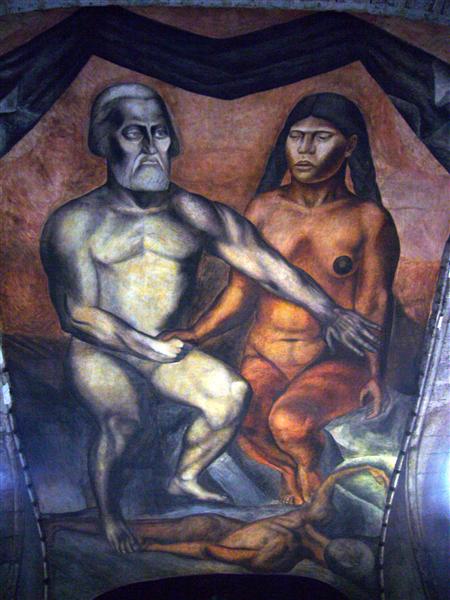
Orozco, Cortes and Malinche
Celebrating mestizaje, the biological and cultural blending of european and indigenous peoples that defines mexico. Malinche was an enslaved Nahua woman who became COrtes’s primary translator, negotiator, and mistress. Sharp geometry and earthy tones. They are the mexican adam and eve, the parents of a modern mexican nation. HIs muscular arm cuts heavily across her torso while they clasp hands, her eyes are downcast. At Cortes’s feet is the corpse of an indigenous man, he steps on top of him, anchoring is conquering of the land. Violent truth of mestizaje, not glorified, restraining melinche, calculated deal, a union born out of political survival.
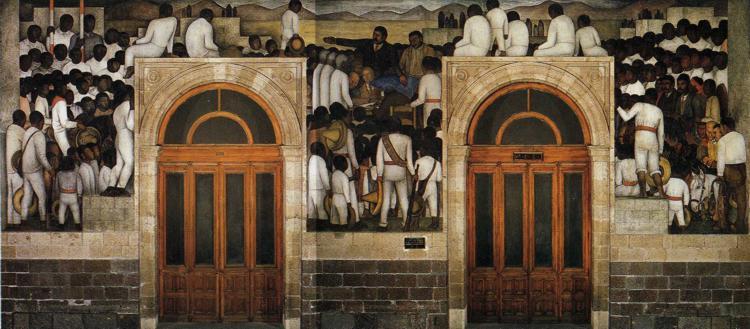
Diego Rivera, The Distribution of Land
Education minsiter gets los tres grandes to paint the walls of government buildings, this is not a school, it is a education secretary building. Construct a new national identity. Agrarian crisis, Mexcian land had been monopolized by the welathy elite under Porfirio Diaz, which is what Zapata fought against. Rivera has the Marxist ideiology of using public murals to empower the working class, he portrays the campesinos not as passive victims of poverty but as noble dignified portagonists inheriting their rightful land. True freedom of the mexican peasant requires both the physical land to harvest adn the intellectual education to prevent future exploitation. Uses architecture of the wall as a sort of trompe l’oeil, they are sitting on the wall.

DIego RIvera May Day Festival
Lots of red socialist banners and a dense, unified sea of working-class people marching together. Tied to post-revolutionary agrarian struggles in mexico, and connects it to the larger, global Marxist labor movement. Urban agrarian alliance, you can see both industrial city laborers and campesinos.
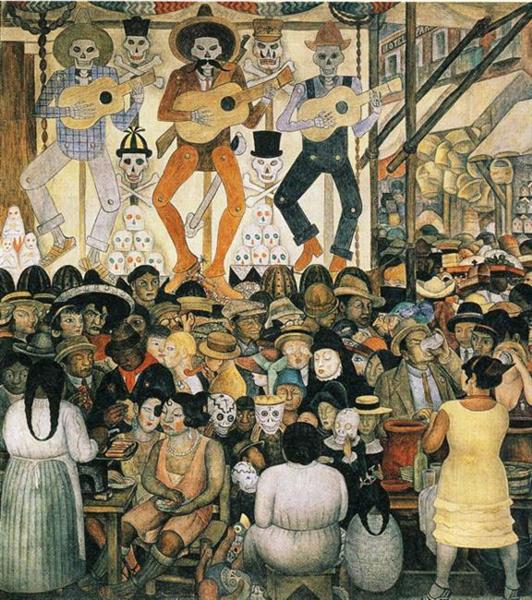
Diego Rivera, The day of the dead
The Day of the Dead shifted from a localized, domestic or religious practice into celebrated public, pedagogical, and aristic of mexicanidad. Rivera uses calaveras/skeletons to present death not as a morbid end, but as a natural continuation of life and a leveling force in soceity, we are all equal at the end. Reference to Jose Guadalupe Posada’s La Catrina, that critique’s social class, aristocracy and historical exploitation. Margiolds symbolize the unbroken bond between the living and the dead. Familial and working-class resilience. No matter who you are, you can find yourself in this painting.

Diego Rivera, Distribution of Arms
Visual manifesto of post-revolucionary Mexican Identity and international Marxist solidarity. Lots of red themes for communism. Workers and soliders emerge past the architectural borders of the mural, breaking the third wall. Inviting viewers in and asking them to join the struggle. He weaves his personal life into the mural, frida kahlo is there, wearing a communist star, tina modotti is there and julio antonio mella who was an exiled cuban revolutionary leader, siqueiros is on the left, and lots of marxist iconography with hammer and sickle. Honros the factory worker alongside the farmer, industrialezed Mexico.

Mardonio Magana, Corn Grinder
Mexicanidad, DIego RIvera discovered Magana’s raw talent and boosted him up. This is usually a female labor that dates back to pre-hispanic mesoamerica. Magana is elevating a gureling everyday domestic chore into a sacred, timeless symbol of indigenous resilience and cultural continuity. Primitiveness, rough textures and simplified form, prioritizing raw emotion over idealized realism. He grants monumental importance to unnamed campesinos.
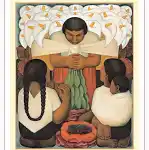
Diego Rivera, Flower Day
Elevates an indigenous flower vendor and her basket of lilies by echoeing the structure and feel of renaissance altarpieces, treating the daily labor of working class with reverence. Some block like forms, merges Rivera’s Cubist training with mesoamerican art forms and the indigenismo political identity. White calla lilies were fashionable for the period, but RIvera used them to spotlight the laborers who grew them, in contrast to the elite consumer taste.

Diego Rivera, Molendera
Dignity of the working class. Mexicanidad. Dedicating his work to scenes of every day life and moving away from eurocentric ideals. Domestic labor is portrayed with a sense of pride and calmness. He omits the signs of modern machinery, preserving rural labor. You can really see the intensity of her effort in the arch of her back.

Maria Izquierdo, Cemetery
Metaphysical art, dreamlike and disorienting environment. NO political, and not for a didactic public purpose, these were all easel paintings. She navgiates personal memory, folklore, and existential metaphors. It brings together mexican views on mortality and their ties to catholic iconography, along with european surrealist techniques. It’s not a scary scene, but she leans into a melancholy, quiet landscape. A symbol of grief is thus turned into a metaphor for human isolation, time, and the subconscious.

Frida Kahlo, Two Women
Two women who worked as maids in the Kahlo’s family home. She originally painted aprons on the women and later edited them out to elevate their presence. It looks like a renaissance madonna portrait, but the women wear somehwat modern indigenous clothing. Domestic workers are depicted with detail and dignity, where portraiture is usually reserved for the wealthy. POsitive and nuanced representation of indigenous adn working-class mexican women. Natural and lush background, grounded human focus, she always included nature in her paintings.

Abraham Angel, Self Portrait
Queer representation in art, he was one of Mexico’s first openly known queer artist, and he depicts this fluid gender expression onto the canvas. He has full lips, an arched eyebrow, and a sly side-glance that invites the viewer in. He is stripped of hyper masculine overtones. Vibrant background of mountains and typical mexican village, he integrates his colorful emotional state with the landscape, they have the same palette. Pure mexican modernism, moving awayf rom eurocentric art.

Julio Castellanos, Two Nudes
Moving away from using the female body as an allegory for mother earth, nature, and the nation, and reclaiming it for its own aesthetic, intimate, and emotional value. Maxicanizing the classical salon nude. Mestiza bodies. Reflecting the 1920s european return to order movement, he emphasizes volumetric, heavy, and blocky shapes. The two bodies almost seem fused into one another, and by turning one woman away, he avoids the passive voyeuristic presentation of women commin in western art, they exist for each other, resisting the invasive gaze of the spectator.

David Alfaro SIqueiros, Molendera, Women with stone mortar
Mirroring the molendera painting that Rivera did, he though it was overly deocrative and hourgeois. He thought that he romanticized the work and didn’t actually capture the rugged, revolutionary spirit of the working class. He makes the woman’s body look like a massive composition, with heavy block-like form, and the weight of the figure communicates her phsyical power rather than passive submission. Strange angle, her arms and torso thrust out toward the viewer, makes the ivewer feel actively involved in teh tension of the canvas. Odd texture of the materials he had to use, cracked texture instead of elegant finishes of academic paintings, echoing the harsh realities of the proletariat.

Tina Modotti, Tank No.1
Flattening the curved wall of an industrial oil tank. Modotti was obsessed with the Mexican Communist Party, and she wanted to humanize the machine age, elevating human labor. She includes the ascent of a laborer climbin gup the vast surface of the tank. Cropping makes the tank look like a massive wall.

Manuel Alvarez Bravo, Triptico Cemento 2, la tolteca.
For the La tolteca contest, combining many different forms of art in a way that embrazed industrialization in mexico, this was for a cement factory. Shift away from rural traditions and towards the rise of a modern urban landscape. Abstract form and structure, lots of geometric elements and formal compositions. Juxtaposition of raw earth and limestone against the sterile, towering ambitions of industrial architecture.

Juan O’Gorman, Aeroplano
Also for the La Tolteca Competition, promoting fien art being integrated with the industrial process. Transformation of the natural landscape of the mountains into raw concrete masses and industrial structures. Facotry in a positive light, looks like a white castle, larger than town but sharing the space with it. No workers, idealized version of factory as a clean, pristine space where no one is suffering.

Juan I’Gorman, House-Studio for Diego RIvera and Frida Kahlo
Reflects a desire to break away from the ornate, european inspired architecture of the porfiriato era and embrace a no national identity. Juan O’Gorman loved the functional and rational principles of Le COrbusier, everything had a utilitarian purpose. Large red house for diego and smaller indigo house for Frida. Perimiter has a cactus fence to reflect Mexico’s landscape instead of a traditional wall.
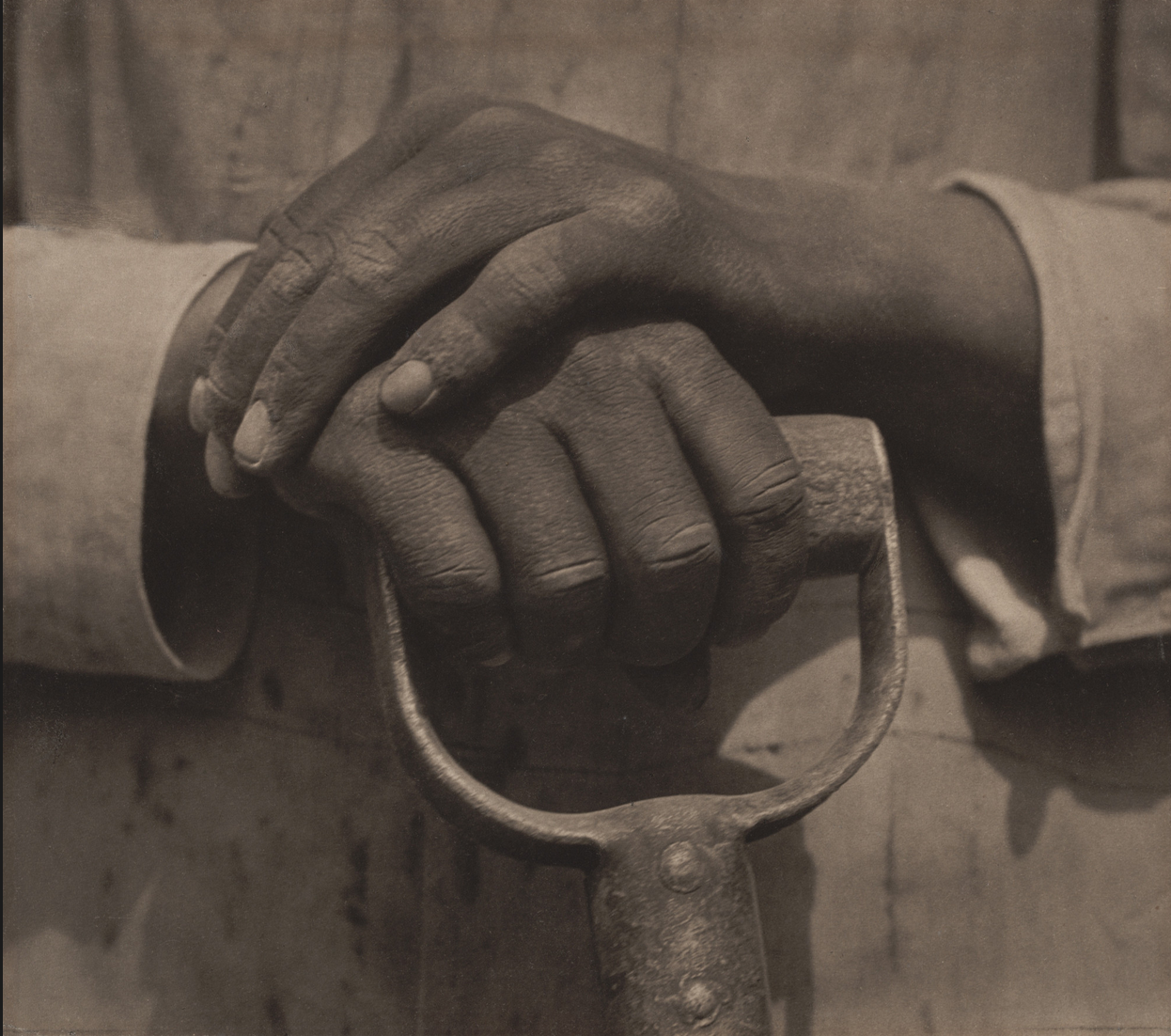
Tina Modotti, Worker’s Hands
Communist allegory, a close-up image of a laborer’s calloused, dusty hands resting on a tool handle is a universal symbol of working-class strenght, resilience, and resistance. Modotti was part of the mexican communist part. She rejected the idea of art for art’s sake, she wnated her images to be intentionally designed to provoke social consciousness and action, they aren’t just for passive enjoyment.

Tina Modotti, Hands Washing
Muscular, weathered hands of a Mexican woman laundering clothes. Her work championed the working class isntead of focusing on abstraction. Same idea of disagreeing with art for art’s sake, it should have a message and an impact. This is elevating a mundane domestic chore into a statement of human dignity and resilience. She crops the image and isolates the hands at work, there are no other distractions and you just see the effort she is putting in.

Edward Weston, Tres Ollas
Emphasis on geometric contours and tactile surfaces. Weston used to shoot with a pictorialist style which favored soft focus lenses and romantic, painterly compositions. Now he shoots with hard-edged, sharp-focus aesthetic known as straight photography. Finding pure artistic form in ordinary, utilitarian items. By cropping tightly around teh pots and employing strong, contrasting lighting, the pots no longer seem like just kitchen tools, they take up the whole composition and look like a monumental sculpture. The silver print registers the gradients of gray and black, highlighting the unique texture of the clay. Reducing jugs to significant form, flattened pictorial space, you don’t know how big the hars are and you are trying to figure it out, he wants your brain to think about what you’re seeing.

Tina Modotti, Woman with Water Jug Oaxaca
Rise of folk art for mexicanidad during this time. Traditional objects like the olla are central to mexican life. lots of geometric shapes, circle of the jug contrasting with the angles and lines of the woman’s body. You’re looking sort of us at the woman, she doesn’t seem like a victim of poverty, but a nodle and strong figure carrying the weight of the jug. Working-class indigenous women possess deep strength and independent agency.

Manuel Alvarez Bravo, Los Agachados
The counter stools are chained together, visually symbolizing the economci struggles that the working lcass faced if they were stealing stools. The cropping includes the door coming down from teh top, giving a sense of entrapment, and also tying the photo to christian artistic tradition of hellmouth where a monster eats sinners, and the gate says comedor which emphasizes this idea. OVerall, they live in an economic hierarchy that is a hell, you can also see the nuance within the working class, as the men are wearing different types of clothing that reflect their socioeconomic status with the working class. Magical realism, this mundane lunch break becomes a mysterious scene where the darkness draws you, creating an uncanny gaping mouth feeling.

Lola Alvarez Bravo, En su propia carcel
Allegory for social, domestic, and psychological restrictions placed on women in mexico. The shadow of some sort of pergola or fencing creating grid lines over her face and the window, making it look like a cage. Forces the viewer to question why she remains indoors or what she is waiting for, reflecting patriarchal pressures that constrained women’s public and professional mobility. ALvarez Bravo uses dramatic geometry, light, and shadow to capture everyday modern life in mexico, revolutionary costumbrista.
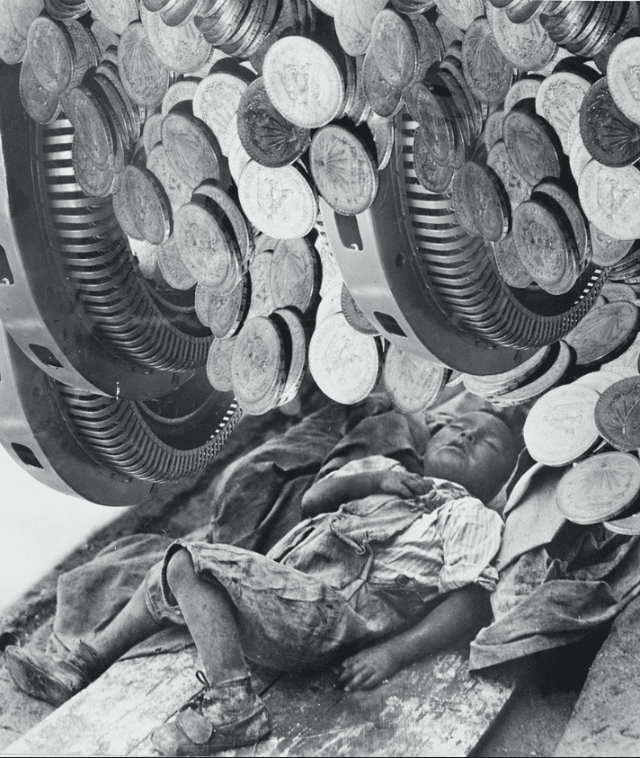
Lola Alvarez Bravo, Sueno de los pobres
Social realism photography. Reflects the disillusionment many felt as modernization and capitalism failed to lift the working class out of poverty. It is a photo montage. Moves beyond romanticized portrayals of indigenous and working-class life and captures some sharp political commentary of poverty in Mexico. He’s sleeping on a bench, with some sort of tarp that is acting like a blanket, while the rich dream of luxury, the poor dream of a real bed and real comfort, which they do not have the money to sustain. He is under gears, boy being eaten by the capitalist money-making machine.

Lola Alvarez Bravo, Architectural Anarchy
Critical visual commentary on the rapid, chaotic urbanizationa nd eocnomic shift of 20th century Mexico. El milagro mexicano, Mexico’s post WWII period of intense industrialization, economic growth, and state-led modernization. Mexico city is transformed into a booming metropolis, during which they have to aggressively get rid of colonial and historic architecture to make way for high-rise corporate skyscrapers. Contains the torre latinoamericana, a simon bolivar statue, and tiny dwarfed human figures that emphasize the grandeur of the construction. They are trapped in a concrete maze. HIghilghts overcrowding and loss of cultural heritage caused by unchecked capitalist development. Everything is warped, very surrealist.

Rufino Tamayo, Arrangement of Objects
Tamayo moves away from politically charged art, he believes more in art for art’s sale. He focuses in arte puro, priortizing aesthetics, universal themes, and formal experimentation. Uncanny avant garde art because it seems like there are a ton of mismatched items thrust together, mannequin hand invokes a human presence and absence. Finding mystery in everyday modern objects. He is one of los contemporaneos. These are all tools of art-making and he rendered them as a still life. Painting is creative process.

Maria Izquierdo, Painting of Belen
Flat treatment of perspective, it looks like she is fighting to get her elbow on top of the table. Detailed representations of mexican popular culture, vases, a rattle, signaling izquierdo’s devotion to elevating indigenous mexican folk traditions. Apple is a sort of trompe l’oeil becuase it roilled off of the tilted table. The spatial distortions and absence of cast shadows demonstrate her connection with french avant garde and modernist painting.

Rufino Tamayo, Homage to Benito Juarez
Rare engagement in political themes that were dominating post-revolutionary Mexico. Arte puro, prioritizing form, color, and texture over political propaganda. Benito Juarez was Mexico’s first indigenous president. Instead of a heroic figure, Jarez is portrayed as a gray, sculptural stone bust. He is enclosed by lots of rigid architecutre, removing him from teh world of the living. Tamayo is critiquing how the post-revolutionary state is fossilizing its heroes. The real person is painted in organic brown tomes that make the mappear alive. Tamayo blends cubism and surrealism with mexican subjects. Everything is familiar but nothing makes sense. Cacophony of nationalist noise, it’s there to be consumed but mostly people just walk past it.
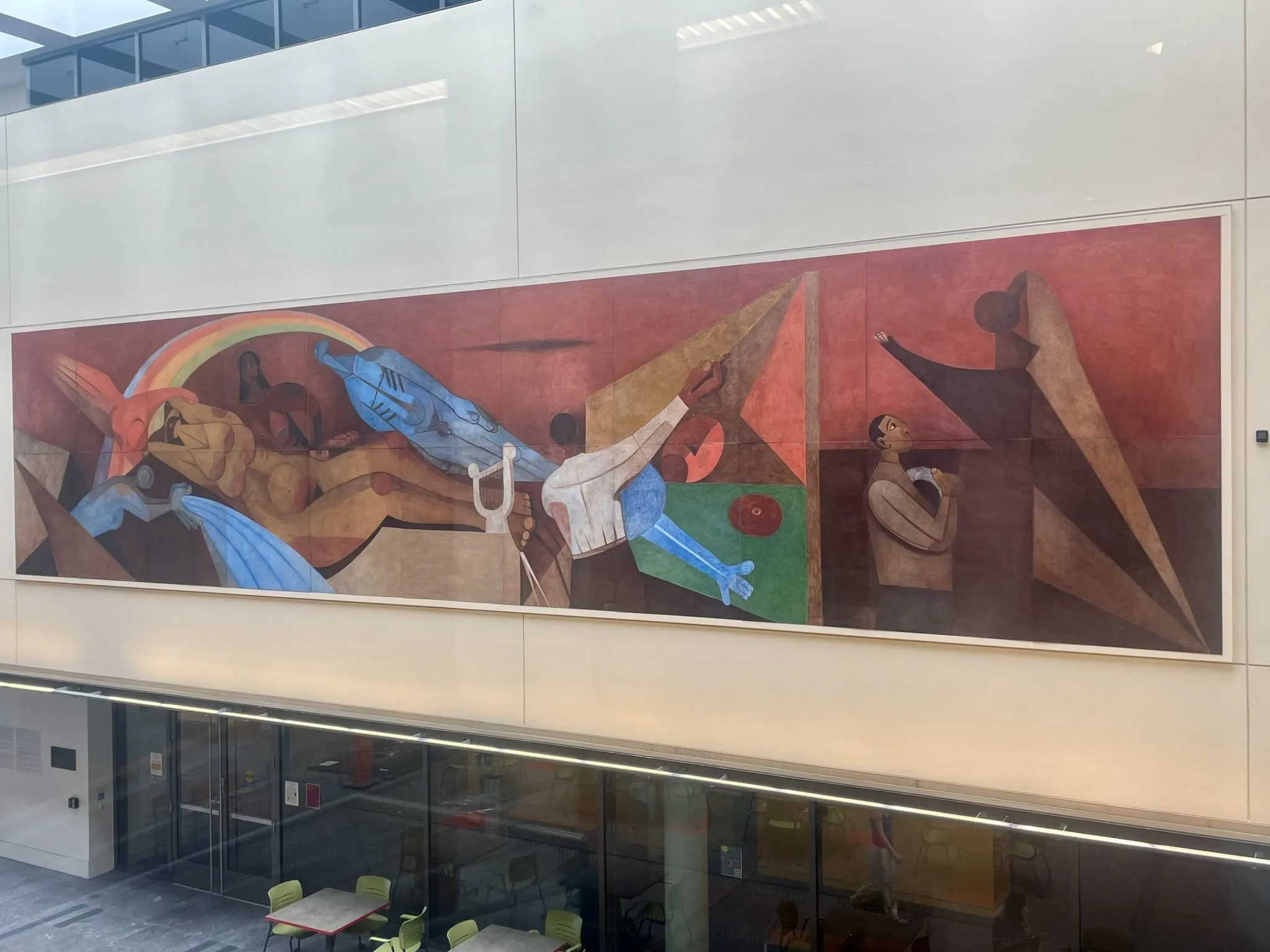
Rufino Tamayo, Nature and the Artist, The Work of Art and the Spectator
Again, rejection of over political narratives in favor of universal themes. Nature is surrounded by the four classical elements, the arcs and geometric shapes of each element create a dynamic feeling in the painting. The artist is using the elements of the universe and using intellect and emotion to produce an aesthetic object. In Tamayo’s opinion, the work is incomplete until it is observed, the spectator brings their own consciousness to the piece, creating a dialogue between teh world, the artist, and the audience. He is looking at nature but not literally depicting it, he is bringing his own intellect to it.

Izquierdo, Woman with Mirror
Influenced by contemporaneos, an avant garde group of writers and intellectuals, Izquierdo favors smaller, intimate works that are rooted in personal memory and mexican folk traditions instead of massive, poltiically didactic murals. Usually a woman looking in a mirror is trope used as an invitation for male voyeurism, but Izquierdo denies the viewer by turning her back on them and not really showing any reflection in the mirror based on the angle that she depicts the scene at. It’s not a delicate compact mirror, the woman is effortlessly holding a large, heavy, rectangular mirror. Surrealist touch of the mirror reflecting an open blue sky instead of her body, internal consideration and boundless potential. There is a mannequin next to her, representing a rigid, voiceless, and objectified gender role that society expectes mexican women to conform to. She could be comparing herself to the mannequin.
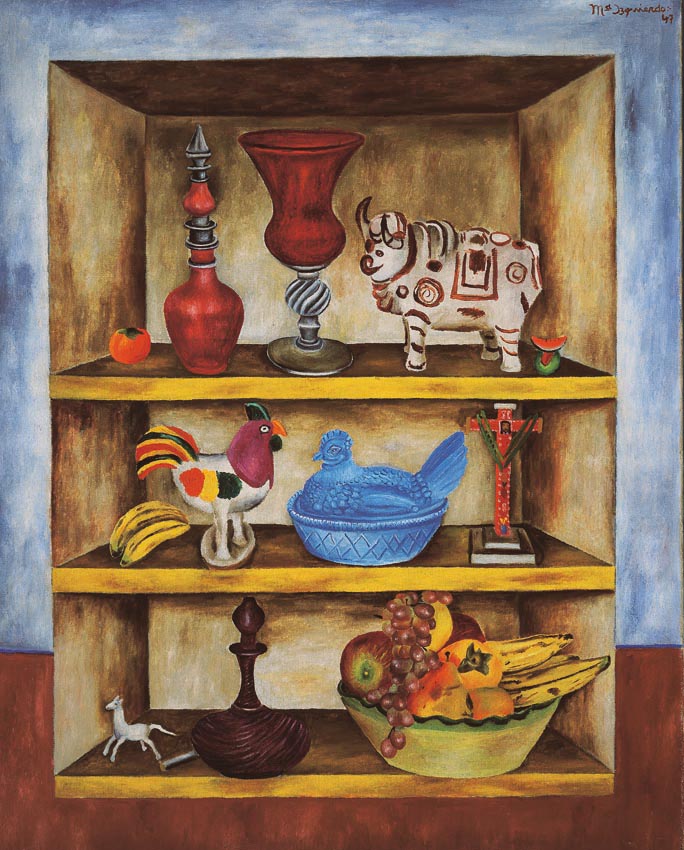
Izquierdo, The Cupboard
Still-life painting, again pushing back against polticized murals. Bit of a trompe-l’oeil becuase if you hung this on the wall it might look like there is actually a cupboard there. The painting is packed with mexican folk art and crafts. These domestic items demonstrate teh value of indigenous traditions and female artistry. About the practice of painting, illusion and lack of illusion

Frida Kahlo, Diego on my Mind
Lace headdress of the tehuana people, with a portrait of diego on her forehead. Roots from the flower of her headdress are reaching towards the edge of the canvas, tendrils are suspending lace from canvas edges, she can peek her face in an out. The tehuanas are strong formidable woman, sort of a monumental vibe you get from teh portrait, becuas ethe headdress takes up almost the entire composition. She felt it portrays mexicanidad. Obsession and mental presence that Diego Rivera had in her life. Maybe the tendrils also represent her tangled, sprawling thoughts about him. Psychological realism, she uses the uncanny vibe of the headdress, alive or not, to display in internal pscyhological pain and resilience.

Kahlo, The Two Fridas
Using clothing to get people’s attention, european clothes on teh left, indigenous on the right. Surreal, dream-like background. Blood on white erases purity, could be a symbol of menstruation. Hearts are very anatmocial, and she had studied to go to medical school. Appears almost like a casta painting, hwer ethere is usually a child involved, and there is a tiny Diego Rivera in her hand. Frida Kahlo was indigenist, not indigenous. Her dual identity, mexico and german heritage. shared blood vessel, both identity halves and meotional life are bound together. She isn’t crying, and isntead displays emotional pain through hemorrhaging in anatomical imagery.
Estredentismo
Mexican avant garde movement in teh 1920s, rejection of conservative academic art, very cosmopolitan, embracing modernity but committed to radical left-wing mexican social action.
Los contemporaneos
Mexican modernist writers, artists, and itellectuals from teh 1920s and 1930s, they believed in art for arts sake. Mexico shouldn’t isolate itself culturally, the art that mexican artists create can participate in a universal global cutlural dialogue. Muralists thought they were very bourgeois.
Return to order movement
Originally a post WWI european art movement, rejected cubism and futurism for the classical harmony and realism of the past. The muralists loved it, especiallyd iego rivera, who combined european classical forms with indigenous mexican history to create stability after a decade of violent civil war.
Neoclassicism
Official isntitutional movement from teh late 1700s to the 1800s. European trend imported by spanish rulers, but then became a tool for shaping mexcian national identity after independence. Art is based on reason, simplicity, symmetry. This was taught at the Academy of San Carlos. Academic realism. Eventually they started portraying indigenous subjects instead of Spanish ones.
Lo Nuestro movement
Ideiological philosophy in Mexico after the revolution, causing a cultural explosion. Demands that mexican artists shed centuries of european cultural imperialism and forge a new national identity, called mexicanidad, roted entirely in teh culture, history, and craftsmanship of the Mexican masses.
Metaphysical art/surrealism
THey both deal with reality-bending, dreamlike worlds. Metaphysical is more about rigid, quiet geometry, and surrealism is using a liquid world that is chaotic. Surrealism is more about the individual, subconscious mind, where metaphysical art is universal mysteries. Metaphysical is usually heavily shadowed, and surrealism is jam-packed with lots of symbolic objects. Metaphysical is more eery and melancholic.