Respiration and Thorax Muscles
 Call Kai
 Learn
 Practice Test
 Spaced Repetition
 Match
 Flashcards
 Knowt Play
1/19

There's no tags or description
Looks like no tags are added yet.
20 Terms
inspiration
inhaling; an active process driven by muscle contraction
expiration
exhaling; a passive return to anatomical position
sternal movement during respiration
superior and anterior movement, like a pump handle
*upper ribs 2-6; uses costovertebral, costotransverse, and costochondral joints

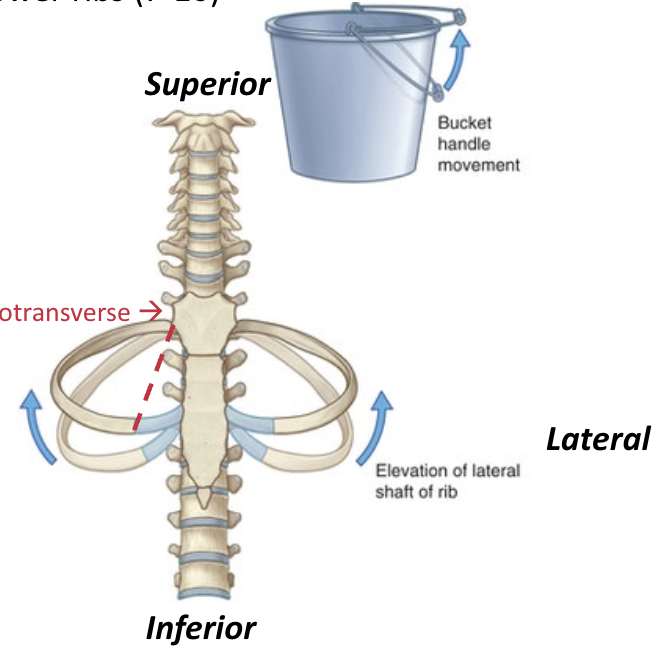
rib movement during respiration
elevation of lateral shaft of rib, like a bucket handle
*lower ribs 7-10; uses costovertebral, cosotransverse, and costochondral joints
extrinsic anterior thorax muscles
subclavius, pec major and minor, serratus anterior
extrinsic posterior thorax muscles
trapezius, rhomboid major and minor, latissimus dorsi

anterior thorax respiratory muscles
external and internal intercostals

inferior thorax respiratory muscle
diaphragm

posterior thorax respiratory muscles
serratus posterior superior and inferior, innermost intercostals, levatores costarum
serratus posterior superior
elevates upper ribs (inspiration)
N: intercostal nerves
O: supraspinous ligament/nuchal ligament, I: superior aspect of upper ribs
serratus posterior inferior
depresses ribs (exhalation)
N: intercostal nerves
O:spinous processes of T11-L2/3 and supraspinous ligament, I=inferior aspect of lower ribs
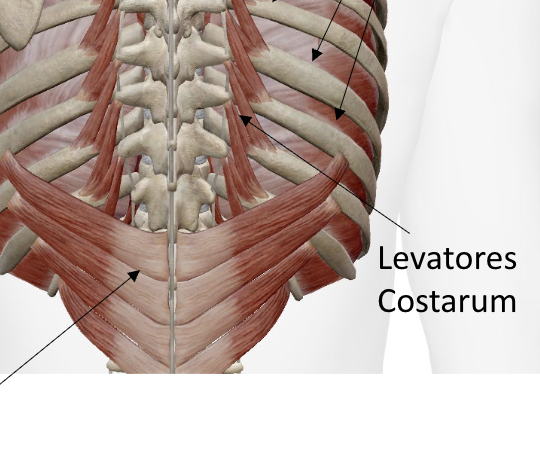
levatores costarum
elevates ribs (inspiration)
N: intercostal nerves
O: C7 and thoracic vertebrae spinous processes, I = outer surface of rib immediately below the vertebra
diaphragm
descends during contraction, expands thorax during inspiration
N: phrenic nerve
O: xiphoid process, lower costal cartilages, upper lumbar vertebrae and crura; I:central tendon
diaphragm hiatuses
caval opening (T8)
esophageal hiatus (T10)
aortic hiatus (T12)
caval opening
located in central tendon of diaphragm at T8 level; where IVC passes through diaphragm
esophageal hiatus
opening in diaphragm located at T10 level; where esophagus and vagal trunks pass through diaphragm
aortic hiatus
opening in diaphragm located at T12 level; where aorta passes between crura in diaphragm
external intercostals
elevates ribs
oblique with inferior edge medial → “hand in pocket”
innervated by intercostal nerves
internal intercostals
depresses ribs
oblique with inferior edge LATERAL → “hand across my heart”
innervated by intercostal nerves
innermost intercostals
depresses ribs and stabilizes thoracic wall
parallel to internal intercostals
innervated by intercostal nerves