Main terms I need practice on for exam from all chapters
 Call Kai
 Learn
 Practice Test
 Spaced Repetition
 Match
 Flashcards
 Knowt Play
1/78

There's no tags or description
Looks like no tags are added yet.
79 Terms

What are the 3 main Cell Surface Receptors (EXAM)
Ion channel-linked receptor, G protein coupled receptor, Receptor tyrosine Kinase
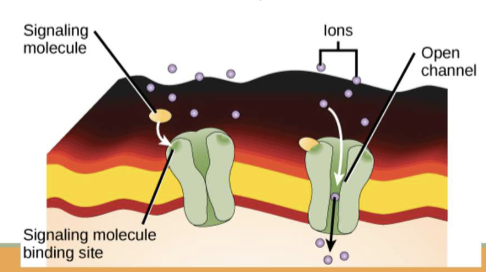
Ion channel-linked receptor EXAM)
open a channel for ions (e.g., ACh receptor).
Ligand binds —> channel opens —> Ions cross the membrane. The open pore allows ions to flow into/out of the cell
Ion Channel Linked Receptor example
Ex. Nicotinic Acetylcholine receptor (nACHR) at the neuromuscular junction
ACh Released → Binds nAChR → Na+ enters muscle cells → muscle contraction
QUIZ: A receptor that opens a pore in the plasma membrane allowing Na+ ions to enter the cell after acetylcholine binds is classified as:
Ion channel linked receptor

G protein-coupled receptor (GPCR) (EXAM)
activate G-proteins that trigger secondary pathways (e.g., cholera toxin modifies G-protein signaling).
Ligand binds GPCR,
G protein exchanges GDP for GTP
Activated G protein regulates an enzyme or ion channel

When G protein signaling goes wrong: Cholera
Water borne bacterium vibrio cholera produces a toxin, choleragen, that binds to cells lining the small intestine. Toxin modifies the G protein, which remains active. Increase in cAMP, chloride increases, water is lost, causing diarrhea
QUIZ: During lecture, we discussed how Vibrio cholerae produces a toxin that interferes with normal G protein signaling in intestinal cells.
The toxin modifies the G protein so that it remains continuously active. What is a consequence of this disruption?
The amount of cAMP increase, leading to increased chloride secretion and water loss into the intestine
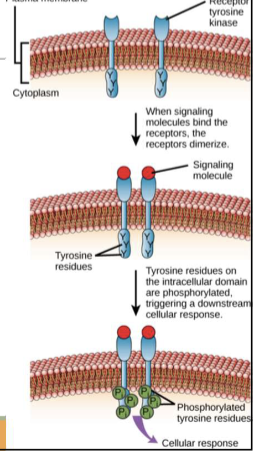
Enzyme Linked Receptor (EXAM)
activate enzymes (e.g., receptor tyrosine kinases, EGFR).
Receptor tyrosine kinases (RTKs) span the plasma
membrane and have an intracellular enzyme
domain.
•Ligand binding causes two receptors to dimerize. (combine two smaller, simpler molecules or subunits (called monomers) into a single larger complex known as a dimer)
•The receptors autophosphorylate (a protein kinase to add a phosphate group (usually from an ATP molecule) to itself) tyrosines on
each other, activating a signaling pathway and
cellular response.
•Phosphatases remove the phosphates, helping
terminate the signal.

Enzyme Linked Receptor: Receptor tyrosine kinases (RTKs)
span the plasma membrane and have an intracellular enzyme domain.

Enzyme Linked Receptor: ligand binding causes two receptors to ______ (EXAM)
dimerize - combine two smaller, simpler molecules or subunits (called monomers) into a single larger complex known as a dimer.

Enzyme Linked Receptor: The receptors _________ tyrosines on each other, activating a ______ _______ and cellular response (EXAM)
Autophosphorylate, signaling pathway

Enzyme Linked Receptor: ________ remove the phosphates, helping terminate the signal (EXAM)
Phosphatases
QUIZ: Match each type of cell surface receptor with the event that occurs following ligand binding:
G protein coupled receptor (GPCR)
Activates a G protein through the exchange of GDP for GTP.
Opens a channel that allows ions to cross the membrane.
Two receptors dimerize and phosphorylate tyrosines on one another.
Activates a G protein through the exchange of GDP for GTP.
QUIZ: Match each type of cell surface receptor with the event that occurs following ligand binding:
Receptor Tyrosine kinase (RTK)
Two receptors dimerize and phosphorylate tyrosines on one another.

Propagation of the Signal: Signaling pathway (EXAM)
Chain of events including second messengers, enzymes and activated proteins that follow ligand binding to a receptor

Propagation of the Signal: Signal Intergration
signals from two or more different cell-surface receptors merge to activate the same response in the cell
Signaling pathway example: Epidermal growth factor receptor (EGFR) definition
A receptor tyrosine insane involved in the regulation of cell growth, wound healing, and tissue repairing
Signaling pathway example: Epidermal growth factor receptor (EGFR) description (EXAM)
When EGF binds to the EGFR, a cascade of downstream events causes the cell to grow and divide
If EGFR is activated at innapriopriate times, uncontrolled cell growth (cancer) may occur

Methods of Intracellular Signaling: Phosphorylation (EXAM)
A phosphate group (po4^-3) is added to resides of the amino acid serine, threonine, and tyrosine
Methods of Intracellular Signaling: Kinase (EXAM)
The enzyme the transfer of a phosphate group

Second Messengers (EXAM)
Small molecules that propagate a signal after it has been initiated by binding of the singling molecule to the receptor

Example of Second Messengers (EXAM)
Formation of cyclic AMP (cAMP). cAMP serves as a ______ ______ to activate or inactivate proteins within the cell
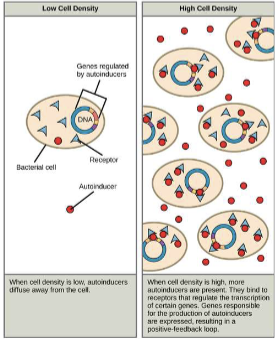
Signaling in single celled organisms: bacteria
In bacteria, population density is often the key factor for signaling
The histone DNA complex (the bead) is called a nucleosome and the connecting DNA (string) is called linker DNA.
This structure coils to form a _______ _____
Chromatin fiber
Regulation at internal checkpoints during cell cycle
Mistakes affecting function (such as mutated chromosomes or the wrong number of chromosomes) are regulated at 3 checkpoints — G1, G2, M
3 Checkpoints of cell cycle
G1, G2, M
QUIZ: (EXAM)
Before a cell proceeds through division, it must pass several checkpoints that ensure the conditions are appropriate and that its genetic material has been correctly duplicated and distributed.
Match each cell cycle checkpoint with the condition it evaluates.
G₁ checkpoint
Checks cell size, resources, growth signals, and DNA damage before S phase.
QUIZ:
Before a cell proceeds through division, it must pass several checkpoints that ensure the conditions are appropriate and that its genetic material has been correctly duplicated and distributed.
Match each cell cycle checkpoint with the condition it evaluates.
G₂ checkpoint (EXAM Term)
Checks that DNA replication is complete and replicated DNA is undamaged.
QUIZ:
Before a cell proceeds through division, it must pass several checkpoints that ensure the conditions are appropriate and that its genetic material has been correctly duplicated and distributed.
Match each cell cycle checkpoint with the condition it evaluates.
M checkpoint (spindle checkpoint) (exam term)
Confirms sister chromatids are correctly attached to spindle microtubules before separation.
Proto-oncogenes (normal “accelerator”) (EXAM)
Normal genes that code for positive cell cycle regulators
When normal genes mutate in certain ways, they become ______
oncogenes, potential to cause normal cell to lose ___

What happens in crossing over (during prophase I)
Crossover exchanges genetic material (DNA) between non sister chromatids of homologous chromosomes
3 Main categories of life cycles in multicellular organisms (EXAM)
Diploid dominant → animals — multicellular organism is diploid; gametes are haploid.
Haploid dominant → fungi/algae - multicellular organism is haploid; zygote is diploid but undergoes meiosis immediately.
Alternation of generations → plants/some algae — both haploid (gametophyte) and diploid

Diploid dominant life cycle (Animals) (EXAM)
Diploid adult → meiosis → haploid gametes (1n) → fertilization → diploid zygote → mitosis → diploid adult. (2n)
Only the gametes are haploid; there is no multicellular haploid stage
Overall definition: multicellular organism is diploid; gametes are haploid.
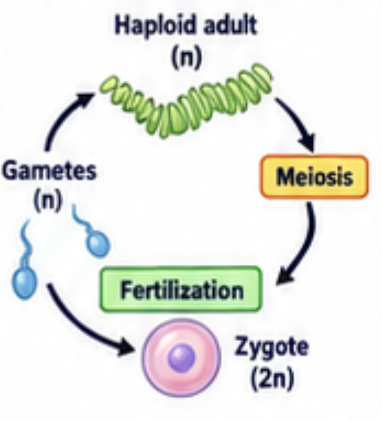
Haploid dominant life cycle (fungi, some algae)(EXAM)
Haploid multicellular organism → haploid cells fuse → diploid zygote → meiosis immediately → haploid spores → mitosis → haploid organisms
The zygote is the only diploid stage
Overall definition: multicellular organism is haploid; zygote is diploid but undergoes meiosis immediately

Alternation of Generations (plants, some algae) (EXAM)
Both the haploid and diploid stages are multicellular
Gametophyte (n) produces gametes by MITOSIS
Sporophyte (2n) → MEIOSIS → spores (n) → MITOSIS → gametophyte (n) → MITOSIS → gametes (n) → FERTILZATION → zygote (2n) → MITOSIS → sporophyte
Overall definition: both haploid (gametophyte) and diploid (sporophyte) multicellular stages alternate.
Understand that ________ restores diploidy (2n) by fusing two haploid gametes. (EXAM)
fertilization

Chapter 12 big picture graphic
review the image
Phenotype (exam)
Observable trait. Example: purple flower or blue eyes
Alleles (exam)
Versions of a gene.
Dominant/recessive = relationship between alleles in a heterozygote
Example of an Allele
P or p
Genotype (exam)
Allele combination for a gene or genes being considered - all of the genes you are considering in an individual organism
For a gene with two alleles, we can have:
PP (homozygous dominant)
Pp (heterozygous)
pp (homozygous recessive)
homozygote (exam)
When both alleles for the same trait are the same. Example PP (dominant) or pp (recessive). Homozygotes are always true breeding based on simple Mendelian genetics
Example of a homozygote
PP (dominant) or pp (recessive)
Heterozygote (exam)
When alleles for the same trait differ. Example — Pp. Heterozygotes are always non-true breeding.
Example of a heterozygote
Pp
Zygote (exam)
First diploid (2n, 2 sets of chromosomes) cell produced by fertilization
Which is a genotype and which is a phenotype:
Pp
Purple
PP = Genotype, Purple = Phenotype
Gene (exam)
DNA sequence that encodes information causing a trait (Mendel’s heridary particles)
Product rule in Genetics
The chance of inheriting an “A” from one parent and an “a” from the other = (1/2) * (1/2) = (1/4) → corresponds to the Aa genotype
Sum Rule in genetics
The probability of being heterozygous (Aa or aA) = ¼ + ¼ = ½
( 𝑃(𝑋 or 𝑌)=𝑃(𝑋)+𝑃(𝑌) )
Using both [sum (Or) and Product (AND)] rules in Genetics (exam: probability rules)
Example: Probability of an Aa offspring from Aa * Aa'
Each parent can contribute either A (1/2) or a (1/2) independently
To get Aa, there are two possible combinations:
A (from parent 1) and a (from parent 2) → ½ * ½ = ¼
a (from parent one) and A (from parent 2) → ½ * ½ = ¼
Because either combination produces the same genotype (Aa), add the two probabilities:
¼ + ¼ = ½
Alkaptonuria
An autosomal recessive genetic disorder. People with this can not properly metabolize phenylalanine and tyrosine
Symptoms: Darkened skin and brown urine, joint damage
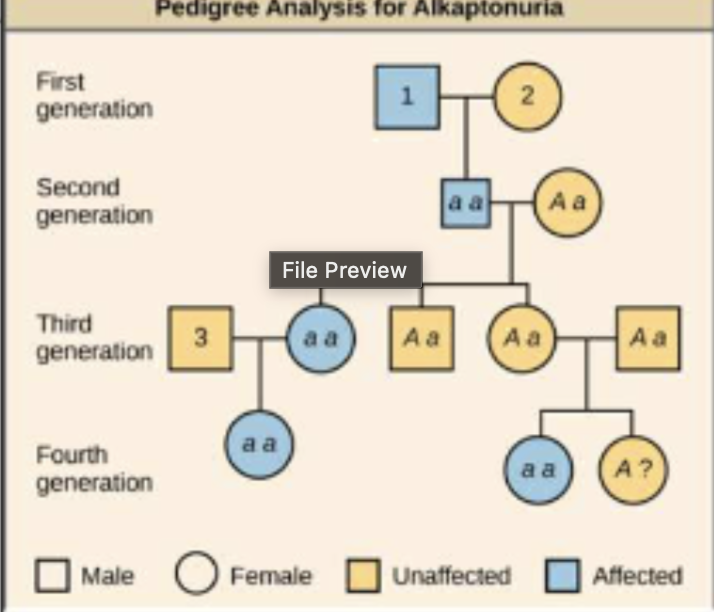
How is it possible to determine a person’s genotype from the genotype of their offspring
If two unaffected parents have an affected child, both parents must be carriers (Aa)
Work Backward from affected individuals to infer possible parental genotype
Incomplete Dominance
blended phenotypes (e.g., red × white snapdragons → pink).
Snapdragons:
Cross a true breeding red flower parent with a true breeding white flowered plant
Result: All pink F1 heterozygotes
If you cross pink F1 sibs you get an F2 that has the following ratio of phenotypes
1 red: 2 pink: 1 white
White is probably due to loss of red pigment function
The alleles do NOT blend; they remain discrete
Incomplete Dominace scenario:
Cross a true breeding red flower parent with a true breeding white flowered plant
What is the outcome?
: All pink F1 heterozygotes
Incomplete Dominace scenario:
If you cross pink F1 sibs you get an F2 that has the following ratio of phenotypes
What is the outcome?
1 red: 2 pink: 1 white
White is probably due to loss of red pigment function
Incomplete dominance phenotype ratio F1 punett square
Get picture from iPhone, ALL Pink

Incomplete dominance phenotype ratio F2 punett square
Red, Pink White Varations (get image from iPhone)

Example of incomplete dominance
snapdragons
Multiple Alleles
(e.g., rabbit coat color hierarchy C > cᶜʰ > cʰ > c) or blood type
More than two alleles of a gene exist in the population, although each individual carries only two
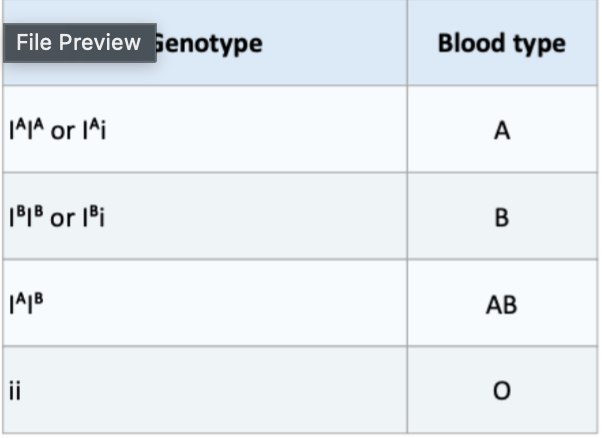
ABO blood type has three alleles:
IA, IB, and i
IA and IB are _______ — both are expressed together
codominant
Both IA and IB are _______ to i
dominant
Type AB (IA IB) demonstrates ________: both A and B ______ are expressed
codominace, antigens

Blood type Genotypes
A - IAIA or IAi
B - IBIB or IBi
AB - IAIB
O - ii

Multiple alleles for a single trait showing an order of dominance
Four different alleles exist for the rabbit coat color (C) gene.
C is dominant to cch
◦ CC, Ccch , Cch , Cc: all brown
cch is dominant to ch
◦ cchcch, cchch , cchc: all black tipped white
ch is dominant to c
chch, cchc: all white fur, black paws

Four different alleles exist for the rabbit coat color (C) gene.
C is dominant to cch
◦ CC, Ccch , Cch , Cc: all brown
cch is dominant to ch
◦ cchcch, cchch , cchc: all black tipped white
ch is dominant to c
chch, chc: all white fur, black paws
Image from slideshow

X linked inheritance (exam)
X linked genes are located on the X chromsomes
e.g., eye color in Drosophila; males more often affected).
XX individuals usually have two copies of an X-linked
gene.
•XY individuals have only one copy of most X-linked
genes; they are hemizygous.
•A recessive X-linked allele is expressed in an XY
individual whenever it is present on the X
chromosome.
•Example: in Drosophila, red eyes are dominant to
white eyes.
X linked inheritance: XX individuals usually have ___ copies of an X-linked
two
X Linked inheritance:
•XY individuals have only one copy of most X-linked
genes; they are _______.
hemizygous
X Linked inheritance:
A ______ X-linked allele is expressed in an XY
individual whenever it is present on the X
chromosome.
recessive

X Linked inheritance example: (exam)
In ________, red eyes are _______ to white eyes
drosophila, dominant
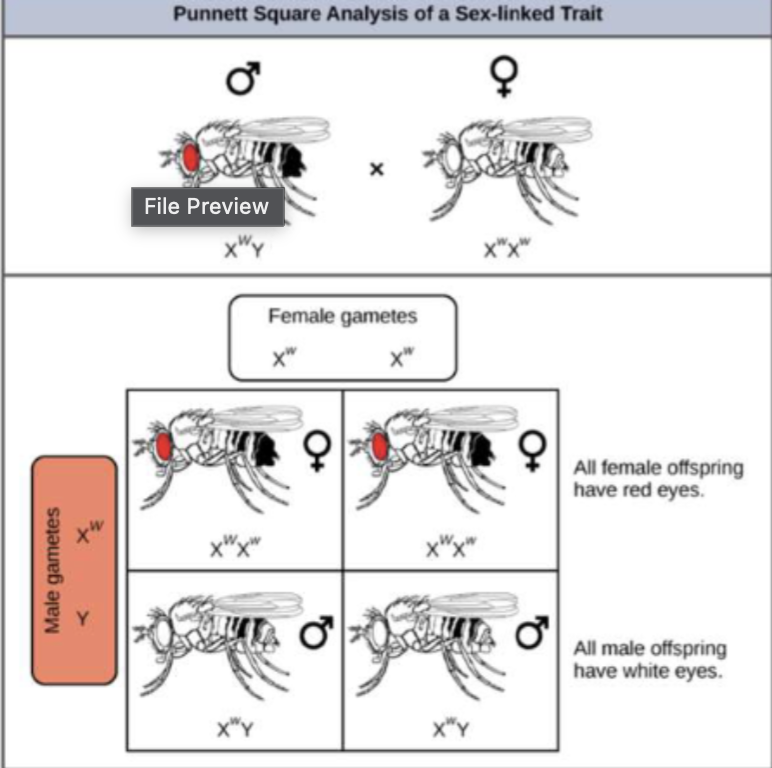
X-Linked Cross: Drosophila Eye Color
•Xᴿ = red-eye allele; Xʳ = white-eye allele.
•Cross: XᴿY × XʳXʳ.
•Daughters receive Xᴿ from father and Xʳ
from mother → XᴿXʳ, red-eyed carriers.
•Sons receive Y from father and Xʳ from
mother → XʳY, white-eyed.
•Fathers give their X chromosome to
daughters and their Y chromosome to son
X Linked Dominant
Image from slideshow
X-Linked Cross: Drosophila Eye Color
Punett Square:
Cross XwY male with XRXr female
Red eye female, Red Eye male
Red Eye female, White eye male
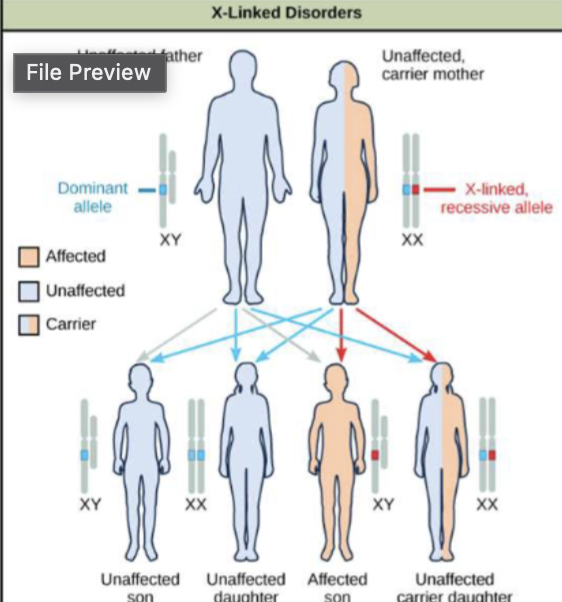
X Linked Recessive: Carrier Mother
Cross: carrier mother XᴺXⁿ × unaffected father
XᴺY.
•Sons: 50% XᴺY unaffected; 50% XⁿY affected.
•Daughters: 50% XᴺXᴺ unaffected non-carriers;
50% XᴺXⁿ unaffected carriers.
•In this cross, no daughters are affected
because the father contributes a normal Xᴺ
allele.
Image from slideshow
Lethal Alleles (exam)
alter expected ratios (e.g., Manx cats → 2:1).
All Manx cat are heterozygotes for the M allele
• mm homozygotes are normal house cats
• Mm heterozygotes are Manx (short/no tail)
• MM homozygotes all die at the embryo stage
• Crossing 2 Manx cats produce an offspring
ratio of 2 Manx : 1 normal. Not 3:1.
• Why? Explain
one of them dies, heterozygous will survive and give phenozytype
Epistasis (exam)
one gene masks the effect of another (e.g., albino mice C gene masks A gene).