LESSON 3 - ENERGY & ENZYMES
 Call Kai
 Learn
 Practice Test
 Spaced Repetition
 Match
 Flashcards
 Knowt Play
1/52

There's no tags or description
Looks like no tags are added yet.
53 Terms
WHAT IS ENERGY?
The capacity to do work or be transferred as heat and can be converted from one form to another
WHAT IS KINETIC ENERGY?
The energy of motion
WHAT IS POTENTIAL ENERGY?
Stored energy
WHAT ARE THE ENERGY LEVELS OF THE ELECTRONS OF AN ATOM?

WHAT IS AN ISOLATED SYSTEM?
Does not exchange matter or energy with its surroundings
WHAT IS A CLOSED SYSTEM?
Exchanges energy but not matter with surroundings
WHAT IS AN OPEN SYSTEM?
Exchanges energy and matter with surroundings and is the most important thing in biology
WHAT IS THERMODYNAMICS?
The study of energy transformations or changes
WHAT IS THE FIRST LAW OF THERMODYNAMICS?
Energy can be transferred or transformed from one form into another, but it cannot be created or destroyed

WHAT IS ENTROPY (S)?
The tendency of energy to become dispersed or spread out
Measure of disorder or randomness
Most increase through transformation of energy into heat

WHAT IS THE SECOND LAW OF THERMODYNAMICS?
Each time energy is transferred or transformed, some are lost as entropy (becomes unavailable to do work)
Can never have 100% efficiency
Increases the entropy (disorder) of a system + surroundings
WHAT ARE SPONTANEOUS REACTIONS?
Occur without a constant input of energy
Means energetically favourable
Reactions tend to be spontaneous if products have less potential energy than reactants
Reactions tend to be spontaneous when products are less ordered than reactants
Entropy, or S: Amount or randomness or disorder
WHAT IS ENTHALPY (H)?
Is the total heat or total energy content
Total Energy = Usable Energy + Unusable Energy
H = G + TS
ENERGY CONTENT
Total Energy = Enthalpy (H)
Usable Energy = Free Energy (G)
Unusable Energy = Entropy (S)
Temperature (T)
WHAT ARE ENDOTHERMIC REACTIONS?
Transformations that result in a system taking up heat from its surroundings (+ve ΔH)
Products have less total/thermal energy than reactants (+ve ΔH)
Requires input of energy
Tend to be non-spontaneous
WHAT ARE EXOTHERMIC REACTIONS?
Transformations that release heat to the surroundings (-ve ΔH)
Products have less total/thermal energy than reactants (-ve ΔH)
Energy released
Tend to be spontaneous
HOW DOES A REACTION BECOME SPONTANEOUS?
If entropy increases, reaction becomes spontaneous
WHAT IS FREE ENERGY (G)?
Energy available to do work (G) = Total energy (H) - Energy lost to entropy (TS): G = H – TS
Thermodynamics is the study of energy transformations or changes. Therefore:
ΔG = ΔH - TΔS
Δ (delta) – change (final state – initial state)
ΔG – change in free energy, the amount of energy available to do work (Hibbs Free Energy)
ΔH – change in enthalpy, total energy available
T – absolute temperature (degree Kelvin)
ΔS – change in entropy, degree of disorder
WHAT ARE EXERGONIC REACTIONS?
Amount of energy released (-ΔG)
Spontaneous
Release energy
Energy reactants > products
ΔG negative

WHAT ARE ENDERGONIC REACTIONS?
Amount of energy available to do work (+ΔG)
Non-spontaneous
Requires an input of energy
Energy products > reactants
ΔG positive

EXPLAIN DIFFUSION ACROSS A MEMBRANE

WHAT IS EQUILIBRIUM?
Is state of maximum stability
Point is reach when reactants are converted to products and products are converted back to reactants at equal rates (ΔG = 0)
Point is also reach when the concentration of a molecule is the same on both sides of a membrane, and rate of movement is the same in both directions
At equilibrium, a system has no capacity to do work
At the point of equilibrium, molecules do not stop reacting
At equilibrium, the rate of the forward reaction equals the rate of the backward reaction
As a system moves toward equilibrium, the free energy change (energy available to do work, ΔG) of the system becomes lower
At equilibrium, there is no drive for change in the forward or reverse directions, ΔG = 0
EXPLAIN EQUILIBRIUM IN LIVING SYSTEMS
Living systems are highly organized (maintain low entropy)
Living systems are OPEN, which means they bring in both energy and matter from surroundings and use them to do work and maintain an organized state
They release energy and disordered molecules into the environment (surroundings); therefore, the second law of thermodynamics is upheld, as the entropy of the system and surroundings increases
WHY DO WE NEED TO EAT?
Organisms never reach equilibrium (ΔG = 0); life requires a constant supply of energy
A significant portion of the energy we consume in food is used to maintain a low entropy, highly organized state for our cells
EXPLAIN THE FLOW OF ENERGY THROUGH THE BIOSPHERE
Photosynthesis: Captures light energy and uses it to convert carbon dioxide into carbohydrates
Cellular Respiration: Breaks down carbohydrates and transforms the energy into ATP

WHAT ARE METABOLIC PATHWAYS?
Series of sequential reactions in which products of one reaction are used immediately as reactants for the next reaction in the series
WHAT ARE CATABOLIC PATHWAYS?
Energy is released by breakdown of complex molecules to simpler compounds
WHAT ARE ANABOLIC PATHWAYS?
Consumes energy to build complicated molecules from simpler ones
WHAT IS CATABOLISM?
Breakdown of molecules into smaller unites, releasing energy
WHAT IS ANABOLISM?
Building of more complex molecules/macromolecules from smaller units, requiring an input of energy
WHAT IS METABOLISM?
Collection of all chemical reactions present within a cell or organism
WHAT IS ATP HYDROLYSIS?
Is an exergonic reaction that can be coupled to make otherwise endergonic reactions proceed spontaneously

WHAT IS ENERGY COUPLING?
The coupling of an endergonic reaction to an exergonic reaction
EXPLAIN THE ATP/ADP CYCLE?

WHAT ARE ENZYMES?
Are a special group of proteins that can increase the rate of chemical reactions
WHAT ARE ENZYME-CATALYZED REACTIONS?
Enzymes bind to a reactant (substrate)
After binding to reactant, and ultimately releasing the product(s), the enzyme is uncharged
Highly specific, recognizing a unique substrate or a class of similar substrates
WHAT IS ACTIVATION ENERGY (EA)?
Initial energy investment required to start a reaction
WHAT ARE BIOLOGICAL CATALYSTS?
Catalyst: Chemical agent that speeds up the rate of reaction without itself being chemically altered
Enzymes: Biological catalysts
EXPLAIN THE RATE OF REACTION

WHAT IS ENZYME SPECIFICITY?
Active site of enzyme combines briefly with reactants (substrates)
After releasing the product, the enzyme is unchanged
EXPLAIN THE CATALYTIC CYCLE OF ENZYMES

WHAT ARE ENZYME COFACTORS?
Non protein groups necessary for catalysis to occur
WHAT ARE COFACTORS?
Metallic ions (Mg2+, Fe2+, Cu2+, Zn2)
WHAT ARE COENZYMES?
Organic cofactors like vitamins
WHAT IS TRANSITION STATE?
Occurs during catalysis where the substrate and active site form
WHAT ARE THE 3 MAJOR MECHANISMS THAT ENZYMES FACILITATE THE FORMATION OF THE TRANSITION STATE?
Bringing the reacting molecules into close proximity
Exposing the reactant molecules to altered environments that promote their interactions
Changing the shape of a substrate molecule
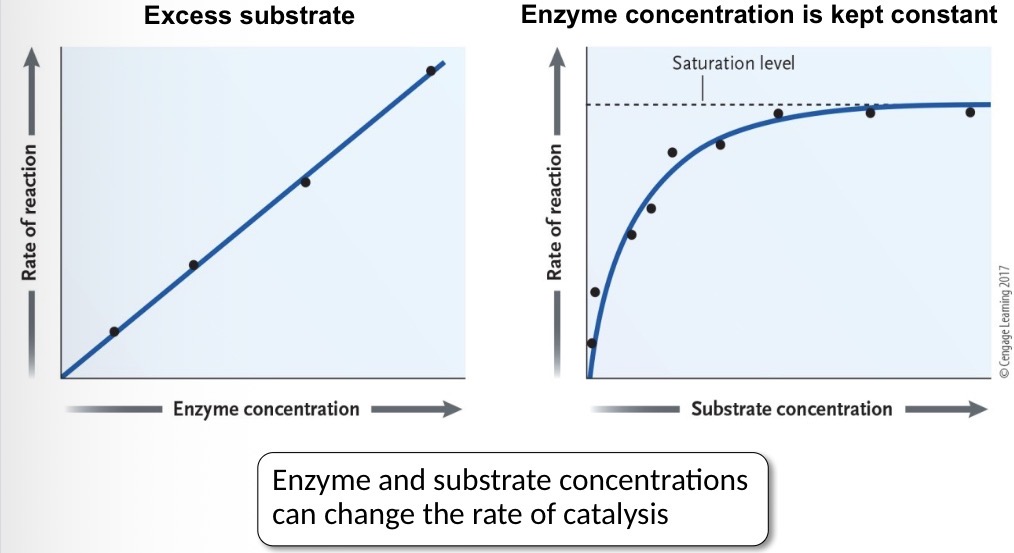
WHAT HAPPENS WHEN SUBSTRATE CONCENTRATION IS LOW?
Enzymes and substrate collide infrequently
Reaction rate slows
WHAT HAPPENS WHEN SUBSTRATE CONCENTRATION IS HIGH?
Enzymes become saturated with reactants
Rate of reaction levels off
WHAT CAN ENZYME AND SUBSTRATE CONCENTRATIONS DO?
WHAT ARE ENZYME INHIBITORS?
Are nonsubstrate molecules that can bind to an enzyme and decrease its activity
WHAT ARE COMPETITIVE INHIBITION?
Inhibitor competes with normal substrate for active site
WHAT ARE NONCOMPETITIVE INHIBITION?
Inhibitor does not compete with normal substrate for active site, but combines with sites elsewhere on enzyme
EXPLAIN COMPETITIVE INHIBITION OF ENZYME ACTIVITY
