ECME Diesels and Purifiers Study Guide
 Call Kai
 Learn
 Practice Test
 Spaced Repetition
 Match
 Flashcards
 Knowt Play
1/55

There's no tags or description
Looks like no tags are added yet.
56 Terms

What is this and what does it do?
Bowl. it spins at high speed with fluid inside it.
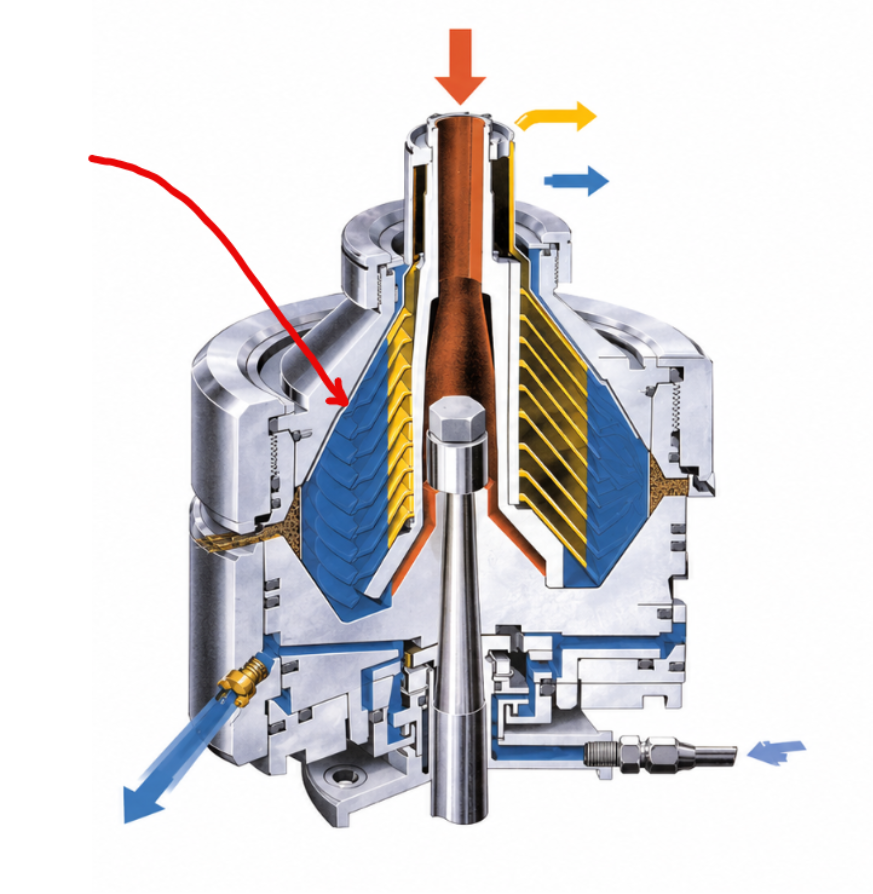
What is this and what does it do?
Wings/disks. they improve separation.

What is this and what does it do?
Gravity Disk. It sets water/oil interface.

What is this and what does it do?
Distributor cone. It holds the disks, distributes to incoming fluid.

What is this and what does it do?
Feed Tubes. For incoming fluid.

What is this and what does it do?
Sliding bowl assembly. Opens for self-cleaning. Ejects contents during cleaning “shooting bowl”

What is this and what does it do?
Closing water. It holds bowl closed during operation.

What is this and what does it do?
Opening water. Timed event or on water sensing.
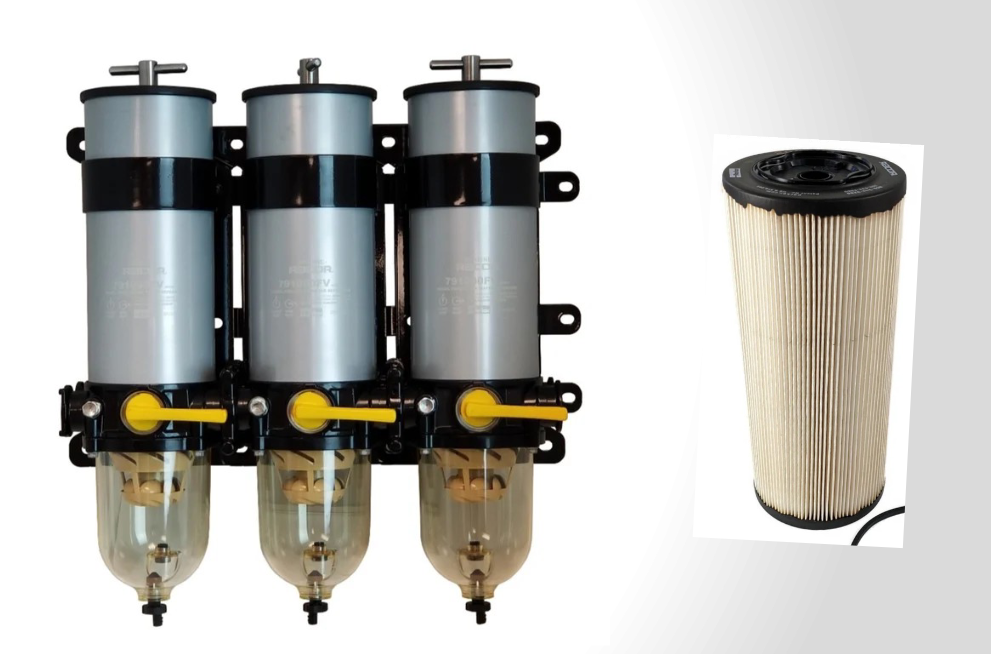
What kind of filter is this?
Racor Filter.
What does oil/water separation rely on? What kind of force is used to separate solids/liquids from a fluid?
Difference in density. Centrifugal.
How do the plates help separate the mixture. What is this called?
The plates reduce distance for particles to settle. This is called thin strata distribution.
What two factors affect separation?
Time and temperature.

What is this and what does it do?
Vertical and Horizontal Drive. Vertical drive drives the bowl, and horizontal drive drives from the motor.
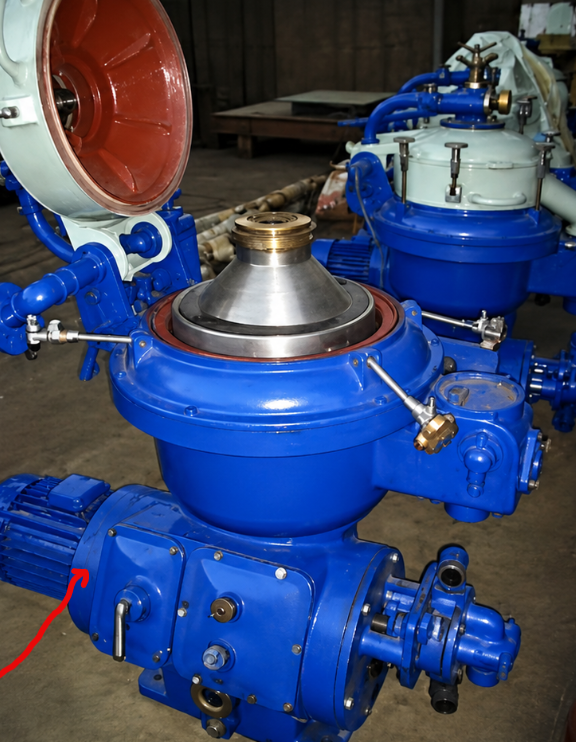
What is this and what does it do?
Clutch. Allows for bowl to come up to speed when started. Limited slip.

What is this and what does it do?
Brake. For stopping and locking bowl for maintenance.

What is this?
Attached pump.

What is this and what does it do?
Oil sump. for lubricating bearings/gears
What are the four events of a Diesel Engine.
Intake, Compression, Power, and Exhaust.
How many degrees does the crankshaft rotate in a 4-stroke vs a 2-stroke Diesel Engine.
4-stroke rotates 720 degrees. 2-stroke rotates 360 degrees.
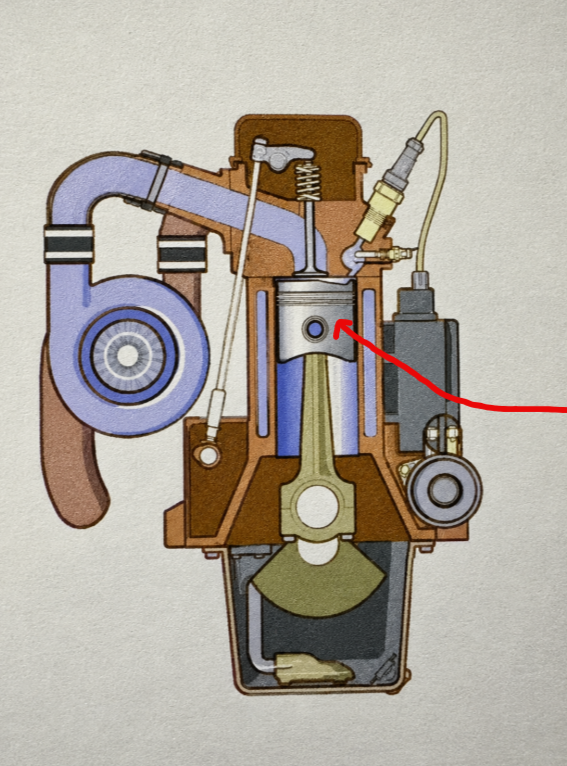
What is this and what does it do?
Piston. Transfer force from expanding gas in the cylinder to the crankshaft.

What is this and what does it do?
Camshaft. Controls the timing of the open/closing of the intake and exhaust valves & start and stop of injectors.

What is this and what does it do?
Rocker arms. Transfers camshaft lobes to valves, using a sea saw.

What is this and what does it do?
Intake valve. Fresh air inlet to the cylinder.

What is this and what does it do?
Crankshaft. Turns linear energy of the piston into rotational energy. Power outlet.
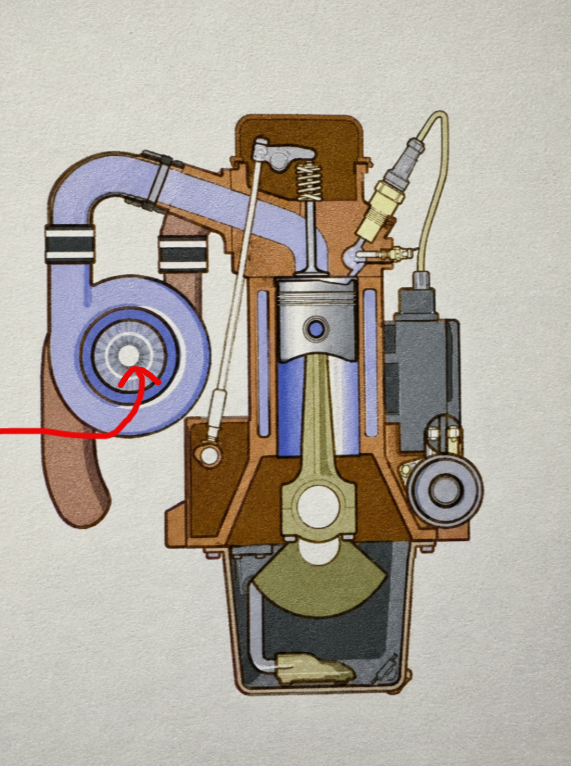
What is this and what does it do?
Turbocharger. Centrifugal compressor, adding higher density to the cylinder for larger and more powerful explosion. It is powered by the exhaust gases leaving the cylinders.
What is a Supercharger and what does it do?
Positive displacement compressor. By adding higher density to the cylinder, it produces a larger and more powerful explosion.
What does a block do?
The frame of the engine. All the other components get attached to it. It has passageways for cooling and contains all the cylinders for the engine.
What does the head do?
It seals the top of the cylinder on the opposite side of the piston. It holds the intake and exhaust valves, as well as the injector.
What do wet and dry Liners do?
Wet Liners: Jacket water is in contact with the liner/cylinder.
Dry Liners: Jacket water is not in contact with the liner/cylinder.
What does an injector do?
Injects the correct amount of fuel, at the right time, in all the cylinders.
What does Lube Oil do?
It Lubricates, cools, and cleans components when there is metal to metal contact. Cleaned via filters or purifiers.
What does Fuel Oil do?
Cleans fuel of contaminants and water, via filers and clarifiers.
What does Start Aid do?
Uses compressed air to rotate the engine, at a high rate of speed.
What does the Control System do?
Controls when the engine is on and off, how much load will be on each engine, and what occurs during casualty (failures)
What does Jacket/Cooling Water do?
Distilled water treated with antimicrobial and antifreeze additives. Will circulate between the engine and a heat exchanger.
Slow Speed Diesel
Less than 300 RPM
Medium Speed Diesel
300 - 900 RPM
High Speed Diesel
Greater than 900 RPM
What is Bore?
Diameter of the cylinder
What is Stroke?
The distance the piston moves from TDC to BDC.
What is TDC?
Top dead center, the highest point the piston will travel in the cylinder.
What is BDC?
Bottom dead center. The lowest point the piston will travel in the cylinder.
What is Atomization?
Breaking up the fuel into small particles, mist like spray. Think cologne.
What is Metering?
Ensuring that the exact same amount of fuel is delivered to each cylinder.
What is Timing?
Fuel Injection starts before the piston is at TDC, so fuel penetrates deep into the cylinder, & combusts driving the piston to BDC.
What is Penetration?
How deep into the cylinder the fuel travels, it should not contact the piston or cylinder walls.
What is Rate?
How long injections take place and under how much pressure.
What is Scavenging?
Air produced by a blower fills the cylinder with fresh air, clearing it of combustion gases, Intake and Exhaust valves are open at the same time.
What are the only two events that can overlap in a two-stroke?
Intake and Exhaust.
What is Supercharging?
The process that supplies more air to the intake system than is normally taken in under atmospheric pressures. Exhaust valves MUST be closed for this to happen.
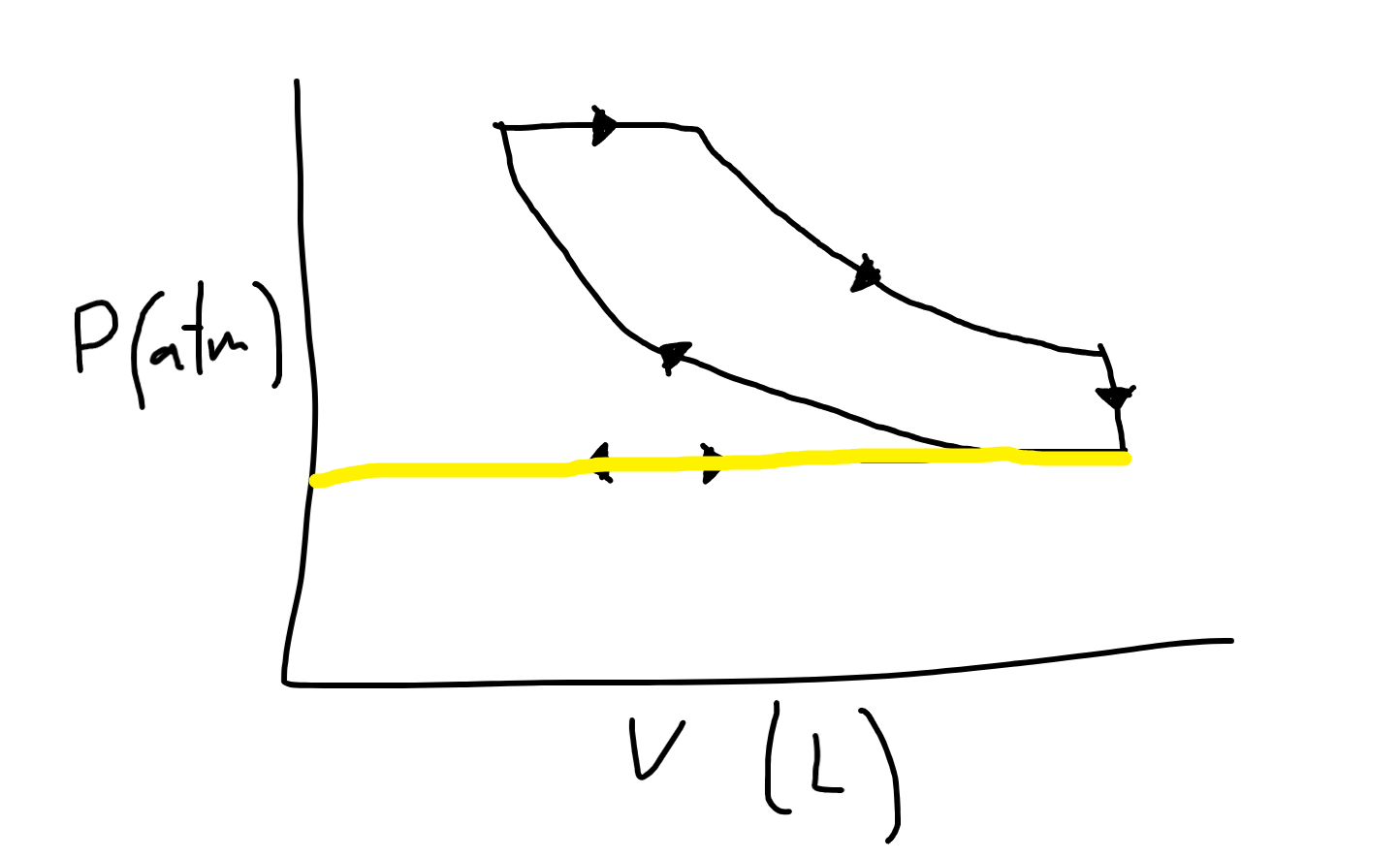
Which event is this?
Intake stroke.

Which event is this?
Compression Stroke

Which event is this?
Power Stroke.

Which event is this?
Exhaust stroke.

What kind of cycle is this?
2-stroke

What kind of cycle is this?
4-stroke